
In the dynamic world of finance, where numbers dictate decisions and trends shape fortunes, understanding the subtle yet profound implications of growth is paramount. At the heart of this understanding lies a fundamental mathematical concept: the percentage of increase between two numbers. Far more than a mere arithmetic exercise, this calculation serves as an indispensable tool for individuals, investors, and businesses alike, providing a clear, normalized measure of change that empowers informed financial decision-making.
From tracking the appreciation of investments and the growth of personal income to analyzing business revenue and understanding the insidious creep of inflation, the ability to accurately calculate and interpret percentage increase is a cornerstone of financial literacy. It transforms raw data into meaningful insights, allowing us to compare performance, project future outcomes, and identify opportunities or risks that might otherwise remain hidden. This article delves into the mechanics of calculating percentage increase, explores its multifaceted applications within the financial realm, and highlights key considerations for its effective use, ultimately equipping you with a foundational skill essential for navigating the complexities of money management.
The Fundamental Formula and How to Calculate It
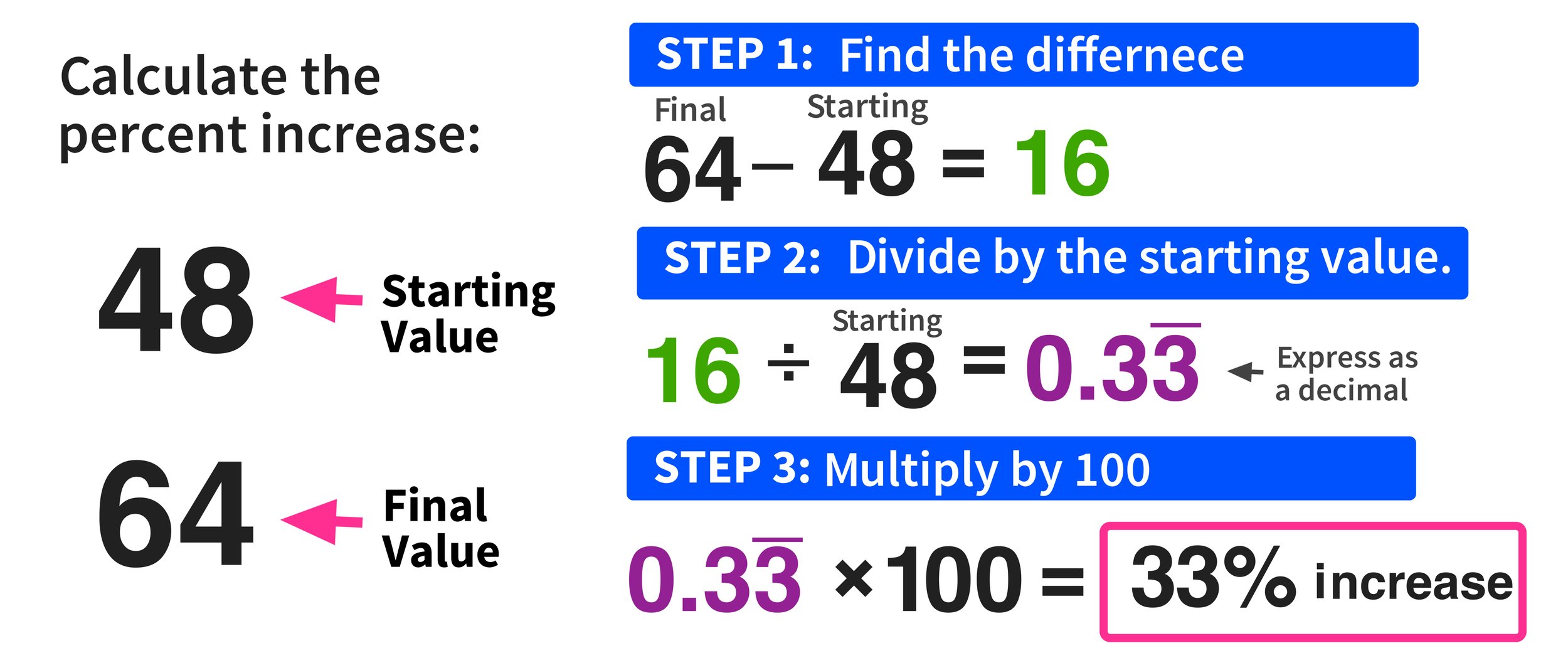
At its core, calculating the percentage of increase is a straightforward process designed to quantify the relative change between an initial value and a subsequent, larger value. It answers the question: “How much larger is the new number, expressed as a proportion of the original number?” Mastering this basic formula is the first step toward unlocking deeper financial analysis.
Deconstructing the Formula
The percentage increase formula is elegantly simple and can be broken down into two main steps:
-
Find the absolute increase: This is the difference between the new (larger) number and the original (smaller) number.
Absolute Increase = New Number - Original Number -
Calculate the percentage: Divide the absolute increase by the original number, and then multiply the result by 100 to convert it into a percentage.
Percentage Increase = (Absolute Increase / Original Number) * 100Alternatively, you can combine these steps into one formula:
Percentage Increase = ((New Number - Original Number) / Original Number) * 100
Let’s illustrate with a common financial example. Imagine a stock you invested in.
- Original Number (Initial Stock Price): $50
- New Number (Current Stock Price): $65
First, find the absolute increase:
$65 - $50 = $15
Next, calculate the percentage increase:
($15 / $50) * 100 = 0.3 * 100 = 30%
So, the stock price has increased by 30%. This single metric instantly tells you the magnitude of your gain relative to your initial investment.
Step-by-Step Calculation Guide
To ensure accuracy, follow these clear steps:
-
Identify the Two Numbers: Clearly distinguish between the original number (the starting point or baseline) and the new number (the ending point or current value). In financial contexts, this might be last year’s revenue versus this year’s, or an initial investment versus its current value.
-
Find the Absolute Difference: Subtract the original number from the new number. If the new number is indeed larger, this result will be positive, indicating an increase. (If it were smaller, it would be a decrease, which is a related but distinct calculation).
-
Divide by the Original Number: Take the absolute difference you found in Step 2 and divide it by the original number. This gives you the increase as a decimal or fractional proportion of the starting value.
-
Multiply by 100: To express this proportion as a percentage, multiply the result from Step 3 by 100. This is the percentage increase.
Example: Tracking Your Savings Account
You started the year with $1,200 in your savings account (Original Number). By the end of the year, your balance grew to $1,452 (New Number).
- Original Number: $1,200
- New Number: $1,452
- Absolute Difference: $1,452 – $1,200 = $252
- Divide by Original Number: $252 / $1,200 = 0.21
- Multiply by 100: 0.21 * 100 = 21%
Your savings account experienced a 21% increase over the year. This provides a much clearer picture of your financial growth than just seeing the raw dollar amount.
Why Percentage Increase is Indispensable in Personal Finance
For individuals striving for financial independence and stability, percentage increase is not just a statistical concept; it’s a vital metric that underpins intelligent personal financial planning. It allows for a standardized way to measure progress and understand economic shifts that directly impact one’s wallet.
Tracking Investment Growth
One of the most common and crucial applications of percentage increase in personal finance is in evaluating investments. Whether you’re tracking a stock portfolio, mutual funds, exchange-traded funds (ETFs), or even the appreciation of real estate, percentage growth provides the clearest indicator of performance.
- Portfolio Returns: When your investment advisor reports a 15% annual return on your portfolio, this percentage increase is far more meaningful than simply stating the dollar gain. A $1,500 gain on a $10,000 portfolio (15%) signifies strong performance, whereas the same $1,500 gain on a $100,000 portfolio (1.5%) indicates a very different level of success.
- Compound Interest: The magic of compound interest, a cornerstone of long-term wealth building, is fundamentally about percentage increase. Your initial investment grows by a certain percentage, and then the next period’s growth is calculated on the new, larger sum. Understanding the power of a consistent percentage increase over decades is key to appreciating its wealth-accelerating potential.
- Real Estate Appreciation: If you buy a house for $300,000 and it’s appraised at $345,000 a few years later, calculating the percentage increase (15%) gives you a concrete measure of your equity growth, essential for refinancing decisions or future sales.
Understanding Income and Expense Changes
Beyond investments, percentage increase offers critical insights into your personal income and expenditure, helping you manage your budget and plan for the future.
- Salary Raises and Bonuses: When you receive a raise, knowing the percentage increase allows you to compare it to previous raises, inflation rates, or industry averages. A 5% raise might sound good, but if inflation is 7%, your real purchasing power has actually decreased.
- Inflation’s Impact: Inflation is the general increase in prices and fall in the purchasing value of money. It is almost always expressed as a percentage increase. Monitoring the Consumer Price Index (CPI), which reflects the percentage increase in the cost of a basket of goods and services, is crucial for understanding how your money’s value is eroding over time. This directly influences your budgeting and saving strategies.
- Budgeting and Expense Creep: Have your utility bills gone up? Has the cost of your weekly groceries increased? Calculating the percentage increase in these recurring expenses helps you identify areas where your budget might be tightening and allows you to adjust your spending habits proactively. For instance, if your electricity bill jumps from $80 to $96, that’s a 20% increase – a significant shift that warrants investigation.
Leveraging Percentage Increase in Business and Investing
For businesses and professional investors, the ability to dissect and interpret percentage change is not just an advantage; it’s a necessity. It informs strategic decisions, performance evaluations, and the allocation of capital, driving growth and managing risk.
Evaluating Business Performance
Companies live and die by their numbers, and percentage increase is a universal language for performance assessment.
- Revenue Growth: Perhaps the most closely watched metric, the percentage increase in revenue (Year-over-Year, Quarter-over-Quarter) indicates a company’s ability to sell more products or services. A consistent 10% annual revenue growth suggests a healthy, expanding business.
- Profit Margins: Tracking the percentage increase in gross or net profit margins helps businesses understand their operational efficiency. A company might have increasing revenue, but if its costs are rising at a higher percentage, its profitability could be shrinking.
- Customer Acquisition and Retention: Businesses often track the percentage increase in new customers or the percentage increase in repeat purchases to gauge marketing effectiveness and customer loyalty.
- Benchmarking and Industry Analysis: Percentage increases allow companies to benchmark their performance against competitors or industry averages. If the sector is growing at 8% annually, but your company is only growing at 3%, that’s a red flag.
Strategic Investment Decisions
For investors, both individual and institutional, percentage increase is the lens through which investment opportunities are evaluated and portfolio performance is measured.
- Analyzing Historical Performance: Before investing, analyzing a company’s past percentage increase in earnings per share (EPS), revenue, or dividends helps gauge its historical stability and growth trajectory. While past performance is not indicative of future results, consistent growth percentages are often a positive sign.
- Projecting Potential Returns: Investors use percentage increase to project potential returns on an investment. If a bond offers a 5% annual yield, or a stock is expected to grow by 12% per year, these percentage figures are crucial for constructing a diversified portfolio aligned with financial goals.
- Risk Assessment: While percentage increase focuses on gains, its counterpart, percentage decrease, is vital for understanding potential losses. Investors constantly assess the potential percentage downside (e.g., how much a stock could drop) versus the potential percentage upside (how much it could gain) to make informed risk-adjusted decisions.
- Comparing Investment Options: When choosing between different assets, percentage returns provide a normalized basis for comparison. For example, comparing the percentage increase in value of a real estate investment versus a stock market index over the same period allows for an objective assessment of which performed better.
Common Pitfalls and Nuances to Consider
While calculating percentage increase is fundamental, its interpretation requires nuance. Misunderstanding certain aspects can lead to flawed conclusions or misleading analyses, especially in financial contexts.
The Importance of the Original Number (Base Effect)
One of the most significant pitfalls is the “base effect.” A large percentage increase can be misleading if the original number (the base) was very small.
- Example: A company’s profit increases from $100 to $1,000. This is a 900% increase, which sounds phenomenal. However, a move from $10,000,000 to $10,000,900 is only a 0.009% increase, despite the same absolute increase of $900.
- Implication: Always consider the absolute numbers alongside the percentage increase. A small startup achieving a 500% revenue growth from $10,000 to $60,000 is impressive for its stage, but a mature company achieving 5% growth from $1 billion to $1.05 billion is a much larger absolute gain and potentially more impactful for the broader economy. Ignoring the base can lead to overstating or understating true financial impact.
Distinguishing Between Real vs. Nominal Growth
In economics and personal finance, it’s crucial to differentiate between nominal (stated) and real (inflation-adjusted) percentage increases.
- Nominal Growth: This is the simple percentage increase calculated using current dollar values, without accounting for inflation. If your salary increases from $50,000 to $52,500, that’s a 5% nominal increase.
- Real Growth: This adjusts for the percentage increase in the cost of living (inflation). If your nominal salary increased by 5%, but inflation (as measured by CPI) was 3%, your real salary increase, and thus your actual purchasing power, only increased by approximately 2% (5% – 3% = 2%). For investors, real return on investment is paramount, as it indicates the actual increase in purchasing power your money has gained.
Percentage Points vs. Percentage Increase
These two terms are often confused, but they have distinct meanings, especially in financial discourse related to interest rates or market share.
- Percentage Points: This refers to the absolute difference between two percentages.
- Example: If an interest rate increases from 2% to 3%, it has increased by 1 percentage point.
- Percentage Increase: This is the relative increase between two percentages, calculated using the standard percentage increase formula.
- Example: If an interest rate increases from 2% to 3%, the percentage increase is
((3 - 2) / 2) * 100 = (1 / 2) * 100 = 50%.
- Example: If an interest rate increases from 2% to 3%, the percentage increase is
Understanding this distinction is vital. A financial pundit saying “the Fed increased interest rates by 0.25 percentage points” means something very different than saying “interest rates saw a 0.25% percentage increase.” The former is an absolute change in the rate itself, the latter a relative change.
Practical Tools and Resources for Calculation
While the formula for percentage increase is straightforward, leveraging modern tools can streamline calculations, reduce errors, and facilitate more complex financial analysis.
Everyday Calculators and Spreadsheets
For most personal and business financial needs, basic tools are more than sufficient.
- Standard Calculator: Any scientific or even basic calculator can handle the operations: subtraction, division, and multiplication by 100. It’s quick for one-off calculations.
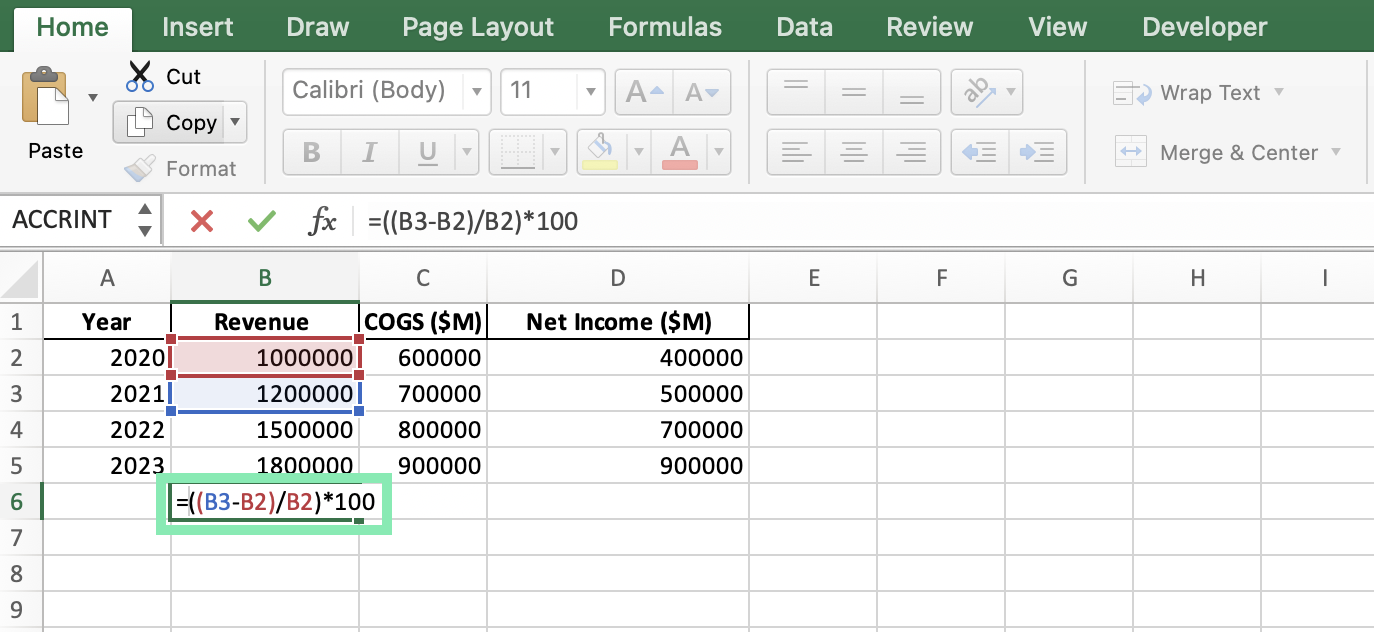
- Excel/Google Sheets: Spreadsheets are invaluable for financial tracking because they allow you to set up formulas that automatically update as your numbers change.
- If your original number is in cell A2 and your new number is in cell B2, the formula for percentage increase would be:
=(B2-A2)/A2(this gives you the decimal) - To display it as a percentage, format the cell as a percentage (e.g.,
=(B2-A2)/A2and then apply the ‘%’ style to the cell, which will automatically multiply by 100 and add the symbol). - Spreadsheets are particularly useful for tracking multiple financial metrics over time, such as month-over-month revenue growth for several product lines or year-over-year portfolio performance.
- If your original number is in cell A2 and your new number is in cell B2, the formula for percentage increase would be:
Online Financial Calculators
For specialized or more complex scenarios, various online calculators offer convenience and often provide additional insights.
- Percentage Increase Calculators: Many websites provide simple tools where you just input the two numbers, and it instantly provides the percentage increase.
- Investment Return Calculators: Financial planning websites often have calculators specifically designed to compute the percentage return on investments, sometimes even accounting for deposits, withdrawals, and different time frames.
- Inflation Calculators: These tools help you understand the percentage increase in prices over historical periods, crucial for discerning real versus nominal growth.
These resources not only save time but also help in visualizing financial data, making it easier to grasp the impact of percentage changes.
Conclusion
The question “what is the percentage of increase between two numbers?” might seem purely mathematical, but its answer holds profound significance in the realm of money. From the minutiae of personal budgeting to the grand scale of corporate finance and investment strategy, understanding and accurately calculating percentage increase is an indispensable skill. It transforms raw financial data into actionable intelligence, allowing individuals to intelligently manage their savings, assess investment performance, and understand the real impact of economic forces like inflation.
For businesses, it’s the metric that measures growth, efficiency, and market position. For investors, it’s the compass guiding portfolio decisions and risk management. By mastering this seemingly simple calculation and being mindful of its nuances—such as the base effect, the distinction between real and nominal growth, and the difference between percentage points and percentage increase—you unlock a deeper level of financial literacy. In a world increasingly driven by numbers, the ability to interpret and apply percentage increase is not just a calculation; it is a critical skill for building wealth, making informed decisions, and achieving financial empowerment.
aViewFromTheCave is a participant in the Amazon Services LLC Associates Program, an affiliate advertising program designed to provide a means for sites to earn advertising fees by advertising and linking to Amazon.com. Amazon, the Amazon logo, AmazonSupply, and the AmazonSupply logo are trademarks of Amazon.com, Inc. or its affiliates. As an Amazon Associate we earn affiliate commissions from qualifying purchases.