
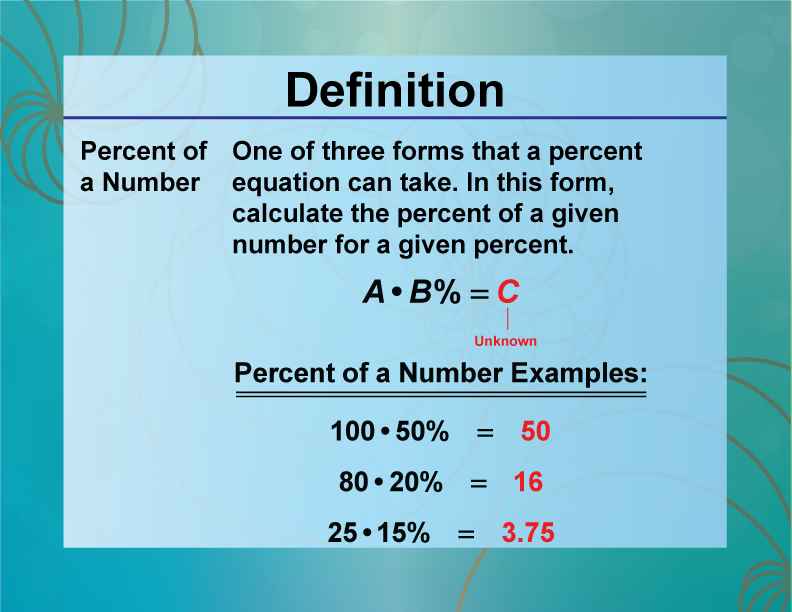
Understanding the concept of “what is the percentage of a number” is not merely an academic exercise; it’s a foundational pillar for navigating the complex world of finance. From personal budgeting and investment decisions to business profitability and economic indicators, percentages provide a universal language to quantify relationships, assess growth, and measure performance. At its core, a percentage represents a fraction of a whole, expressed as a number out of 100. For instance, 50% means 50 out of 100, or one-half. Mastering this seemingly simple concept unlocks a deeper comprehension of financial statements, market trends, and personal wealth management strategies, empowering individuals and businesses alike to make more informed and strategic monetary decisions.

The Fundamental Role of Percentages in Personal Finance
In the realm of personal finance, percentages are not just theoretical constructs but practical tools that directly influence daily financial choices and long-term financial health. They provide clarity, allowing for comparisons and assessments that raw numbers alone cannot offer.
Budgeting and Income Allocation
A well-structured personal budget is often built upon percentage allocations. Financial experts frequently recommend the 50/30/20 rule: 50% of after-tax income for needs (housing, utilities, groceries), 30% for wants (dining out, entertainment, hobbies), and 20% for savings and debt repayment. This percentage-based approach makes budgeting flexible and scalable, regardless of one’s income level. It allows individuals to quickly visualize where their money is going and identify areas for adjustment without getting bogged down in precise dollar amounts, which can vary significantly. For example, knowing that 40% of your income is spent on housing instantly highlights a potential area for savings or reevaluation, far more effectively than merely stating a dollar figure without context.
Understanding Interest Rates (Savings, Loans, Credit)
Interest rates are perhaps the most pervasive application of percentages in personal finance. Whether it’s the interest earned on a savings account, the Annual Percentage Rate (APR) on a credit card, or the interest rate on a mortgage or car loan, these percentages dictate how much extra money you will pay or earn over time. A 5% annual interest rate on a savings account means your principal will grow by 5% each year. Conversely, a 15% APR on a credit card means you’ll pay 15% of your outstanding balance in interest over a year if not paid off. Understanding how these percentages compound – interest earning interest – is critical for both maximizing savings and minimizing debt. The seemingly small difference between a 3% and a 4% mortgage rate can translate into tens of thousands of dollars over the lifetime of a loan, underscoring the power of these figures.
Discounts, Sales, and Value Assessment
When shopping, percentages are plastered everywhere, signaling sales, discounts, and promotional offers. A “20% off” sign directly translates to a specific amount of savings, which can be easily calculated: 20% of the original price. However, understanding percentages allows consumers to go beyond surface-level promotions. It enables them to compare discounts across different items or stores, calculate the final price after multiple discounts, or even assess the true value proposition. For instance, a “buy one, get one 50% off” deal on two items of equal price is effectively a 25% discount on each item. Being adept at these calculations helps consumers make smarter purchasing decisions, ensuring they genuinely benefit from advertised savings and avoid impulse buys driven by a perceived, rather than actual, bargain.
Percentages in Investing and Wealth Growth
For investors, percentages are the lingua franca of performance measurement, risk assessment, and portfolio management. They provide standardized metrics to compare disparate assets, analyze market movements, and project future growth.
Calculating Returns on Investment (ROI)
The most fundamental application of percentages in investing is the calculation of Return on Investment (ROI). ROI measures the profitability of an investment relative to its cost, expressed as a percentage. The formula is typically: (Current Value of Investment – Original Cost of Investment) / Original Cost of Investment * 100. If you invest $1,000 and it grows to $1,200, your ROI is ($1,200 – $1,000) / $1,000 * 100 = 20%. This metric allows investors to compare the effectiveness of different investments, regardless of their initial capital outlay. A stock that returned 15% over a year can be directly compared to a real estate investment that yielded 10% over the same period, providing a clear indication of which performed better proportionally.
Understanding Portfolio Allocation
Portfolio allocation, the strategy of dividing investments among different asset classes (e.g., stocks, bonds, real estate, cash), is inherently percentage-driven. Investors decide what percentage of their total portfolio should be allocated to each asset class based on their risk tolerance, financial goals, and time horizon. A conservative investor might allocate a higher percentage to bonds, known for their lower volatility, while an aggressive investor might allocate a larger percentage to stocks for higher growth potential. As market values fluctuate, these percentages shift, necessitating periodic rebalancing to return the portfolio to its target allocations. This disciplined, percentage-based approach helps manage risk and maintain a strategy aligned with personal financial objectives.
Inflation, Deflation, and Purchasing Power
Inflation and deflation, key macroeconomic indicators, are always expressed as percentages. Inflation, typically measured by the Consumer Price Index (CPI), represents the percentage increase in the general price level of goods and services over a period, eroding purchasing power. If inflation is 3% annually, it means that what cost $100 last year will cost $103 this year. For investors, understanding inflation’s percentage impact is crucial for assessing real (inflation-adjusted) returns. A 5% investment return might seem good, but if inflation was 3%, the real return is only 2%. Conversely, deflation, a percentage decrease in prices, also impacts investment strategies, potentially making holding cash more attractive or increasing the real burden of debt. These percentage rates are critical for long-term financial planning, particularly for retirement savings where maintaining purchasing power over decades is paramount.
Business Finance: Profitability, Growth, and Metrics
In the commercial world, percentages are indispensable for analyzing business performance, making strategic decisions, and communicating financial health to stakeholders. They transform raw financial data into meaningful insights.
Gross and Net Profit Margins
Profit margins are fundamental percentage-based metrics that indicate a company’s profitability.
-
Gross Profit Margin is calculated as (Gross Profit / Revenue) * 100. Gross profit is revenue minus the cost of goods sold. This percentage tells a company how much profit it makes from each dollar of sales after accounting for the direct costs of production. A higher gross profit margin suggests efficient production or strong pricing power.
-
Net Profit Margin is calculated as (Net Profit / Revenue) * 100. Net profit is what remains after all expenses, including taxes and interest, have been deducted from revenue. This percentage provides the ultimate measure of a company’s overall profitability, indicating how much profit the company makes from each dollar of revenue available to shareholders. These margins are essential for comparing a company’s performance against competitors or industry benchmarks, regardless of their absolute sales figures.
Sales Growth and Market Share Analysis
Business growth is often quantified using percentage changes. Sales growth percentage calculates the increase or decrease in sales revenue over a specific period, typically quarter-over-quarter or year-over-year. A 10% year-over-year sales growth signals expansion and market acceptance. Similarly, market share is expressed as a percentage: a company’s sales as a percentage of the total sales within its industry. A company with a 25% market share controls a quarter of its industry’s sales. Tracking these percentages allows businesses to gauge their competitive standing, assess the effectiveness of marketing campaigns, and identify opportunities or threats within their market segment. An increasing market share percentage indicates competitive strength and potential for future revenue growth.
Operating Ratios and Efficiency
Various operating ratios, expressed as percentages, provide insights into a company’s operational efficiency and financial leverage. For example:
-
Operating Expense Ratio (Operating Expenses / Revenue * 100) measures how efficiently a company manages its overhead and administrative costs relative to its sales. A lower percentage often indicates greater efficiency.
-
Debt-to-Equity Ratio (Total Debt / Shareholder Equity * 100) is crucial for assessing financial leverage and risk. While not strictly a percentage (it’s often expressed as a decimal or ratio), it fundamentally compares two parts of a company’s capital structure, with implications for a company’s financial stability.
-
Return on Assets (ROA) (Net Income / Total Assets * 100) and Return on Equity (ROE) (Net Income / Shareholder Equity * 100) are profitability ratios that use percentages to demonstrate how effectively a company is using its assets and equity to generate profits. These percentage-based metrics allow investors and management to dissect a company’s financial statements, identifying strengths and weaknesses and guiding strategic decisions aimed at improving operational performance and shareholder value.
Practical Application: Financial Tools and Strategic Decision-Making
Beyond theoretical understanding, the practical application of percentages is amplified by modern financial tools and underpins robust strategic decision-making in personal and business finance.
Utilizing Online Calculators and Spreadsheets
The digital age has made percentage calculations more accessible than ever. Online financial calculators for mortgages, loan amortization, retirement savings, and investment returns all rely heavily on percentage inputs and outputs. Spreadsheets like Microsoft Excel or Google Sheets are indispensable tools, allowing users to automate complex percentage calculations, create dynamic budgets, forecast financial scenarios, and analyze large datasets. Formulas for calculating interest, discounts, growth rates, and margins can be easily implemented, reducing the chance of manual error and freeing up time for analysis rather than computation. Mastering basic percentage functions in a spreadsheet is a powerful skill for anyone managing money, whether personal or business.
Financial Planning and Goal Setting
Effective financial planning and goal setting are inherently percentage-driven. Setting a goal to save “15% of every paycheck” for a down payment, or to allocate “7% of your portfolio to emerging markets,” provides clear, measurable targets. These percentage goals are adaptable to changes in income or market conditions, making them more resilient than fixed dollar amounts. Financial advisors frequently use percentages when creating personalized financial plans, projecting retirement income needs as a percentage of current income, or recommending insurance coverage as a percentage of total assets or income. This systematic, percentage-based approach ensures that financial plans are realistic, achievable, and dynamically adjusted to evolving circumstances.

Risk Assessment and Diversification
In investing, percentages are vital for risk assessment and implementing diversification strategies. Diversification, the practice of spreading investments across various assets to reduce risk, is typically defined by percentage allocations. For example, an investor might decide that no single stock should represent more than 5% of their total portfolio value, or that international equities should constitute 20% of their stock allocation. Volatility, often measured by percentage changes in asset prices, helps investors understand the potential ups and downs of an investment. Understanding the probability of a 10% market correction, or the percentage chance of a bond default, allows investors to make informed decisions about risk exposure. By quantitatively assessing risk through percentages, individuals and businesses can construct portfolios that align with their risk tolerance while maximizing potential returns.
In conclusion, “what is the percentage of a number” is far more than a simple arithmetic query; it is a gateway to financial literacy and empowerment. Its universal application across personal finance, investing, and business operations underscores its critical importance. A solid grasp of percentages enables individuals to manage their money more effectively, make wiser investment choices, and contribute to the strategic growth and stability of businesses, ultimately fostering greater financial security and prosperity.
aViewFromTheCave is a participant in the Amazon Services LLC Associates Program, an affiliate advertising program designed to provide a means for sites to earn advertising fees by advertising and linking to Amazon.com. Amazon, the Amazon logo, AmazonSupply, and the AmazonSupply logo are trademarks of Amazon.com, Inc. or its affiliates. As an Amazon Associate we earn affiliate commissions from qualifying purchases.