
The Patient Health Questionnaire (PHQ-9) is a concise, nine-item self-report questionnaire designed to screen for and measure the severity of depression. It has become a widely adopted tool in clinical practice and research due to its simplicity, validity, and reliability. Understanding the PHQ-9 is crucial for healthcare professionals, patients, and anyone interested in mental health assessment. This article delves into what the PHQ-9 is, its applications, interpretation, and significance in the broader landscape of mental health care.
Understanding the Core Components of the PHQ-9
The PHQ-9 is built upon the foundation of the Patient Health Questionnaire, a larger suite of self-report measures for various mental health conditions. The PHQ-9 specifically focuses on diagnosing and assessing the severity of depressive symptoms. Its efficacy lies in its direct approach to capturing the diagnostic criteria for Major Depressive Disorder (MDD) as outlined in the Diagnostic and Statistical Manual of Mental Disorders (DSM).

The Nine Items and Their Focus
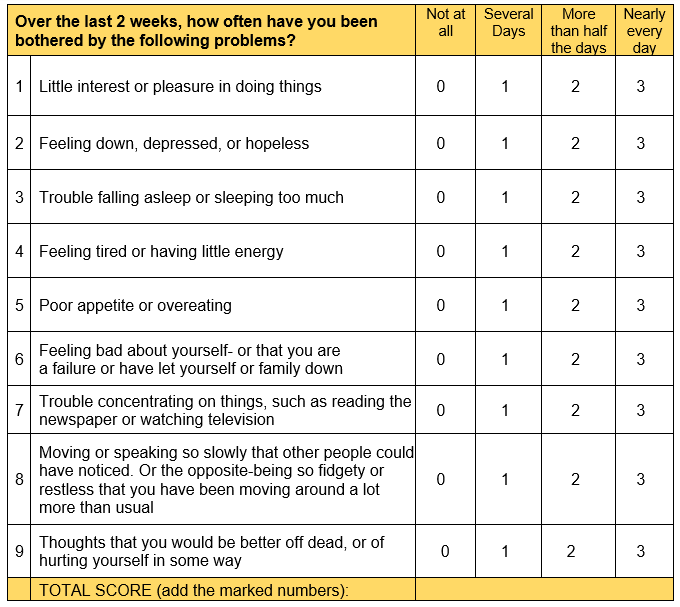
Each of the nine items on the PHQ-9 addresses a specific symptom of depression that has been present “over the last two weeks.” This timeframe is critical, as it distinguishes between transient mood fluctuations and more persistent depressive symptoms that warrant clinical attention. The items cover a range of cognitive, emotional, and somatic manifestations of depression.
- Little interest or pleasure in doing things: This item captures anhedonia, a core symptom characterized by a diminished ability to experience pleasure from activities that were once enjoyable.
- Feeling down, depressed, or hopeless: This item directly addresses depressed mood, a subjective feeling of sadness, low spirits, or despair.
- Trouble falling or staying asleep, or sleeping too much: Sleep disturbances are common in depression and can manifest as insomnia or hypersomnia.
- Feeling tired or having little energy: Fatigue and a lack of energy are pervasive symptoms that can significantly impair daily functioning.
- Poor appetite or overeating: Changes in appetite, leading to either weight loss or gain, are frequently associated with depression.
- Feeling bad about yourself—or that you are a failure or have let yourself or your family down: This item addresses feelings of worthlessness, guilt, and self-blame, which are common cognitive distortions in depression.
- Trouble concentrating on things, such as reading the newspaper or watching television: Impaired concentration and attention deficits are significant cognitive symptoms of depression.
- Moving or speaking so slowly that other people could have noticed? Or the opposite—being so fidgety or restless that you have been moving around a lot more than usual: This item assesses psychomotor changes, which can range from retardation (slowed movement and speech) to agitation (restlessness and increased motor activity).
- Thoughts that you would be better off dead, or of hurting yourself: This is a crucial item that probes for suicidal ideation, a potentially life-threatening symptom of depression that requires immediate clinical intervention.
Scoring and Interpretation
Each of the nine items is rated on a 4-point Likert scale, indicating the frequency of the symptom over the past two weeks:
- 0 – Not at all
- 1 – Several days
- 2 – More than half the days
- 3 – Nearly every day
The scores for each item are then summed to obtain a total score ranging from 0 to 27. This total score is used to categorize the severity of depression:
- 0–4: Minimal depression
- 5–9: Mild depression
- 10–14: Moderate depression
- 15–19: Moderately severe depression
- 20–27: Severe depression
It is important to note that while the PHQ-9 provides a severity score, it is a screening tool and not a diagnostic instrument in itself. A diagnosis of Major Depressive Disorder must be made by a qualified healthcare professional based on a comprehensive clinical evaluation, which may include the PHQ-9 as one component. However, the PHQ-9’s scoring system is invaluable for tracking changes in symptom severity over time and for informing treatment decisions. A significant increase in the score might indicate a worsening of depression, while a decrease suggests a positive response to treatment.
Applications of the PHQ-9 in Clinical Practice
The PHQ-9’s utility extends across various settings within healthcare, making it a versatile tool for mental health assessment and management. Its ease of administration and interpretation contributes to its widespread adoption.
Screening and Diagnosis of Depression
One of the primary applications of the PHQ-9 is in the routine screening for depression in primary care settings. Many individuals with depression may not present with overt psychiatric symptoms, and their condition might be overlooked during a standard medical visit. By incorporating the PHQ-9 into routine care, healthcare providers can identify individuals who may be experiencing depressive symptoms and are at risk. A score of 10 or higher on the PHQ-9 typically warrants further clinical evaluation to determine if a diagnosis of MDD or another depressive disorder is appropriate.
Monitoring Treatment Efficacy
Beyond initial screening, the PHQ-9 serves as an excellent tool for monitoring the effectiveness of antidepressant medications and psychotherapies. By administering the PHQ-9 at regular intervals, clinicians can objectively track changes in a patient’s symptom severity. A reduction in the PHQ-9 score over time can indicate a positive response to treatment, while a persistent high score may suggest the need for adjustments to the treatment plan, such as medication changes or augmentation, or the exploration of different therapeutic approaches. This longitudinal data provided by the PHQ-9 is critical for personalized medicine and optimizing patient outcomes.

Identifying Suicidal Risk
The inclusion of a question about suicidal ideation makes the PHQ-9 particularly important for assessing risk. While the PHQ-9 is not a comprehensive suicide risk assessment tool, a high score on the final item, or even moderate scores on other items in conjunction with suicidal thoughts, should prompt immediate and thorough evaluation by a mental health professional. Prompt identification and intervention for suicidal ideation are paramount in preventing self-harm.
Research and Public Health Initiatives
The PHQ-9 is extensively used in research studies investigating the prevalence, correlates, and treatment of depression. Its standardized format and validated psychometric properties allow for consistent data collection across different studies and populations, contributing to a better understanding of depression as a public health issue. Furthermore, its use in large-scale public health initiatives helps in identifying populations at higher risk and in evaluating the impact of mental health interventions.
Advantages and Limitations of the PHQ-9
Like any assessment tool, the PHQ-9 possesses both strengths and weaknesses that are important to consider for its optimal use.
Strengths of the PHQ-9
- Conciseness and Ease of Administration: The nine-item format makes the PHQ-9 quick to complete, typically taking only a few minutes. This is a significant advantage in busy clinical settings where time is often a constraint. It can be administered by various healthcare professionals, including nurses, medical assistants, and primary care physicians.
- Cost-Effectiveness: As a self-report measure, the PHQ-9 requires minimal resources to administer and score, making it a cost-effective screening tool.
- Validated and Reliable: The PHQ-9 has undergone extensive validation studies across diverse populations, demonstrating good reliability and validity in identifying depressive symptoms and their severity. It correlates well with more comprehensive diagnostic interviews and other depression rating scales.
- Sensitivity to Change: The PHQ-9 has been shown to be sensitive to changes in symptom severity, making it useful for tracking treatment progress.
- Accessibility: The PHQ-9 is widely available in multiple languages, facilitating its use in diverse cultural and linguistic contexts.
Limitations of the PHQ-9
- Screening Tool, Not a Diagnostic Instrument: It is crucial to reiterate that the PHQ-9 is a screening tool. A positive screen does not automatically equate to a diagnosis of depression. A comprehensive clinical interview is still necessary to establish a formal diagnosis and rule out other potential causes of symptoms.
- Potential for Response Bias: As a self-report questionnaire, the PHQ-9 is susceptible to response biases, such as social desirability bias (where individuals may underreport symptoms to appear more favorable) or recall bias.
- Cultural and Linguistic Nuances: While translated into many languages, subtle cultural differences in symptom expression or interpretation of Likert scale responses can sometimes influence scores.
- Limited Scope for Comorbidity: The PHQ-9 specifically targets depressive symptoms. It does not comprehensively assess for other co-occurring mental health conditions, such as anxiety disorders, which are frequently present with depression.
- Severity of Symptoms: While it measures severity, the PHQ-9 might not fully capture the nuanced impact of depression on an individual’s life, such as functional impairment in specific domains (e.g., social, occupational).
The Role of the PHQ-9 in Integrated Behavioral Healthcare
The increasing recognition of the interconnectedness between physical and mental health has led to the widespread adoption of integrated behavioral healthcare models. In these models, mental health services are embedded within primary care settings, allowing for early detection and intervention for mental health conditions. The PHQ-9 plays a pivotal role in facilitating this integration.
Bridging the Gap Between Physical and Mental Health
Primary care physicians are often the first point of contact for patients, and they are uniquely positioned to identify early signs of depression that might otherwise go unnoticed. By routinely using the PHQ-9, primary care providers can initiate conversations about mental well-being and offer support or referrals. This proactive approach helps to destigmatize mental health issues and encourages individuals to seek help.
Facilitating Collaborative Care
Integrated behavioral healthcare emphasizes collaboration between primary care physicians, mental health professionals, and other healthcare providers. The PHQ-9 provides a common language and a standardized measure that facilitates communication among these professionals. A patient’s PHQ-9 score can be readily shared and discussed, allowing for a coordinated approach to care. For example, a primary care physician might initiate a brief intervention for mild depression based on a PHQ-9 score, while referring patients with more severe symptoms or complex presentations to a mental health specialist.
Patient Empowerment and Engagement
The PHQ-9 empowers patients by giving them a structured way to communicate their experiences and concerns about their mood. When patients are involved in tracking their own symptoms using tools like the PHQ-9, they become more engaged in their treatment journey. They can actively participate in discussions with their healthcare providers about their progress and the effectiveness of different interventions. This shared understanding fosters a sense of ownership over their health and can lead to better adherence to treatment recommendations.
In conclusion, the Patient Health Questionnaire (PHQ-9) is an indispensable tool in modern mental healthcare. Its simplicity, validity, and versatility have made it a cornerstone for screening, assessing severity, and monitoring treatment of depression across a wide spectrum of clinical and research settings. By understanding its components, interpretation, and judicious application, healthcare professionals can leverage the PHQ-9 to improve patient outcomes and contribute to the broader goal of enhancing mental well-being.
aViewFromTheCave is a participant in the Amazon Services LLC Associates Program, an affiliate advertising program designed to provide a means for sites to earn advertising fees by advertising and linking to Amazon.com. Amazon, the Amazon logo, AmazonSupply, and the AmazonSupply logo are trademarks of Amazon.com, Inc. or its affiliates. As an Amazon Associate we earn affiliate commissions from qualifying purchases.