
In the world of high finance and retail investing, few terms are as ubiquitous as “the Nasdaq.” Whether you are watching the evening news or checking a mobile brokerage app, the performance of the Nasdaq Composite Index is often cited as a primary barometer for the health of the economy, particularly the technology sector. However, for many investors, the index remains a somewhat nebulous concept—a collection of symbols and numbers that fluctuate daily without a clear explanation of what they truly represent.
The Nasdaq Composite Index is more than just a list of tech stocks; it is a massive, market-capitalization-weighted index that includes over 3,000 common equities listed on the Nasdaq Stock Market. Understanding its mechanics, its history, and its unique role in the global financial landscape is essential for any investor looking to build a diversified portfolio and navigate the complexities of modern growth investing.
Understanding the Foundation of the Nasdaq Composite
To understand the Nasdaq Composite, one must first understand the exchange that houses it. The Nasdaq (National Association of Securities Dealers Automated Quotations) debuted on February 8, 1971, as the world’s first electronic stock market. At its inception, it was designed to provide a more efficient way for investors to trade stocks without the need for a physical trading floor, such as the one used by the New York Stock Exchange (NYSE).
Definition and History of the Index
The Nasdaq Composite Index was launched alongside the exchange itself, starting with a base value of 100. Over the decades, it has grown from a niche platform for “over-the-counter” stocks into a global powerhouse. Unlike the Dow Jones Industrial Average (DJIA), which tracks only 30 blue-chip companies, or the S&P 500, which tracks 500 large-cap U.S. companies, the Nasdaq Composite is remarkably broad. It includes virtually all companies listed on the Nasdaq exchange, provided they are common stocks (or equivalents like ADRs and REITs).
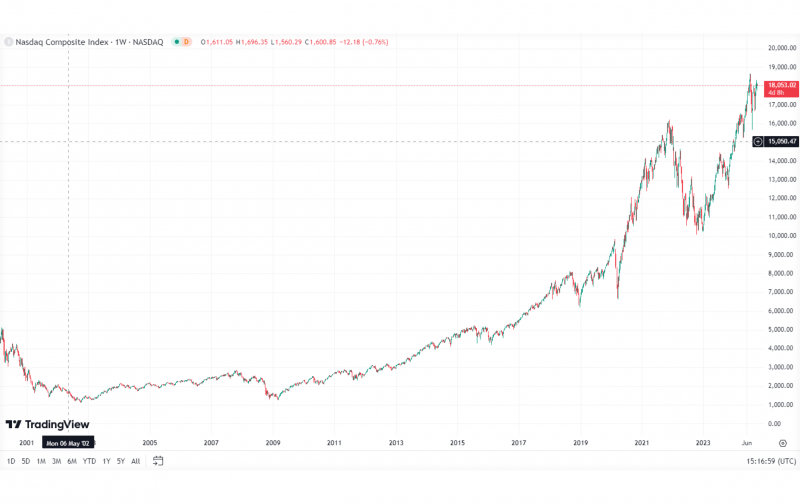
Historically, the index has been a mirror for the evolution of the modern economy. It famously soared during the dot-com boom of the late 1990s, crashed in the early 2000s, and has since led the charge in the “digital-first” era, fueled by the rise of cloud computing, social media, and artificial intelligence.
The Market-Cap Weighting Methodology
The Nasdaq Composite utilizes a market-capitalization-weighted methodology. This means that the influence a single company has on the index’s movement is proportional to its total market value (share price multiplied by the number of outstanding shares).
For example, a trillion-dollar company like Apple or Microsoft has a significantly larger impact on the index’s daily percentage change than a small-cap biotech firm. This weighting reflects the reality of the market, where the largest players drive the most economic activity. While this provides a realistic view of where the money is flowing, it also means the index can be heavily influenced by a handful of “mega-cap” stocks, often referred to as the “Magnificent Seven” in recent financial discourse.
Key Differences Between the Nasdaq Composite and the Nasdaq-100
It is a common mistake for novice investors to confuse the Nasdaq Composite with the Nasdaq-100. While they are related, they serve different purposes:
- The Nasdaq Composite: Includes over 3,000 stocks across various sectors, though it is heavily weighted toward technology. It includes both domestic and international companies.
- The Nasdaq-100: This is a subset of the Composite. It includes only the 100 largest non-financial companies listed on the Nasdaq. If you are looking at popular ETFs like the QQQ, you are tracking the Nasdaq-100, not the broader Composite.
The Significance of the Nasdaq in Today’s Global Economy
Why do investors care so much about the Nasdaq? The answer lies in the type of companies that choose to list on the exchange. Since its inception, the Nasdaq has positioned itself as the home for innovators, disruptors, and companies that prioritize growth over immediate dividends.
The Tech-Heavy Reputation
While the Nasdaq Composite includes companies from healthcare, consumer services, and utilities, it is undeniably dominated by the technology sector. Roughly 50% of the index is composed of tech companies. This concentration makes the Nasdaq the primary gauge for the “New Economy.” When software, semiconductors, and internet retail are performing well, the Nasdaq thrives. Conversely, when interest rates rise—which typically hurts growth-oriented tech companies—the Nasdaq often experiences more significant pullbacks than the more value-oriented Dow Jones.
A Barometer for Growth Stocks and Innovation
Investors look to the Nasdaq Composite to understand the market’s appetite for risk and innovation. Because the index is home to many “growth” stocks (companies expected to grow at a rate significantly above the average for the market), it serves as a leading indicator of investor sentiment. During periods of economic optimism, capital tends to flow into the Nasdaq as investors seek high returns from future-oriented technologies like green energy, biotechnology, and AI.
Comparison with the S&P 500 and the Dow
To understand the Nasdaq’s role, one must compare it to its peers. The Dow Jones is the “grandfather” of indices, representing old-guard stability. The S&P 500 is the “gold standard” for the broader U.S. economy. The Nasdaq, however, is the “growth engine.” It is generally more volatile than the other two, offering higher potential rewards during bull markets but steeper declines during bear markets. For a “Money” focused strategy, recognizing these personality differences between indices is crucial for asset allocation.
How the Nasdaq Composite Affects Individual Investors
For the individual investor, the Nasdaq Composite is more than just a headline on CNBC; it is a tool for understanding portfolio performance and market psychology.
Volatility and Risk Management
One of the defining characteristics of the Nasdaq Composite is its high “beta.” In financial terms, beta measures a security’s or index’s volatility in relation to the overall market. Because the Nasdaq is growth-heavy, it tends to swing more violently. Investors who have a high concentration of Nasdaq-listed stocks in their portfolio must be prepared for “drawdowns”—periods where the index might drop 20% or more. Understanding this allows investors to set appropriate stop-loss orders and maintain a long-term perspective rather than panicking during short-term dips.
Diversification Through Nasdaq-Tracking Funds
While many people associate the Nasdaq with “taking a gamble” on tech, the sheer volume of companies (3,000+) provides a unique form of diversification. By investing in a fund that tracks the Composite, an investor is essentially betting on the continued dominance of the U.S. (and international) innovation sector. It allows for exposure to small-cap and mid-cap companies that are not yet large enough to make it into the S&P 500 but are already listed and trading on a major exchange.
Using the Index to Gauge Market Sentiment
The Nasdaq often acts as a “canary in the coal mine.” Because growth stocks are sensitive to interest rate changes (determined by the Federal Reserve), the Nasdaq often reacts first to shifts in monetary policy. If the Nasdaq begins to slide while the Dow remains flat, it may indicate that investors are becoming “risk-averse,” moving their money from high-growth tech into safer, dividend-paying value stocks.
Practical Ways to Invest in the Nasdaq Composite
For those looking to put their money to work, there are several ways to gain exposure to the Nasdaq Composite. You cannot “buy” an index directly, but you can buy financial products that mirror its performance.
Index Funds vs. ETFs
The most common way to invest in the Nasdaq is through Exchange-Traded Funds (ETFs) or Mutual Funds.
- ETFs: These trade like stocks throughout the day. While the QQQ is the most famous Nasdaq-related ETF (tracking the Nasdaq-100), there are others, such as the Fidelity Nasdaq Composite Index ETF (ONEQ), which seeks to track the broader Composite.
- Index Mutual Funds: These are priced once at the end of the day. They are excellent for long-term investors who want to set up automatic monthly contributions (dollar-cost averaging) without worrying about intraday price fluctuations.
Long-term Growth vs. Short-term Trading
Because of its volatility, the Nasdaq is a favorite for both day traders and “buy and hold” investors.
- For the Long-term: The Nasdaq has historically outperformed the S&P 500 over long horizons (10-20 years), making it an attractive core holding for younger investors with a high risk tolerance.
- For the Short-term: Traders use the Nasdaq’s volatility to capitalize on “momentum.” However, this requires a deep understanding of technical analysis and market timing, which can be risky for the uninitiated.
Tax Considerations and Expense Ratios
When choosing a Nasdaq-tracking vehicle, savvy investors look at the “expense ratio”—the annual fee charged by the fund manager. Because index funds are passively managed, these fees should be very low (often below 0.20%). Additionally, because the Nasdaq Composite is composed of growth stocks that often reinvest their profits rather than paying dividends, these funds can be more “tax-efficient” for investors in high-tax brackets, as they trigger fewer annual dividend tax liabilities compared to value-heavy indices.

Conclusion: The Role of the Nasdaq in a Modern Portfolio
The Nasdaq Composite Index is the heartbeat of the modern financial world. It represents the collective ambition of thousands of companies striving to redefine how we live, work, and communicate. For the individual investor, it offers a window into the future of the global economy.
While its volatility can be daunting, the Nasdaq’s track record of recovery and growth makes it an indispensable component of a “Money” strategy focused on wealth accumulation. By understanding its market-cap weighting, its sector concentration, and the practical tools available for investment, you can move beyond simply “watching the news” and start using the Nasdaq Composite as a powerful engine for your personal financial growth. Whether you are a seasoned trader or a beginner making your first contribution to a brokerage account, the Nasdaq remains the premier destination for those who believe that the next great innovation is just around the corner.
aViewFromTheCave is a participant in the Amazon Services LLC Associates Program, an affiliate advertising program designed to provide a means for sites to earn advertising fees by advertising and linking to Amazon.com. Amazon, the Amazon logo, AmazonSupply, and the AmazonSupply logo are trademarks of Amazon.com, Inc. or its affiliates. As an Amazon Associate we earn affiliate commissions from qualifying purchases.