
The quest to understand chemical reactivity is fundamental to numerous technological advancements. While the term “reactivity” might evoke images of dramatic explosions or bubbling beakers in a chemistry lab, its practical implications extend far beyond academic curiosity. In the realm of technology, the inherent reactivity of metals dictates their suitability for specific applications, influencing everything from the efficiency of electronic components to the durability of materials used in cutting-edge devices. Understanding which metals are most reactive, and more importantly, why, is crucial for engineers, material scientists, and innovators striving to push the boundaries of what’s possible. This article delves into the science behind metal reactivity and its profound impact on the technological landscape.

The Fundamental Nature of Metal Reactivity
Metal reactivity is a complex interplay of atomic structure, electron configuration, and the environment in which a metal exists. At its core, reactivity refers to a metal’s tendency to undergo chemical reactions, most commonly oxidation, which is the loss of electrons. Metals that readily lose electrons are considered highly reactive.
Atomic Structure and Electron Configuration
The key to understanding reactivity lies in the outermost electrons of a metal atom, known as valence electrons. These electrons are less tightly bound to the nucleus and are therefore more susceptible to being lost or shared in chemical interactions. The number of valence electrons and their energy levels significantly influence how readily an atom will participate in a reaction.
Metals with fewer valence electrons, particularly those in Group 1 (alkali metals) and Group 2 (alkaline earth metals) of the periodic table, tend to be highly reactive. Alkali metals, for instance, have just one valence electron. Losing this single electron allows them to achieve a stable electron configuration, mimicking that of the preceding noble gas. This strong driving force makes them eager to react. Alkaline earth metals, with two valence electrons, are also very reactive, though generally less so than alkali metals because they need to lose two electrons for stability.
Electronegativity and Ionization Energy
Two key concepts that quantify a metal’s tendency to lose electrons are ionization energy and electronegativity. Ionization energy is the energy required to remove an electron from a gaseous atom or ion. Metals with low ionization energies readily lose electrons. Conversely, electronegativity measures an atom’s ability to attract electrons in a chemical bond. Highly reactive metals have low electronegativity, indicating they have little attraction for electrons and are more likely to donate them.
The periodic trends are illuminating here. Ionization energy generally decreases as you move down a group (larger atoms have their valence electrons further from the nucleus and more shielded by inner electrons, making them easier to remove) and increases as you move across a period from left to right (increasing nuclear charge pulls valence electrons more tightly). This trend aligns perfectly with the observed reactivity: the most reactive metals are found in the lower-left portion of the periodic table, specifically the alkali metals.
The Alkali Metals: The Kings of Reactivity
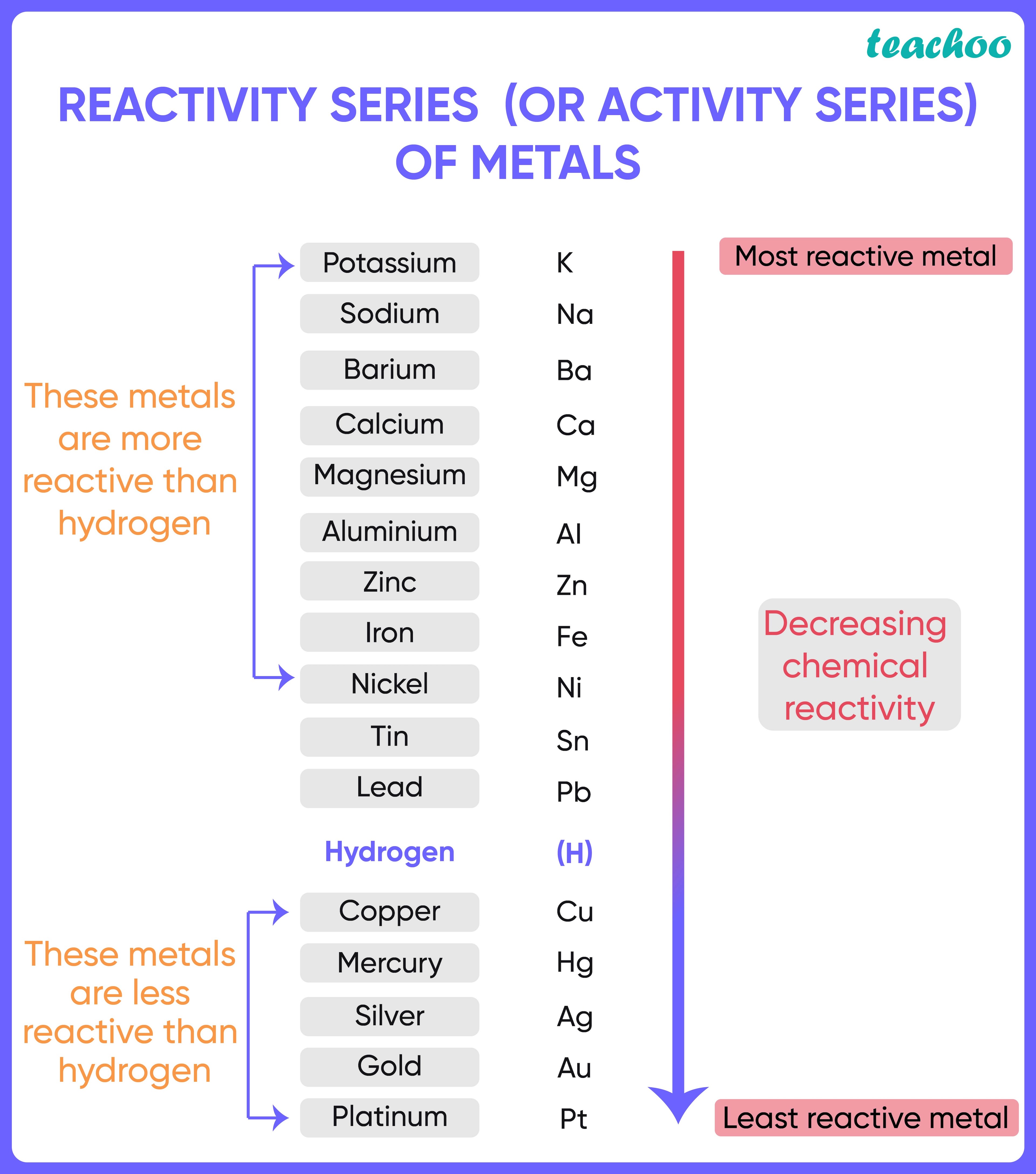
The alkali metals – lithium (Li), sodium (Na), potassium (K), rubidium (Rb), cesium (Cs), and francium (Fr) – are consistently cited as the most reactive metallic elements. Their position in Group 1 of the periodic table, each possessing a single valence electron, makes them exceptionally prone to oxidation.
- Lithium (Li): The least reactive of the alkali metals, lithium still reacts vigorously with water and oxygen. Its low density and high electrochemical potential make it invaluable in battery technology.
- Sodium (Na): Known for its explosive reaction with water, producing hydrogen gas and sodium hydroxide. Sodium’s reactivity necessitates careful handling and storage.
- Potassium (K): More reactive than sodium, potassium ignites the hydrogen gas produced during its reaction with water, leading to a violet flame.
- Rubidium (Rb) and Cesium (Cs): These heavier alkali metals are even more reactive than potassium. Cesium, in particular, is so reactive that it can ignite spontaneously in air and reacts explosively with water. Its reactivity is so pronounced that it is often used in photocells and atomic clocks due to its photoelectric properties.
- Francium (Fr): While technically the most reactive alkali metal, francium is extremely rare and highly radioactive, existing only in trace amounts. Its radioactive nature and short half-life make it impractical for most technological applications, though its theoretical reactivity is immense.
The extreme reactivity of alkali metals is a double-edged sword. While this propensity to react is harnessed in certain high-energy applications, it also means they must be carefully protected from moisture and air, often stored under inert oil or in a vacuum.
Implications of Metal Reactivity in Technology
The reactivity of metals is not merely a chemical curiosity; it is a fundamental property that shapes material selection and engineering design across a vast spectrum of technological fields. From the microscopic components of our smartphones to the massive infrastructure powering our cities, metal reactivity plays a critical, often silent, role.
Energy Storage and Conversion: The Battery Revolution
The rechargeable battery industry, a cornerstone of modern portable electronics and electric vehicles, owes its existence to the controlled reactivity of certain metals. Lithium-ion batteries, ubiquitous in our daily lives, rely on the facile movement of lithium ions between electrodes.
- Lithium’s Role in Batteries: Lithium’s low atomic weight and high electrochemical potential make it an ideal candidate for high-energy-density batteries. In a lithium-ion battery, lithium atoms lose an electron (oxidation) at the anode and the resulting lithium ions travel through an electrolyte to the cathode, where they are reduced. This controlled redox reaction is the basis of electrical energy storage. The relative inertness of lithium within the battery’s operational environment (compared to its pure elemental form) is crucial for longevity and safety, but its inherent tendency to lose an electron is what powers the device.
- Other Reactive Metals in Energy: While lithium dominates, other reactive metals are explored for next-generation energy storage. Magnesium, for instance, is being investigated for its potential to create high-capacity batteries due to its divalent nature (readily losing two electrons). However, challenges in developing suitable electrolytes to manage its higher reactivity and tendency to form dendrites remain significant hurdles.
The ability to precisely control and exploit the reactivity of metals allows for the creation of power sources that are compact, efficient, and increasingly sustainable.
Corrosion Resistance and Material Longevity
Conversely, the high reactivity of some metals poses significant challenges in terms of corrosion and degradation. Corrosion is an electrochemical process where a metal deteriorates due to its reaction with its environment, typically involving oxidation. Understanding and mitigating corrosion is paramount for ensuring the longevity and safety of countless technological applications.

- Protective Coatings and Alloys: Metals that are highly susceptible to corrosion, like iron and copper, are often protected through various means. This includes applying protective coatings made of less reactive materials, such as paints, plastics, or noble metals. Alloying, the process of combining metals with other elements, can also dramatically alter reactivity. For instance, stainless steel, an alloy of iron, chromium, and nickel, is far more resistant to rust (iron oxide formation) than pure iron because the chromium forms a passive, protective oxide layer.
- Sacrificial Anodes: In applications like shipbuilding or underground pipelines, a highly reactive metal, such as zinc or magnesium, is often attached to the structure. This “sacrificial anode” is more reactive than the metal of the structure (e.g., steel) and will preferentially corrode, thereby protecting the primary material from oxidation. This is a direct application of harnessing controlled reactivity for protection.
Catalysis: Accelerating Chemical Transformations
Many technological processes rely on catalysts to speed up chemical reactions without being consumed themselves. Certain highly reactive metals and their compounds play crucial roles as catalysts, facilitating the production of essential materials and fuels.
- Precious Metal Catalysts: Platinum, palladium, and rhodium are noble metals known for their catalytic properties, particularly in automotive catalytic converters. They facilitate the oxidation of carbon monoxide and hydrocarbons into less harmful substances like carbon dioxide and water, and the reduction of nitrogen oxides. While these metals are relatively unreactive in bulk form, their surfaces possess unique electronic properties that enable them to adsorb reactant molecules and lower activation energies for chemical transformations.
- Nickel and Other Transition Metals: Nickel is another important catalyst used in hydrogenation reactions, a key process in the production of edible oils and petrochemicals. Its ability to facilitate the addition of hydrogen to unsaturated organic compounds is vital for numerous industrial syntheses.
Emerging Technologies and Future Possibilities
The ongoing exploration of novel materials and advanced manufacturing techniques continues to highlight the importance of metal reactivity.
- 3D Printing and Additive Manufacturing: The precise control over material deposition in 3D printing requires an understanding of how different metals react under specific printing conditions, such as high temperatures and laser interactions. Selecting the right metal powder and printing parameters ensures structural integrity and desired properties in printed components.
- Nanomaterials and Quantum Computing: At the nanoscale, the surface area to volume ratio increases dramatically, amplifying the reactivity of metals. This is being exploited in fields like nanotechnology for drug delivery and advanced sensors. In quantum computing, exotic materials, often involving highly reactive or precisely controlled metal-oxygen interactions, are being investigated for their potential to host quantum bits (qubits).
Navigating the Extremes: Safety and Handling of Reactive Metals
The extreme reactivity of certain metals, particularly the alkali metals, necessitates stringent safety protocols and specialized handling techniques. Mishandling these elements can lead to severe accidents, including fires, explosions, and chemical burns.
Storage and Handling Protocols
- Inert Atmosphere: Highly reactive metals like sodium, potassium, and cesium are typically stored under an inert atmosphere, such as argon gas, or under mineral oil to prevent contact with air and moisture. Even trace amounts of water vapor can trigger a violent reaction.
- Controlled Environments: Laboratories and industrial facilities working with these materials must be equipped with specialized ventilation systems, fire suppression equipment (using Class D fire extinguishers designed for combustible metals), and emergency response protocols.
- Personal Protective Equipment (PPE): When handling reactive metals, appropriate PPE is essential. This includes flame-resistant lab coats, safety goggles or face shields, and gloves that are impermeable to corrosive byproducts of reactions.
Transportation and Disposal
- Secure Packaging: The transportation of reactive metals is heavily regulated. They are packaged in specialized containers designed to isolate them from potential reactants and prevent any accidental release.
- Controlled Deactivation: The disposal of reactive metals requires careful deactivation processes. This often involves controlled reactions with less hazardous substances under carefully monitored conditions to render them safe before final disposal. Simply discarding them can lead to dangerous environmental hazards and unpredictable reactions.
The inherent dangers associated with the most reactive metals underscore the critical importance of rigorous scientific understanding and meticulous operational procedures.
The Periodic Table as a Roadmap of Reactivity
The arrangement of elements in the periodic table provides an intuitive roadmap to understanding metal reactivity. By observing trends in electron configuration, ionization energy, and electronegativity, chemists and material scientists can predict the behavior of elements and make informed decisions about their technological applications.
Trends in Reactivity Across the Periodic Table
- Group 1 (Alkali Metals): As discussed, these are the most reactive metals, with reactivity increasing down the group. They readily lose their single valence electron.
- Group 2 (Alkaline Earth Metals): These metals are also highly reactive, though generally less so than alkali metals. They readily lose their two valence electrons. Their reactivity also increases down the group.
- Groups 3-12 (Transition Metals): This block of metals exhibits a wide range of reactivities. Some, like copper and silver, are relatively unreactive, while others, like iron and nickel, are more reactive and prone to corrosion. Their reactivity is influenced by the complex interactions of their d-orbitals.
- Groups 13-16: Metals in these groups generally become less reactive as you move across a period and down a group. For instance, aluminum, a Group 13 metal, is quite reactive but forms a protective oxide layer that mitigates its reactivity in many applications.
- Lanthanides and Actinides: These inner transition metals also display complex reactivity patterns, often influenced by relativistic effects and the filling of f-orbitals. Many are highly reactive.
Predicting Reactivity for Novel Applications
The ability to predict reactivity is not just about understanding known elements; it is crucial for the discovery and development of new materials. By analyzing the electronic structure and expected ionization energies of hypothetical or newly synthesized elements, researchers can anticipate their chemical behavior. This predictive power is invaluable in fields like materials science, where the development of novel alloys, catalysts, and electronic materials depends on precisely tailoring the chemical properties of constituent elements. For example, when designing a new battery chemistry, understanding the relative reactivity of potential electrode materials and electrolytes is paramount to ensuring efficiency, safety, and longevity.
Conclusion: Reactivity as a Cornerstone of Technological Innovation
The question “what is the most reactive metal” leads us on a journey through the fundamental principles of chemistry and their profound impact on the world of technology. The alkali metals, with their insatiable urge to shed an electron, represent the pinnacle of metallic reactivity. While their extreme nature demands respect and careful handling, this very reactivity is ingeniously harnessed in energy storage, catalysis, and beyond.
Conversely, understanding the factors that drive reactivity – electron configuration, ionization energy, and electronegativity – allows us to mitigate unwanted reactions like corrosion, ensuring the durability and longevity of our technological infrastructure. From the lithium powering our smartphones to the complex alloys in aircraft, the controlled manipulation and understanding of metal reactivity are indispensable. As we continue to innovate and explore new frontiers in technology, from advanced materials to quantum computing, the principles governing metal reactivity will undoubtedly remain a cornerstone of progress, guiding us in the creation of a more advanced and sustainable future.
aViewFromTheCave is a participant in the Amazon Services LLC Associates Program, an affiliate advertising program designed to provide a means for sites to earn advertising fees by advertising and linking to Amazon.com. Amazon, the Amazon logo, AmazonSupply, and the AmazonSupply logo are trademarks of Amazon.com, Inc. or its affiliates. As an Amazon Associate we earn affiliate commissions from qualifying purchases.