
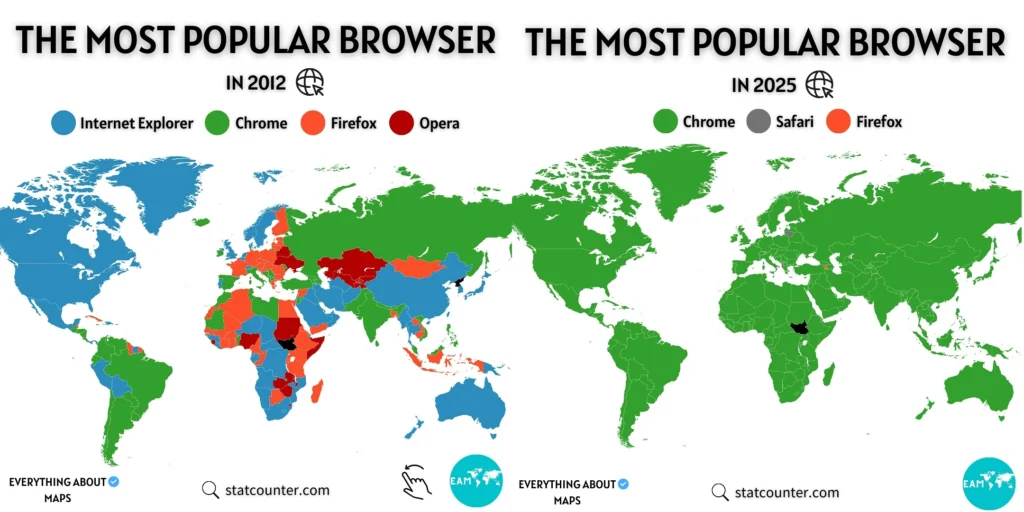
In the current digital landscape, the internet browser serves as the primary gateway to the global network of information, commerce, and communication. For over a decade, a single name has dominated the conversation: Google Chrome. However, the question of which browser is most popular involves more than just identifying the leader by market share. It requires an analysis of platform-specific dominance, the technological engines driving these tools, and the shifting user priorities regarding privacy, speed, and artificial intelligence integration.
As of the current technical epoch, Google Chrome maintains a commanding lead, holding approximately 65% of the global market share across all platforms. Yet, the story of browser popularity is a multifaceted one, defined by the competition between rendering engines, the rise of mobile-first browsing, and the resurgence of niche browsers that prioritize security over synchronization.

The Dominance of Google Chrome: A Market Analysis
Google Chrome’s ascent to the top of the browser hierarchy was not an overnight phenomenon but a calculated disruption of the status quo. When it launched in 2008, it challenged the bloat of Internet Explorer and the then-stagnant performance of Firefox by introducing a minimalist interface and a superior JavaScript engine.
The Rise of Chromium and the Engine Monopoly
The primary reason for Chrome’s sustained popularity is the technical foundation known as Chromium. This open-source project provides the source code for Chrome and has become the industry standard for web rendering. By developing the Blink rendering engine and the V8 JavaScript engine, Google ensured that Chrome could handle increasingly complex web applications with unprecedented speed.
The success of Chromium has led to a unique situation in the software industry: a “monoculture” where most major browsers, including Microsoft Edge, Opera, and Brave, are built on the same underlying engine. This ensures compatibility for developers but also consolidates Google’s influence over how web standards are defined and implemented. For the average user, this translates to a “best-in-class” experience where websites are almost always optimized first for Chrome’s architecture.
Ecosystem Integration and User Retention
Beyond pure performance, Chrome’s popularity is fueled by deep integration with the Google ecosystem. For users of Gmail, Google Drive, and YouTube, the browser acts as a seamless extension of their digital identity. Features such as cross-device synchronization of passwords, bookmarks, and browsing history create a “sticky” user experience. When a user logs into a new device, their entire digital workspace is immediately available, making the friction of switching to a competitor high. This ecosystem lock-in is a significant driver of Chrome’s 65% market share, particularly in professional and academic environments.
The Battle for Second Place: Safari, Edge, and Firefox
While Chrome dominates the overall market, the “silver medal” in the browser wars is contested by different players depending on the hardware and the user’s technical requirements.
Safari’s Mobile Fortress
Safari currently holds the second-largest market share globally, hovering around 18%. Its popularity is inextricably linked to the success of Apple’s hardware ecosystem. Because Safari is the default browser on hundreds of millions of iPhones and iPads, it dominates the mobile browsing sector in many affluent markets, particularly the United States and Western Europe.
Technologically, Safari utilizes the WebKit engine. Apple’s tight control over hardware-software integration allows Safari to be exceptionally energy-efficient on MacBooks and mobile devices. For users within the Apple ecosystem, Safari offers features like Intelligent Tracking Prevention and seamless Handoff between devices, maintaining a loyal user base that values battery life and privacy over the extension-heavy environment of Chrome.
Microsoft Edge’s Corporate Resurgence
Microsoft Edge has seen a significant revitalization since migrating to the Chromium engine in 2020. Now holding approximately 5% of the market, it has successfully shed the negative reputation of its predecessor, Internet Explorer. Edge’s growth is driven by its status as the default browser on Windows 10 and 11, combined with aggressive integration of corporate features.
Edge has carved out a niche by offering superior memory management through “sleeping tabs” and deeply integrating Microsoft 365 tools. For enterprise users, Edge is often the preferred choice because it balances Chromium compatibility with Microsoft’s security protocols. Furthermore, the integration of Bing AI (powered by GPT-4) has given Edge a modern technical edge, attracting users interested in generative AI tools baked directly into the sidebar.
Mozilla Firefox and the Privacy Niche
Mozilla Firefox remains the only major competitor that does not rely on the Chromium engine. Using its own Gecko engine, Firefox represents a critical pillar of web diversity. While its market share has declined to roughly 3%, it remains the browser of choice for tech enthusiasts, developers, and privacy advocates. Firefox’s commitment to being a non-profit, open-source entity allows it to implement aggressive privacy features, such as Total Cookie Protection, without the conflict of interest inherent in an advertising-driven company like Google.
Emergent Trends: AI Integration and the Browser as an Operating System
The definition of a “popular” browser is currently shifting from a simple window for viewing web pages to a complex AI-powered productivity hub. The technology behind how we browse is undergoing its most significant evolution since the introduction of tabs.
Generative AI and Search Evolution
The most disruptive trend in modern browser technology is the integration of Generative AI. Google is currently rolling out Search Generative Experience (SGE) into Chrome, while Microsoft has already fully integrated Copilot into Edge. These tools change the user interface from a passive search bar to an active assistant that can summarize articles, write code, and organize tabs.
For a browser to remain popular in 2024 and beyond, it must do more than render HTML; it must synthesize information. This has paved the way for “boutique” browsers like Arc by The Browser Company. Though its market share is currently small, Arc has gained massive traction among power users by reimagining the UI, focusing on “Spaces” and “Boosts” to customize the web, and using AI to rename downloads and summarize links. This indicates a growing segment of the population that is willing to move away from Chrome for a more modern, organized experience.
The Impact of WebAssembly and Cloud Computing
Technologically, the browser is becoming more like a thin-client operating system. The advancement of WebAssembly (Wasm) allows high-performance applications—like video editors and complex 3D modeling software—to run directly in the browser at near-native speeds. As more professional software moves to the cloud (SaaS), the browser’s ability to manage heavy workloads becomes a key metric of its popularity. Chrome and Edge’s focus on performance optimization for these heavy-duty web apps is a major reason they remain the preferred tools for remote work and digital creation.
Security and Privacy: The New Competitive Edge
As cyber threats become more sophisticated, the technical security architecture of a browser has become a primary factor in its adoption. Users are increasingly aware of data harvesting, leading to a shift in what constitutes a “good” browser.
Beyond Cookies: Privacy Sandbox vs. Total Cookie Protection
The industry is currently in the midst of a “privacy war.” Google is attempting to phase out third-party cookies through its Privacy Sandbox initiative, which aims to balance user privacy with the needs of the ad-supported web. However, competitors like Brave and Firefox have taken a more radical approach by blocking trackers by default.
Brave, in particular, has seen a surge in popularity among users who are tired of intrusive advertisements. By utilizing a “Shields” system that blocks ads and trackers at the engine level, Brave offers a significantly faster browsing experience on data-heavy sites. This technical differentiation has allowed Brave to grow to over 60 million monthly active users, proving that privacy is no longer a niche concern but a mainstream demand.
Hardening the Browser Against Modern Threats
Modern browsers have implemented advanced security features like site isolation, where each tab runs as a separate process to prevent malicious code from jumping between sites. They also utilize automated sandboxing and HTTPS-only modes. Chrome’s popularity is bolstered by its “Safe Browsing” technology, which protects billions of users from phishing and malware by leveraging Google’s massive database of malicious URLs. The ability of a browser to provide a “safe” experience is now a prerequisite for market dominance.

Looking Ahead: The Future of Web Navigation
The question of which browser is most popular is currently answered by Google Chrome, but the landscape is far from static. As we look toward the next decade, several technical shifts could disrupt the current hierarchy.
The rise of spatial computing (VR/AR) is forcing browsers to adapt to three-dimensional environments. Apple’s Vision Pro and Meta’s Quest devices require browsers that can handle immersive content and gaze-based navigation. Furthermore, the continued push for decentralization (Web3) may lead to the rise of browsers that natively support blockchain technologies and decentralized file storage (IPFS).
Ultimately, while Chrome holds the crown today due to its speed, Chromium-based ecosystem, and Google integration, the “popularity” of a browser is increasingly defined by how well it protects user data and integrates emerging AI technologies. The browser is no longer just a tool for viewing the web; it is the central interface for our digital lives, and the competition to be that interface is fiercer than ever. Whether Chrome can maintain its 65% share in the face of AI-driven competitors and increasing privacy demands will be the defining story of the next era of internet technology.
aViewFromTheCave is a participant in the Amazon Services LLC Associates Program, an affiliate advertising program designed to provide a means for sites to earn advertising fees by advertising and linking to Amazon.com. Amazon, the Amazon logo, AmazonSupply, and the AmazonSupply logo are trademarks of Amazon.com, Inc. or its affiliates. As an Amazon Associate we earn affiliate commissions from qualifying purchases.