
Navigating the complexities of the Social Security Administration (SSA) is a critical component of personal finance for any American approaching the end of their career. Among the most frequent questions asked by those nearing the milestone of 60 is whether they should claim benefits as soon as they become eligible at age 62, and more importantly, what the “floor” or minimum payment might look like.
While many hope for a guaranteed minimum income that provides a comfortable safety net, the reality of Social Security is nuanced. There is a distinction between the “Special Minimum Benefit” designed for long-term low-wage earners and the practical minimum benefit that an individual might receive based on their own specific work history. Understanding these differences is essential for effective retirement planning and long-term financial security.
The Reality of the Special Minimum Benefit
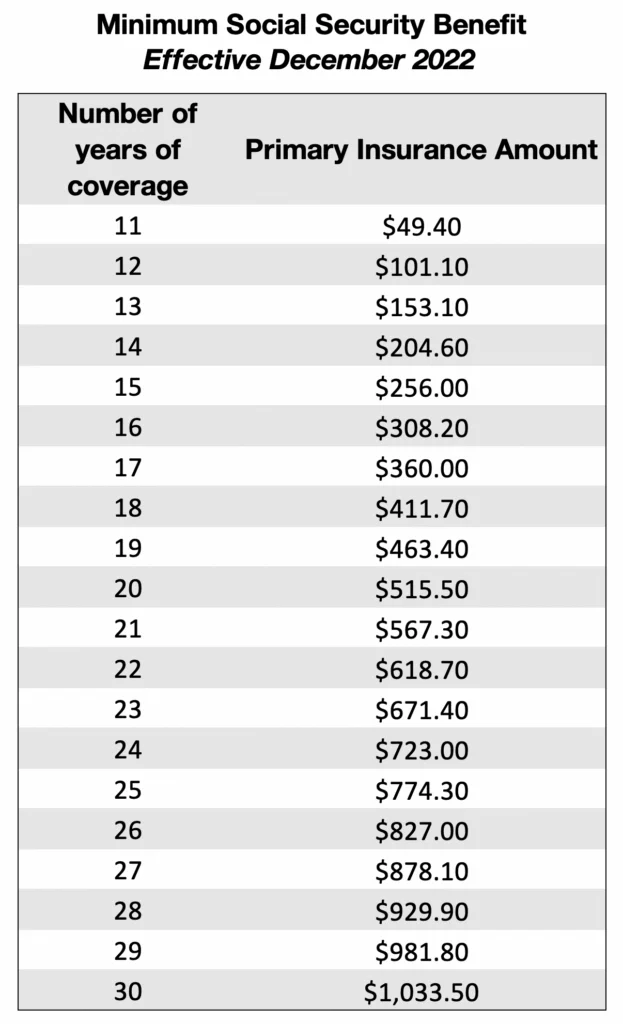
When people search for a “minimum benefit,” they are often referring to a specific provision in the law known as the Special Minimum Benefit. Established in 1972, this was intended to provide a higher benefit to individuals who worked in low-paying jobs for many years.
Defining the Special Minimum Benefit
The Special Minimum Benefit is not based on the amount of money you earned, but rather on the number of years you worked and paid into the system. To qualify, a worker must have at least 11 “years of coverage.” A year of coverage is defined by a specific amount of earnings in that calendar year. For example, in 2024, a worker needs to earn a significant amount to credit that year toward the special minimum.
The maximum Special Minimum Benefit is reserved for those with 30 years of coverage. However, there is a catch that many retirees overlook: the Special Minimum Benefit is rarely paid out today. This is because the standard benefit formula—which uses your Average Indexed Monthly Earnings (AIME)—almost always results in a higher payment than the Special Minimum Benefit. Because the law dictates that the SSA must pay the higher of the two amounts, the Special Minimum has become largely obsolete for new retirees.
Why Few Qualify for the “Special” Minimum
The primary reason the Special Minimum Benefit has lost its impact is due to how it is adjusted for inflation. While the standard Social Security benefit is indexed to wage growth, the Special Minimum is indexed to price inflation. Historically, wages have grown faster than prices. Consequently, the standard benefit formula has overtaken the special minimum for nearly all workers. Unless Congress acts to reform the indexing of the Special Minimum Benefit, it will continue to fade into the background of the American financial landscape.
The Math of Early Filing at Age 62
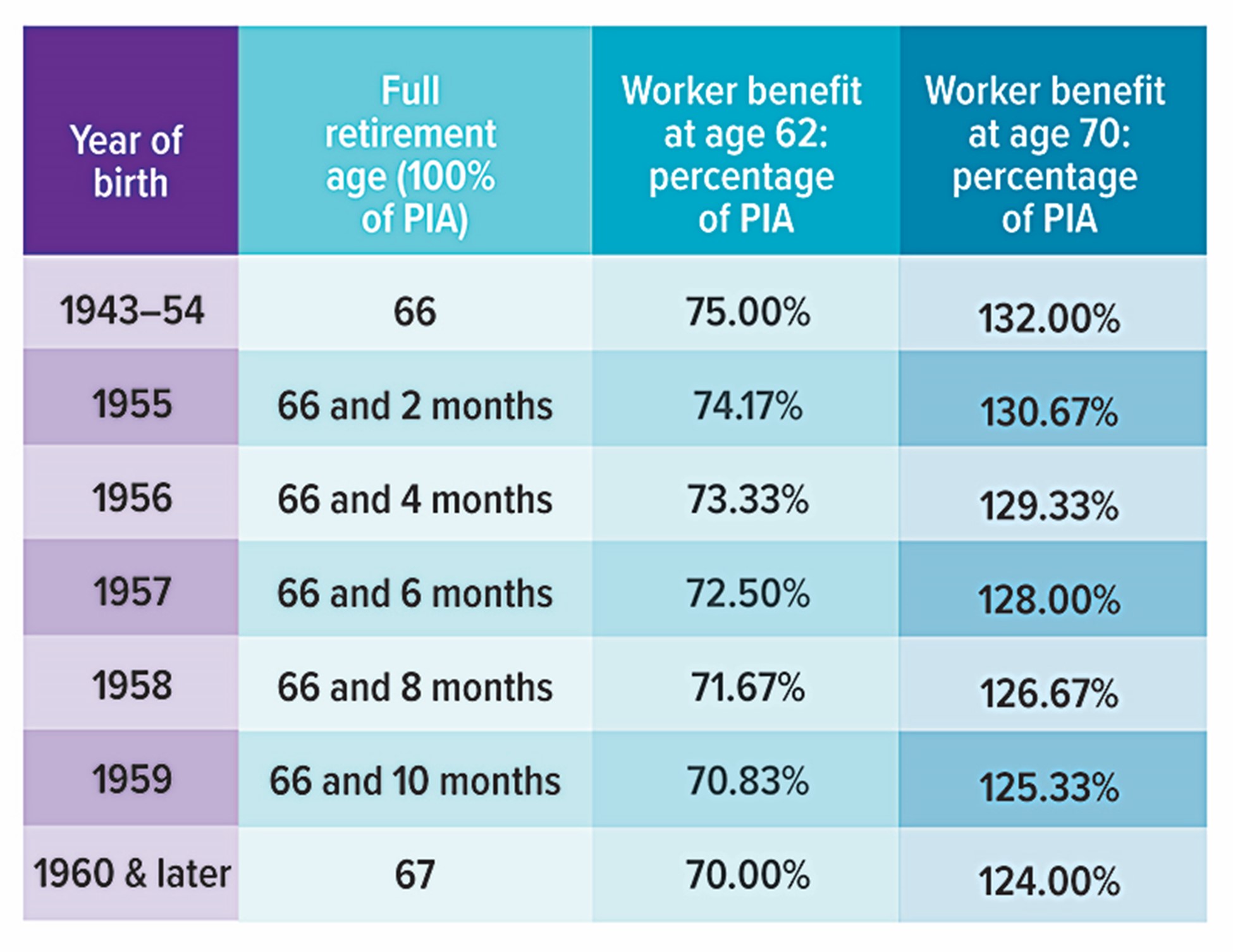
Age 62 is the earliest point at which a worker can claim retirement benefits, but choosing this path comes with a permanent financial cost. The SSA considers age 67 to be the Full Retirement Age (FRA) for anyone born in 1960 or later. Claiming at 62 results in a “reduction in benefits” because you are expected to receive payments over a longer period of time.
Full Retirement Age vs. Early Filing
Your Primary Insurance Amount (PIA) is the monthly benefit you are entitled to if you wait until your FRA. If your FRA is 67 and you choose to file at 62, your monthly check will be reduced by approximately 30%. This reduction is permanent. While you receive more checks over your lifetime by starting early, each individual check is significantly smaller.
For someone whose PIA at age 67 would be $2,000, filing at age 62 would result in a monthly benefit of only $1,400. This 30% gap can be the difference between a comfortable retirement and one where a retiree is constantly struggling to cover basic expenses.
Calculating the 30% Reduction
The SSA uses a specific formula to calculate this reduction. For the first 36 months of early filing, the benefit is reduced by 5/9 of 1% for each month. For any months beyond 36, the benefit is reduced by an additional 5/12 of 1% per month.
When you sum these fractions over the five years (60 months) between age 62 and age 67, you arrive at the 30% total reduction. From a personal finance perspective, this is a steep price to pay for liquidity. It essentially functions as a reverse interest rate, where the cost of accessing your “money” early is a permanent haircut on your primary source of guaranteed income.
How Your Earnings History Dictates Your Minimum
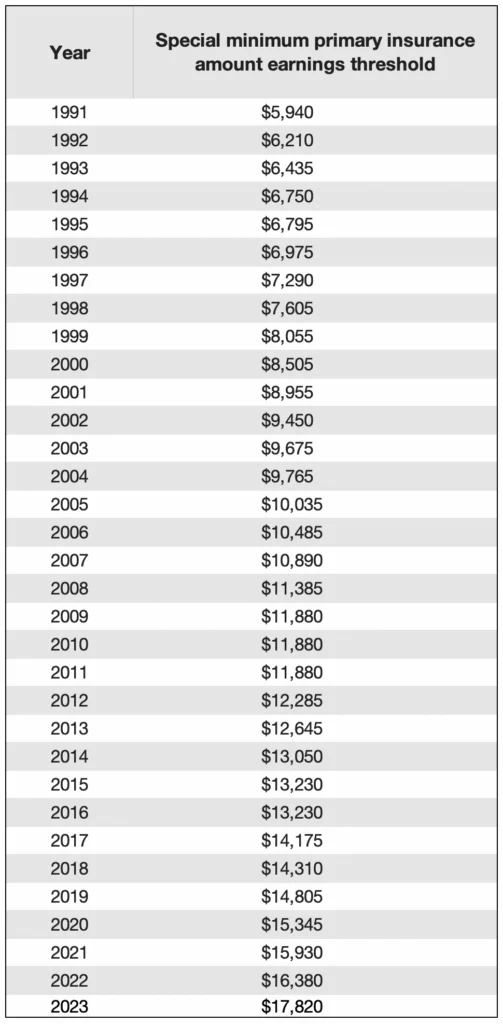
Since the Special Minimum Benefit is rarely applicable, your “minimum” is effectively determined by your own work history. Social Security is a “contributory” system; what you get out is directly tied to what you put in, though the formula is weighted to help lower-income earners.
The 35-Year Rule
The SSA looks at your 35 highest-earning years. These years are “indexed” to account for inflation, meaning your earnings from 1990 are adjusted to reflect what they would be worth in today’s dollars. If you have fewer than 35 years of work history, the SSA enters a zero for each missing year.
These zeros are “benefit killers.” Even a few years of zero earnings can significantly drag down your Average Indexed Monthly Earnings (AIME), which in turn lowers your monthly benefit. For those looking to maximize their “minimum” payout, ensuring they have at least 35 years of covered employment is the most effective strategy.
Average Indexed Monthly Earnings (AIME) and Bend Points
Once your AIME is calculated, the SSA applies a formula with “bend points” to determine your PIA. In 2024, the formula takes 90% of the first $1,174 of your AIME, 32% of earnings between $1,174 and $7,078, and 15% of any earnings above that.
This progressive structure ensures that low-wage earners receive a higher percentage of their pre-retirement income than high-wage earners. Therefore, if you were a low-wage earner for your entire career, your “minimum” benefit at age 62 might represent a significant portion of your previous salary, even after the 30% early filing reduction.
Factors That Can Further Lower or Increase Your Benefit
Beyond the basic calculation of work history and filing age, several variables can impact the actual dollar amount you see in your bank account every month.
The Retirement Earnings Test
One of the most important factors for those filing at 62 is the Retirement Earnings Test. If you continue to work while receiving Social Security benefits before you reach your Full Retirement Age, the SSA may temporarily withhold some of your benefits.
In 2024, if you earn more than $22,320, the SSA will deduct $1 from your benefits for every $2 you earn above that limit. While these withheld benefits are eventually “returned” to you in the form of higher monthly payments once you reach FRA, the immediate impact is a reduction in your liquid income. This makes working and claiming at 62 a complex balancing act that requires careful tax and cash-flow planning.
Taxation of Benefits
Many retirees are surprised to learn that Social Security benefits can be taxable. If your “combined income” (adjusted gross income + untaxed interest + half of your Social Security benefits) exceeds $25,000 for individuals or $32,000 for couples filing jointly, you may owe federal income tax on up to 50% to 85% of your benefits. This reduces the “net” minimum you actually have available to spend.
Spousal and Survivor Benefit Minimums
It is also worth noting that your minimum benefit might not be based on your own work record at all. If you are married, or were married for at least 10 years and are currently single, you may be eligible for spousal benefits. A spousal benefit can be up to 50% of your spouse’s PIA. If you file at 62, this amount is also reduced. For many who stayed home to raise children or had erratic work histories, the “minimum” they receive is often based on this spousal provision rather than their own AIME.
Strategic Considerations for Claiming at 62
Deciding to take the minimum benefit at age 62 is a personal financial decision that should not be made in a vacuum. It requires an analysis of health, longevity, and total portfolio composition.
When Taking the Minimum Makes Financial Sense
There are specific scenarios where filing for a reduced benefit at 62 is the most rational choice:
-
Health Concerns: If an individual has chronic health issues and does not expect to reach the “break-even” age (usually around 77 or 78), taking the money early maximizes the total lifetime value of the benefit.
-
Urgent Financial Need: If Social Security is the only way to avoid debt or cover essential living expenses, the 30% reduction is a secondary concern compared to immediate survival.
-
Investment Opportunities: In rare cases, a sophisticated investor might claim early to invest the funds, hoping to achieve a market return that outpaces the guaranteed growth of Social Security (which is roughly 8% per year between FRA and age 70). However, this is high-risk and generally not recommended for the average retiree.
Bridging the Gap with Other Income Streams
For those who are worried that the minimum benefit at 62 won’t be enough, it is crucial to look at other pillars of retirement. This includes 401(k) or IRA distributions, part-time “bridge” jobs, or even rental income.
The most effective way to protect yourself from a low Social Security payout is to view the benefit as one part of a diversified income stream. By understanding that there is no universal “floor” other than the one created by your own earnings and the timing of your claim, you can take proactive steps to ensure your financial tools are aligned with your retirement goals. Whether that means working a few extra years to eliminate “zero” years from your record or waiting until age 67 to avoid the 30% haircut, the power to define your minimum benefit rests largely in your hands during your working years.
aViewFromTheCave is a participant in the Amazon Services LLC Associates Program, an affiliate advertising program designed to provide a means for sites to earn advertising fees by advertising and linking to Amazon.com. Amazon, the Amazon logo, AmazonSupply, and the AmazonSupply logo are trademarks of Amazon.com, Inc. or its affiliates. As an Amazon Associate we earn affiliate commissions from qualifying purchases.