
In the realm of software engineering, computer graphics, and artificial intelligence, the most fundamental concepts of Euclidean geometry serve as the invisible scaffolding for complex digital architectures. While many encounter the “median of a triangle” in secondary school mathematics, its application in modern technology—ranging from game engine physics to machine learning algorithms—is profound. At its simplest, a median of a triangle is a line segment joining a vertex to the midpoint of the opposite side. However, in the context of tech trends and digital development, this definition is the starting point for understanding how we calculate spatial balance, optimize 3D meshes, and drive the future of spatial computing.

Understanding the Geometry: The Foundation of Digital Construction
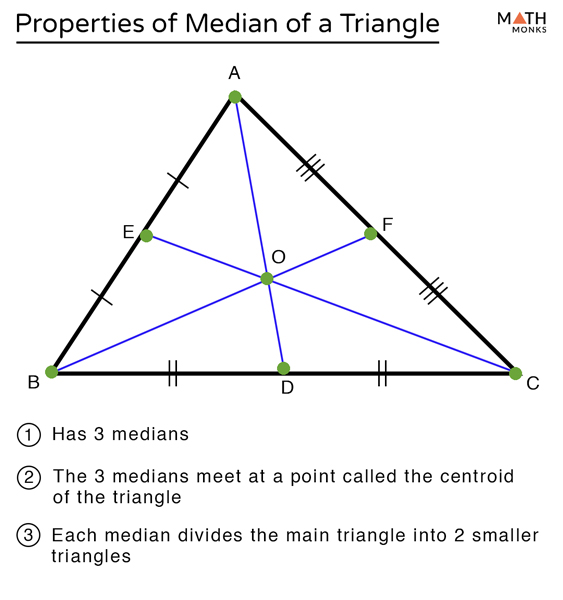
Before diving into the high-level applications in software and AI, it is essential to establish the technical definition of the median through the lens of computational geometry. Every triangle possesses exactly three medians, and these three lines are always concurrent, meaning they intersect at a single point. This point of intersection is known as the centroid.
Defining the Median in Computational Terms
In a digital environment, a triangle is defined by three coordinates or vertices: A, B, and C. If we represent these as vectors in 2D or 3D space, the median is the vector path from one vertex to the arithmetic mean of the other two. For instance, the median from vertex A is the segment connecting A to the midpoint M, where M is calculated as (B + C) / 2.
For developers working in languages like C++ or Python for graphics programming, this simple midpoint formula is the basis for linear interpolation. It allows software to bisect shapes with precision, ensuring that the geometric properties of a model remain consistent regardless of scale or rotation. The properties of the median, such as its ability to divide the triangle into two sub-triangles of equal area, are not merely academic; they are used in load-balancing algorithms where spatial partitioning is required to manage rendering tasks across multiple GPU cores.
The Centroid: The Intersection of Logic and Physics
The centroid, or the geometric center of the triangle, is perhaps the most significant technological byproduct of the median. In physics engines—such as those found in the Unreal Engine or Unity—the centroid represents the center of mass for a uniform triangular lamina.
The centroid divides each median in a 2:1 ratio. This mathematical constant is hard-coded into simulation software to determine how objects behave when subjected to gravity, torque, and collision. When a 3D model of a vehicle or a character is rigged for a game, the software uses the medians of the underlying polygonal mesh to identify the equilibrium point. Without this geometric calculation, digital objects would lack “weight” and fail to interact realistically with their environments.
Medians in Computer Graphics and 3D Rendering
In the world of technology, triangles are the universal language of 3D modeling. Every complex character, architectural visualization, and digital landscape is a collection of thousands or millions of triangles, collectively known as a “mesh.” The median of these triangles plays a pivotal role in how these meshes are optimized and displayed on our screens.
Mesh Optimization and Polygon Reduction
Modern hardware, despite its power, has limits on how many polygons it can render per second while maintaining a high frame rate. To manage this, software developers use algorithms for “Level of Detail” (LOD) management. When a 3D object moves further away from the camera, the software reduces its complexity through a process called decimation.
Geometric medians are crucial here. To simplify a mesh without distorting the object’s silhouette, the software must identify the central points of existing triangles to merge them into larger, simpler shapes. By calculating the medians and centroids, the algorithm can collapse edges while preserving the visual “balance” of the model. This ensures that a character’s face still looks like a face, even when it is represented by 500 triangles instead of 50,000.
Rasterization and Texture Mapping
Texture mapping—the process of wrapping a 2D image around a 3D object—relies heavily on the internal coordinates of triangles. Barycentric coordinates, which are derived from the relationship between a point and the vertices of a triangle, are frequently calculated using the medians. These coordinates allow the GPU to determine exactly where a pixel of a texture should land on a 3D surface. By understanding the median, developers can ensure that textures do not stretch or warp unnaturally as the object deforms, which is essential for realistic animation in film and gaming.
Geometric Algorithms in Artificial Intelligence and Big Data
The application of triangle medians extends far beyond visual aesthetics into the logical heart of Artificial Intelligence (AI) and Machine Learning (ML). In high-dimensional data analysis, geometry is used to categorize information and recognize patterns.
Spatial Data Partitioning
In big data, information is often represented as points in a multi-dimensional space. To search this data efficiently, developers use “K-D Trees” or “Spatial Partitioning.” This involves dividing a large field of data points into smaller, more manageable cells.
When the data is clustered in triangular formations (a common occurrence in Lidar scans for autonomous vehicles), the median is used to find the “median split.” By bisecting the data along the median of a triangle formed by key data points, the algorithm can create a balanced search tree. This allows a self-driving car to process its surroundings in milliseconds, identifying the “median” path between obstacles to ensure safety and efficiency.
Centroid-Based Clustering (K-Means)
Machine learning models often use “K-Means Clustering” to group similar data points. This process is iterative: the model chooses a central point (a centroid), assigns data points to it, and then recalculates the centroid based on the new group’s geometry.
While K-Means can apply to many shapes, in triangular data distributions, the median-derived centroid is the optimal target. This is particularly relevant in natural language processing (NLP) and recommendation engines, where “conceptual distance” between words or products is measured geometrically. The median provides the most mathematically stable path to finding the center of a data set, reducing the computational “noise” that can lead to AI hallucinations or inaccuracies.
Software Engineering and UI Layout Architecture
While 3D graphics and AI represent the cutting edge, the median of a triangle also influences the software we use daily: our mobile apps and web browsers. Modern UI (User Interface) design is increasingly dynamic, requiring layouts that adapt to different screen sizes and orientations.
The Geometry of Visual Balance
Design systems like Google’s Material Design or Apple’s Human Interface Guidelines emphasize the importance of visual weight. When a designer creates a play button (usually an equilateral or isosceles triangle), it must be “optically centered” rather than just mathematically centered.
If a play icon is placed inside a circle based on its bounding box, it often looks off-center to the human eye. To fix this, frontend developers use the geometric median to find the centroid of the triangle icon. By aligning the centroid of the triangle with the center of the surrounding circle, the interface achieves a perfect “optical balance.” This subtle use of geometry is what makes professional software feel “polished” and intuitive to the user.
Responsive Vector Graphics
Scalable Vector Graphics (SVG) are the standard for modern web icons and illustrations. Unlike raster images (pixels), SVGs are written in code using geometric coordinates. When a developer writes a script to animate a triangular element—such as a dropdown arrow or a loading spinner—they often use the median to define the axis of rotation. Rotating a triangle around one of its vertices creates a wobbling effect, whereas rotating it around its centroid (the intersection of its medians) creates a smooth, professional spin.

The Future of Geometry in Spatial Computing and Robotics
As we move toward the era of spatial computing—driven by headsets like the Apple Vision Pro and Meta Quest—the median of a triangle becomes even more critical. These devices must map the physical world into a digital “twin” in real-time.
In robotics, pathfinding in a 3D environment requires the machine to “triangulate” its position. By calculating the medians of the triangles formed between the robot and landmarks in the room, the navigation software can determine the most stable and centered path through a space. This prevents robots from clipping into walls and allows for more fluid movement in human-centric environments.
Furthermore, in the field of Digital Security, geometric hashing is used to identify objects in encrypted video feeds. By analyzing the medians of triangular features within a frame, a security AI can identify a specific object’s “geometric signature” without needing to access raw, sensitive pixel data. This provides a layer of privacy and security that is essential for the future of smart-home technology.
The median of a triangle is far more than a line on a page; it is a fundamental tool for the modern digital age. From the physics that governs how a character jumps in a video game to the algorithms that help an AI understand the world, the humble median is a testament to the enduring power of geometry in the evolution of technology. As software continues to bridge the gap between the physical and the digital, our reliance on these ancient mathematical principles will only deepen, proving that the most advanced tools are often built on the simplest foundations.
aViewFromTheCave is a participant in the Amazon Services LLC Associates Program, an affiliate advertising program designed to provide a means for sites to earn advertising fees by advertising and linking to Amazon.com. Amazon, the Amazon logo, AmazonSupply, and the AmazonSupply logo are trademarks of Amazon.com, Inc. or its affiliates. As an Amazon Associate we earn affiliate commissions from qualifying purchases.