
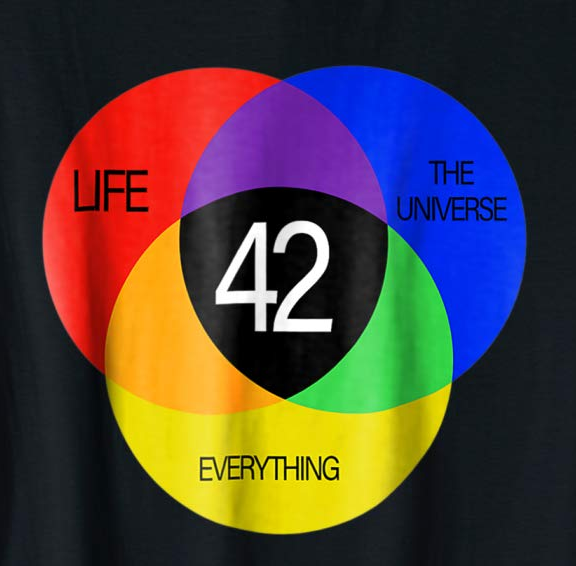
In Douglas Adams’ seminal work, The Hitchhiker’s Guide to the Galaxy, a supercomputer named Deep Thought spends seven and a half million years calculating the answer to the “Ultimate Question of Life, the Universe, and Everything.” The result, famously, was 42. While intended as a satirical jab at the absurdity of seeking profound meaning in raw data, the premise has become an unintentional blueprint for the modern technological era. Today, we are no longer waiting millions of years for a fictional computer to provide answers. Instead, we are building the infrastructure of that very computer through Artificial Intelligence, quantum computing, and the digitization of the physical world.

In the context of 21st-century technology, the “meaning of life and the universe” is being redefined not through philosophy, but through the lens of information theory, computational power, and the pursuit of Artificial General Intelligence (AGI). We are transitioning from a species that observes the universe to one that attempts to simulate, decode, and perhaps ultimately rewrite its underlying source code.
The Computation of Existence: Data as the Universal Language
At the core of the modern tech revolution is a foundational belief: everything that exists can be represented as information. From the sequencing of the human genome to the gravitational waves of distant black holes, the universe is being translated into data. This shift suggests that the “meaning” we seek might be hidden within the patterns of this data, waiting for the right algorithm to extract it.
The Rise of Big Data and Pattern Recognition
In the past decade, the explosion of data—often referred to as the “new oil”—has fundamentally changed how we understand reality. We are no longer limited to small sample sizes or anecdotal evidence. Through massive data lakes and real-time processing, we can track the movement of entire populations, the mutation of viruses, and the shifting of tectonic plates.
Technology has reached a point where pattern recognition is outstripping human intuition. When we ask “what is the meaning” of a complex system, such as the global climate or the human brain, we are looking for the predictive patterns that govern those systems. In this sense, meaning is synonymous with predictability and structural understanding.
Digital Twins and the Simulation of Reality
One of the most ambitious trends in current tech is the creation of “Digital Twins.” These are highly complex virtual models of physical objects, systems, or even cities. By creating a digital replica of the universe—or parts of it—we can run infinite simulations to see how different variables play out. This technological capability moves us closer to answering “what if” questions that were once the domain of pure speculation. If we can simulate the universe to a high enough degree of fidelity, the “meaning” becomes a matter of observing the results of the simulation’s parameters.
Artificial General Intelligence: Building the Modern “Deep Thought”
The quest for the ultimate answer has found its most potent expression in the development of Artificial Intelligence. We are currently in the era of Narrow AI—systems designed for specific tasks like image recognition or language translation. However, the tech industry’s North Star is Artificial General Intelligence (AGI): a system that can understand, learn, and apply intelligence across any cognitive domain, much like a human, but at an exponential scale.
Large Language Models and the Synthesis of Knowledge
Current Large Language Models (LLMs) represent a significant step toward synthesizing the “universe” of human knowledge. By processing nearly every book, article, and piece of code ever written, these models act as a mirror to human thought. When a user asks an AI about the meaning of life, the AI provides a statistical synthesis of every philosophical and scientific thought ever recorded. It is, in a very real sense, the first time humanity has had a tool capable of holding the entirety of human wisdom in a single, queryable interface.
The Alignment Problem and the Search for Value
As we build more powerful AI, we face the “Alignment Problem”—the challenge of ensuring that an AI’s goals align with human values. This technical hurdle is, at its heart, a philosophical one. To program “meaning” or “purpose” into a machine, we must first define it for ourselves. The process of coding ethics and objectives into AGI is forcing tech leaders and engineers to confront the very questions Douglas Adams joked about. If an AI is tasked with “optimizing human well-being,” it must first have a data-driven definition of what a meaningful life looks like.
Digital Physics: Is the Universe an Algorithm?
A growing movement in theoretical physics and computer science suggests that the universe itself may be a computational process. This theory, often called “Digital Physics,” posits that the fundamental building blocks of reality are not particles or waves, but bits of information.
The Universe as a Quantum Computer
Quantum computing is not just a tool for faster processing; it is a way to speak the native language of the universe. Classical computers operate on bits (0s and 1s), which are a simplification of reality. Quantum computers use qubits, which can exist in multiple states simultaneously, mirroring the probabilistic nature of subatomic reality.
By building quantum computers, we are creating hardware that operates on the same principles as the universe itself. Many researchers believe that the only way to truly understand “the universe and everything” is to simulate it on a quantum level. This could lead to breakthroughs in material science, medicine, and our understanding of time and space, effectively “solving” the equations of existence.
The Simulation Hypothesis
Popularized by figures like Nick Bostrom and discussed extensively in tech circles, the Simulation Hypothesis suggests that if a civilization reaches a point where it can simulate a universe with sentient inhabitants, it is statistically likely that we are living in such a simulation. From a technical perspective, this changes the search for “meaning” into a search for “code.” Scientists are looking for “glitches” or “constraints” in the laws of physics that might indicate the computational limits of our reality. In this framework, the meaning of the universe is found in the intent of the programmer.
The Human Element: Digital Security and the Preservation of Meaning
As we delegate the search for meaning to our tools, we encounter new risks. The more we rely on technology to define our reality, the more vulnerable that reality becomes to manipulation, corruption, and loss.
The Ethics of Data Sovereignty
If our collective knowledge and the “answers” to our existence are stored in proprietary algorithms, who owns that meaning? The centralization of AI power in a few tech giants raises questions about the democratization of truth. Digital security is no longer just about protecting passwords; it is about protecting the integrity of the information that defines our world. Ensuring that the “meaning” generated by technology is not biased or manipulated is the great challenge of modern digital governance.
Consciousness and the Ghost in the Machine
One of the most profound “meaning” questions involves consciousness. Can a silicon-based entity ever “feel” the meaning of life? As we develop sophisticated neural networks that mimic the human brain, the line between software and sentience begins to blur. The technological quest for meaning eventually hits the wall of subjectivity. Even if a computer provides the answer “42,” it requires a conscious observer to interpret it, value it, or find it absurd.
The Future: Quantum Supremacy and the Final Frontier
We are standing at a threshold where our gadgets and software are no longer just tools for productivity; they are instruments of cosmic discovery. The next few decades will likely see the convergence of several “God-tier” technologies that will bring us closer to an ultimate understanding of our environment.
Merging Biology and Technology
Through brain-computer interfaces (BCIs) like Neuralink and advancements in biotechnology, the gap between the “observer” (human) and the “tool” (tech) is narrowing. We may soon be able to process information at the speed of silicon, allowing us to perceive the “universe and everything” in ways our biological brains currently cannot. This evolution suggests that the meaning of life may not be something we find, but something we become as we integrate with our technological creations.

The Infinite Iteration
Ultimately, the technological perspective suggests that the meaning of the universe is not a static answer, but an ongoing process of iteration and optimization. Just as software is never truly “finished” but is constantly updated, our understanding of reality is a series of version updates. We are moving from Version 1.0 (myth and folklore) to Version 2.0 (classical science) and now toward Version 3.0 (the computational universe).
Technology has provided us with a new set of metaphors and tools to tackle the oldest questions in history. Whether the answer is a mathematical constant, a line of code, or a quantum probability, the quest itself is being driven by the relentless march of innovation. We may never reach a final, singular answer, but in the process of building the tools to find it, we are expanding the boundaries of what it means to be alive in an infinite, data-rich cosmos.
aViewFromTheCave is a participant in the Amazon Services LLC Associates Program, an affiliate advertising program designed to provide a means for sites to earn advertising fees by advertising and linking to Amazon.com. Amazon, the Amazon logo, AmazonSupply, and the AmazonSupply logo are trademarks of Amazon.com, Inc. or its affiliates. As an Amazon Associate we earn affiliate commissions from qualifying purchases.