
The United States economy is often characterized by its massive consumer market and its role as a global importer of goods. However, the other side of the ledger—the export sector—is a sophisticated, multi-trillion-dollar engine that dictates the strength of the U.S. dollar, influences global interest rates, and provides a roadmap for savvy investors. When asking “what is the main export of the United States,” the answer is rarely a single product. Instead, it is a complex portfolio of high-value commodities, capital goods, and intangible services that maintain the nation’s status as a global financial superpower.

To understand the financial health of the U.S. and where the next big investment opportunities lie, one must look beyond the surface level of “made in America” labels and dive into the specific sectors that drive the country’s trade balance.
The Tangible Powerhouse: Refined Petroleum and Industrial Machinery
In the realm of physical goods, the United States has undergone a massive structural shift over the last decade. Historically a net importer of energy, the U.S. has transformed into one of the world’s leading exporters of energy products. This shift has profound implications for corporate finance and international trade agreements.
The Energy Revolution and its Financial Ripple Effects
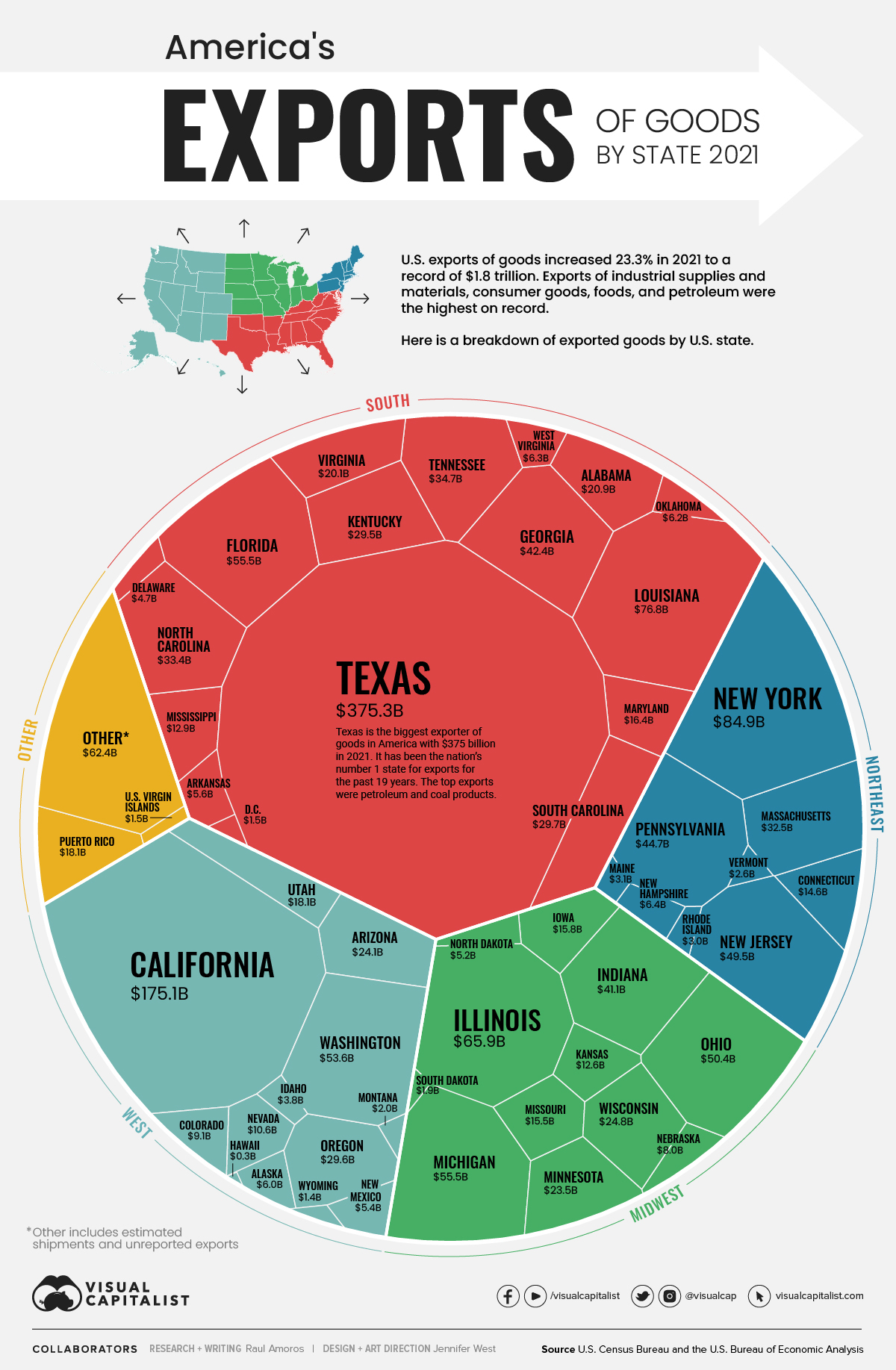
Refined petroleum remains the leading physical export of the United States by value. The “Shale Revolution” allowed the U.S. to tap into vast reserves, leading to a surplus that is processed in Gulf Coast refineries and shipped globally. From a financial perspective, this sector is a cornerstone of the U.S. trade strategy. The export of refined oils, liquefied natural gas (LNG), and petroleum gases generates hundreds of billions of dollars in annual revenue.
For investors and business analysts, this sector represents a hedge against global instability. When energy prices fluctuate, the U.S. export capacity acts as a stabilizer for the domestic economy, keeping the trade deficit from expanding too rapidly during periods of high oil prices.
Capital Goods: Why High-Value Machinery Dominates Trade
Second only to energy is the category of “capital goods.” This includes civilian aircraft, engines, and industrial machinery. Companies like Boeing and General Electric are not just manufacturing firms; they are financial entities that facilitate multi-billion dollar credit lines and long-term service contracts across borders.
Civilian aircraft, specifically, often top the list of individual product exports. The financial complexity of these deals—often involving Export-Import Bank (EXIM) financing—shows how the U.S. uses its high-tech manufacturing base to secure long-term capital inflows. These are not one-time sales; they are decades-long financial relationships that include maintenance, software updates, and parts, ensuring a steady stream of “online income” for the U.S. corporate sector.
The Invisible Giant: Services and Intellectual Property
While physical products like planes and oil make for great headlines, the true “main export” of the United States is arguably its services and intellectual property (IP). In the modern digital economy, value is increasingly found in what cannot be touched. The U.S. maintains a significant trade surplus in services, which helps offset the trade deficit in goods.
Financial Services and Global Market Dominance
The U.S. is the world leader in the export of financial services. This includes banking, insurance, asset management, and investment brokerage. When a foreign corporation uses a U.S. bank to underwrite an IPO or a foreign government seeks the expertise of U.S. financial consultants, that is a U.S. export.
Wall Street is essentially a factory that produces financial instruments and expertise, which are then sold to every corner of the globe. This dominance ensures that the U.S. dollar remains the primary reserve currency, which in turn allows the U.S. to borrow money at lower rates than almost any other nation. For anyone interested in business finance, understanding this “invisible export” is crucial to understanding how the U.S. maintains its economic leverage.
Licensing and Royalties: Capitalizing on American Innovation
Intellectual property is a massive revenue generator. This includes the licensing of software, trademarks, patents, and entertainment media. Every time a company in Europe pays for a SaaS (Software as a Service) subscription from a U.S. firm, or a movie studio receives royalties from an international screening, the U.S. is exporting “innovation.”
From a financial tool perspective, IP is the ultimate high-margin export. Unlike a barrel of oil, which has significant extraction and shipping costs, a piece of software can be exported infinitely with near-zero marginal cost. This makes the IP sector one of the most profitable areas for equity investors looking for high-growth potential within the U.S. trade portfolio.

The Strategic Impact of Exports on Personal and Corporate Finance
Understanding what the U.S. exports is not just an academic exercise; it is a vital component of strategic financial planning. Whether you are an individual investor or a business owner, the composition of U.S. exports affects your bottom line through currency valuation and sector growth.
Investing in Export-Oriented Sectors
For those looking at “Money” through the lens of investing, the export data provides a roadmap for sector rotation. When the global economy is expanding, demand for U.S. capital goods and financial services tends to rise. This often leads to outperformance in the industrial and financial sectors of the S&P 500.
Furthermore, because many of the top U.S. exporters are multinational corporations, they offer a way for domestic investors to gain international exposure without the risks associated with investing directly in foreign markets. These “blue-chip” exporters provide a safety net; they earn revenue in multiple currencies, which can provide a natural hedge against a weakening U.S. dollar.
Managing Currency Risk in International Trade
For small to medium-sized businesses (SMBs) looking to tap into “online income” or international markets, the U.S. export landscape dictates the cost of doing business. Because the U.S. exports so much high-value technology and financial expertise, the demand for the USD remains high.
However, a “strong dollar” can be a double-edged sword. While it makes imports cheaper, it makes U.S. exports more expensive for foreign buyers. Businesses involved in the export of goods must utilize sophisticated financial tools, such as forward contracts and currency options, to manage the risk of exchange rate volatility. Understanding the macro-trends of what the U.S. sells globally allows these businesses to price their products competitively while protecting their profit margins.
Future Trends: The Evolution of U.S. Trade in a Digital Economy
The landscape of U.S. exports is not static. As we move further into the 2020s, the “Money” niche is seeing a pivot toward technology-enabled financial exports and sustainable commodities.
The Rise of Tech-Enabled Financial Exports
We are currently witnessing the “fintechization” of U.S. exports. The traditional banking services are being augmented or replaced by digital payment gateways, blockchain-based settlement systems, and AI-driven financial analytics. These are the new frontiers of U.S. trade.
The U.S. is currently the leader in developing the infrastructure for the global digital economy. As more countries move toward cashless societies, the platforms and security protocols developed by U.S. firms become essential exports. This represents a massive opportunity for side hustles and new business ventures in the digital security and financial consulting spaces, as the world seeks U.S. expertise to navigate the digital transition.
Sustainability and the Shift in Global Commodity Values
The global push toward “Green Finance” and ESG (Environmental, Social, and Governance) standards is also reshaping U.S. exports. While refined petroleum is currently the king of tangible exports, the U.S. is rapidly increasing its export of renewable energy technology, including advanced battery components and carbon capture expertise.
From a business finance perspective, this shift is being driven by massive capital inflows into sustainable projects. Investors are no longer just looking at the volume of exports, but the “quality” and sustainability of those exports. Companies that can pivot from traditional carbon-heavy products to “green” capital goods are likely to see the highest valuations in the coming decade.
Conclusion: The Diversified Portfolio of a Superpower
In summary, the “main export” of the United States is not a single item, but a diversified portfolio designed for resilience and growth. From the high-volume energy products that fuel global industry to the high-margin intellectual property that defines the digital age, the U.S. remains an indispensable supplier to the world.
For the individual interested in the “Money” niche, this data is a powerful tool. It informs investment decisions, highlights emerging business opportunities, and provides clarity on the global movements of capital. By tracking the shift from tangible goods to intangible services and digital assets, one can better navigate the complexities of the global market and secure a more prosperous financial future. The U.S. export machine is a testament to the nation’s ability to innovate and adapt, ensuring that its “main export” will always be the very engine of global economic progress itself.
aViewFromTheCave is a participant in the Amazon Services LLC Associates Program, an affiliate advertising program designed to provide a means for sites to earn advertising fees by advertising and linking to Amazon.com. Amazon, the Amazon logo, AmazonSupply, and the AmazonSupply logo are trademarks of Amazon.com, Inc. or its affiliates. As an Amazon Associate we earn affiliate commissions from qualifying purchases.