
At the height of the global pandemic, the rapid antigen test became one of the most ubiquitous pieces of technology in households worldwide. While much of the public’s attention was focused on the plastic casing and the resulting colored lines, the true technological marvel resided in the small, unassuming vial of clear liquid provided with each kit. Known technically as an extraction buffer, this liquid is a sophisticated chemical tool engineered to facilitate a complex bio-molecular reaction in a matter of minutes.
Understanding the liquid in a COVID-19 test requires peering into the intersection of chemical engineering, molecular biology, and microfluidics. It is not merely “water,” but a high-performance solvent designed to stabilize, prepare, and transport viral particles across a diagnostic sensor.
The Chemistry of the Buffer: A Bio-Tech Masterpiece
The extraction buffer serves as the primary interface between a biological sample and the diagnostic hardware of the test strip. To the naked eye, it appears to be simple water, but on a molecular level, it is a precisely calibrated environment. The primary objective of this liquid is to “lyse” the virus—essentially breaking open the lipid envelope of the SARS-CoV-2 virus to expose the nucleocapsid (N) proteins that the test is designed to detect.
Detergents and Surfactants: The Viral Dissectors
The most critical components of the liquid are specialized detergents or surfactants, such as Triton X-100 or Sodium Dodecyl Sulfate (SDS). These molecules are engineered to be amphiphilic, meaning they have both water-attracting and oil-attracting properties. In the context of a COVID test, these detergents target the fatty outer layer (the lipid bilayer) of the virus.
By disrupting this membrane, the surfactants “pop” the viral particle, releasing its internal proteins into the solution. Without this specific chemical intervention, the viral proteins would remain trapped inside the envelope, making them invisible to the test’s sensors. This process must be instantaneous and thorough, representing a significant achievement in rapid-reaction chemistry.
pH Stabilizers and Buffering Agents
Biological reactions are notoriously sensitive to acidity. If the sample—collected from a human nasal cavity—is too acidic or too alkaline, it could denature the antibodies printed on the test strip, rendering the device useless. To prevent this, the liquid contains buffering agents like Tris (tris(hydroxymethyl)aminomethane) or HEPES.
These chemicals maintain a constant pH level (usually around 7.4 to 8.0, mimicking human physiological conditions). This stability ensures that the “wet” chemistry remains functional even if the user has recently consumed acidic beverages or has an unusual nasal pH. It is a fail-safe mechanism built directly into the liquid’s molecular structure.
Preservatives and Blocking Agents
To ensure a shelf-life of 12 to 24 months, the liquid includes antimicrobial agents like Sodium Azide. This prevents any bacterial growth within the vial that could interfere with the test results. Additionally, many buffers include “blocking agents” like bovine serum albumin (BSA) or casein. These proteins act as chemical “noise-reduction” tools, preventing non-specific binding—basically ensuring that the test components don’t stick to things they aren’t supposed to, which reduces the chance of a false positive.
Lateral Flow Technology: The Hardware of the Liquid Path
Once the sample is mixed with the extraction buffer, the liquid moves from the vial to the test cassette. This is where the liquid transitions from being a chemical reagent to becoming the fuel for a microfluidic device. The test strip inside the plastic housing is a sophisticated multi-layered technological stack known as a Lateral Flow Assay (LFA).
Capillary Action as a Power Source
A rapid test does not require batteries or an external power source. Instead, it utilizes capillary action—the same physical phenomenon that allows trees to pull water from their roots to their leaves. The liquid in the COVID test is engineered with specific viscosity and surface tension properties to move through the nitrocellulose membrane at a precise speed. If the liquid moves too fast, the antibodies won’t have time to capture the viral proteins; if it moves too slow, the test will “dry out” before completion.
The Conjugate Pad and Gold Nanoparticles
As the liquid migrates across the strip, it first hits the conjugate pad. This area contains billions of “detection antibodies” that are chemically bonded to nanometer-sized particles of colloidal gold or fluorescent latex beads. These nanoparticles are the “ink” of the test.
The liquid must be capable of picking up these heavy gold particles and carrying them effortlessly downstream. When the liquid encounters the viral proteins (the antigens) in the sample, the gold-labeled antibodies latch onto them. This creates a moving “complex” of liquid, protein, and gold particles flowing toward the detection zone.

Nitrocellulose Membranes: The Diagnostic Micro-Processor
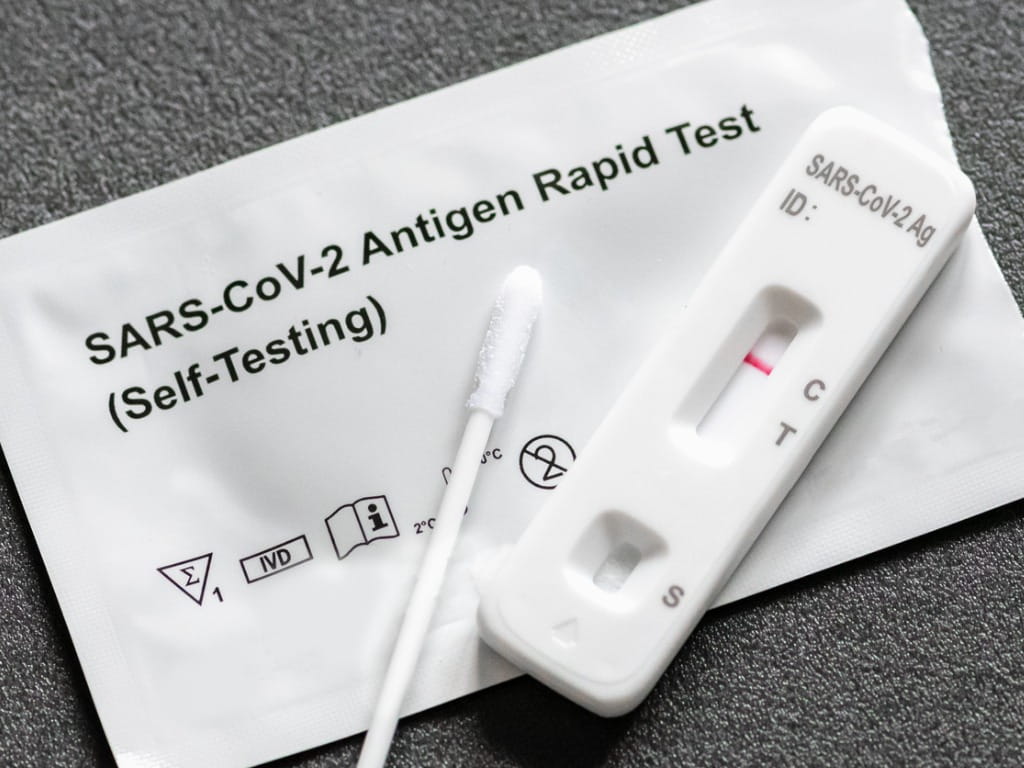
The liquid then enters the nitrocellulose membrane, which acts like a physical filter and a chemical sensor. The membrane is “printed” with two lines of fixed antibodies. The first line (the Test Line) captures the protein-gold complexes. As more and more gold particles get trapped at this line, they become visible to the human eye as a red or purple stripe.
The second line (the Control Line) is designed to catch any gold-labeled antibody, regardless of whether the virus is present. This confirms that the liquid has successfully navigated the entire length of the device. This “liquid logic” is what makes the test a reliable piece of diagnostic tech.
Digital Integration and AI-Enhanced Diagnostics
As the pandemic progressed, the technology within the liquid and the cassette began to merge with digital tools. The “liquid” results are no longer just for human eyes; they have become data points for sophisticated software ecosystems.
App-Based Interpretation and Computer Vision
One of the major tech trends in rapid testing is the use of smartphone-based AI to interpret the results. Because the intensity of the line formed by the liquid reaction can be faint, human error in reading results is common. Tech companies developed computer vision algorithms that can analyze a photo of the test strip, compensating for varied lighting conditions and shadows. These apps use the contrast of the gold nanoparticles against the nitrocellulose background to provide a definitive “Positive” or “Negative” result, often with higher sensitivity than the naked eye.
Data Aggregation and Public Health Tech
The liquid in the test also serves as the starting point for global health data. Many “smart” COVID tests are connected to cloud-based platforms. When a user performs a test, the results (verified by the app) are automatically uploaded to public health databases. This allows for real-time “heat mapping” of viral outbreaks. In this sense, the chemical buffer in the vial is the primary sensor in a global, decentralized diagnostic network, turning individual homes into data nodes for pandemic surveillance.
Manufacturing and Quality Control in Diagnostic Tech
The production of the extraction buffer is a feat of industrial automation. Because even a slight deviation in chemical concentration can lead to thousands of faulty tests, manufacturers use high-precision liquid handling robots to formulate and fill the vials.
Lyophilization and Stabilization Tech
For certain high-performance tests, the “liquid” isn’t always liquid at the start. Some advanced diagnostic kits use “lyophilized” (freeze-dried) reagents. In this configuration, the critical enzymes and antibodies are dried into a tiny pellet. The liquid provided in the kit acts as a “reconstitution buffer,” instantly bringing the dry tech back to life. This allows the tests to be transported into extreme environments—such as tropical climates or rural areas without cold-chain infrastructure—without the biological components degrading.
Micro-Dosing and Volumetric Precision
The amount of liquid in the vial is calibrated to the microliter. If there is too much liquid, the sample becomes too dilute, and the test loses sensitivity (leading to false negatives). If there is too little, the liquid won’t have enough volume to carry the sample across the entire length of the test strip. The engineering of the dropper tip itself is a study in fluid dynamics, designed to dispense a consistent drop size every time, regardless of the angle at which the user holds the vial.
Future Trends: Beyond the Buffer
The technology developed for the COVID-19 extraction buffer is now being pivoted toward a new generation of “at-home” diagnostic tech. We are entering an era where the same liquid-based lateral flow technology will be used for a variety of health metrics.
Multiplexing and Multi-Pathogen Detection
Future “liquids” are being engineered to handle multiplexing—the ability to detect multiple viruses (like Flu A, Flu B, and COVID-19) from a single swab. This requires an even more complex buffer chemistry that can stabilize various types of viral proteins simultaneously without cross-reactivity. The tech is moving toward “Lab-on-a-Chip” (LoC) designs, where the liquid moves through etched micro-channels in plastic rather than paper, allowing for even more precise control over the molecular reactions.

Quantitative At-Home Testing
While current tests provide a binary yes/no answer, the next generation of liquid reagents will allow for quantitative results. By using fluorescent dyes in the liquid that are read by a small electronic sleeve or a smartphone flash, users will be able to see their “viral load” or “antibody levels” in numerical form. This represents a massive shift from qualitative to quantitative personal health technology.
In conclusion, the liquid in a COVID test is a sophisticated piece of chemical hardware. It is the result of decades of research in proteomics, fluid dynamics, and molecular biology. Far from being a simple accessory, it is the fundamental technological engine that allows a piece of plastic and paper to perform a complex medical diagnosis in the palm of a hand. As diagnostic tech continues to evolve, the innovations found in these small vials will undoubtedly pave the way for a more proactive and digitally integrated approach to personal health.
aViewFromTheCave is a participant in the Amazon Services LLC Associates Program, an affiliate advertising program designed to provide a means for sites to earn advertising fees by advertising and linking to Amazon.com. Amazon, the Amazon logo, AmazonSupply, and the AmazonSupply logo are trademarks of Amazon.com, Inc. or its affiliates. As an Amazon Associate we earn affiliate commissions from qualifying purchases.