
The question of which airline reigns supreme in the United States is more complex than a simple glance at a single metric might suggest. While many might instinctively name a particular carrier, defining “largest” in the intensely competitive and capital-intensive airline industry requires a multifaceted financial and operational perspective. For investors, business analysts, and anyone interested in the economic powerhouses of American commerce, understanding these distinctions is crucial to grasping the true scale and financial health of these aviation giants.
Defining “Largest”: A Multifaceted Financial Perspective
Determining the “largest” airline is not a static exercise but rather a dynamic assessment based on various financial and operational indicators. Each metric offers a unique lens through which to evaluate a carrier’s market dominance, financial strength, and operational footprint.
Revenue and Market Capitalization: The Ultimate Financial Benchmarks
From a purely financial standpoint, annual revenue is often the most straightforward measure of an airline’s size. It reflects the total income generated from passenger fares, cargo, ancillary services, and other operations. A higher revenue figure typically indicates greater market penetration and overall economic activity. Closely related is market capitalization, which represents the total value of a company’s outstanding shares. For publicly traded airlines, market cap reflects investor confidence in the company’s future earnings potential and provides a real-time assessment of its perceived value in the financial markets. These two metrics are paramount for investors seeking to identify financially robust and market-leading entities.
Passenger Traffic and Capacity: Operational Scale and Throughput
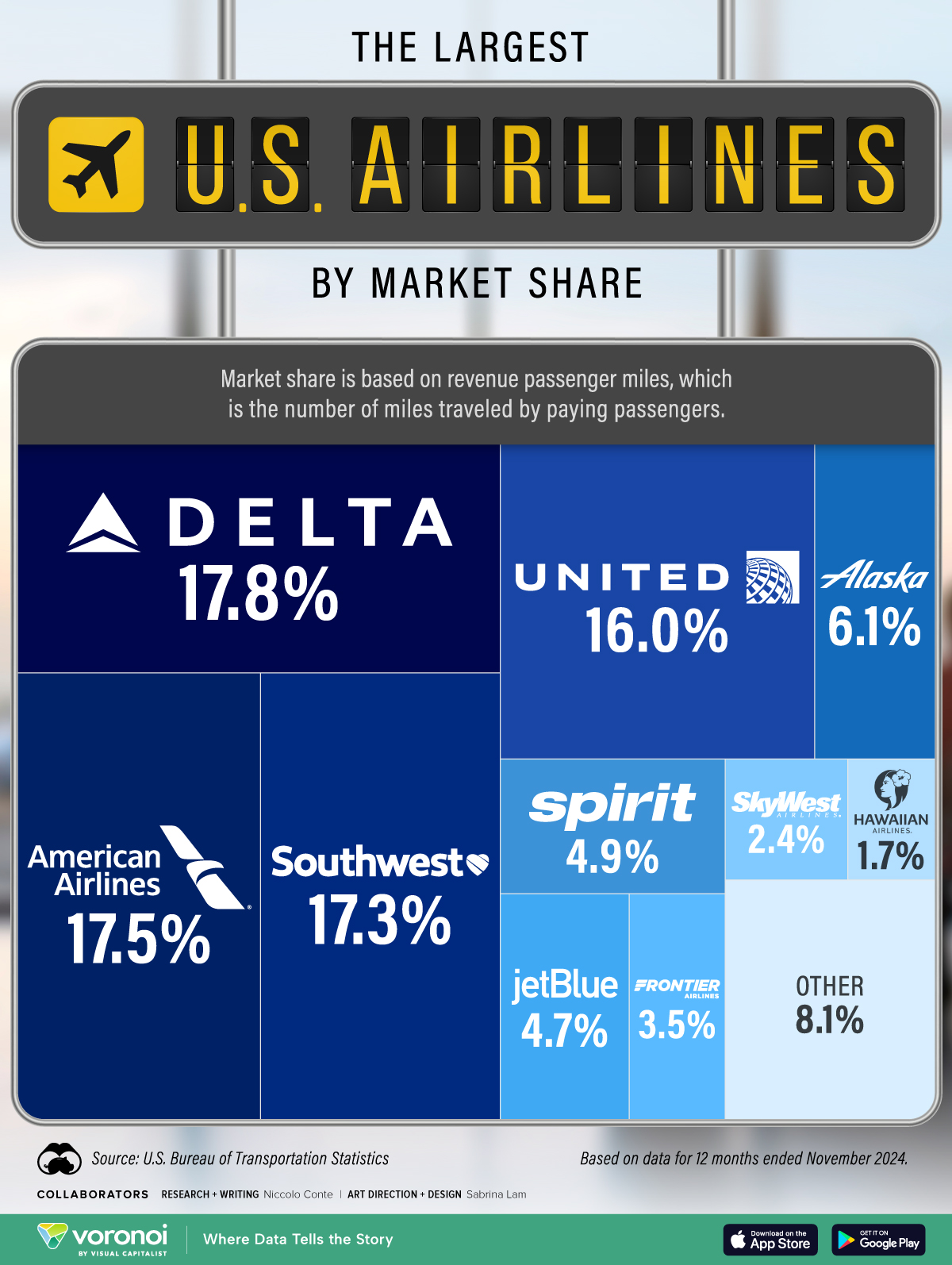
While revenue is the outcome, passenger traffic and capacity metrics illustrate the operational scale that drives that revenue. Revenue Passenger Miles (RPMs) or Revenue Passenger Kilometers (RPKs) measure the total distance flown by paying passengers, representing the actual demand fulfilled. Available Seat Miles (ASMs) or Available Seat Kilometers (ASMs) measure the total capacity an airline offers. By comparing RPMs to ASMs, one can derive the load factor, a critical efficiency metric. An airline with higher RPMs carries more passengers further, translating directly into greater revenue potential and a larger operational footprint. These metrics are vital for understanding an airline’s ability to generate throughput and manage its vast network efficiently, directly impacting its financial performance.
Fleet Size and Asset Value: Capital Intensity and Balance Sheet Strength
The number of aircraft an airline operates, along with the total value of its fleet and other assets, speaks volumes about its capital intensity and balance sheet strength. A larger fleet generally allows an airline to serve more destinations, offer greater frequency, and scale its operations. However, it also entails significant capital expenditure, maintenance costs, and depreciation. For investors, understanding the composition of an airline’s fleet (e.g., narrow-body vs. wide-body, age of aircraft) provides insight into its cost structure, operational flexibility, and future investment needs. The sheer asset value tied up in aircraft, ground equipment, and real estate represents a substantial portion of an airline’s financial leverage and operational capability.
Geographic Reach and Network Value: Strategic Assets for Market Dominance
The breadth and depth of an airline’s route network are strategic assets that contribute significantly to its “largeness.” A vast domestic and international network allows an airline to connect a wide range of origins and destinations, creating valuable market share and providing diverse revenue streams. The number of destinations served, the number of daily departures, and the strategic importance of its hubs all contribute to the network’s financial value. Airlines with extensive networks can command premium pricing on certain routes, benefit from network effects, and offer more comprehensive connectivity, making them more attractive to both leisure and business travelers. This network value is directly correlated with market share and long-term profitability.
The Contenders for US Airline Dominance
In the United States, the competitive landscape is dominated by what are colloquially known as the “Big Four”: American Airlines, Delta Air Lines, United Airlines, and Southwest Airlines. While all are titans in their own right, their strategies, market positioning, and financial characteristics differ, leading to varying claims of “largest” depending on the metric applied. Understanding their individual strengths reveals why each can be considered a leader in specific aspects of the industry.

American Airlines: A Case for Top Position
American Airlines, headquartered in Fort Worth, Texas, frequently lays claim to being the world’s largest airline by fleet size and revenue passenger miles (RPMs), often extending this to the US market. Its sheer operational scale is formidable.
Historically, American Airlines has maintained one of the largest fleets globally, consistently operating over 900 mainline aircraft before recent fleet adjustments and deferrals. This extensive fleet underpins an equally vast route network, serving hundreds of destinations across the United States and around the globe. By passenger count, American Airlines often leads, carrying hundreds of millions of passengers annually across its extensive hub-and-spoke system, which includes major airports like Dallas/Fort Worth (DFW), Charlotte (CLT), Chicago O’Hare (ORD), and Miami (MIA).
Financially, American’s revenue generation has historically been among the highest in the US, reflecting its broad market reach and significant passenger volume. While recent years have seen profitability challenges and debt accumulation, the airline’s fundamental capacity to generate revenue from its extensive network remains a key indicator of its size. Its global alliances, particularly through Oneworld, further extend its reach and allow it to compete effectively on international routes, bolstering its overall financial throughput.
Delta Air Lines: The Revenue and Operational Prowess
Delta Air Lines, based in Atlanta, Georgia, is consistently recognized for its strong financial performance, operational reliability, and premium market positioning. While it might not always lead in raw fleet size, Delta often excels in revenue per passenger and overall profitability, making a strong case for its “largeness” from an investor’s perspective.
Delta’s strategy emphasizes premium service, customer loyalty through its SkyMiles program, and operational excellence. This focus has historically translated into higher average fares and a robust yield per passenger, driving strong revenue figures. The airline has also been innovative in developing non-ticket revenue streams, such as its lucrative credit card partnerships, which significantly contribute to its financial health.
Delta’s primary hub at Hartsfield-Jackson Atlanta International Airport (ATL) is one of the busiest in the world, anchoring a powerful domestic and international network. Its joint ventures and partnerships, particularly with airlines like Air France-KLM and Virgin Atlantic, provide extensive international coverage and feed into its hub system, optimizing passenger flow and revenue generation. For investors, Delta’s consistent focus on managing capacity, maintaining a strong balance sheet (pre-pandemic, it significantly reduced debt), and delivering operational reliability often makes it a preferred choice within the airline sector, signifying its substantial and financially sound presence.
United Airlines: Global Network and Strategic Expansion
United Airlines, headquartered in Chicago, Illinois, stands out for its extensive global network and strategic focus on international markets, particularly across the Pacific and Atlantic. With major hubs in cities like Chicago (ORD), Houston (IAH), Newark (EWR), San Francisco (SFO), and Denver (DEN), United commands a significant share of long-haul international travel.
United’s large wide-body fleet is a testament to its international ambitions, allowing it to serve a vast array of global destinations. Its membership in the Star Alliance, the world’s largest airline alliance, further amplifies its reach, providing seamless connectivity to hundreds of cities worldwide. This robust international footprint is a key driver of its revenue, especially from high-yield business travelers.
Financially, United has been aggressively investing in fleet modernization and strategic expansion, particularly in its premium offerings and technology. This forward-looking investment strategy aims to capture future growth in key international markets and enhance its competitiveness. While it competes fiercely with American and Delta for domestic market share, United’s distinct strength in global connectivity often positions it as a leading choice for travelers seeking international routes, contributing significantly to its overall financial scale and importance in the US airline industry.
Southwest Airlines: The Low-Cost Giant and Domestic Leader
Southwest Airlines, based in Dallas, Texas, holds a unique and powerful position as the largest low-cost carrier in the United States and a formidable contender for the largest overall in terms of domestic passengers carried and operational efficiency. Unlike its “Big Four” counterparts, Southwest primarily operates a point-to-point network within the US and to near-international destinations, rather than relying on a traditional hub-and-spoke model.
Southwest’s business model is characterized by its single-fleet type (Boeing 737s), high aircraft utilization, and a focus on operational simplicity and cost efficiency. This strategy has consistently translated into strong profitability and a loyal customer base attracted by its low fares and distinct customer service. Its operational efficiency and cost control have historically given it a significant advantage, particularly during economic downturns, allowing it to maintain profitability where others struggle.
From a financial perspective, Southwest’s consistent profitability and strong balance sheet have made it a favorite among investors looking for stability in the volatile airline sector. While its revenue figures might be lower than the global network carriers due to its focus, its profit margins and return on invested capital are often industry-leading. Its significant domestic market share, consistently high load factors, and ability to stimulate demand with competitive pricing underscore its immense scale and financial influence within the US aviation landscape.

The Dynamic Nature of Airline Leadership and Investment Implications
The title of “largest airline” is not a static crown but a dynamic reflection of economic conditions, strategic decisions, and the chosen metric of measurement. The dominance of any one carrier can shift based on fuel prices, labor costs, geopolitical events, and global pandemics, all of which directly impact financial performance and operational capacity.
For investors, understanding these nuances is critical. Evaluating an airline’s financial health involves looking beyond top-line revenue to consider profit margins, debt levels, cash flow generation, and management’s ability to adapt to changing market conditions. Diversification across carriers with different strategic focuses (e.g., premium global network vs. efficient domestic low-cost) can also be a consideration. Operational efficiency, reflected in metrics like on-time performance and load factor, directly translates into financial success and investor confidence.
The US airline industry remains a vital component of the nation’s economy, subject to cyclical upturns and downturns. While American Airlines, Delta Air Lines, United Airlines, and Southwest Airlines each present compelling arguments for their respective leadership positions based on varying financial and operational metrics, their collective strength and ongoing evolution underscore the industry’s significant financial footprint and its dynamic competitive environment.