
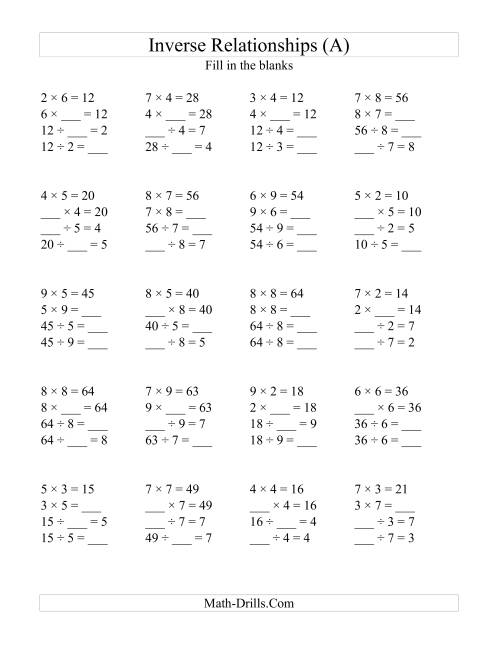
In the realm of mathematics, the inverse operation of division is multiplication. While this may seem like a fundamental concept taught in elementary school, its implications within the technology sector are profound and far-reaching. From the architecture of central processing units (CPUs) to the complex algorithms that power artificial intelligence and digital security, the ability to “undo” a mathematical action is the cornerstone of modern computational logic.
In technology, inverse operations are not just theoretical constructs; they are functional requirements. Whether a developer is writing a simple script or an engineer is designing a cryptographic protocol, understanding how to reverse a process—moving from a quotient back to a dividend—is essential for data integrity, system performance, and algorithmic efficiency.

The Computational Foundation: Multiplication as the Inverse Logic
At the most basic level of hardware engineering, the relationship between division and multiplication defines how machines process information. In binary logic, operations are performed using gates and registers. Interestingly, for a computer, division is significantly more “expensive” in terms of processing power than multiplication.
Implementation in Low-Level Programming
In software optimization, particularly when working with low-level languages like C or Assembly, developers often leverage the inverse relationship of division to increase speed. Since division operations take more clock cycles than multiplication, compilers frequently perform “strength reduction.” This technique involves replacing a division operation with multiplication by a reciprocal. For instance, instead of dividing a variable by two, the system may multiply it by 0.5. This nuanced application of the inverse operation ensures that software runs faster without sacrificing accuracy.
Floating-Point Precision and the “Inverse” Challenge
One of the most significant hurdles in technology is the precision of floating-point numbers. While multiplication is the theoretical inverse of division, in a digital environment, multiplying a quotient by its divisor does not always return the exact original dividend. This is due to rounding errors in binary representations. Tech professionals must implement “epsilon” checks—small tolerance ranges—to account for these discrepancies. Understanding the friction between theoretical inverse operations and practical digital execution is a hallmark of a high-level software architect.
Digital Security: Modular Inverses and Cryptographic Integrity
Moving beyond simple arithmetic, the concept of the inverse operation of division is the literal “key” to modern digital security. In cryptography, particularly in asymmetric encryption like RSA (Rivest–Shamir–Adleman), we rely on modular arithmetic. Here, the “modular multiplicative inverse” is the engine that allows data to be encrypted by one party and decrypted by another.
Public Key Infrastructure (PKI)
The security of our digital world—from online banking to encrypted messaging—relies on the mathematical difficulty of reversing certain operations. In PKI, a public key is used to encrypt data (a process involving complex division and remainders), and only a specific private key, which represents the modular inverse, can decrypt it. Without the mathematical certainty that an inverse operation exists, secure data transmission across the internet would be impossible.
The RSA Algorithm and Mathematical Reversibility
In the RSA algorithm, two large prime numbers are multiplied to create a public modulus. To decrypt a message, one must find the “d” value, which is the multiplicative inverse of the encryption exponent “e” modulo the totient of the product. This is a sophisticated application of the inverse of division. The sheer computational difficulty of finding this inverse without the private “trapdoor” information is what keeps hackers from breaking into secure systems. In this context, the inverse operation is not just a math fact; it is a shield.
Artificial Intelligence: Inverse Operations in Neural Networks
The explosion of AI tools and machine learning models in recent years has brought the concept of inverse operations to the forefront of data science. Training a neural network is essentially an exercise in finding the right “weights” to produce a desired output. This process, known as backpropagation, relies heavily on the principles of calculus and inverse relationships.

Calculating the Gradient and Backpropagation
When an AI model makes a mistake, the system must calculate the error (the loss) and send that information back through the network to adjust the weights. This “backward pass” is the functional inverse of the “forward pass.” If the forward pass involves multiplying inputs by weights and dividing them into layers, backpropagation uses the chain rule to reverse those operations. By understanding the inverse relationship between the layers, the AI learns to minimize error and improve accuracy over time.
The Role of Linear Algebra in AI Models
Modern AI models, such as Large Language Models (LLMs), operate on massive matrices. Division in linear algebra is handled through the “matrix inverse.” Because you cannot “divide” a matrix in the traditional sense, you must multiply it by its inverse to achieve the same result. This allows AI tools to solve systems of equations that contain billions of parameters simultaneously. The efficiency of these inverse matrix operations determines how quickly an AI can respond to a user prompt or generate an image.
Digital Signal Processing and Transformative Operations
In the world of gadgets, media apps, and telecommunications, inverse operations are used to compress and decompress data. Whether you are streaming a 4K video or listening to a podcast, your device is constantly performing “inverse” calculations to turn compressed binary code back into sight and sound.
Fast Fourier Transforms (FFT)
Digital Signal Processing (DSP) uses the Fourier Transform to convert a signal from the time domain (how it sounds over time) to the frequency domain (the pitches involved). To play the sound back, the software must perform the Inverse Fourier Transform. This is a perfect example of technology using mathematical inverses to manipulate data for human consumption. If the inverse operation were not mathematically perfect, our digital media would be plagued by distortion and artifacts.
Data Compression Logic
Consider the JPEG image format or the MP3 audio format. These technologies “divide” data into essential and non-essential components to save space. When you open a file, the software uses inverse algorithms to reconstruct the original data as closely as possible. The sophistication of the “inverse” determines the quality of the software. High-end professional tools use more complex inverse operations to ensure that “lossy” compression remains imperceptible to the human eye or ear.
Software Engineering Best Practices: Leveraging Inverse Logic
For the professional developer, the concept of the inverse operation is a mental model for building robust, reversible, and testable code. It is a fundamental principle of functional programming and systems design.
Undo/Redo Logic and State Management
Every modern application, from Google Docs to Adobe Photoshop, features an “Undo” button. At its core, this is the implementation of inverse operations. If a software action “divides” a set of data into a new state, the undo function must be the inverse operation that restores the previous state. Developers use patterns like the “Command Pattern” to store the inverse of every action performed by the user, ensuring that the system’s state remains fluid and error-tolerant.
Unit Testing and Verification
In software testing, the inverse operation of division is often used to verify the accuracy of an algorithm. A standard test case for a mathematical function involves running the primary operation and then running its inverse to see if the original value is returned. If a function Divide(a, b) returns c, the test must confirm that Multiply(c, b) equals a. This “round-trip” verification is a staple of digital security and software reliability, ensuring that no data is lost in translation.
Conclusion: The Ubiquity of Inverse Logic in Tech
While “multiplication” is the simple answer to what the inverse operation of division is, its application in the technology sector is anything but simple. It is the silent engine behind the encryption that protects our privacy, the algorithms that power our AI tools, and the logic that allows our software to be fast and reliable.
As we move toward a future defined by quantum computing and even more complex AI, the mathematical principle of reversibility will only grow in importance. Understanding the inverse relationship between operations allows tech professionals to build systems that are not only functional but also secure and resilient. In the digital world, every action has a reaction, and for every division of data, there is an inverse multiplication that holds the system together.
aViewFromTheCave is a participant in the Amazon Services LLC Associates Program, an affiliate advertising program designed to provide a means for sites to earn advertising fees by advertising and linking to Amazon.com. Amazon, the Amazon logo, AmazonSupply, and the AmazonSupply logo are trademarks of Amazon.com, Inc. or its affiliates. As an Amazon Associate we earn affiliate commissions from qualifying purchases.