
In the intricate world of technology, where algorithms drive innovation and simulations predict future outcomes, a solid understanding of fundamental mathematical principles is not just beneficial, it’s essential. Among these principles, calculus stands as a cornerstone, providing the tools to describe and analyze change. For those navigating the landscape of software development, data science, electrical engineering, or even advanced game design, encountering integrals is a certainty. One such integral, the integral of the secant function, sec(x), while seemingly esoteric, holds surprising relevance in various technological domains. This article will demystify this integral, exploring its derivation and highlighting its importance within the broader context of computational mathematics and its applications in technology.
The Mathematical Foundation: Deriving the Integral of Secant(x)
Understanding how to calculate the integral of sec(x) requires a brief journey into the techniques of integration. Unlike simpler trigonometric functions, the integral of sec(x) isn’t immediately obvious from basic differentiation rules. This often leads to a moment of contemplation for students and professionals alike, prompting the very question: “What is the integral of sec(x)?” The answer, and the process to arrive at it, showcases elegant mathematical manipulation and offers a glimpse into the power of substitution and logarithmic forms.
Strategic Manipulations for Integration
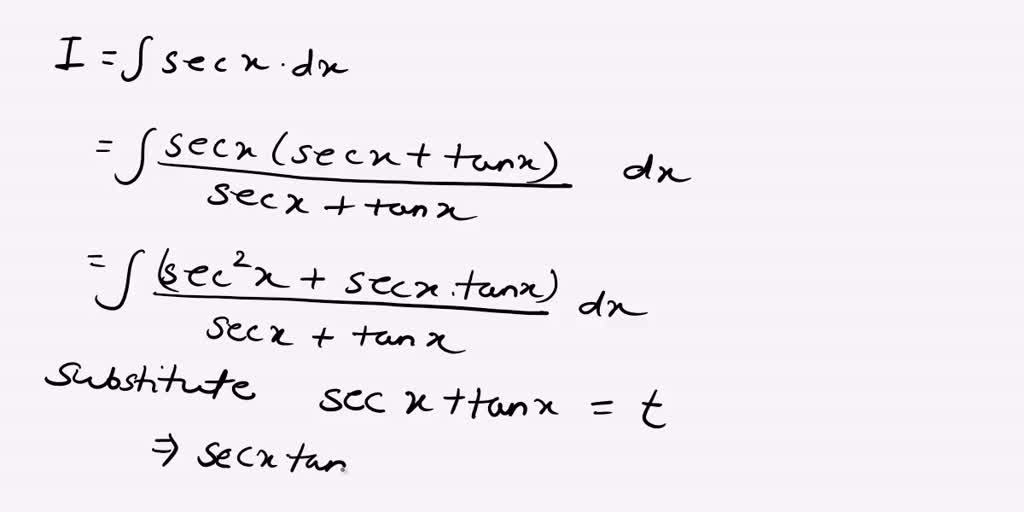
The standard approach to finding the integral of sec(x) involves a clever trick: multiplying the integrand by a seemingly innocuous fraction, $frac{sec(x) + tan(x)}{sec(x) + tan(x)}$. This doesn’t change the value of the integral, as we are essentially multiplying by 1. The integrand then becomes:
$$ int sec(x) , dx = int sec(x) cdot frac{sec(x) + tan(x)}{sec(x) + tan(x)} , dx $$
$$ = int frac{sec^2(x) + sec(x)tan(x)}{sec(x) + tan(x)} , dx $$
This strategic manipulation sets the stage for a successful substitution.
The Power of u-Substitution
The next crucial step is to employ a u-substitution. Let $u = sec(x) + tan(x)$. Now, we need to find the differential $du$. Differentiating $u$ with respect to $x$:
$$ frac{du}{dx} = frac{d}{dx}(sec(x)) + frac{d}{dx}(tan(x)) $$
We know from standard derivative rules that $frac{d}{dx}(sec(x)) = sec(x)tan(x)$ and $frac{d}{dx}(tan(x)) = sec^2(x)$. Therefore:
$$ frac{du}{dx} = sec(x)tan(x) + sec^2(x) $$
Rearranging this, we get $du = (sec(x)tan(x) + sec^2(x)) , dx$.
Notice that the numerator of our manipulated integrand, $sec^2(x) + sec(x)tan(x)$, is exactly $du$. The denominator is our chosen $u$. So, the integral transforms into a much simpler form:
$$ int frac{1}{u} , du $$
Reaching the Logarithmic Form
The integral of $frac{1}{u}$ with respect to $u$ is a fundamental result in calculus: $ln|u| + C$, where $C$ is the constant of integration. Substituting back our original expression for $u$:
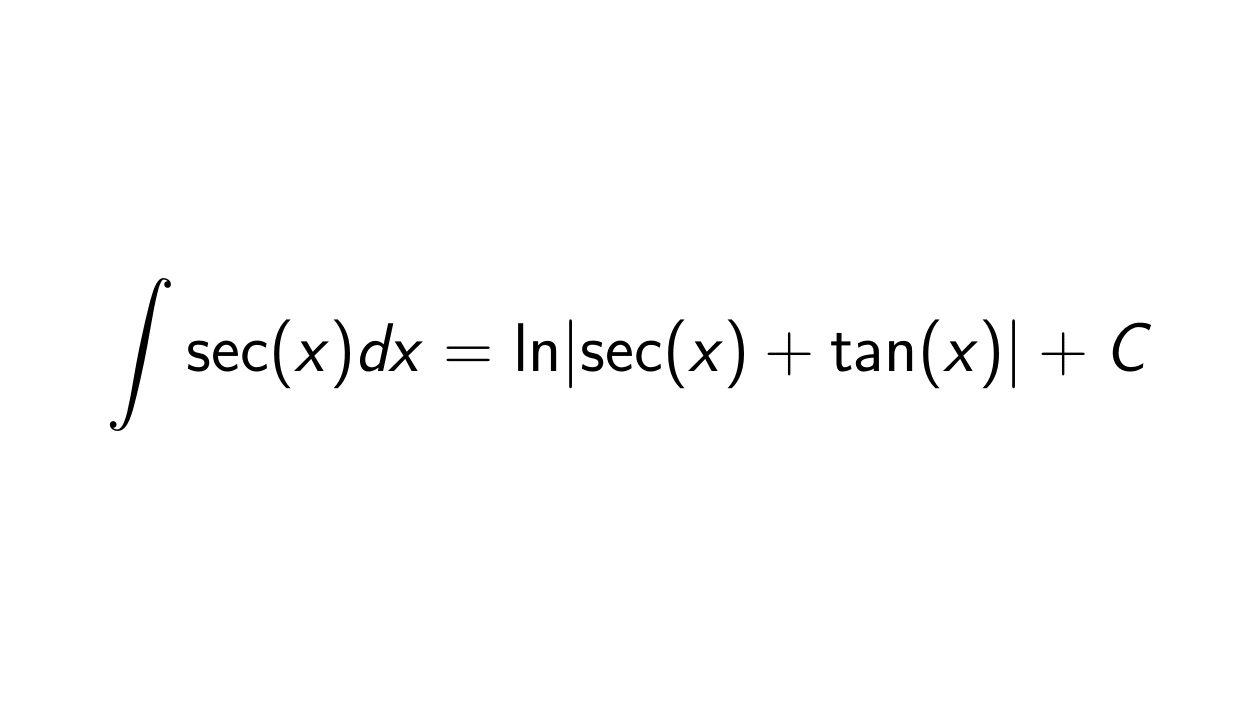
$$ int sec(x) , dx = ln|sec(x) + tan(x)| + C $$
This logarithmic form is the widely recognized integral of secant(x). While this derivation is a staple of calculus education, its true value is amplified when we consider how such mathematical underpinnings fuel technological advancement.
Computational Implementation and Numerical Integration
The analytical solution to the integral of sec(x) is elegant, but in many real-world technological applications, direct analytical solutions are not always feasible or computationally efficient. This is where numerical integration techniques come into play, and understanding the analytical form provides a benchmark and a deeper comprehension of the methods used.
Symbolic Computation Libraries
Modern programming languages and computational environments are equipped with powerful symbolic computation libraries that can directly compute integrals. Libraries like SymPy in Python, or Mathematica and MATLAB’s Symbolic Math Toolbox, can take the expression sec(x) and, through sophisticated algorithms often based on the derivation described above, return the analytical result ln(abs(sec(x) + tan(x))). These tools are invaluable for:
- Automated Derivation: Quickly obtaining integral forms for complex functions during the development of new algorithms or models.
- Verification: Checking the correctness of hand-derived integrals or the output of numerical methods.
- Educational Tools: Providing interactive platforms for learning and practicing calculus concepts.

These symbolic engines are built upon a deep understanding of calculus and algebraic manipulation, effectively automating the process of finding integrals like that of sec(x).
Numerical Integration Techniques
In scenarios where analytical solutions are intractable or when dealing with discrete data, numerical integration methods are employed. Techniques such as the Trapezoidal Rule, Simpson’s Rule, or more advanced adaptive quadrature methods approximate the definite integral of a function over a given interval.
For instance, if we needed to compute $int_{a}^{b} sec(x) , dx$ numerically:
- Discretization: The interval $[a, b]$ is divided into a series of smaller subintervals.
- Approximation: Within each subinterval, the area under the curve of $sec(x)$ is approximated using geometric shapes (trapezoids, parabolas, etc.).
- Summation: The areas of these approximations are summed up to yield an estimate of the total integral.
While numerical methods provide approximations, their accuracy is highly dependent on the number of subintervals used and the complexity of the function. Understanding the analytical form of $int sec(x) , dx$ is crucial for:
- Setting Integration Bounds: Knowing the behavior of $sec(x)$ (e.g., its asymptotes at $frac{pi}{2} + npi$) informs the choice of integration intervals to avoid singularities.
- Error Analysis: The analytical solution serves as a reference point to evaluate the accuracy of numerical approximations.
The interplay between symbolic and numerical integration highlights how foundational calculus, including the integral of sec(x), is seamlessly integrated into the computational tools that drive technological progress.
Applications in Technology and Engineering
The integral of sec(x), and the mathematical principles it represents, finds its way into various corners of the technological landscape. While not always appearing in its simplest form, the underlying concepts of integration and trigonometric analysis are pervasive.
Signal Processing and Fourier Analysis
In signal processing, functions are often decomposed into a sum of simpler sinusoidal components using Fourier series or transforms. The analysis of these components can involve integrals of trigonometric functions. While sec(x) itself might not be a direct input in typical audio or image processing, the methods used to analyze periodic signals rely heavily on integration, and the understanding of the behavior of trigonometric functions, including their integrals and derivatives, is fundamental. For example, analyzing the harmonic content of a signal might involve integrals of products of trigonometric functions, where the techniques for integrating sec(x) can provide foundational insights.
Electrical Engineering and Circuit Analysis
In electrical engineering, AC (alternating current) circuits are described using sinusoidal functions. Calculating quantities like the RMS (Root Mean Square) voltage or current, or analyzing the behavior of circuits with reactive components (capacitors and inductors), often involves integration. While direct integration of sec(x) might be rare, understanding how to integrate trigonometric functions is essential for analyzing impedance, phase shifts, and power consumption in AC systems. The mathematical rigor applied to solving for the integral of sec(x) mirrors the analytical approaches used to solve complex circuit equations.
Physics-Based Simulations and Modeling
Many physical phenomena modeled in technology, such as wave propagation, fluid dynamics, or electromagnetic fields, are described by differential equations that often involve trigonometric functions. Solving these equations, whether analytically or numerically, requires integration techniques. For instance, in analyzing the behavior of oscillating systems or wave patterns, the integration of sec(x) or similar trigonometric functions might arise in intermediate steps of complex derivations or in specialized boundary condition analyses.
Geometric Modeling and Computer Graphics
In computer graphics and geometric modeling, calculations involving curves, surfaces, and transformations can lead to the need for integration. While direct integration of sec(x) might not be common in everyday rendering, advanced algorithms for calculating surface areas, volumes, or the properties of complex shapes can involve integrals of trigonometric functions. The principles of calculating areas under curves, as exemplified by the integral of sec(x), are foundational to these computations.
Beyond the Formula: The Algorithmic Mindset
The question “what is the integral of sec(x)?” is more than just a query about a specific mathematical result. It’s a gateway to understanding the analytical rigor, problem-solving strategies, and computational thinking that underpin much of modern technology. The ability to break down complex problems, apply systematic techniques (like substitution), and arrive at a concise, usable solution is a skill set directly transferable to programming, algorithm design, and data analysis.
The Art of Decomposition
The derivation of the integral of sec(x) exemplifies the power of problem decomposition. By recognizing that $sec(x)$ could be manipulated into a form suitable for substitution, mathematicians were able to transform a challenging problem into a straightforward one. This mindset of dissecting complex issues into manageable parts is a hallmark of effective software engineering and technological problem-solving. Whether debugging a complex piece of code or designing a new machine learning architecture, the ability to isolate and solve smaller components is critical.
The Efficiency of Abstraction
The final form of the integral, $ln|sec(x) + tan(x)| + C$, is an abstraction. It represents a general solution that applies to any interval where the function is defined. In technology, abstraction is key. We create functions, classes, and APIs that encapsulate complex operations, allowing developers to use them without needing to understand their intricate internal workings. The integral of sec(x) serves as an abstract mathematical tool, just as a well-designed software module serves as an abstract computational tool.
The Constant Pursuit of Solutions
The existence of a constant of integration, $C$, in indefinite integrals also carries a subtle but important message for technologists. It signifies that there isn’t a single, unique answer for an indefinite integral, but rather a family of solutions. This resonates with the iterative nature of technological development, where solutions are often refined, improved, and built upon over time. The initial “solution” might be a good approximation or a functional prototype, but it often evolves to incorporate more data, better algorithms, and increased efficiency.
In conclusion, while the specific integral of sec(x) might seem like a niche mathematical curiosity, its derivation and its conceptual implications are deeply intertwined with the fabric of technology. It’s a reminder that the sophisticated tools and systems we use daily are built upon a bedrock of fundamental mathematical principles, mastered through logic, innovation, and the persistent pursuit of elegant solutions. Understanding such foundational concepts equips individuals with the analytical prowess needed to not just use technology, but to shape its future.
aViewFromTheCave is a participant in the Amazon Services LLC Associates Program, an affiliate advertising program designed to provide a means for sites to earn advertising fees by advertising and linking to Amazon.com. Amazon, the Amazon logo, AmazonSupply, and the AmazonSupply logo are trademarks of Amazon.com, Inc. or its affiliates. As an Amazon Associate we earn affiliate commissions from qualifying purchases.