
The inductive effect represents a fundamental concept in organic chemistry that dictates how molecules behave, react, and maintain stability. While the term might sound abstract, it is the primary engine behind the acidity of carboxylic acids, the reactivity of alkyl halides, and the stability of carbocations. To understand the inductive effect, one must visualize the molecular bond not as a static connection, but as a dynamic, polarized landscape where electrons are constantly being pulled toward more electronegative centers.
At its core, the inductive effect is the permanent displacement of shared electron pairs along a chain of atoms due to the difference in electronegativity. Unlike resonance, which involves the delocalization of pi electrons, the inductive effect operates strictly through sigma bonds. It is a distance-dependent phenomenon, meaning its influence wanes rapidly as you move further away from the source of the electron displacement. By mastering this concept, one gains a predictive lens through which to view chemical synthesis, stability, and reactivity.

The Mechanism of Electron Displacement
The inductive effect is driven by electronegativity, the inherent ability of an atom to attract a shared pair of electrons in a covalent bond. When a highly electronegative atom, such as fluorine or oxygen, is covalently bonded to a carbon atom, it creates a dipole moment. The electrons within that sigma bond are drawn closer to the electronegative atom, leaving the carbon atom slightly electron-deficient.
The Polarization of Sigma Bonds
This electron deficiency at the primary carbon atom does not remain isolated. Because that carbon atom is now slightly positive, it begins to pull electron density from the adjacent carbon atom to which it is bonded. This creates a chain reaction of polarization. While the effect is strongest at the immediate site of substitution, it ripples down the carbon chain. However, because each subsequent bond transfer is less efficient than the last, the inductive effect is generally considered negligible beyond three or four carbon atoms.
The Dual Nature: +I and -I Effects
To categorize these interactions, chemists divide the inductive effect into two distinct types: the electron-withdrawing inductive effect (-I) and the electron-donating inductive effect (+I).
The -I effect is exhibited by groups that are more electronegative than hydrogen. Common examples include halogens like fluorine, chlorine, and bromine, as well as functional groups like nitro (-NO2) or cyano (-CN) groups. These groups pull electron density away from the carbon skeleton.
Conversely, the +I effect is exhibited by groups that are less electronegative than hydrogen, primarily alkyl groups like methyl (-CH3) or ethyl (-C2H5). Alkyl groups are often described as having an electron-releasing character compared to a hydrogen atom. When attached to a carbon chain, they push electron density toward the rest of the molecule.
The Role of Inductive Effect in Molecular Stability
Molecular stability is the ultimate goal of chemical systems. The inductive effect serves as a critical stabilization mechanism for reaction intermediates, particularly carbocations. A carbocation is a species where a carbon atom carries a positive charge and is bonded to only three other atoms. Because this carbon is electron-deficient, it is inherently unstable.
Stabilizing Carbocations through the +I Effect
The stability of a carbocation is directly proportional to the number of alkyl groups attached to the positively charged carbon. A tertiary carbocation, which has three alkyl groups attached, is significantly more stable than a primary carbocation, which has only one. This occurs because the alkyl groups exert a +I effect, donating electron density toward the electron-poor carbocation center. By spreading out the positive charge, these groups reduce the overall energy of the molecule, making it less reactive and more persistent.
The Influence on Acidity and Basicity
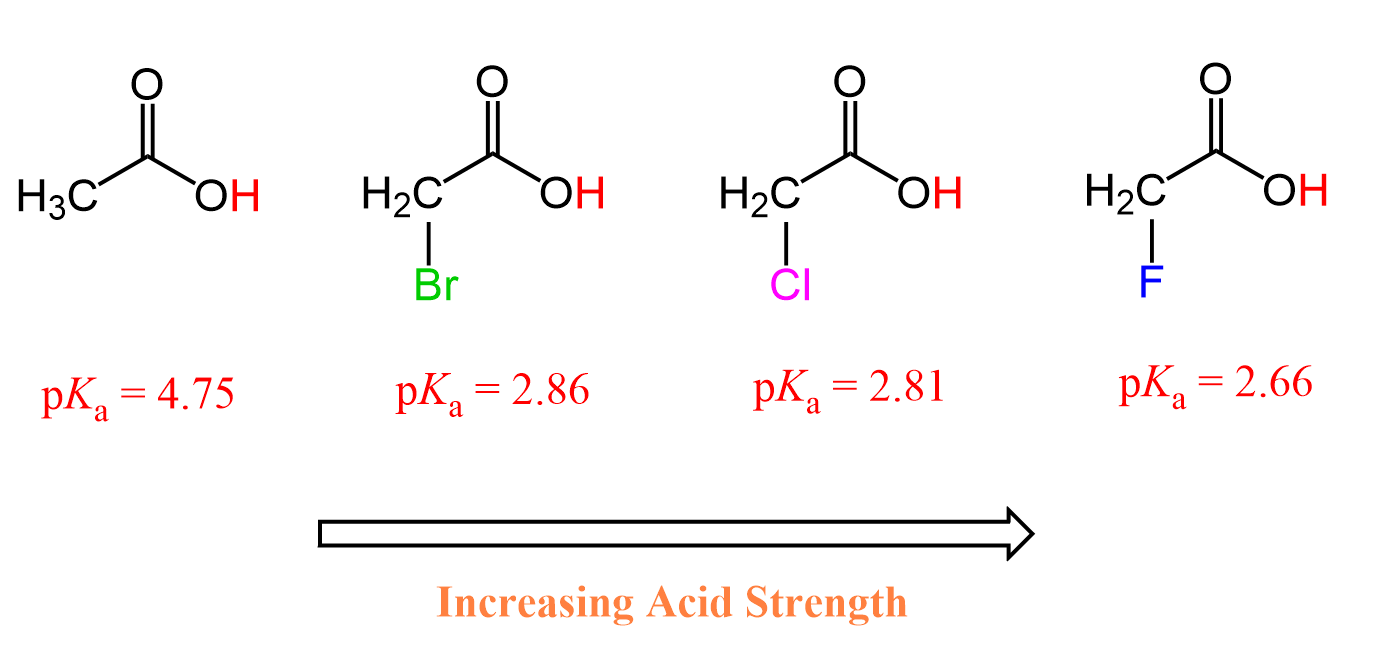
The inductive effect is perhaps most famous for its role in determining the acidity of carboxylic acids. Consider acetic acid versus chloroacetic acid. In acetic acid, the methyl group exerts a +I effect, which pushes electron density toward the carboxylate group, thereby destabilizing the conjugate base (the carboxylate ion).
In contrast, the chlorine atom in chloroacetic acid exerts a powerful -I effect. This electron-withdrawing pull stabilizes the negative charge on the carboxylate ion by dispersing it across the molecular framework. Consequently, chloroacetic acid is a much stronger acid than acetic acid because its conjugate base is more stable. This logic extends to all organic acids and bases; the proximity and electronegativity of substituents can shift pKa values by several units.
Comparing Inductive Effect with Other Electronic Effects
While the inductive effect is essential, it is rarely the only factor at play. To predict the behavior of a molecule accurately, one must weigh the inductive effect against other electronic phenomena like resonance (mesomeric effect), hyperconjugation, and steric hindrance.
Inductive Effect vs. Resonance
The most critical distinction to make is between the inductive effect and resonance. Resonance is the delocalization of electrons through pi-bond systems and lone pairs. It is often much stronger than the inductive effect. However, resonance requires orbital overlap, which is strictly dependent on the geometry of the molecule.
The inductive effect, by contrast, operates regardless of geometry, provided the sigma-bond framework exists. In many aromatic systems, the two effects compete. For instance, in a substituted benzene ring, a halogen group exerts a -I effect (withdrawing electrons from the ring) but also possesses lone pairs that can donate electron density via resonance. Predicting the net outcome of these competing forces is a hallmark of advanced organic synthesis.
The Distance Constraint
A common error is overestimating the reach of the inductive effect. Because it relies on the polarization of sigma bonds, the strength of the effect is inversely proportional to the square of the distance between the substituent and the site of interest. This is why substituents on the alpha-carbon have a profound impact, while those on the delta-carbon are essentially ignored in most practical scenarios.
Practical Applications in Synthesis and Analysis
Understanding the inductive effect allows chemists to design more efficient reactions and predict the outcomes of complex multi-step syntheses. By manipulating the electronic environment of a molecule through substitution, chemists can “tune” the reactivity of specific sites.
Directing Substitutions
In electrophilic aromatic substitution, the inductive effect of substituents already present on the ring dictates where a new incoming group will attach. Groups with a -I effect, like nitro groups, pull density away from the ring, making it less reactive overall and generally directing incoming groups to the meta position. Conversely, electron-donating groups that provide density via +I or resonance increase the reactivity of the ring and direct substitutions to the ortho or para positions.

Predicting Reactivity in Nucleophilic Substitution
In SN1 and SN2 reactions, the inductive effect plays a pivotal role. In SN1 reactions, the formation of the carbocation intermediate is the rate-limiting step. Therefore, any substituent that can stabilize this intermediate via the +I effect will accelerate the reaction. Conversely, in SN2 reactions, which require a backside attack on an electrophilic carbon, the presence of electron-withdrawing groups can increase the electrophilicity of the carbon, potentially speeding up the reaction, provided the transition state is not overly crowded by sterics.
As science progresses into the realm of computational chemistry, the inductive effect remains a cornerstone of our predictive models. From developing pharmaceuticals that bind effectively to biological targets to designing new materials with specific electronic properties, the ability to control and calculate the distribution of charge via the inductive effect is indispensable. It is not merely a theoretical construct; it is the silent hand that guides the behavior of matter at the molecular scale. By internalizing these principles, one moves from simply observing chemistry to mastering the underlying forces that shape it.
aViewFromTheCave is a participant in the Amazon Services LLC Associates Program, an affiliate advertising program designed to provide a means for sites to earn advertising fees by advertising and linking to Amazon.com. Amazon, the Amazon logo, AmazonSupply, and the AmazonSupply logo are trademarks of Amazon.com, Inc. or its affiliates. As an Amazon Associate we earn affiliate commissions from qualifying purchases.