
In the landscape of personal finance and career development, the “six-figure salary” has long been viewed as a definitive milestone of professional success. Earning $100,000 a year represents a level of financial stability that allows for comfortable living, robust saving, and the ability to invest for the future. However, looking at a salary as a lump annual sum can be misleading. To truly master your finances and understand the value of your time, you must break that figure down into its most granular form: the hourly rate.
Understanding your hourly rate is not just a mathematical exercise; it is a fundamental tool for budgeting, evaluating job offers, and determining the opportunity cost of your daily activities. Whether you are a salaried employee, a freelancer, or an aspiring entrepreneur, knowing exactly what an hour of your life is worth at the $100,000 mark is the first step toward sophisticated financial management.
The Mathematical Foundation: Calculating the Standard Hourly Rate
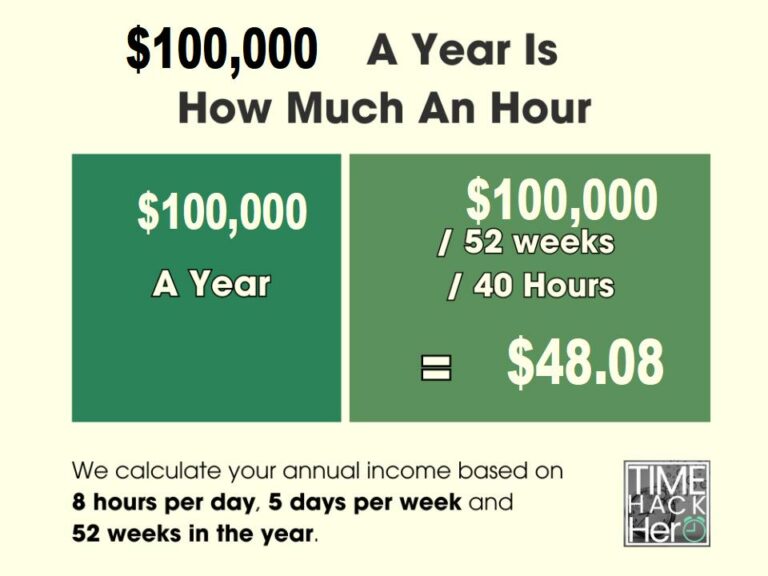
The most direct way to calculate an hourly rate from an annual salary is to use the standard work-year model. In the United States and many other Western economies, a full-time schedule is typically defined as 40 hours per week for 52 weeks a year.
The 2,080-Hour Standard
The total number of work hours in a standard year is 2,080 (40 hours multiplied by 52 weeks). When you divide a $100,000 annual salary by 2,080 hours, the result is $48.08 per hour.
This figure serves as the baseline for most corporate payroll departments. If you are a non-exempt employee earning $100,000, your overtime rate (usually 1.5x) would be calculated based on this $48.08 figure. However, the 2,080-hour calculation assumes you are working every single week without a break. To get a more realistic view of your “active” work time, we must consider variations in the work schedule.
Factoring in Paid Time Off and Holidays
Most professionals earning six figures receive a benefits package that includes paid time off (PTO) and public holidays. If you receive three weeks of vacation and ten paid holidays, you are actually “working” fewer hours for the same pay.
For example, if you take four weeks of total time off (20 days), your actual working hours drop to 1,920 per year. In this scenario, your “working hourly rate” increases to $52.08. While your paycheck remains the same, your time is technically more valuable because you are producing the same annual revenue in fewer hours. Conversely, for those in high-pressure industries like law or investment banking where 60-hour weeks are the norm, the hourly rate plummets. A $100,000 salary for someone working 60 hours a week results in an hourly rate of just $32.05, highlighting the importance of the “time-for-money” trade-off.
Gross vs. Net: The Difference Between What You Earn and What You Take Home
While $48.08 is the mathematical answer to the question, it does not reflect the reality of your bank account. In the world of personal finance, there is a massive chasm between “Gross Income” (the $100k) and “Net Income” (what you actually have available to spend).
The Tax Impact
A $100,000 salary is subject to a variety of taxes including Federal Income Tax, Social Security (FICA), Medicare, and, in most cases, State and Local taxes. Depending on your location, your effective tax rate could range from 20% to 35%.
If we assume a conservative effective tax rate of 25%, your $100,000 salary becomes $75,000 in take-home pay. When you divide this net amount by the standard 2,080 hours, your hourly “spendable” rate drops to $36.05. This is a crucial distinction for budgeting. When deciding if you can afford a luxury purchase or a new monthly subscription, calculating it against your net hourly rate provides a much clearer picture of the labor required to sustain that expense.
Benefit Deductions and Retirement Contributions
Beyond taxes, most $100,000 earners have other deductions that further reduce their hourly take-home pay. These include:
- Health Insurance Premiums: Often ranging from $200 to $600 per month.
- 401(k) or 403(b) Contributions: Financial experts often recommend saving 15% of your gross income.
- HSA or FSA Contributions: Pre-tax dollars set aside for healthcare.
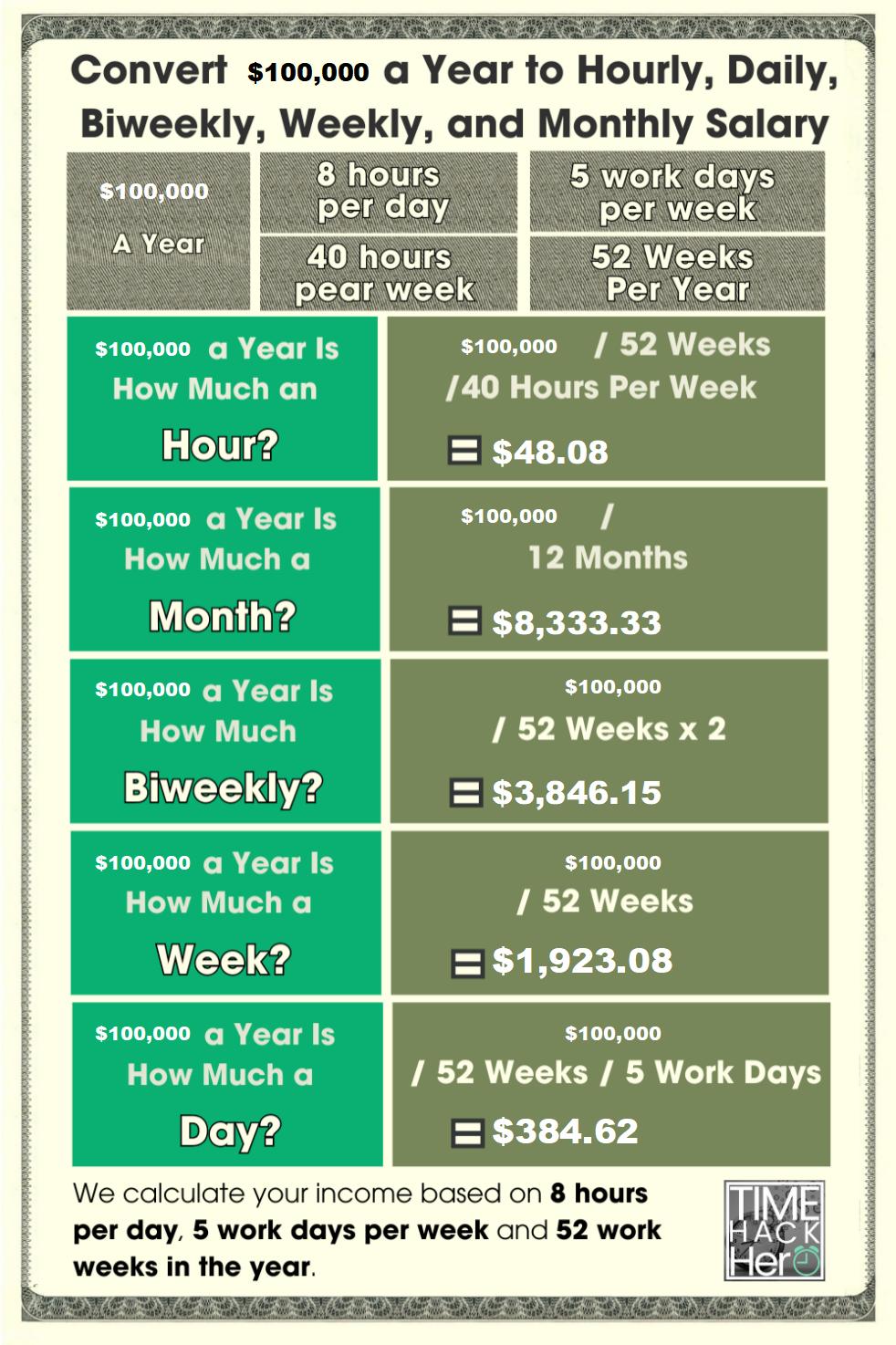
If you are contributing 10% to your 401(k) and paying for a family health plan, your actual take-home pay might be closer to $60,000 a year. This brings your “real-world” hourly rate down to approximately $28.85. Understanding this prevents the “lifestyle creep” that often traps six-figure earners who wonder why they feel “broke” despite their high salary.
Beyond the 40-Hour Week: Comparing Salaried Roles to Freelance Rates
The $48.08 hourly rate assumes you are a traditional employee with benefits. However, for those in the “Money” niche looking to transition into consulting or side hustles, the math changes drastically.
The Cost of Overworking and “Shadow Work”
For many salaried employees, the work doesn’t end when they leave the office. Commuting, responding to emails after hours, and unpaid “shadow work” (preparation for the next day) all eat into your hourly value. If you spend 5 hours a week commuting and 5 hours a week on after-hours tasks, your 40-hour week is actually a 50-hour week. At $100,000 a year, this reduces your hourly rate from $48.08 to $38.46. When evaluating your financial health, it is essential to account for these hidden hours.
The Freelance “Premium”
If you are looking to earn $100,000 as a freelancer or independent contractor, you cannot simply charge $48.08 per hour. A freelancer must cover their own:
- Self-Employment Tax: An additional 7.65% that employers usually pay.
- Insurance: Health, dental, and professional liability.
- Unpaid Time: Marketing, invoicing, and administrative tasks.
- Equipment and Overhead: Software, hardware, and office space.
To net the equivalent of a $100,000 salary, a freelancer typically needs to charge 1.5x to 2x the standard hourly rate. This means an independent consultant should aim for a rate between $75 and $100 per hour to maintain a lifestyle comparable to a $100k-salaried employee.
Financial Strategy: Maximizing a Six-Figure Income
Once you understand that your time is worth approximately $48 per hour (gross), you can begin to make more informed financial decisions. This perspective is the cornerstone of wealth building.
Budgeting Based on Hourly Cash Flow
One of the most effective ways to control spending is to translate costs into hours. If you want to buy a new smartphone that costs $1,200, don’t look at it as a fraction of your annual salary. Instead, look at it through the lens of your net hourly rate. At a net rate of $36 per hour, that phone costs you roughly 33 hours of work.
Is that device worth nearly a full week of your life at the office? This mental shift often curbs impulsive spending and encourages a more disciplined approach to personal finance. It allows you to prioritize high-value experiences over low-value material goods.
Investing for the Long Term
The ultimate goal of understanding your hourly rate is to eventually stop trading your hours for money altogether. This is achieved through investing. If your “labor rate” is $48.08 per hour, your goal should be to build an investment portfolio where your “passive rate” begins to supplement it.
For instance, a well-managed investment portfolio of $500,000 with a 4% withdrawal rate generates $20,000 a year. In hourly terms, that portfolio is “earning” you $9.61 per hour, 24 hours a day, 365 days a year, without you lifting a finger. By viewing your investments as a secondary “employee” working on your behalf, you can strategically allocate your $100,000 salary to buy back your time in the future.
Conclusion: Mastering the Value of Your Time
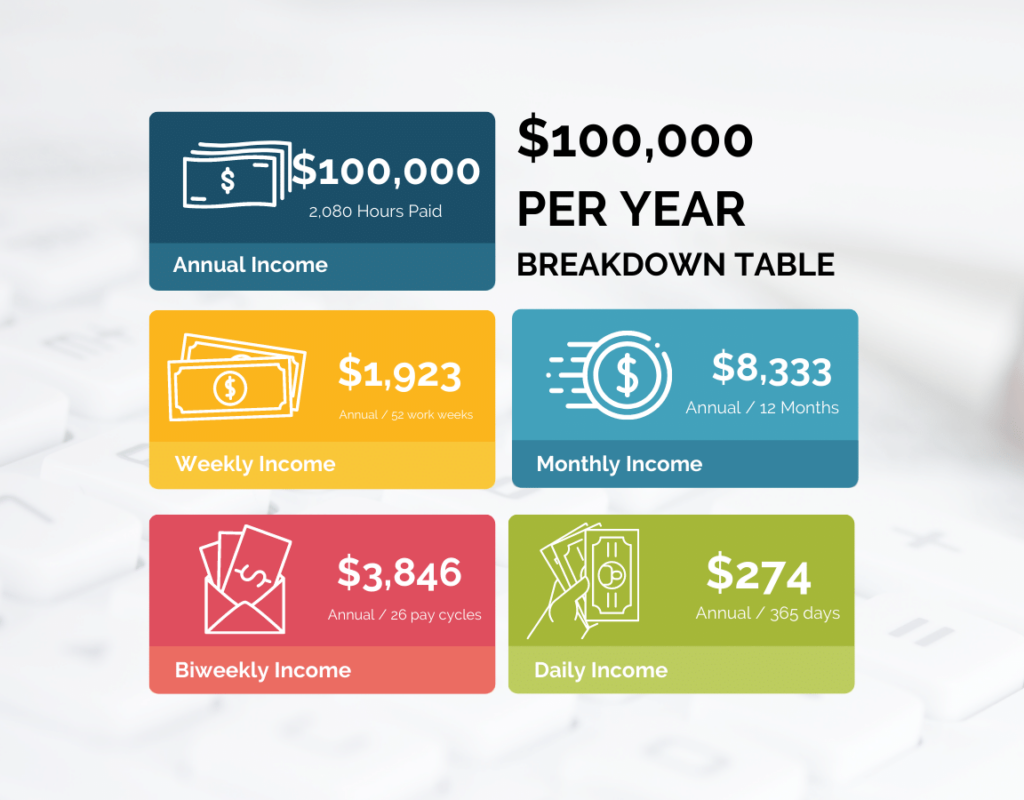
An annual salary of $100,000 is a significant achievement, but it is only a surface-level metric. By breaking it down to an hourly rate of $48.08—and further adjusting for taxes, benefits, and actual hours worked—you gain a much more sophisticated understanding of your financial reality.
In the realm of personal finance, clarity is power. When you know the exact value of an hour of your time, you become a better negotiator, a more disciplined spender, and a more strategic investor. Whether you are aiming to increase your hourly value through skill acquisition or seeking to preserve it through better tax planning, the $100,000 hourly breakdown is the essential map for your financial journey. Remember, the goal isn’t just to earn more; it’s to ensure that every hour you give to your career is working as hard for you as you are for it.
aViewFromTheCave is a participant in the Amazon Services LLC Associates Program, an affiliate advertising program designed to provide a means for sites to earn advertising fees by advertising and linking to Amazon.com. Amazon, the Amazon logo, AmazonSupply, and the AmazonSupply logo are trademarks of Amazon.com, Inc. or its affiliates. As an Amazon Associate we earn affiliate commissions from qualifying purchases.