
In the world of finance, whether you’re managing personal investments, analyzing business performance, or tracking economic trends, the ability to quantify change is paramount. One of the most fundamental and frequently used tools for this is the percentage increase. It provides a standardized way to measure growth, progress, or upward shifts, allowing for meaningful comparisons across different scales and timeframes. Understanding its formula and myriad applications is not just a mathematical exercise; it’s a critical skill for informed financial decision-making.
Understanding the Core Concept: Why Percentages Matter in Finance
At its heart, a percentage increase measures the relative change between an original value and a new, larger value. While an absolute change (the simple difference between two numbers) tells you the raw amount of growth, it often lacks context. For instance, a $100 increase might seem substantial for an investment of $500, but negligible for an investment of $100,000. This is where percentages become indispensable.

Percentages standardize this change, expressing it as a proportion of the original amount. This standardization allows for “apples-to-apples” comparisons, making it easier to evaluate the performance of different assets, gauge the impact of economic shifts, or understand the true growth trajectory of a business, regardless of their starting points. Without the ability to calculate and interpret percentage increases, navigating the complexities of personal finance, investing, and business strategy would be a far more challenging and less precise endeavor.
Deconstructing the Percentage Increase Formula
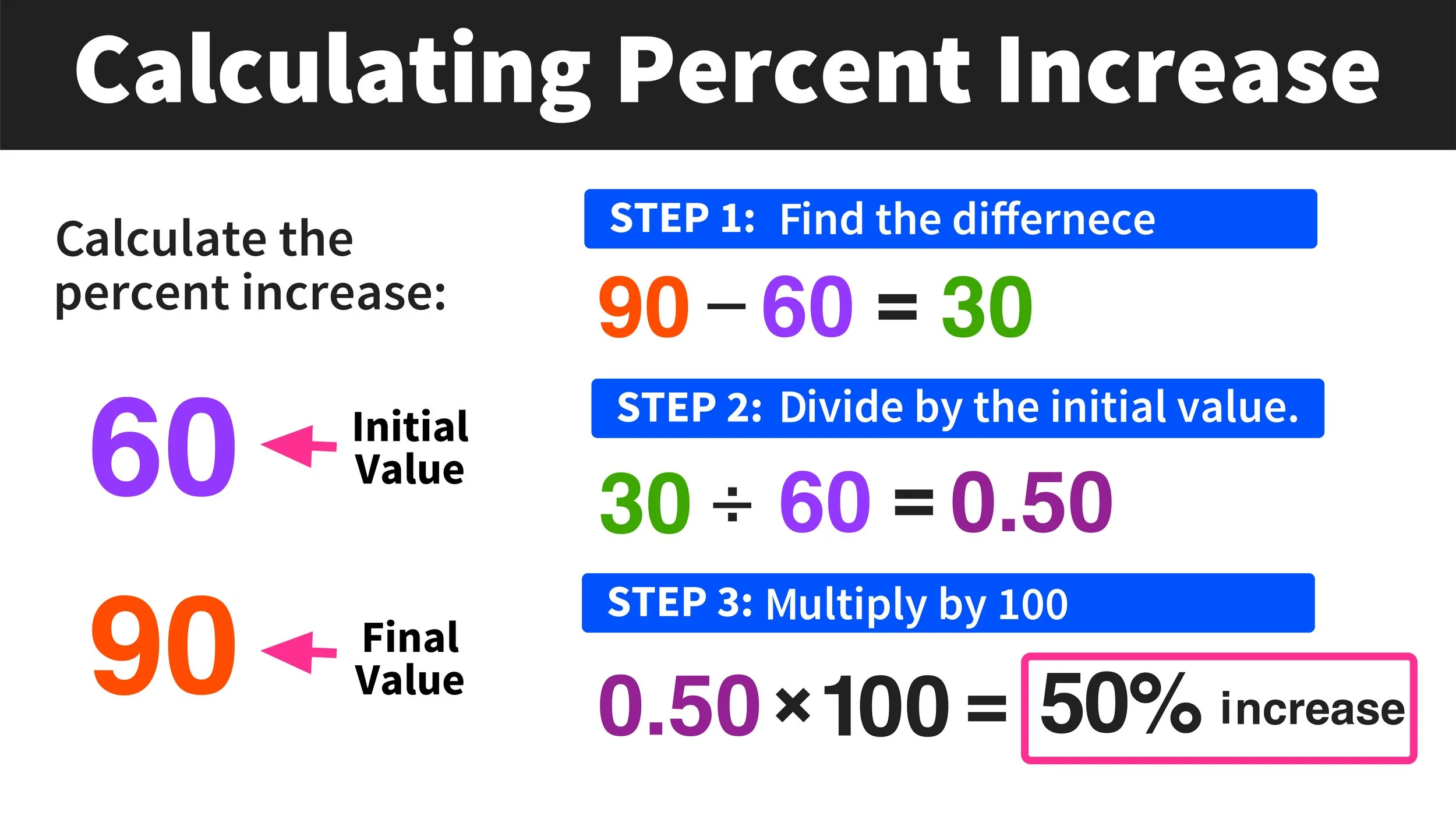
The formula for percentage increase is straightforward, yet incredibly powerful. It quantifies how much a value has grown in relation to its initial state.
The Basic Formula
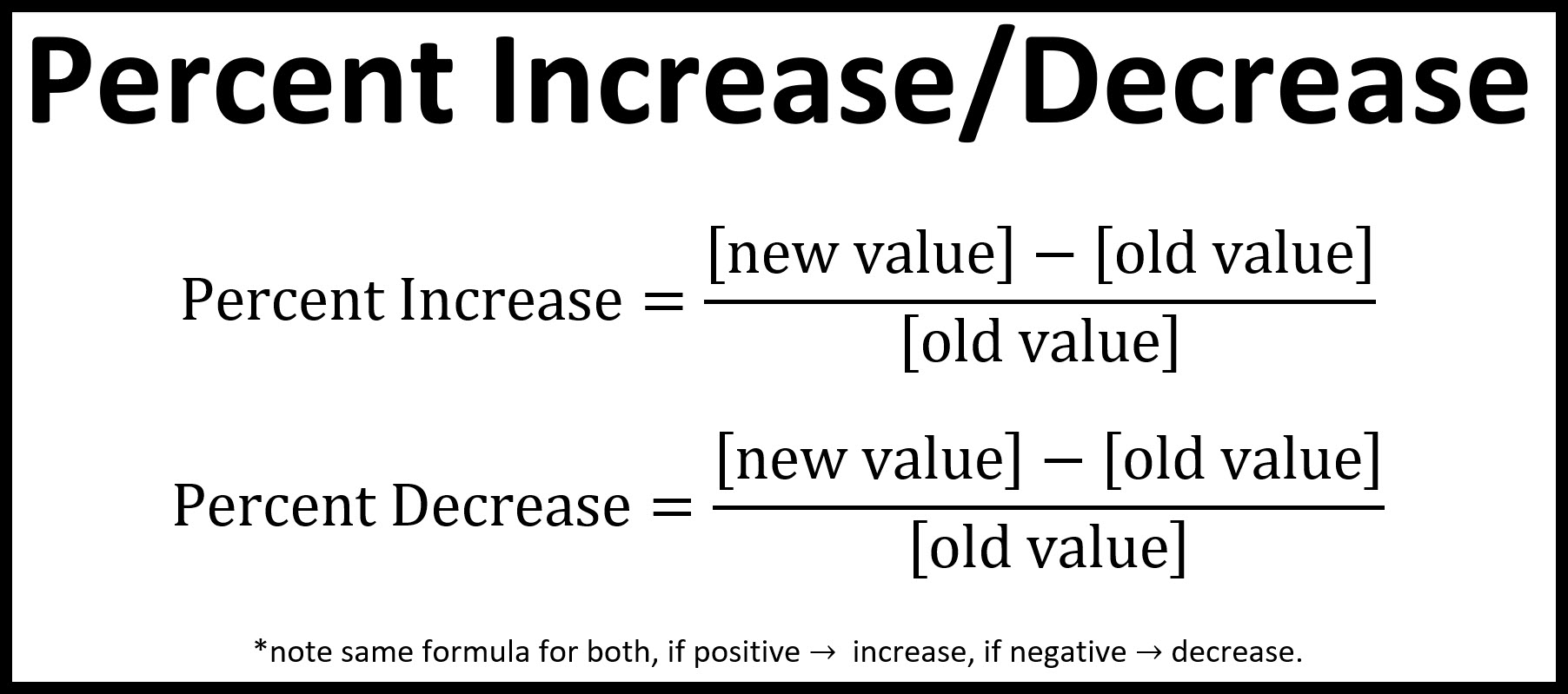
The universal formula for calculating percentage increase is:
Percentage Increase = ((New Value - Original Value) / Original Value) * 100
Let’s break down each component:
-
Original Value: This is the starting point, the initial amount, or the baseline from which you are measuring growth.
-
New Value: This is the ending point, the current amount, or the value after the increase has occurred.
-
New Value – Original Value: This calculation gives you the absolute increase or the raw difference between the two values. It tells you how much the value has grown in absolute terms.
-
(New Value – Original Value) / Original Value: This step calculates the decimal representation of the increase relative to the original value. It expresses the absolute increase as a fraction of the starting amount.
-
* 100: Multiplying the result by 100 converts the decimal fraction into a percentage, making it easier to understand and communicate.
A Step-by-Step Example
Let’s illustrate this with a common financial scenario: tracking an investment.
Imagine you invested $5,000 in a mutual fund, and after one year, its value grew to $5,750. What is the percentage increase in your investment?
-
Identify the Original Value: $5,000
-
Identify the New Value: $5,750
-
Calculate the Absolute Increase:
$5,750 - $5,000 = $750 -
Divide the Absolute Increase by the Original Value:
$750 / $5,000 = 0.15 -
Multiply by 100 to get the Percentage Increase:
0.15 * 100 = 15%
So, your investment experienced a 15% percentage increase over the year.
Practical Applications in Personal Finance and Investing
The percentage increase formula is a cornerstone of sound personal finance and investing strategies. Its applications are diverse and crucial for making informed decisions.
Investment Returns (ROI)
Perhaps the most common use in personal finance is calculating the Return on Investment (ROI). Whether it’s stocks, bonds, real estate, or a diversified portfolio, understanding the percentage gain allows you to:
-
Compare Performance: Easily pit one investment against another, even if their initial capital amounts were vastly different. An investment of $1,000 that grew by 20% is directly comparable in terms of efficiency to an investment of $10,000 that also grew by 20%.
-
Assess Growth Over Time: Track the percentage growth of your entire portfolio over months, quarters, or years to gauge your financial progress toward your goals.
-
Evaluate Fund Managers: If you use financial advisors or mutual funds, their performance is almost always reported as a percentage return, enabling you to assess their efficacy.
Example: You bought a stock for $50 per share. A year later, it’s trading at $65 per share.
Percentage Increase = (($65 – $50) / $50) * 100 = ($15 / $50) * 100 = 0.30 * 100 = 30%. Your stock gained 30%.
Salary Growth and Income Analysis
For individuals, tracking salary increases as a percentage is vital.
-
Negotiating Raises: Knowing the percentage increase of your last raise or comparing it to industry averages provides leverage in salary negotiations.
-
Understanding Purchasing Power: When comparing a salary raise percentage to the inflation rate, you can determine if your real (inflation-adjusted) income has actually increased, decreased, or stayed stagnant. A 3% raise might sound good, but if inflation was 5%, your purchasing power has actually declined by 2%.
Budgeting and Expense Tracking
Analyzing your spending habits over time also benefits from percentage increase calculations.
-
Identifying Cost Creep: Are your grocery bills increasing by 5% year-over-year? Is your utility cost up 10% this quarter? Tracking these percentage changes helps you pinpoint areas where expenses are growing disproportionately and requires attention to maintain your budget.
-
Comparing Spending Categories: You can see which categories of your budget are growing fastest, allowing you to prioritize cost-cutting efforts.
Business Finance and Economic Indicators
Beyond personal finance, the percentage increase is a fundamental metric for businesses and economists to gauge performance, health, and growth.
Revenue and Profit Growth
For businesses, percentage growth is a key indicator of success and operational efficiency.
-
Sales Growth: Companies constantly report their revenue growth as a percentage, year-over-year (YoY) or quarter-over-quarter (QoQ). This helps investors and stakeholders understand market penetration and overall demand for their products or services.
-
Profit Margin Expansion: Comparing the percentage increase in net profit to the percentage increase in revenue can indicate improvements in operational efficiency or pricing power.
-
Shareholder Value: For publicly traded companies, a consistent percentage increase in earnings per share (EPS) is often directly correlated with a rising stock price, benefiting shareholders.
Example: A company reported $1 million in revenue last year and $1.2 million this year.
Percentage Increase = (($1,200,000 – $1,000,000) / $1,000,000) * 100 = ($200,000 / $1,000,000) * 100 = 0.20 * 100 = 20%. The company’s revenue grew by 20%.
Market Share Expansion
Businesses often measure their competitive position by calculating the percentage increase in their market share. If a company increases its share of the total market from 10% to 12%, that’s a significant 20% increase in their market presence, indicating successful competitive strategies.
Inflation and Economic Growth
On a macroeconomic level, percentage increases are vital for understanding the broader economic landscape.
-
Inflation Rate: The Consumer Price Index (CPI), which measures inflation, is expressed as a percentage increase. A 3% inflation rate means the cost of a basket of goods and services has increased by 3% over a period, directly impacting purchasing power.
-
Gross Domestic Product (GDP) Growth: GDP growth rate, reported as a percentage, indicates the health and expansion of a country’s economy. A positive percentage signifies economic growth, while a negative one points to contraction or recession.
-
Interest Rates: While changes in interest rates are often quoted in “basis points” or “percentage points,” the impact on loan repayments or investment returns can still be understood in terms of the percentage increase of the overall principal or return.
Common Pitfalls and Nuances When Using Percentage Increase
While powerful, percentage increase can be misleading if not interpreted with care. Understanding these nuances is crucial for accurate financial analysis.
The Base Value Matters Significantly
A small absolute change can result in a dramatically high percentage increase if the original base value is very small. For example, if a stock price goes from $0.01 to $0.02, that’s a 100% increase. While technically correct, this needs context. It might represent a minuscule absolute gain ($0.01) and could be less significant than a $10 increase on a $100 stock (10% increase). Always consider the absolute change alongside the percentage for a complete picture.
Avoiding Confusion with Percentage Point Change
This is a common source of error. An increase “of X percent” is different from an increase “by X percentage points.”
-
Percentage Increase: An interest rate that goes from 5% to 6% has increased by 20% (calculated as ((6-5)/5)*100).
-
Percentage Point Increase: The same interest rate has increased by 1 percentage point.
Financial professionals typically use “percentage points” when discussing changes in rates (like interest rates or tax rates) to avoid ambiguity. Always clarify whether you’re discussing a percentage increase of a value or an increase in percentage points.
Limitations of Single-Period Percentages
A single percentage increase over one period might not tell the whole story, especially for investments. Compounding effects over multiple periods are critical. An investment with a 10% increase per year will yield more than 10% over two years because the second year’s 10% is applied to a larger principal. For longer-term investments, annualizing returns provides a more accurate picture of sustained growth.
The Danger of “Percentage of a Percentage”
Be cautious when applying percentages to values that are already percentages. For example, if a market share increases from 20% to 22%, it’s incorrect to say it increased by 2%. It actually increased by 2 percentage points or by 10% relative to its original share (calculated as ((22-20)/20)*100). Misinterpreting these can lead to flawed analysis and poor financial decisions.
Mastering the formula for percentage increase and understanding its applications and pitfalls is an indispensable skill for anyone navigating the financial landscape. From personal savings goals to corporate growth strategies, this simple calculation unlocks a deeper understanding of financial dynamics, empowering more confident and informed choices.
aViewFromTheCave is a participant in the Amazon Services LLC Associates Program, an affiliate advertising program designed to provide a means for sites to earn advertising fees by advertising and linking to Amazon.com. Amazon, the Amazon logo, AmazonSupply, and the AmazonSupply logo are trademarks of Amazon.com, Inc. or its affiliates. As an Amazon Associate we earn affiliate commissions from qualifying purchases.