
In the classical sense, force is defined as any interaction that, when unopposed, will change the motion of an object. To a physicist, it is a vector quantity represented by the equation F=ma—force equals mass times acceleration. However, in the context of the modern technological landscape, “the force” in physics is far more than a textbook definition; it is the fundamental underlying architecture of every gadget, software algorithm, and digital network we interact with today.
From the electromagnetic pulses that carry data across fiber-optic cables to the quantum mechanical forces that allow transistors to switch on and off, understanding the “force” in physics is essential to understanding the trajectory of 21st-century innovation. We are no longer merely observing these forces; we are engineering them at a molecular level to build the next generation of artificial intelligence, high-performance hardware, and global connectivity.

The Electromagnetic Force: The Foundation of Digital Computing
Of the four fundamental forces of nature—gravity, electromagnetism, the strong nuclear force, and the weak nuclear force—electromagnetism is the primary “force” that powers the tech industry. It is the interaction responsible for the behavior of electrically charged particles. Without our ability to manipulate this force, the digital revolution would never have occurred.
The Transistor and Electron Manipulation
At the heart of every CPU and GPU is the transistor. This tiny component acts as a gatekeeper for the electromagnetic force. By applying a specific voltage, engineers can encourage or repel the flow of electrons, creating the binary language of 1s and 0s. The “force” here is used to overcome the resistance of materials, allowing for the logic gates that perform the complex calculations required for modern software. As we shrink these transistors down to the 3-nanometer scale, our mastery over the electromagnetic force determines the efficiency and speed of our most powerful AI chips.
Data Transmission and Photonics
Beyond the processor, electromagnetism governs how we move information. Fiber optics utilize the electromagnetic force in the form of light waves. By modulating the frequency and amplitude of light, we can transmit terabytes of data across oceans in milliseconds. The physics of photons—massless particles that carry the electromagnetic force—is the reason we have high-speed internet and real-time cloud synchronization. In this niche, “the force” is about precision timing and the reduction of signal decay.
Wireless Connectivity and Radio Frequency
Every smartphone relies on the electromagnetic spectrum to communicate with cell towers and routers. This involves managing the force of oscillating electric and magnetic fields. Tech companies invest billions in spectrum auctions because they are essentially buying the rights to utilize specific frequencies of this physical force. From 5G to Wi-Fi 6E, the evolution of wireless tech is a story of squeezing more data into the electromagnetic waves that surround us.
Quantum Forces: Powering the Next Frontier of Processing
As hardware developers reach the physical limits of silicon, the tech industry is turning toward quantum physics to find a new kind of “force.” Classical physics begins to break down at the subatomic level, giving way to quantum mechanics, where forces behave in counterintuitive ways.
Quantum Tunneling and Its Challenges
In traditional semiconductor manufacturing, a major hurdle is quantum tunneling. This is a phenomenon where a particle “tunnels” through a barrier that it shouldn’t be able to cross according to classical physics. For chip designers at Intel or TSMC, this force was once a nuisance—a source of current leakage that caused overheating. Today, understanding this force is critical to building the next generation of flash memory and specialized sensors that can detect minute changes in physical environments.
The Force of Entanglement and Superposition
Quantum computing relies on the forces that govern entanglement and superposition. Unlike a classical bit, a qubit can exist in multiple states simultaneously until it is measured. The “force” in this context is the delicate interaction between these qubits. Tech giants like Google, IBM, and Microsoft are currently in a race to stabilize these forces. If successful, quantum computers will be able to solve optimization problems and cryptographic challenges that would take a classical supercomputer thousands of years to crack.
Spintronics: The Future of Storage
Standard hard drives and SSDs use charge-based storage, but a new field called spintronics looks at the “spin” force of electrons. By utilizing the intrinsic angular momentum of particles, tech researchers are developing memory devices that are faster, use less power, and are non-volatile. This represents a pivot from using the movement of electrons as a force to using their inherent physical properties as a medium for data.
Simulating Physical Forces: The Role of AI and Physics Engines
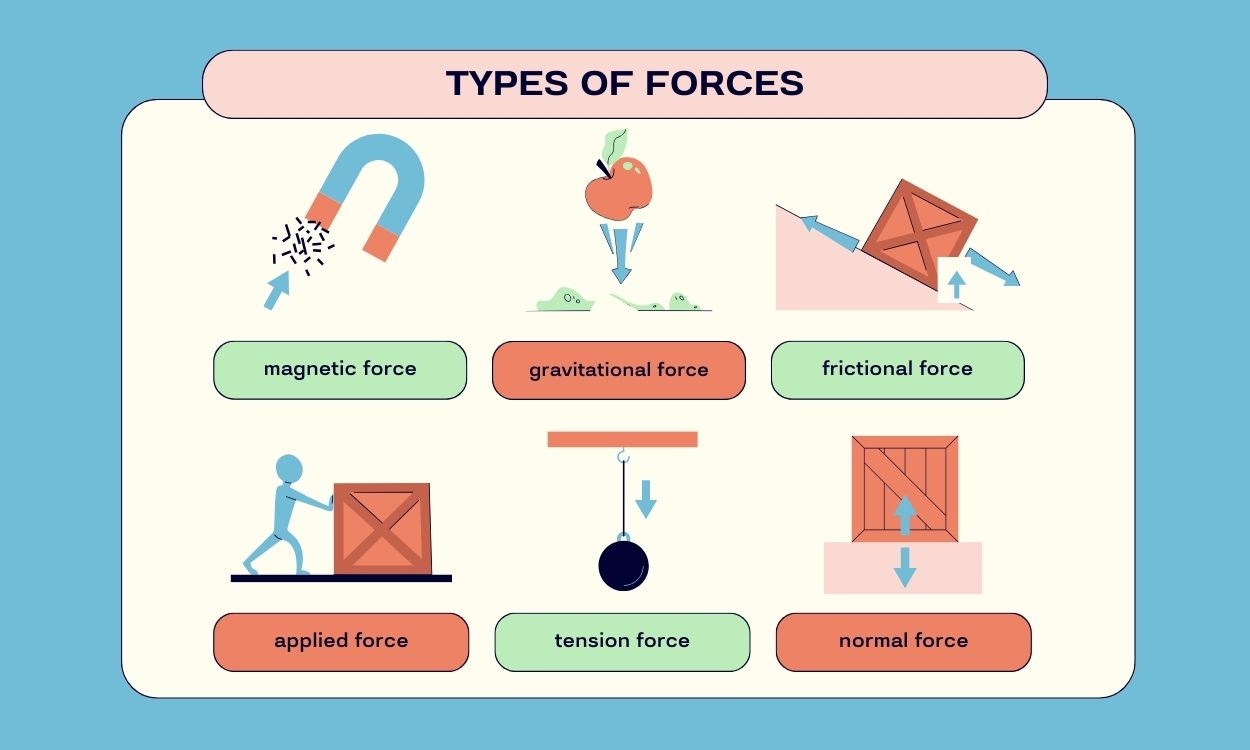
In the realm of software, the “force” in physics is represented through mathematical models. We are no longer just using physics to build hardware; we are using software to simulate the physical world with startling accuracy.
Physics Engines in Software Development
Every modern video game and industrial simulation relies on a physics engine (such as PhysX or Havok). These software components calculate the forces of gravity, friction, and fluid dynamics in real-time. For a software developer, the “force” is an algorithm. If a virtual car hits a wall in a high-fidelity simulation, the engine calculates the force of impact, the crumple zones of the digital metal, and the resulting debris. This tech isn’t just for entertainment; it is used in “Digital Twins” to simulate how a new jet engine or bridge will react to physical stress before it is even built.
AI and Neural Physics
Artificial Intelligence is currently being used to “learn” the laws of physics. Neural physics is a branch of AI research where models are trained on how physical objects interact. Instead of manually coding the force of gravity, developers feed an AI thousands of hours of video data, allowing the model to predict how forces will move objects in the future. This is a crucial component of autonomous vehicle technology. A self-driving car must understand the force of momentum and the friction coefficient of a wet road to make safe, split-second decisions.
Ray Tracing and the Force of Light
In computer graphics, ray tracing is the process of simulating the physical behavior of light. By calculating how photons bounce off surfaces, refract through water, and create shadows, tech companies like NVIDIA have revolutionized visual fidelity. This involves massive computational “force” to track millions of light rays simultaneously. The result is a digital environment that is indistinguishable from reality, a cornerstone of the burgeoning Metaverse and high-end cinematic production.
Gravitational and Kinetic Forces in Hardware Engineering
While we often focus on the invisible forces of electrons and code, the physical “force” of gravity and motion remains a significant factor in gadget design and robotics.
Haptics and Kinetic Feedback
Modern smartphones and wearable devices use haptic engines to simulate the “force” of a physical button press or a notification vibration. These engines use electromagnetic actuators to create precise kinetic forces. Companies like Apple have mastered this tech with their Taptic Engine, which uses the physics of inertia to trick the human brain into feeling textures or clicks on a flat glass surface.
Accelerometers and Gyroscopes
Every device that rotates its screen or tracks your steps is utilizing sensors that measure the forces of gravity and acceleration. Micro-Electro-Mechanical Systems (MEMS) are tiny physical structures inside your phone that move in response to physical force. When you tilt your phone, the force of gravity shifts a microscopic mass, sending an electrical signal that the software interprets. This is a direct bridge between the physical “force” of the Earth and the digital “logic” of your apps.
Robotics and Actuator Force
In the field of robotics, the primary challenge is managing the force of movement. Whether it is a Boston Dynamics robot performing a backflip or an industrial arm on an assembly line, the physics of torque, tension, and compression are paramount. Engineers must develop software that can modulate the force of a hydraulic or electric actuator to ensure the robot can pick up a delicate egg without crushing it or lift a heavy payload with stability.
The Future: Energy, Fusion, and the Force of Sustainability
As we look toward the future of tech, the ultimate goal is to harness the most powerful “force” in the universe: nuclear fusion. Often described as “putting a star in a bottle,” fusion tech seeks to replicate the strong nuclear force that powers the sun.
Fusion as a Tech Power Source
Current data centers consume massive amounts of energy to power AI models and cloud infrastructure. The tech industry is increasingly looking toward clean, near-limitless energy sources. If we can master the magnetic confinement of plasma—a feat of extreme physical force management—we can provide the sustainable power necessary for the next century of technological growth.

Thermodynamics and Heat Dissipation
Finally, the force of thermodynamics is perhaps the greatest limiting factor in modern tech. Every time an electron moves through a wire, it generates heat. This thermal force can destroy hardware if not managed correctly. The innovation in cooling tech—from liquid cooling systems in gaming PCs to massive underwater data centers—is all about fighting the force of heat to maintain the integrity of our digital systems.
In conclusion, “the force” in physics is not just a scientific curiosity; it is the raw material of the tech industry. By mastering electromagnetism, navigating the complexities of quantum mechanics, and simulating physical laws in code, we have built a world that operates at the speed of thought. As our understanding of these forces deepens, so too will the capabilities of the technology we create.
aViewFromTheCave is a participant in the Amazon Services LLC Associates Program, an affiliate advertising program designed to provide a means for sites to earn advertising fees by advertising and linking to Amazon.com. Amazon, the Amazon logo, AmazonSupply, and the AmazonSupply logo are trademarks of Amazon.com, Inc. or its affiliates. As an Amazon Associate we earn affiliate commissions from qualifying purchases.