
In the rapidly evolving landscape of scientific research and educational technology, understanding atomic structure remains a foundational pillar for students and professionals alike. As we integrate sophisticated AI tools and digital platforms into our STEM learning workflows, mastering the fundamental properties of elements—like bromine—becomes an essential task. By leveraging modern educational software and digital periodic tables, we can move beyond rote memorization to a conceptual mastery of quantum mechanics and orbital theory.
Understanding the Quantum Foundation of Bromine
To determine the electron configuration of bromine, one must first look at its position on the periodic table. Bromine, denoted by the symbol Br, holds the atomic number 35. In the realm of chemistry, the atomic number indicates the number of protons in the nucleus, which, in a neutral atom, corresponds exactly to the number of electrons orbiting that nucleus.
The Principles of Electron Occupancy
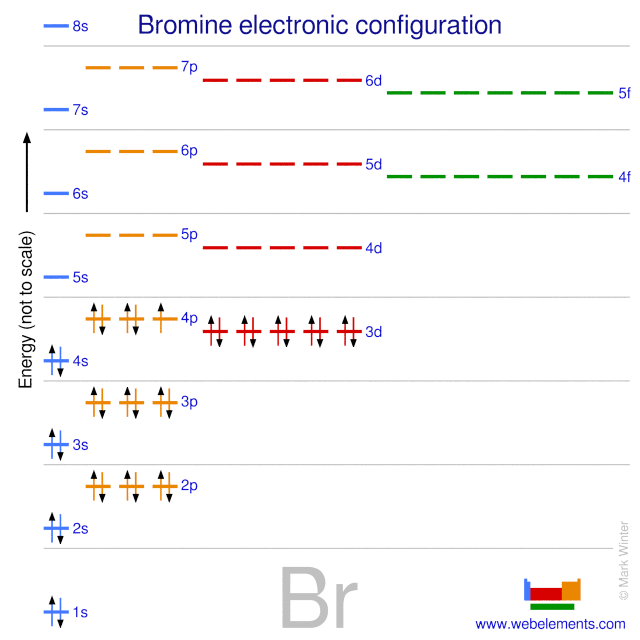
Electrons are arranged in shells, subshells, and orbitals defined by specific quantum mechanical rules. The Aufbau principle dictates that electrons fill the lowest energy orbitals first. Following this, the Pauli Exclusion Principle ensures that no two electrons can occupy the same quantum state simultaneously, and Hund’s Rule clarifies that electrons will fill empty orbitals singly before pairing up.
For an atom with 35 electrons, the distribution follows a precise sequence: 1s, 2s, 2p, 3s, 3p, 4s, 3d, and 4p. Utilizing digital modeling tools allows students to visualize these orbitals as complex 3D shapes, moving from the spherical 1s orbital to the more intricate p and d orbital structures. This visual aid is a significant advancement in educational technology, transforming abstract mathematical probabilities into tangible spatial models.
Determining the Electron Configuration
The process of mapping out bromine’s 35 electrons requires a systematic approach. By breaking down the energy levels, we arrive at the full configuration.
The Full Notation
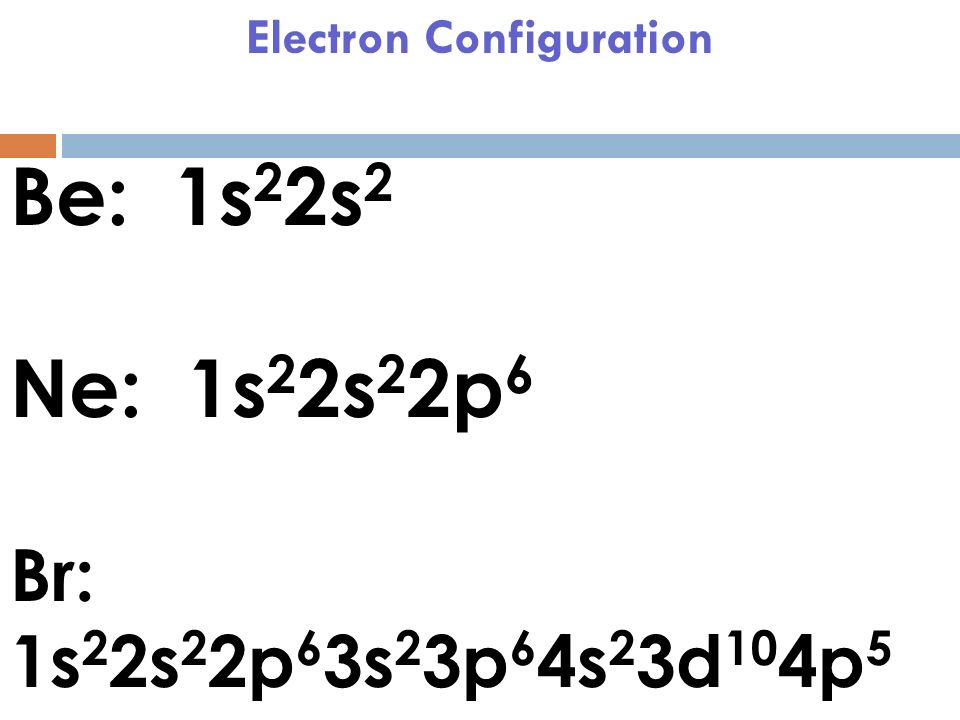
Starting from the first energy level, the distribution of bromine’s 35 electrons is as follows:
1s² 2s² 2p⁶ 3s² 3p⁶ 4s² 3d¹⁰ 4p⁵.
When you sum the superscripts—2+2+6+2+6+2+10+5—you reach exactly 35. Each segment represents a distinct subshell. The 1s, 2s, 3s, and 4s orbitals represent the spherical nodes of energy, while the p and d orbitals provide the directional complexity required for chemical bonding. Advanced educational apps now offer interactive components where users can click through these subshells, seeing the specific electron spin and orientation change in real-time, effectively gamifying the process of learning quantum chemistry.
The Noble Gas Shorthand
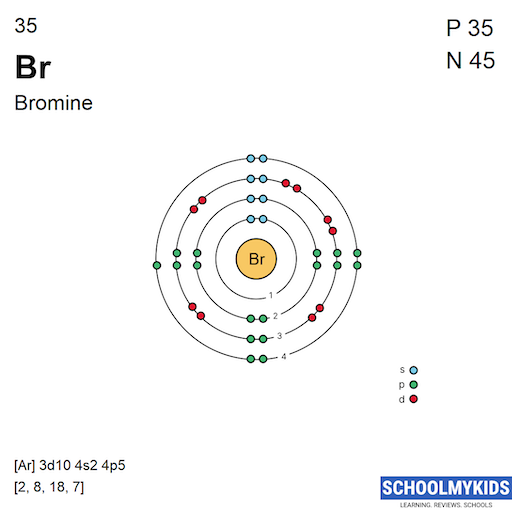
In professional scientific notation, particularly when documenting data in lab software or research papers, shorthand is preferred for clarity. By referencing the previous noble gas in the periodic table—Argon (Ar), which has 18 electrons—we can simplify the expression for bromine.
The shorthand configuration is: [Ar] 4s² 3d¹⁰ 4p⁵.
This notation highlights the valence shell, which is critical for understanding the element’s chemical reactivity. In software engineering and AI-driven data analysis, recognizing these patterns is vital for predictive modeling in molecular simulation tools. By focusing on the [Ar] core and the remaining valence electrons, researchers can quickly assess how bromine will interact with other elements in various technological applications.
Chemical Reactivity and Technological Applications
Bromine is a halogen, situated in Group 17 of the periodic table. Its electron configuration reveals exactly why it behaves the way it does. With seven electrons in its outermost shell (the 4s² and 4p⁵ levels), bromine is just one electron short of a stable octet, a configuration characteristic of the noble gases.
Valence Electrons and Bonding
The presence of those seven valence electrons drives bromine’s high electronegativity. In the context of material science and chemical engineering—fields heavily supported by modern digital simulation tools—this configuration explains bromine’s tendency to gain an electron to form the bromide ion (Br⁻).
Understanding this behavior is not just an academic exercise; it is the basis for industrial processes. Bromine compounds are essential in the production of flame retardants, photographic chemicals, and specific types of batteries. When data scientists use AI to simulate new high-density battery architectures, they rely on the fundamental electron configurations of elements like bromine to predict how ions will move across membranes or interact with electrodes.
Digital Tools in Modern Chemistry
The shift toward digital chemistry platforms has revolutionized how we approach these configurations. Cloud-based software now allows researchers to input elemental data and generate 3D models of molecular interactions in seconds. These tools utilize algorithms based on the very electron configurations discussed here. Whether it is calculating the binding energy of a potential pharmaceutical drug or optimizing the flow of chemicals in a manufacturing plant, the accuracy of these digital tools starts with the foundational knowledge of how electrons fill their orbitals.
As AI continues to be integrated into laboratory workflows, the role of the scientist is shifting from manual calculation to high-level analysis. However, the requirement for a deep understanding of atomic properties remains constant. If an AI tool suggests a particular molecular binding property, a human researcher must be able to verify that suggestion against the known electronic structure of the atoms involved. Bromine, with its complex 3d¹⁰ filling, serves as an excellent case study for why quantum mechanical models must be precise.
The Future of Scientific Learning and Data Integration
As we look toward the future of technology in education, the integration of Augmented Reality (AR) and Virtual Reality (VR) into the study of chemistry is creating an immersive environment for students. Imagine putting on a headset and walking through an atomic lattice, observing the electron density of bromine in real-time. These experiences are powered by the same configuration data that textbooks have contained for decades, yet they provide an entirely new level of engagement.
Data-Driven Scientific Literacy
For professionals in tech-centric fields, the ability to interpret chemical data is a form of scientific literacy that informs better decision-making. Whether one is working in nanotechnology, semiconductor design, or biotechnology, the properties of the materials used are governed by their electron configurations.
Bromine’s role in modern technology is diverse. From its use in advanced water purification systems that rely on automated sensor arrays to its function in lithium-bromine battery research aimed at increasing energy density for electric vehicles, bromine is a key player in the green technology sector. By mastering the electron configuration of bromine, students and professionals alike gain a deeper appreciation for how the invisible dance of subatomic particles powers the macroscopic world of our modern gadgets and sustainable energy solutions.
In conclusion, the electron configuration of bromine—1s² 2s² 2p⁶ 3s² 3p⁶ 4s² 3d¹⁰ 4p⁵—is far more than a string of letters and numbers. It is a fundamental key to understanding the reactive potential of a highly useful element. As digital tools continue to refine our ability to interact with and apply this knowledge, the gap between theoretical chemistry and applied technology will continue to shrink, enabling innovation that starts at the subatomic level and reaches into the future of our digital society.
aViewFromTheCave is a participant in the Amazon Services LLC Associates Program, an affiliate advertising program designed to provide a means for sites to earn advertising fees by advertising and linking to Amazon.com. Amazon, the Amazon logo, AmazonSupply, and the AmazonSupply logo are trademarks of Amazon.com, Inc. or its affiliates. As an Amazon Associate we earn affiliate commissions from qualifying purchases.