
Choosing between the Regular Army and the National Guard is often framed as a lifestyle choice or a commitment to service, but from a strictly financial perspective, it is a decision between two distinct economic models. One represents a full-time, salaried career with a comprehensive benefits package designed to cover every aspect of a person’s cost of living. The other functions as a high-value “side hustle” or supplemental income stream that allows an individual to maintain a civilian career while accessing elite-tier financial tools, insurance, and retirement vehicles.
Understanding the difference between the two requires a deep dive into how they impact your net worth, your long-term earning potential, and your overall financial security. Whether you are looking for a total career pivot or a strategic way to bolster your personal balance sheet, the distinction between active duty and the reserve component is foundational to your long-term fiscal health.
The Direct Compensation Model: Salary vs. Supplemental Income
The most immediate difference lies in the structure of your paycheck. For those in the regular Army, the military is their sole employer. For those in the National Guard, the military is often their secondary employer. This creates a significant variance in how wealth is accumulated in the short term.
Active Duty Pay: Total Cost of Living Coverage
In the regular Army, compensation is divided into Basic Pay and various allowances. From a personal finance standpoint, the “Regular Military Compensation” (RMC) is frequently undervalued because much of it is non-taxable. Basic Allowance for Housing (BAH) and Basic Allowance for Subsistence (BAS) provide a significant tax advantage. Because these allowances are not considered income by the IRS, a soldier’s take-home pay is often equivalent to a civilian salary that is 20-30% higher on paper. For a young professional, this creates a unique opportunity to maintain a low cost of living while maximizing contributions to investment accounts.
National Guard Pay: The Strategic Side Hustle
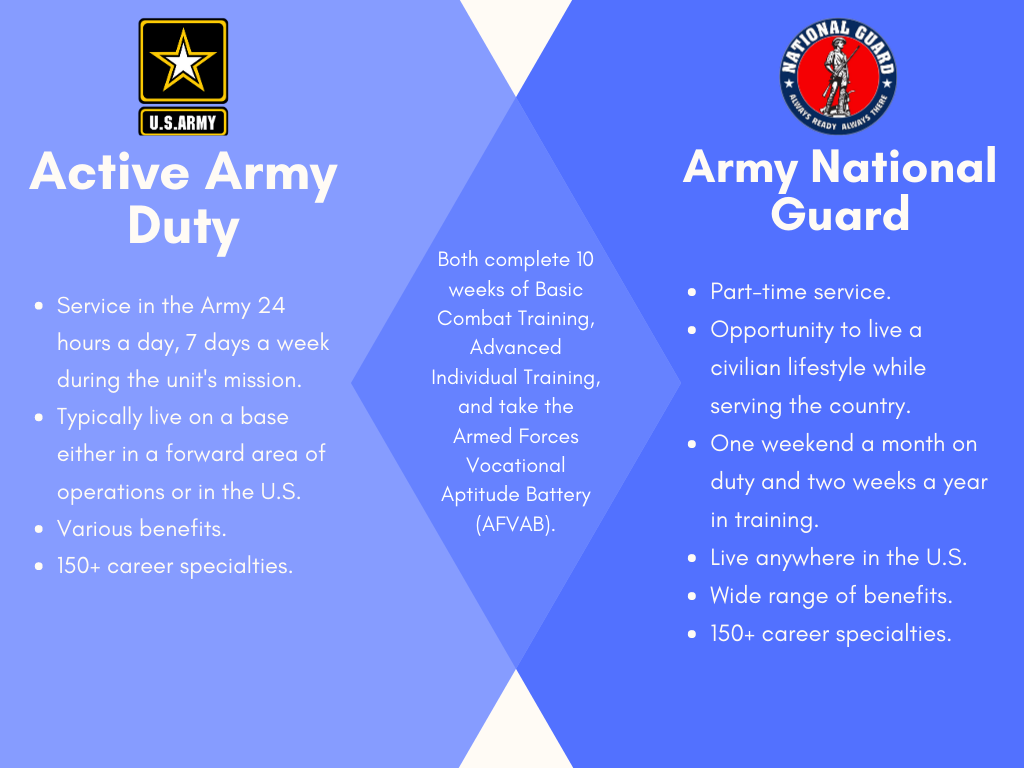
The National Guard operates on a “drill pay” system, typically consisting of one weekend a month and two weeks of annual training. This is calculated as 1/30th of active duty basic pay for each “period” worked. While the raw dollar amount is lower than active duty, the return on investment (ROI) regarding time spent can be exceptional. For a civilian professional earning a high salary in the private sector, the National Guard provides a “dual-income” household dynamic where the military pay covers discretionary spending, high-yield savings contributions, or aggressive debt repayment, all without interfering with their primary career trajectory.
Special Pays and Incentives
Both components offer bonuses, but their application differs. The Army often uses high-dollar enlistment or reenlistment bonuses to fill critical gaps in active-duty manning. The National Guard also offers these, but they are frequently paired with state-specific incentives. From a financial planning perspective, these lump-sum payments should be viewed as capital for investment rather than lifestyle inflation tools.
Long-Term Wealth Building: Pensions and the Thrift Savings Plan
The military offers one of the few remaining defined-benefit pension plans in the United States, but the timeline for accessing that wealth varies drastically between the regular Army and the National Guard.
The Blended Retirement System (BRS)
Both components now fall under the Blended Retirement System, which combines a traditional pension with a 401(k)-style account known as the Thrift Savings Plan (TSP). The government matches contributions up to 5%, providing an immediate 100% return on that portion of the investment. For both active duty and Guard members, the TSP is the cornerstone of military wealth building. It offers some of the lowest expense ratios in the investment world, allowing more of the member’s money to compound over decades.
The Pension Timeline Gap
This is where the two paths diverge most sharply. An active-duty soldier can retire after 20 years of service and begin receiving a lifetime monthly pension immediately. If an individual joins at age 18, they could technically have a guaranteed, inflation-adjusted income for life starting at age 38.
In contrast, National Guard members generally cannot begin drawing their pension until age 60, regardless of when they hit their 20th year of service (though certain deployments can lower this age). While the Guard pension is calculated based on a “points system” that reflects the actual time served, it serves as a supplement to Social Security and civilian 401(k)s rather than a mid-life career bridge. For the savvy investor, the Guard pension acts as a massive hedge against longevity risk in their 60s and 70s.

Educational ROI: Funding Human Capital
One of the most significant ways the military impacts a person’s financial life is through the elimination of student debt and the funding of higher education. Both the Army and the National Guard offer robust programs, but the “best” choice depends on your current educational status.
The Post-9/11 GI Bill and Yellow Ribbon Program
Active duty members earn 100% eligibility for the Post-9/11 GI Bill after 36 months of service. This covers full tuition at public institutions, a monthly housing allowance (MHA) based on the school’s zip code, and a book stipend. In many cases, the MHA alone can be worth $2,000 to $4,000 a month tax-free, allowing a veteran to focus entirely on their studies without taking on debt.
State-Specific Guard Benefits
The National Guard offers a unique financial “superpower”: State Tuition Assistance. Many states offer 100% tuition waivers for Guard members at state-funded universities. This can often be used before or in conjunction with federal benefits. A strategic Guard member can use state waivers for an undergraduate degree and save their federal GI Bill—or transfer it to a spouse or child—representing a transfer of wealth and educational value worth hundreds of thousands of dollars.
Risk Mitigation: Healthcare and Insurance
In any financial plan, the “defensive” side—insurance and healthcare—is just as important as the “offensive” side. The military provides some of the most cost-effective risk mitigation tools available in the modern economy.
TRICARE: The Competitive Advantage
Healthcare costs are one of the largest line items in a civilian budget. Active-duty Army members and their families receive TRICARE Prime, which has zero premiums and zero out-of-pocket costs for most services. This represents a “hidden” compensation of $15,000 to $25,000 annually compared to a civilian family plan.
National Guard members have access to TRICARE Reserve Select (TRS). While it does have a premium, it is notoriously one of the least expensive and most comprehensive health insurance plans in the country. For a small business owner or a freelancer in the Guard, TRS can be a game-changer, providing elite-level coverage at a fraction of the cost of a private marketplace plan. This allows the individual to redirect thousands of dollars in annual premiums toward their business or investment portfolio.
The VA Home Loan: Wealth Through Real Estate
Both active duty and Guard members (after a certain period of service) gain access to the VA Home Loan. From an investment perspective, this is one of the most powerful tools in existence. It allows for 0% down payment and requires no Private Mortgage Insurance (PMI). In a high-interest or high-growth real estate market, the ability to acquire an appreciating asset with no equity upfront allows military members to enter the real estate market years earlier than their civilian counterparts. Many “house hack” by using the VA loan to buy a multi-unit property, living in one unit while the others pay the mortgage, effectively creating an automated wealth-building machine.
Career Opportunity Costs and External Income
Finally, one must consider the “opportunity cost” of each path. The Army is a full-time commitment that often dictates where you live and what you do, while the Guard allows for a dual-track life.
Civilian Career Trajectory and Networking
The National Guard allows you to build a civilian career in a high-paying field (like tech, finance, or law) while simultaneously gaining military leadership experience. This “double-dipping” in professional development can lead to faster promotions and higher lifetime earnings in the private sector. Furthermore, the military provides a security clearance—a “golden ticket” in the government contracting world that can instantly add $20,000 to $50,000 to a civilian salary.

The Stability of the Active Duty Model
Conversely, the regular Army provides a recession-proof income. During economic downturns, while civilian sectors face layoffs and wage freezes, active-duty soldiers continue to receive scheduled raises and housing allowances. For those who prioritize a guaranteed floor for their earnings, the Army offers a level of financial stability that is virtually unmatched in the private sector.
In summary, the difference between the Army and the National Guard is a difference of financial strategy. The Army is an all-inclusive, low-overhead model that allows for aggressive saving and early “retirement” income. The National Guard is a high-leverage supplemental model that provides elite benefits and extra income to bolster a primary civilian career. Both paths offer a significant “wealth-building” advantage, but the right choice depends on whether you view your service as your primary economic engine or a strategic asset in your broader financial portfolio.
aViewFromTheCave is a participant in the Amazon Services LLC Associates Program, an affiliate advertising program designed to provide a means for sites to earn advertising fees by advertising and linking to Amazon.com. Amazon, the Amazon logo, AmazonSupply, and the AmazonSupply logo are trademarks of Amazon.com, Inc. or its affiliates. As an Amazon Associate we earn affiliate commissions from qualifying purchases.