
While the terms “malignant” and “benign” are often thrown around in discussions about health and medical conditions, understanding their fundamental differences is crucial. When it comes to tumors, this distinction is not just a matter of semantics; it carries profound implications for prognosis, treatment, and overall well-being. This article will delve into the core differences between malignant and benign tumors, exploring their characteristics, behaviors, and the underlying biological processes that define them. We will approach this topic with a clarity and accessibility that aims to demystify medical terminology, making it understandable for a general audience.
Understanding the Fundamentals: What Exactly is a Tumor?
Before we can differentiate between malignant and benign tumors, it’s essential to establish what a tumor itself is. In essence, a tumor, also known as a neoplasm, is an abnormal mass of tissue that forms when cells grow and divide uncontrollably, exceeding their normal limits. This uncontrolled proliferation can occur in virtually any part of the body.
Normally, our cells have a built-in mechanism for self-destruction or programmed cell death (apoptosis) when they become damaged or old. They also regulate their growth and division to maintain the body’s equilibrium. However, when this regulatory system malfunctions due to genetic mutations or other cellular insults, cells can begin to divide without restraint, forming a tumor.
The key factor in distinguishing between malignant and benign tumors lies in their behavior and their potential impact on the body. This behavioral difference is rooted in their cellular architecture and their ability to interact with their surroundings.
Benign Tumors: The Non-Invasive Neighbors
Benign tumors are characterized by their localized and non-invasive nature. Think of them as well-behaved cells that have gone slightly astray in their growth but haven’t developed the aggressive tendencies of their malignant counterparts.
Key Characteristics of Benign Tumors:
- Non-Cancerous: This is the most significant distinction. Benign tumors are not cancerous. They do not possess the cellular machinery or genetic alterations that enable them to invade surrounding tissues or spread to distant parts of the body.
- Slow Growth: Benign tumors typically grow slowly over months or years. Their growth rate is often proportional to the rate of cell division, which is still somewhat regulated compared to malignant cells.
- Well-Defined Borders: They usually have clear, distinct boundaries and are often enclosed within a capsule of connective tissue. This makes them relatively easy to surgically remove because they are physically separated from the surrounding healthy tissue.
- Do Not Invade Surrounding Tissues: A hallmark of benign tumors is their inability to infiltrate or invade neighboring organs or tissues. They might push against surrounding structures, causing pressure effects, but they don’t grow into them.
- Do Not Metastasize: This is perhaps the most critical characteristic. Benign tumors cannot spread to other parts of the body through the bloodstream or lymphatic system. Metastasis, the spread of cancer, is a defining feature of malignancy.
- Cellular Similarity: Under a microscope, the cells of a benign tumor often resemble the normal cells of the tissue from which they originated. They are generally well-differentiated, meaning they still retain many of the characteristics of their parent cells.
Examples and Implications of Benign Tumors:
While benign tumors are not cancerous, they can still cause problems depending on their size and location. For instance:
- Lipomas: These are common benign tumors composed of fat cells, often found just under the skin. They are usually painless and harmless.
- Fibroids: These are benign tumors that grow in the uterus. While most are asymptomatic, large fibroids can cause heavy bleeding, pain, and fertility issues.
- Adenomas: These benign tumors arise from glandular tissue, such as in the thyroid or pituitary gland. They can sometimes secrete hormones, leading to hormonal imbalances.
- Meningiomas: These tumors grow from the membranes that surround the brain and spinal cord. While benign, a large meningioma can press on the brain, causing neurological symptoms.
In many cases, benign tumors are asymptomatic and may never require treatment. If they do cause symptoms due to size or location, surgical removal is often curative, and the tumor typically does not recur. However, it is important for any detected lump or growth to be evaluated by a medical professional to confirm its benign nature.

Malignant Tumors: The Aggressive Invaders
Malignant tumors, commonly referred to as cancers, are the antithesis of benign tumors. They are characterized by their aggressive behavior, their ability to invade and destroy healthy tissues, and their potential to spread throughout the body.
Key Characteristics of Malignant Tumors:
- Cancerous: Malignant tumors are cancerous. They are formed by cells that have undergone significant genetic mutations, leading to uncontrolled growth and invasive behavior.
- Rapid and Invasive Growth: Malignant tumors tend to grow more rapidly than benign tumors. Critically, they invade and infiltrate the surrounding tissues, destroying normal cellular structures. This invasive nature is a hallmark of cancer.
- Irregular Borders: Unlike benign tumors, malignant tumors often have poorly defined, irregular borders. This makes them difficult to surgically excise completely, as microscopic cancer cells can easily spread into the surrounding healthy-appearing tissue.
- Ability to Metastasize: This is the most dangerous characteristic of malignant tumors. Cancer cells can break away from the primary tumor, enter the bloodstream or lymphatic system, and travel to distant organs and tissues. There, they can form secondary tumors, known as metastases. This process of metastasis is what makes cancer so challenging to treat and often life-threatening.
- Undifferentiated or Poorly Differentiated Cells: Under a microscope, the cells of a malignant tumor often look abnormal. They may vary in size and shape, have large nuclei, and appear less like the original healthy cells from which they arose. This lack of differentiation signifies a loss of specialized function and an increase in their ability to proliferate aggressively.
- Angiogenesis: Malignant tumors often stimulate the formation of new blood vessels (angiogenesis) to supply themselves with oxygen and nutrients. These blood vessels can also serve as pathways for metastasis.
Examples and Implications of Malignant Tumors:
The implications of malignant tumors are far more serious due to their invasive and metastatic potential. Some common examples include:
- Carcinomas: These are the most common type of cancer, originating in epithelial cells that line organs and skin. Examples include lung cancer, breast cancer, colon cancer, and skin cancer.
- Sarcomas: These cancers arise from connective tissues like bone, muscle, cartilage, and fat. Examples include osteosarcoma (bone cancer) and liposarcoma (cancer of fat tissue).
- Leukemias: These are cancers of the blood-forming tissues, usually in the bone marrow, leading to an overproduction of abnormal white blood cells.
- Lymphomas: These cancers originate in the lymphatic system, affecting white blood cells called lymphocytes.
The treatment for malignant tumors typically involves a multimodal approach, which may include surgery to remove the primary tumor, chemotherapy to kill cancer cells throughout the body, radiation therapy to destroy cancer cells in a specific area, immunotherapy, and targeted therapies. The prognosis for malignant tumors depends heavily on the type of cancer, its stage (how far it has spread), and the patient’s overall health.
The Critical Differences Summarized: A Behavioral Contrast
The core difference between malignant and benign tumors boils down to their behavior and their potential for harm.
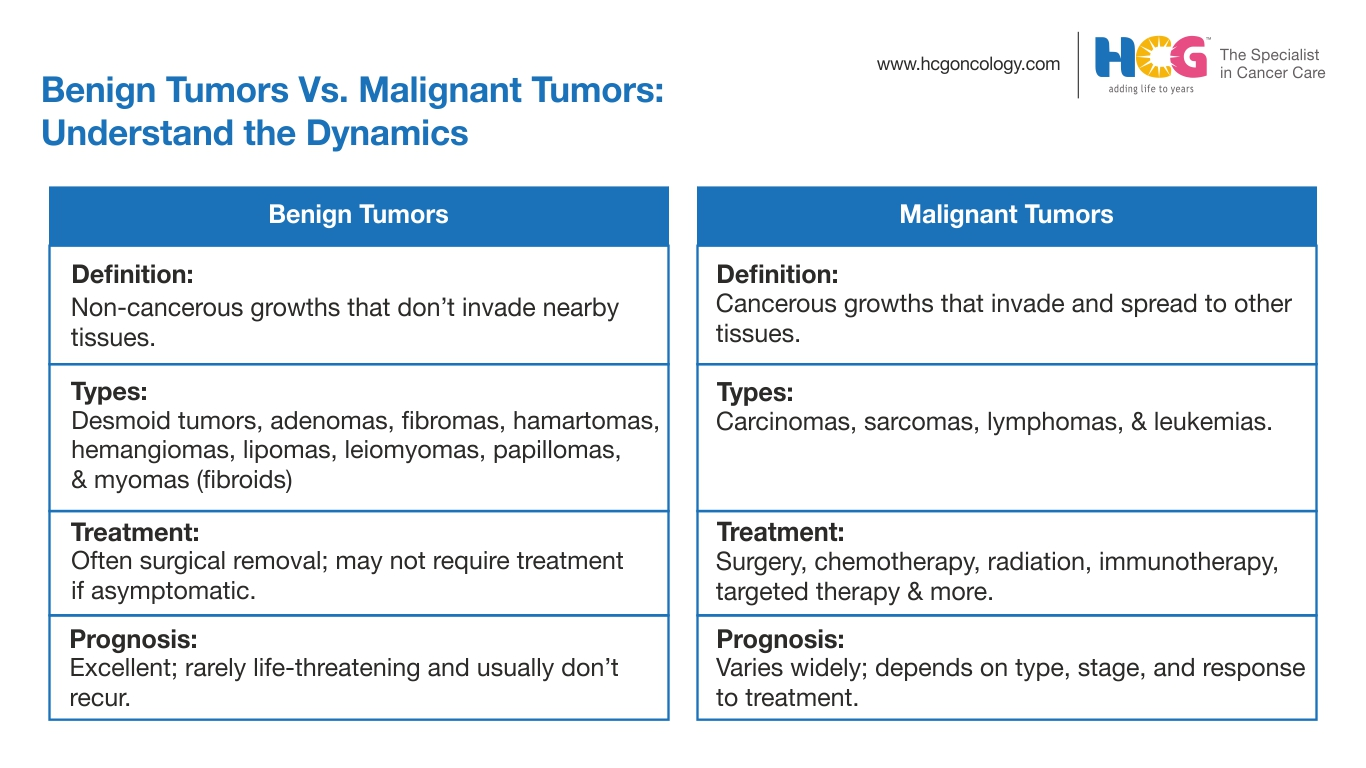
| Feature | Benign Tumor | Malignant Tumor (Cancer) |
|---|---|---|
| Nature | Non-cancerous | Cancerous |
| Growth Rate | Typically slow | Often rapid |
| Borders | Well-defined, distinct, often encapsulated | Irregular, poorly defined, infiltrative |
| Invasion | Does not invade surrounding tissues | Invades and destroys surrounding tissues |
| Metastasis | Does not spread to distant parts of the body | Can spread (metastasize) to distant parts of the body |
| Cell Appearance | Resembles normal cells (well-differentiated) | Abnormal, often poorly differentiated |
| Prognosis | Generally good; often curable with removal | Variable; depends on type, stage, and treatment |
| Recurrence | Rare after complete removal | More common, especially if not completely removed |

Why Does This Distinction Matter?
Understanding the difference between malignant and benign tumors is paramount for several reasons:
- Diagnosis and Treatment Planning: Accurate diagnosis is the first step in effective treatment. Identifying a tumor as benign or malignant dictates the entire treatment strategy. Benign tumors might require simple observation or localized surgical removal, while malignant tumors necessitate aggressive, often systemic, treatments.
- Prognosis and Patient Education: Knowing whether a tumor is benign or malignant provides crucial information about the likely outcome. For patients, this understanding is vital for managing expectations, making informed decisions about their care, and coping with their diagnosis.
- Public Health and Research: Epidemiological studies, cancer registries, and research efforts rely on differentiating between benign and malignant growths to track disease prevalence, identify risk factors, and develop new therapies.
- Technological Advancements: The very technologies that help us distinguish between these two types of tumors – advanced imaging techniques (MRI, CT scans), biopsies, and sophisticated laboratory analyses – are themselves products of innovation in fields like AI and medical device development, reflecting the broader trends in technology.
In conclusion, while both malignant and benign tumors represent deviations from normal cellular growth, their fundamental nature and implications are worlds apart. Benign tumors are generally localized, slow-growing, and non-invasive growths that do not spread. Malignant tumors, conversely, are cancerous, aggressive, invasive, and possess the life-threatening ability to metastasize. Recognizing these differences is fundamental to understanding cancer and navigating the complex landscape of medical diagnosis and treatment.
aViewFromTheCave is a participant in the Amazon Services LLC Associates Program, an affiliate advertising program designed to provide a means for sites to earn advertising fees by advertising and linking to Amazon.com. Amazon, the Amazon logo, AmazonSupply, and the AmazonSupply logo are trademarks of Amazon.com, Inc. or its affiliates. As an Amazon Associate we earn affiliate commissions from qualifying purchases.