
In the landscape of modern technology, particularly within the domains of artificial intelligence, machine learning, and high-performance computing, certain mathematical constants and functions serve as the invisible scaffolding for complex algorithms. Among these, the natural exponential function, $e^x$, and its derivative occupy a position of singular importance. To the uninitiated, the question “What is the derivative of $e^x$?” may seem like a relic of high school calculus. However, for software engineers, data scientists, and AI researchers, the answer—that the derivative of $e^x$ is simply $e^x$—is a fundamental property that enables the training of deep neural networks and the optimization of digital systems.
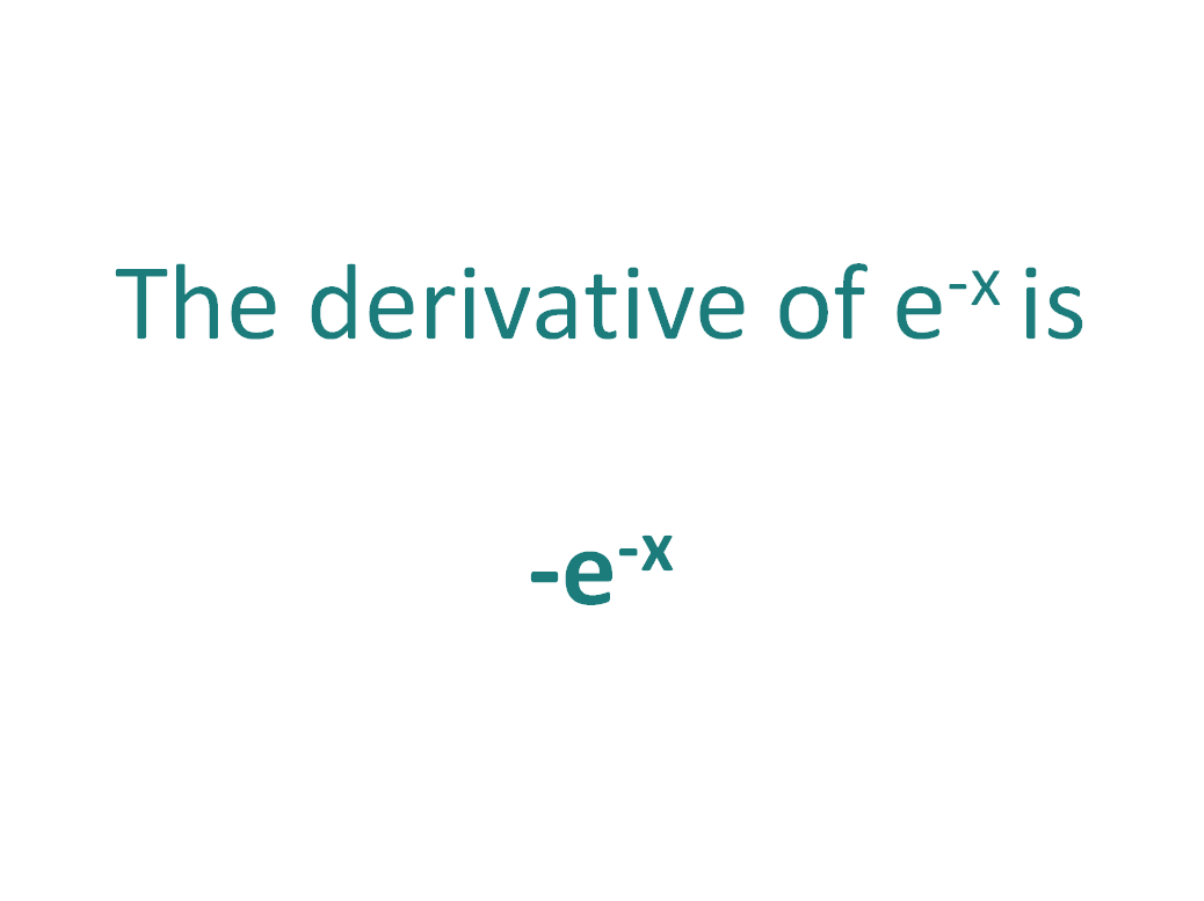
The uniqueness of $e^x$ lies in its identity as a fixed point under the operation of differentiation. In a digital world governed by rates of change, a function that describes its own growth is not just a mathematical curiosity; it is a computational superpower. This article explores the technical implications of this derivative, its role in the “backpropagation” algorithm that powers AI, and how it is implemented within the software stacks that drive the modern tech industry.
The Unique Property of the Natural Exponential Function
To understand why $e^x$ is the backbone of technological modeling, one must first appreciate the elegance of its calculus. The constant $e$, approximately equal to 2.71828, is known as Euler’s number. It is the base of the natural logarithm and characterizes processes that grow proportionally to their current value.
The Mathematical Proof of Identity
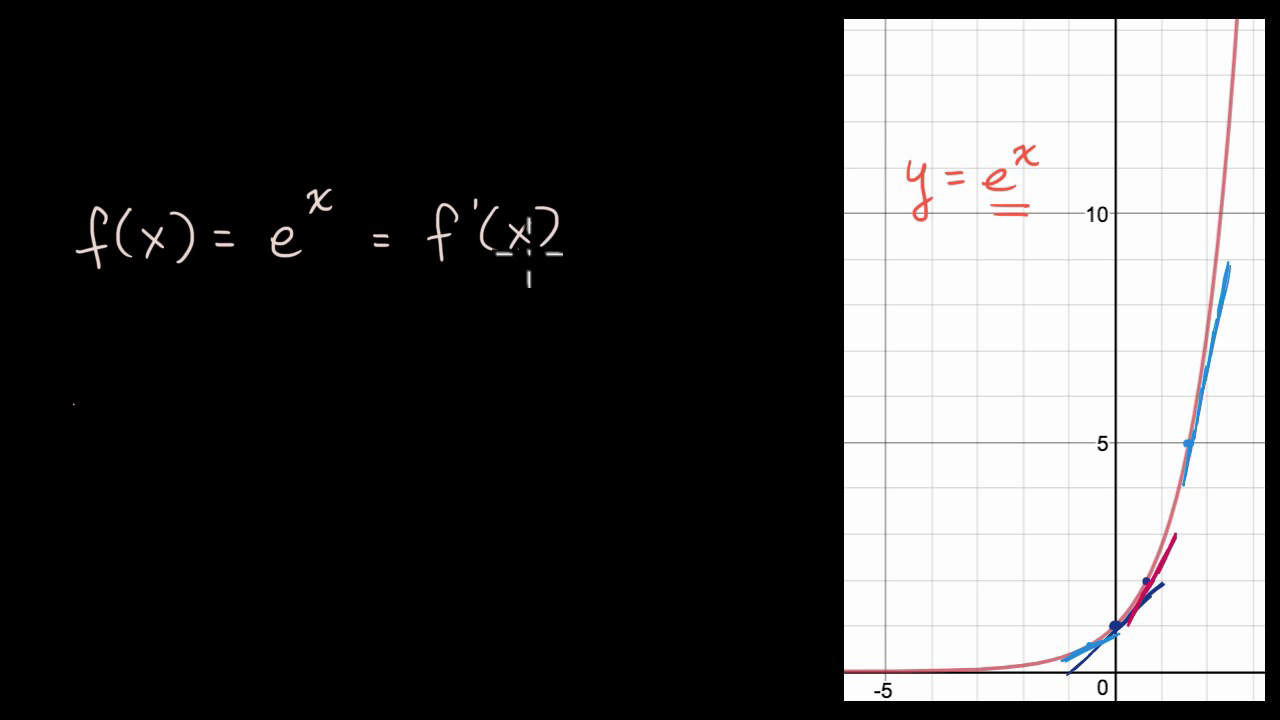
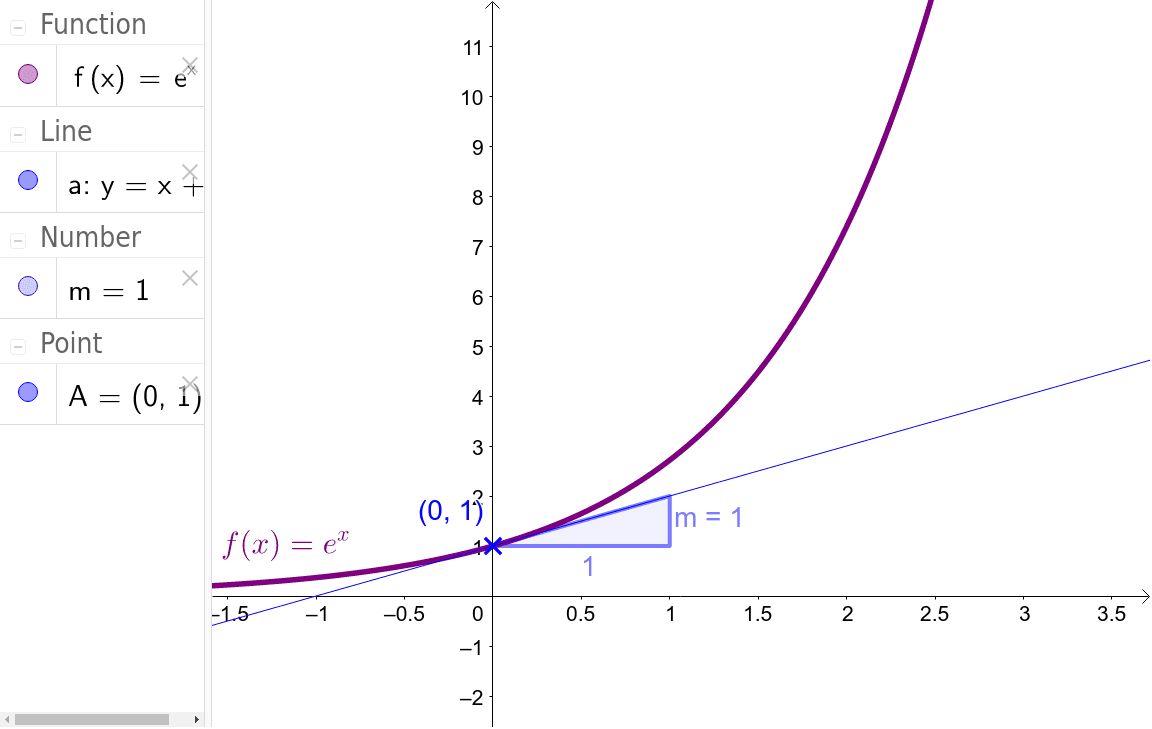
The derivative of a function represents its instantaneous rate of change. When we apply the limit definition of a derivative to $f(x) = e^x$, we find a remarkable result: the slope of the curve at any given point is equal to the value of the function at that point. Mathematically, $frac{d}{dx} e^x = e^x$.
For a developer building a simulation or an optimization engine, this means that the complexity of calculating the rate of change is zero. Unlike polynomial functions (where the derivative of $x^3$ is $3x^2$) or trigonometric functions (where the derivative of $sin(x)$ is $cos(x)$), the exponential function requires no transformation of its form. This leads to massive savings in computational overhead when these calculations are performed billions of times per second across GPU clusters.
The Role of e in Digital Growth Models
In tech, we often speak of “exponential growth.” Whether it is the scaling of a cloud database, the spread of a viral feature, or the increasing complexity of Moore’s Law, these phenomena are modeled using $e^x$. Because the derivative is also $e^x$, engineers can predict future states with high precision. If a system’s growth rate is known to be proportional to its size, $e^x$ is the only function that provides an exact, stable model for that behavior.
Exponential Functions in Neural Network Activation
The most significant application of $e^x$ in the current tech era is within the architecture of Artificial Neural Networks (ANNs). For an AI to “learn,” it must process data through layers of “neurons,” each of which applies a mathematical function to its input to determine whether it should “fire.” These are known as activation functions.
The Sigmoid and Softmax Functions
Two of the most critical functions in machine learning history are the Sigmoid and the Softmax functions, both of which are built upon $e^x$.
- The Sigmoid Function: Defined as $sigma(x) = frac{1}{1 + e^{-x}}$, this function squashes any input value into a range between 0 and 1. This is essential for binary classification tasks (e.g., determining if an email is spam or not). The derivative of the sigmoid function is computationally elegant: $sigma'(x) = sigma(x)(1 – sigma(x))$. Because this derivative relies on the original function’s value, it allows AI models to update their weights with minimal arithmetic steps.
- The Softmax Function: In multi-class classification (e.g., an AI identifying different objects in an image), the Softmax function uses $e^x$ to turn a vector of raw scores into a probability distribution. By exponentiating the inputs, the model amplifies the differences between scores, making the “winner” more distinct.
Differentiability and the “Vanishing Gradient”
The fact that $e^x$ is continuous and differentiable everywhere is a requirement for modern AI. Algorithms like Gradient Descent require functions that have a smooth derivative. However, the use of $e^x$ in deep networks led to a famous challenge in tech: the Vanishing Gradient Problem. Because the derivative of the Sigmoid function (which involves $e^x$) peaks at 0.25, multiplying these small values across many layers of a neural network causes the “gradient” to shrink toward zero, effectively stopping the AI from learning. This led to the development of alternative functions like ReLU, though $e^x$ remains vital in the output layers of almost every modern Transformer and Large Language Model (LLM).
Backpropagation: Why the Identity Derivative is a Computational Gift
In the training phase of AI software, the “Backpropagation” algorithm is used to adjust the internal parameters (weights) of the model to reduce errors. This process is essentially a massive application of the Chain Rule from calculus.
Simplifying the Chain Rule
When a software tool like PyTorch or TensorFlow calculates the gradient of a loss function, it must differentiate through every layer of the network. If the activation function is $e^x$, the “internal” derivative remains $e^x$. This predictability allows for “Autograd” (Automatic Differentiation) engines to be highly optimized. The software doesn’t need to store complex new formulas for each derivative; it simply references the values it has already computed during the “forward pass.”
Efficiency at Scale
In a model with 175 billion parameters (like GPT-3), the efficiency of the derivative calculation is the difference between a model that takes weeks to train and one that takes months. By utilizing the property that $frac{d}{dx} e^x = e^x$, chip architects can design hardware (like Google’s TPUs) specifically to handle these exponential calculations at the transistor level, ensuring that the throughput of AI training remains economically viable.
Software Implementation and Hardware Optimization
Beyond the theory, the derivative of $e^x$ must be implemented in code. This brings us into the realm of numerical stability and floating-point arithmetic, which are core concerns for any software developer working on high-performance applications.
Library Implementations (NumPy, SciPy, and C++)
In standard software libraries, the exp() function is rarely calculated using a simple power series. Instead, developers use highly optimized approximations like the Taylor series or Padé approximants. For example, in the C standard library (math.h), exp(x) is implemented using hardware-level instructions that minimize the “rounding errors” that can accumulate during millions of successive differentiations.
GPU Acceleration and Vectorization
Modern Tech relies on “vectorization”—performing the same operation on many data points simultaneously. When a developer writes code to find the derivative of $e^x$ across a matrix of 10,000 data points, modern GPUs use “SIMD” (Single Instruction, Multiple Data) architectures. Because the derivative is the function itself, the GPU can reuse the memory cache where the initial $e^x$ values were stored, significantly reducing “memory latency”—a common bottleneck in software performance.
Beyond AI: The Derivative in Digital Systems and Security
While AI is the most visible user of the $e^x$ derivative, its influence extends into digital security and systems engineering.
Cryptography and Complexity
In digital security, exponential functions (often over finite fields) are used in public-key cryptography, such as the Diffie-Hellman key exchange. While these are discrete rather than continuous functions, the underlying mathematics of how rates of change occur in modular exponentiation is what makes these codes difficult to crack. The “one-way” nature of certain exponential transformations ensures that while it is easy to calculate a value, it is computationally “hard” to reverse the process without a key.
Signal Processing and Digital Communication
In the world of 5G, Wi-Fi, and digital audio, the Fourier Transform is the tool used to convert signals between time and frequency domains. The core of the Fourier Transform is Euler’s Formula: $e^{ix} = cos(x) + isin(x)$. The derivative of this complex exponential is essential for filtering noise from signals. Because the derivative of $e^{ix}$ is simply $ie^{ix}$, engineers can design digital filters that manipulate sound and data with incredible precision, ensuring that your Zoom call remains clear or your streaming video doesn’t buffer.
Conclusion: The Foundation of the Digital Future
The question of what the derivative of $e^x$ is might seem like basic calculus, but in the context of technology, it is a foundational truth that enables the complexity of our modern world. Its unique property of being its own derivative provides the mathematical simplicity required for the most complex computations ever attempted by humanity.
From the gradients that allow a neural network to recognize a human face to the signal processing that carries data across the globe, $e^x$ is the silent engine of the tech industry. As we move further into the era of AI and quantum computing, our reliance on these fundamental mathematical identities only grows. For the software engineer or tech enthusiast, understanding the derivative of $e^x$ is more than a lesson in math—it is a lesson in how the digital universe is constructed, one optimized calculation at a time.
aViewFromTheCave is a participant in the Amazon Services LLC Associates Program, an affiliate advertising program designed to provide a means for sites to earn advertising fees by advertising and linking to Amazon.com. Amazon, the Amazon logo, AmazonSupply, and the AmazonSupply logo are trademarks of Amazon.com, Inc. or its affiliates. As an Amazon Associate we earn affiliate commissions from qualifying purchases.