
In the realm of personal finance and investing, few concepts hold as much transformative power as compound interest. Often lauded as the “eighth wonder of the world” by Albert Einstein, it is the engine that drives significant wealth accumulation over time. Understanding what compound interest is, how its formula works, and its profound implications is not merely academic; it is an essential pillar of financial literacy that can dramatically shape your financial future. This article will demystify the compound interest formula, explore its components, and illustrate why grasping this concept is non-negotiable for anyone aspiring to build wealth, manage debt effectively, or simply make informed financial decisions.
At its core, compound interest is the interest earned not only on the initial principal but also on the accumulated interest from previous periods. Unlike simple interest, which is calculated solely on the original principal amount, compound interest continually builds upon itself, creating an accelerating growth trajectory. This seemingly small distinction creates a monumental difference over time, allowing investments to grow exponentially and making it a cornerstone principle for long-term financial planning.
Understanding the Compound Interest Formula
To harness the power of compound interest, one must first understand its mathematical representation. The compound interest formula is a fundamental tool for financial projections, allowing individuals to calculate the future value of an investment or the total cost of a loan over a specified period.
Deconstructing the Formula: A = P(1 + r/n)^(nt)
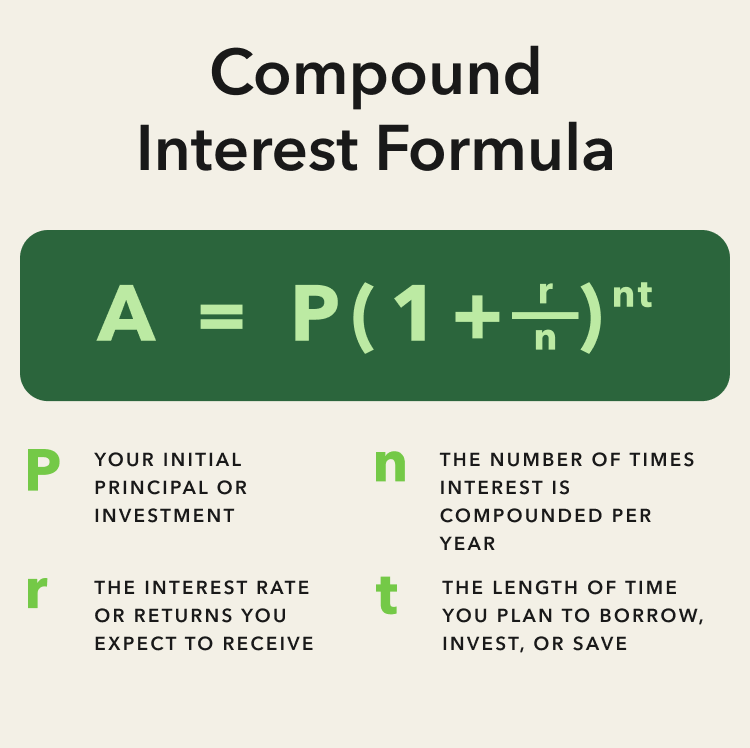
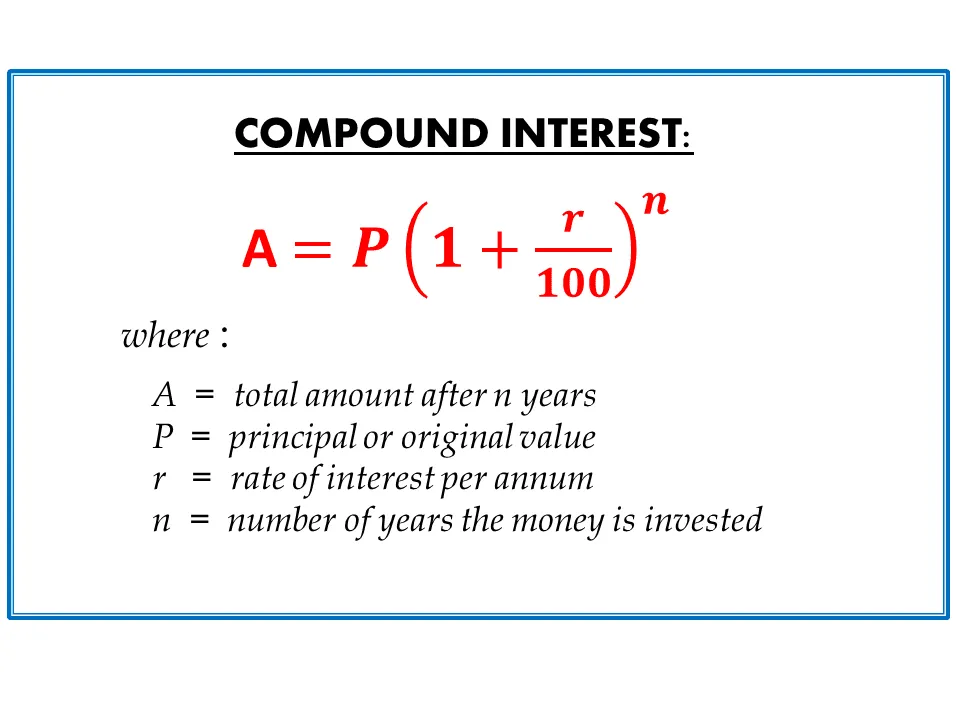
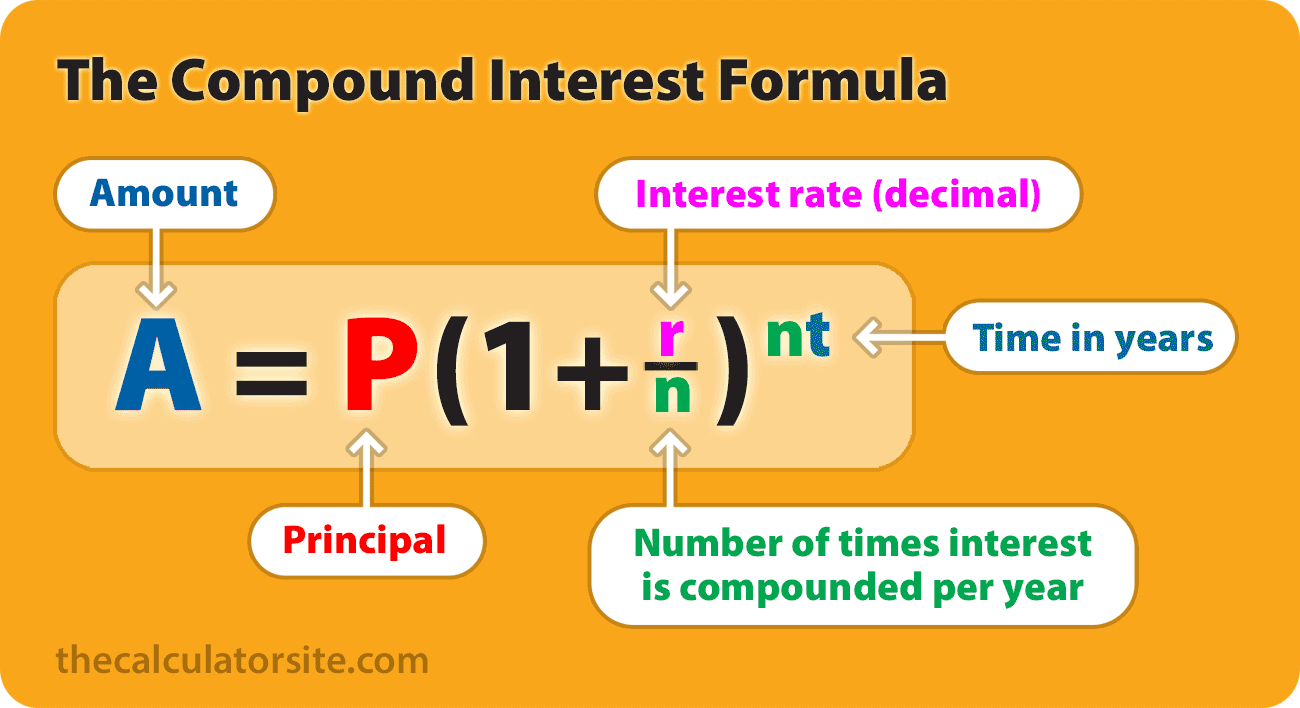
The standard formula for calculating compound interest, specifically the future value of an investment, is:
A = P(1 + r/n)^(nt)
Let’s break down each component:
- A = Future Value of the Investment/Loan, including interest: This is the total amount you will have at the end of the investment period, or the total amount you will owe on a loan, after all interest has been compounded. It represents the sum of your initial principal and all accumulated interest.
- P = Principal Investment Amount (the initial deposit or loan amount): This is the original sum of money that you either invest or borrow. It’s the starting point from which all interest calculations begin.
- r = Annual Interest Rate (as a decimal): This is the stated rate of interest for the year. It’s crucial to convert percentage rates to their decimal equivalent before using them in the formula (e.g., 5% becomes 0.05).
- n = Number of Times Interest is Compounded per Year: This variable dictates how frequently the interest is calculated and added back to the principal. Common compounding frequencies include:
- Annually: n = 1
- Semi-annually: n = 2
- Quarterly: n = 4
- Monthly: n = 12
- Weekly: n = 52
- Daily: n = 365 (or 360 for some financial institutions)
- t = Number of Years the Money is Invested or Borrowed For: This represents the duration over which the compounding occurs. The longer the time frame, the greater the impact of compounding.
The Core Concept: Interest on Interest
The magic of compound interest lies in the “interest on interest” phenomenon. Each time interest is compounded, it is added to the principal balance. In the subsequent compounding period, the interest is then calculated on this new, larger principal. This creates a snowball effect: the base for interest calculation continuously grows, leading to accelerated growth over time.
Imagine starting with $1,000 at a 10% annual interest rate.
- Year 1: You earn $100 interest ($1,000 * 0.10). Your balance becomes $1,100.
- Year 2: You earn interest not just on the original $1,000, but on $1,100. So, you earn $110 interest ($1,100 * 0.10). Your balance becomes $1,210.
- Year 3: You earn interest on $1,210, which is $121. Your balance becomes $1,331.
Notice how the amount of interest earned each year increases, even though the interest rate remains constant. This is the power of compounding in action.
Simple Interest vs. Compound Interest: A Quick Comparison
To truly appreciate compound interest, it’s helpful to contrast it with simple interest.
- Simple Interest: Calculated only on the original principal amount. The formula is I = P * r * t, where I is the interest earned. This means the interest earned each period remains constant, and the growth is linear. Simple interest is rarely used in long-term investments but can be seen in some short-term loans or bonds.
- Compound Interest: Calculated on the principal and accumulated interest from previous periods. This results in exponential growth over time. Virtually all long-term savings accounts, retirement plans, and investment vehicles utilize compound interest.
The difference may seem minor initially, but over decades, the divergence in returns between simple and compound interest is staggering, underscoring why understanding and leveraging compounding is crucial for financial success.
The Mechanics of Compounding: How It Works
The effectiveness of compound interest is influenced by several key factors that dictate the speed and magnitude of wealth accumulation. Understanding these mechanics allows investors to make strategic decisions to optimize their returns.
The Role of Compounding Frequency
The value of ‘n’ in the formula – the number of times interest is compounded per year – has a significant impact. All else being equal, the more frequently interest is compounded, the faster your money grows.
- Annual Compounding (n=1): Interest is added once a year.
- Semi-Annual Compounding (n=2): Interest is added twice a year.
- Quarterly Compounding (n=4): Interest is added four times a year.
- Monthly Compounding (n=12): Interest is added twelve times a year.
- Daily Compounding (n=365): Interest is added daily.
While the difference between annual and daily compounding might seem negligible over a short period, over decades, daily compounding will yield a noticeably higher return than annual compounding, even with the same annual interest rate. This is because the interest starts earning interest sooner and more often. For example, a loan with daily compounding will accrue debt faster than one with annual compounding.
The Power of Time in Compounding
Perhaps the most critical variable in the compound interest formula is ‘t’ – the number of years. The longer the investment horizon, the greater the impact of compounding. This concept is often referred to as “the magic of starting early.” An individual who begins investing a modest sum in their 20s can accumulate significantly more wealth than someone who starts investing a larger sum in their 30s or 40s, even if they contribute the same total amount over their lifetime.
This exponential growth curve means that the later years of an investment generate far more interest than the early years. The effect becomes dramatically more pronounced as time extends, making patience and a long-term perspective indispensable for successful investing.
The Impact of Interest Rate
The annual interest rate ‘r’ is another direct driver of compound growth. A higher interest rate means a larger percentage of your principal (and accumulated interest) is added back to your balance each compounding period. Naturally, higher rates accelerate wealth accumulation.
However, high returns often come with higher risks. It’s essential to balance the pursuit of higher interest rates with a thorough understanding of the associated investment risks. While the mathematical impact of a higher ‘r’ is clear, prudent financial planning involves choosing investments with rates that align with your risk tolerance and financial goals.
Why Compound Interest is a Cornerstone of Financial Growth
Compound interest isn’t just a theoretical concept; it’s a practical force that underpins nearly every aspect of modern finance. Its understanding is crucial for both offensive (wealth building) and defensive (debt management) financial strategies.
Wealth Accumulation and Retirement Planning
For investors, compound interest is the engine of wealth accumulation. It’s the primary mechanism by which retirement accounts like 401(k)s, IRAs, and other investment vehicles such as mutual funds, stocks, and bonds grow over time. Regular contributions combined with consistent compounding can turn even modest initial investments into substantial nest eggs over several decades.
For instance, a consistent monthly contribution to a retirement account, earning an average annual return, will see the invested principal grow steadily. But it’s the compounding interest on those returns and the accumulated principal that truly supercharges the growth, enabling individuals to achieve financial independence and secure their post-working lives. This is why financial advisors universally preach the importance of “time in the market” rather than “timing the market.”
Debt Management: The Double-Edged Sword
While compound interest is a powerful ally for savers, it can be a formidable adversary for borrowers. Just as it works to grow your savings, it works to expand your debt. Credit cards, personal loans, and even mortgages often involve compound interest, where interest is calculated on your outstanding balance, including any unpaid interest from previous periods.
High-interest debts like credit card balances can spiral out of control rapidly due to compounding. If you carry a balance month after month, the interest you owe is added to your principal, and then you start paying interest on that higher amount. This can make paying off debt extremely challenging and costly, highlighting the critical importance of understanding interest rates and compounding frequencies when taking on any form of debt. Prioritizing the repayment of high-interest debts is a fundamental financial strategy to prevent compound interest from working against you.
Real-World Applications Beyond Savings
The principles of compounding extend beyond personal investments and debt. They influence broader economic concepts:
- Inflation: The erosion of purchasing power over time is, in essence, a form of reverse compounding. The cost of living compounds annually, meaning things cost more each year.
- Economic Growth: Compound growth principles are used to model economic growth rates, population growth, and the expansion of businesses.
- Company Dividends: Reinvesting dividends from stocks allows those dividends to start earning their own returns, creating a compounding effect on your investment portfolio.
Practical Applications and Maximizing Compound Growth
Understanding the compound interest formula is the first step; applying it strategically to your financial life is where the real gains are made.
Strategies for Investors
To maximize the benefits of compound interest, consider these strategies:
- Start Early: As discussed, time is your most valuable asset. The earlier you begin investing, the longer your money has to compound, leading to substantially larger returns.
- Regular Contributions: Consistently adding to your investments, even small amounts, dramatically increases your principal over time, giving compounding more fuel to work with.
- Reinvest Dividends and Interest: If your investments generate income (e.g., dividends from stocks, interest from bonds), choose to reinvest that income back into the investment. This compounds your returns even faster.
- Long-Term Horizon: Resist the temptation to constantly tinker with your investments or withdraw funds prematurely. Allow your money the time it needs to experience significant compound growth.
- Seek Reasonable Returns: While higher interest rates are appealing, prioritize sustainable, long-term growth from diversified investments rather than chasing unrealistic, high-risk returns.
Utilizing Financial Tools and Calculators
You don’t need to be a mathematician to leverage compound interest. Numerous tools are available to help:
- Online Compound Interest Calculators: Many financial websites offer free calculators where you can input your principal, interest rate, compounding frequency, and time horizon to see how your money will grow. These are invaluable for planning and visualizing future wealth.
- Spreadsheets: Programs like Excel or Google Sheets can be used to create custom compound interest models, allowing for more detailed scenario planning and sensitivity analysis.
- Financial Advisors: A qualified financial advisor can help you develop a personalized investment strategy that incorporates compound interest to meet your specific financial goals.
The Importance of Financial Literacy
Ultimately, the compound interest formula is more than just an equation; it’s a testament to the power of consistent, disciplined financial behavior. A deep understanding of how it works empowers individuals to:
- Make Informed Decisions: Whether it’s choosing a savings account, evaluating a loan offer, or planning for retirement, knowing about compound interest allows for better choices.
- Avoid Pitfalls: Recognizing how compounding accelerates debt helps in prioritizing repayment and avoiding financially damaging situations.
- Set Realistic Goals: By projecting future growth, individuals can set achievable financial goals and develop concrete plans to reach them.
In conclusion, the compound interest formula, A = P(1 + r/n)^(nt), is a cornerstone of financial success. It illustrates how consistent investment, patient waiting, and strategic decision-making can transform modest sums into significant wealth. By embracing the principles of compounding, understanding its mechanics, and applying its lessons to both investments and debt, individuals can confidently navigate their financial journeys, making compound interest their most powerful ally in achieving long-term prosperity.
aViewFromTheCave is a participant in the Amazon Services LLC Associates Program, an affiliate advertising program designed to provide a means for sites to earn advertising fees by advertising and linking to Amazon.com. Amazon, the Amazon logo, AmazonSupply, and the AmazonSupply logo are trademarks of Amazon.com, Inc. or its affiliates. As an Amazon Associate we earn affiliate commissions from qualifying purchases.