
In the complex landscape of federal taxation, the relationship between a taxpayer, their advisor, and the Internal Revenue Service (IRS) is governed by a specific set of regulations known as Treasury Department Circular No. 230. Formally titled “Regulations Governing Practice before the Internal Revenue Service,” Circular 230 serves as the ethical and procedural backbone for professionals who represent clients in tax matters. For business owners, high-net-worth individuals, and financial professionals, understanding these rules is not merely an academic exercise; it is a fundamental component of ensuring financial integrity and mitigating the risk of costly disputes with the federal government.
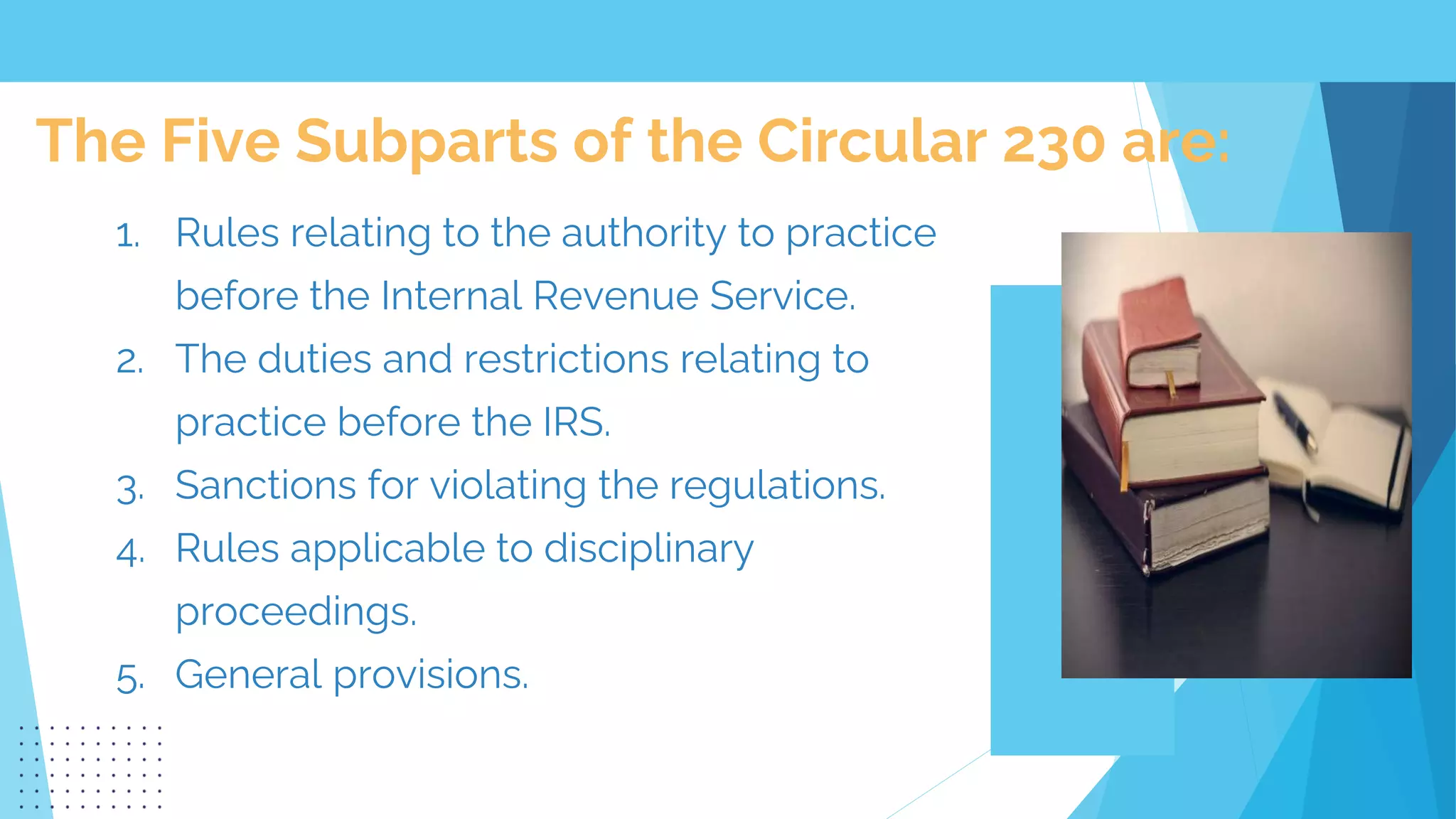
At its core, Circular 230 is designed to protect the integrity of the tax system by ensuring that tax practitioners—including Attorneys, Certified Public Accountants (CPAs), and Enrolled Agents (EAs)—adhere to high standards of conduct. It outlines who has the authority to practice before the IRS, the duties and restrictions related to that practice, and the sanctions for violating these standards.
The Scope and Authority of Circular 230
Circular 230 is not a set of tax laws in the sense of the Internal Revenue Code (IRC). Instead, it is a set of federal regulations (Title 31 of the Code of Federal Regulations, Part 10) that dictates how practitioners must behave when interacting with the IRS on behalf of a client. This distinction is vital for anyone involved in business finance or personal wealth management, as it establishes the “rules of engagement” for professional tax advice and representation.
Who is Subject to Circular 230?
The reach of Circular 230 is broad. It applies to any individual who is authorized to practice before the IRS. This includes:
- Attorneys and CPAs: Who are in good standing with their respective state bars or regulatory boards.
- Enrolled Agents: Individuals who have passed a comprehensive IRS examination or have relevant experience as an IRS employee.
- Enrolled Actuaries and Retirement Plan Agents: Professionals specializing in specific areas of tax law.
- Unenrolled Tax Return Preparers: While their authority is more limited, they are still subject to certain provisions regarding the preparation of returns.
Defining “Practice Before the IRS”
“Practice” is defined broadly. It encompasses all matters connected with a presentation to the IRS or any of its officers or employees relating to a taxpayer’s rights, privileges, or liabilities under laws or regulations administered by the IRS. This includes preparing documents, filing documents, corresponding and communicating with the IRS, and representing a client at conferences, hearings, and meetings.
The Office of Professional Responsibility (OPR)
The enforcement of Circular 230 is overseen by the IRS Office of Professional Responsibility (OPR). The OPR is an independent body within the IRS that investigates allegations of practitioner misconduct. Its existence ensures that the standards set forth in Circular 230 have “teeth,” providing a mechanism for disciplining those who fail to meet their professional obligations.
Essential Rules of Conduct for Financial Professionals
The heart of Circular 230 lies in its sections regarding the duties and restrictions imposed on practitioners. These rules are designed to ensure that the financial advice provided to taxpayers is accurate, transparent, and free from conflicts of interest.
Due Diligence and the Accuracy Standard
One of the most critical provisions is Section 10.22, which requires practitioners to exercise “due diligence” in several areas. Specifically, a practitioner must be diligent in preparing or assisting in the preparation of tax returns and in determining the correctness of oral or written representations made to the IRS.
For a business owner, this means your tax professional cannot simply take your numbers at face value if they appear incorrect or inconsistent. They have a regulatory obligation to ask follow-up questions and ensure the information submitted to the government is as accurate as possible. This duty protects the practitioner from liability and protects the taxpayer from the penalties associated with filing “frivolous” or grossly inaccurate returns.
Managing Conflicts of Interest
Section 10.29 addresses the ethical dilemmas that arise when a practitioner’s interests—or the interests of another client—clash with the interests of a current client. Under Circular 230, a practitioner generally may not represent a client if the representation involves a “significant risk” that the representation will be materially limited by the practitioner’s own interests or responsibilities to another person.
However, representation may still occur if the practitioner reasonably believes they can provide competent and diligent representation to each affected client and if all affected clients give informed consent, confirmed in writing. This transparency is vital in complex business structures where multiple partners or entities might share the same tax advisor.
Rules Regarding Contingent Fees
In the world of business finance, fee structures are a point of frequent negotiation. Circular 230 imposes strict limitations on “contingent fees”—fees where the amount is based on whether a specific tax position is sustained or based on the amount of taxes saved.
Generally, a practitioner may not charge a contingent fee for preparing an original tax return. Contingent fees are typically only permitted in very specific scenarios, such as an IRS examination of an original return, a claim for credit or refund, or any judicial proceeding arising under the Internal Revenue Code. These rules prevent practitioners from taking overly aggressive or “shady” tax positions simply to increase their own payout.

The Return of Client Records
Section 10.28 stipulates that a practitioner must, at the request of a client, promptly return any and all “records of the client” necessary for the client to comply with their federal tax obligations. Even if there is a fee dispute, the practitioner generally cannot withhold these records, although they may retain copies. This protects the taxpayer’s ability to remain compliant with the law regardless of their relationship with their advisor.
The Evolution of Written Advice and Disclaimers
For many years, almost every email from a CPA or tax attorney ended with a “Circular 230 Disclaimer”—a block of text stating that the advice contained in the email could not be used to avoid tax penalties. This was a result of strict regulations regarding “covered opinions.” However, in 2014, the Treasury Department overhauled these rules to move toward a more “principles-based” approach.
The 2014 Amendments
The 2014 amendments eliminated the complex requirements for “covered opinions” and the associated mandatory disclaimers. The goal was to reduce the burden on practitioners and to ensure that the rules for written advice were more intuitive.
Under the current Section 10.37, a practitioner must base all written advice on reasonable factual and legal assumptions. They must consider all relevant facts that they know or reasonably should know and must not rely on representations or statements that are unreasonable. Essentially, the “Disclaimer” era was replaced by a “Reasonableness” era.
Standards for Written Tax Advice
When a professional provides written advice today, they must:
- Base the advice on reasonable assumptions: They cannot assume a “fact” that they know is false.
- Consider all relevant facts: They must perform the necessary research to understand the full context of the transaction.
- Relate the law to the facts: The advice must demonstrate how the tax code specifically applies to the client’s situation.
- Avoid taking the “audit lottery” into account: Advice cannot be based on the likelihood that a return will not be audited.
For the client, this shift means that the quality of written communication has improved. Instead of generic boilerplate disclaimers, practitioners are now focused on providing substantive, well-reasoned analysis that holds up under scrutiny.
Enforcement, Sanctions, and Professional Impact
The IRS does not take violations of Circular 230 lightly. The OPR has the authority to impose various levels of discipline on practitioners who fail to comply with the standards of practice.
The Spectrum of Disciplinary Actions
When a practitioner is found to have violated the regulations—whether through incompetence, disreputable conduct, or a willful violation—the OPR may issue several types of sanctions:
- Private Reprimand: A formal letter of warning that does not become part of the public record.
- Censure: A public reprimand that stays on the practitioner’s record.
- Suspension: A temporary prohibition from practicing before the IRS, ranging from months to years.
- Disbarment: A permanent revocation of the right to practice before the IRS.
- Monetary Penalties: The OPR can also impose financial fines on the practitioner or the firm for certain violations.
The Economic Consequences of Non-Compliance
For a tax professional, a Circular 230 violation is a “career-ender.” A suspension or disbarment not only halts their ability to work with the IRS but often triggers reciprocal discipline from state boards of accountancy or state bar associations.
For the client, a practitioner’s non-compliance can lead to disastrous financial outcomes. If an advisor is sanctioned for providing poor or unethical advice, the taxpayer is often left “holding the bag” for back taxes, interest, and penalties. While the taxpayer might have legal recourse against the advisor through a malpractice suit, the immediate financial strain and the stress of an IRS investigation can be overwhelming.
Why Circular 230 Matters for Long-Term Financial Health
Circular 230 is more than just a regulatory hurdle for tax professionals; it is a consumer protection mechanism for anyone involved in the financial markets. By enforcing a standard of “due diligence” and “reasonableness,” these regulations ensure that the tax strategies used by businesses and individuals are grounded in reality and legal merit.
Ensuring High-Quality Advice
When you hire a professional who is governed by Circular 230, you are hiring someone who is legally bound to act with integrity. This provides a level of security in your financial planning. You can be confident that your advisor is not just looking for “loopholes” but is instead applying the law in a way that minimizes your liability while keeping you on the right side of the IRS.
Mitigating Risk in Business Transactions
In mergers, acquisitions, and complex real estate deals, tax implications are often the deciding factor in whether a deal is profitable. Circular 230 ensures that the “tax opinions” used to justify these transactions are prepared with a high level of professional care. This reduces the risk of the IRS re-characterizing a transaction years later, which could result in millions of dollars in unexpected tax liabilities.

Building a Relationship of Trust
Ultimately, Circular 230 fosters a relationship of trust between the taxpayer and the advisor. By setting clear boundaries on fees, conflicts of interest, and the handling of records, the regulations allow for a transparent partnership. For a business to thrive, the owners must know that their financial “house” is in order. Circular 230 provides the framework to make that order possible, ensuring that the intersection of private wealth and public tax obligation is navigated with the highest degree of professionalism.
aViewFromTheCave is a participant in the Amazon Services LLC Associates Program, an affiliate advertising program designed to provide a means for sites to earn advertising fees by advertising and linking to Amazon.com. Amazon, the Amazon logo, AmazonSupply, and the AmazonSupply logo are trademarks of Amazon.com, Inc. or its affiliates. As an Amazon Associate we earn affiliate commissions from qualifying purchases.