
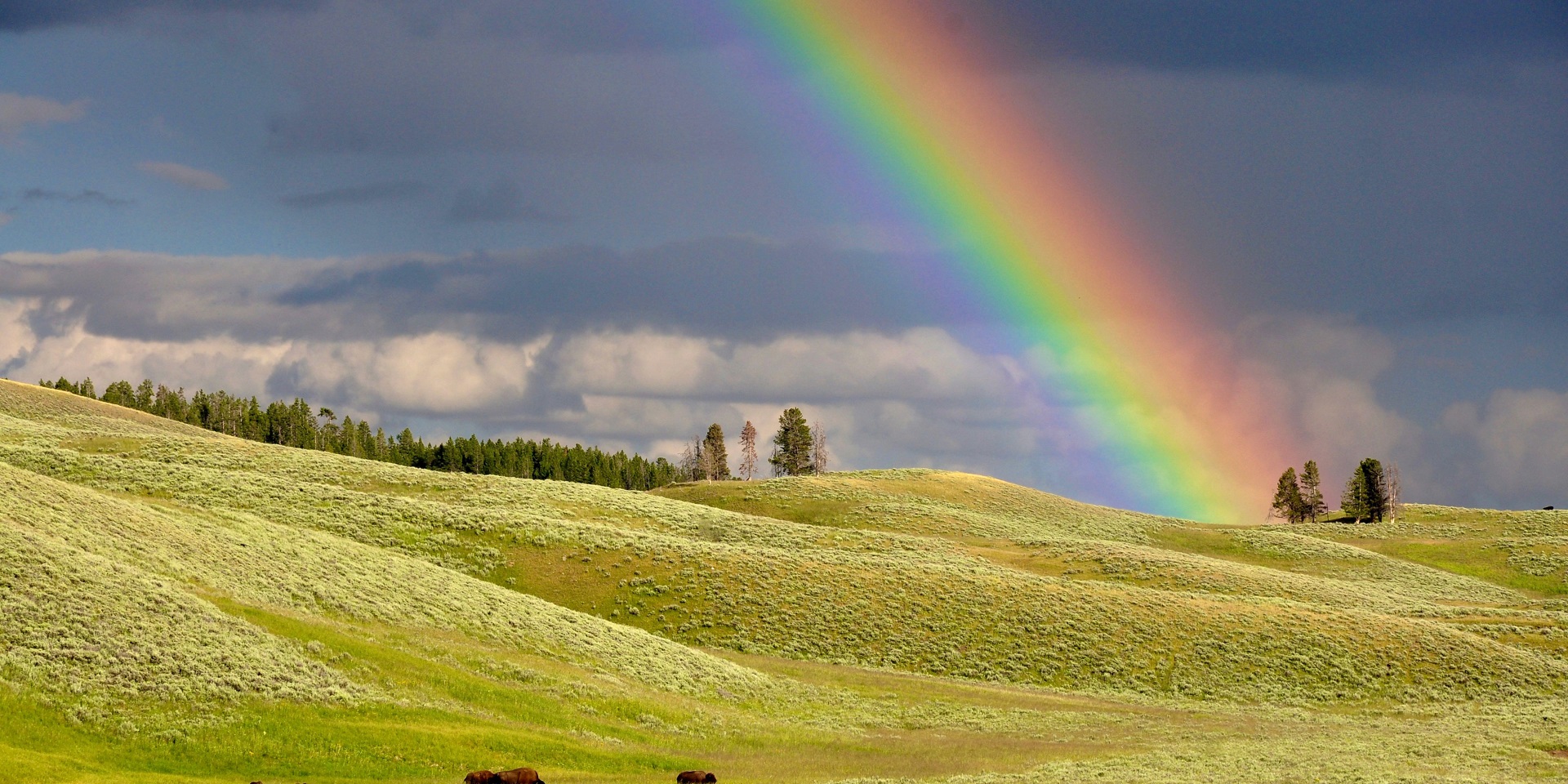
In the physical world, a rainbow is a meteorological phenomenon caused by reflection, refraction, and dispersion of light in water droplets. However, in the rapidly evolving landscape of computer graphics, digital imaging, and high-end simulation, the “cause” of a rainbow is an intricate dance of sophisticated algorithms and hardware acceleration. For developers, engineers, and tech enthusiasts, recreating the ephemeral beauty of a rainbow represents one of the most significant challenges in optical physics simulation.
To understand what causes a rainbow in the digital realm, we must move beyond the simple prism and look into the world of spectral rendering, ray tracing, and the computational power required to split a single pixel of white light into its constituent colors.
1. The Intersection of Optics and Algorithms: Simulating Dispersion
In traditional computer graphics, light is often simplified into an RGB (Red, Green, Blue) model. While this works for standard UI elements or basic gaming, it fails to capture the complexity of a rainbow. The cause of a digital rainbow begins with the move from simplified light models to complex “spectral” algorithms that mimic the actual behavior of electromagnetic waves.
From Refraction to Rasterization
At the heart of any simulated rainbow is the concept of dispersion. In physics, dispersion happens because the refractive index of a material (like water) varies based on the frequency or wavelength of the light. Tech-heavy rendering engines must calculate these variations using Snell’s Law, but with a twist: they must calculate it differently for every color in the spectrum.
In older rasterization techniques, a rainbow was often just a “cheat”—a pre-designed texture applied to a transparent mesh. Today, however, advanced shaders allow for dynamic dispersion. These shaders use mathematical functions to offset the UV coordinates of a texture based on the angle of the “camera” and the “sun,” creating a procedurally generated arc that reacts to the environment in real-time.
The Role of Wavefront Sensing in Modern Sensors
The tech behind rainbows isn’t just limited to software; it is deeply embedded in hardware. Modern digital camera sensors and wavefront-sensing technology are designed to mitigate or capture chromatic aberration—a “rainbow effect” that occurs when a lens fails to focus all colors to the same point.
By using computational photography, devices like smartphones can identify these unintended rainbows (lens flares) and use AI-driven post-processing to either remove them or, in the case of “Cinematic Modes,” artistically enhance them. This requires a deep technological understanding of how light wavelengths interact with silicon sensors.
2. Ray Tracing and Path Tracing: Decoding the Path of Light
When we ask what causes a rainbow in a high-end video game or a Hollywood CGI sequence, the answer is almost always Ray Tracing. This technology has revolutionized how we perceive digital light by simulating the physical behavior of photons as they bounce off surfaces and pass through mediums.
Path Tracing vs. Traditional Rendering
While traditional rendering looks at a scene and determines what color a pixel should be, path tracing works backward. It sends “rays” out from the camera, bounces them off objects, and traces them back to the light source. To create a rainbow, the engine must simulate millions of these rays passing through simulated water droplets in the atmosphere.
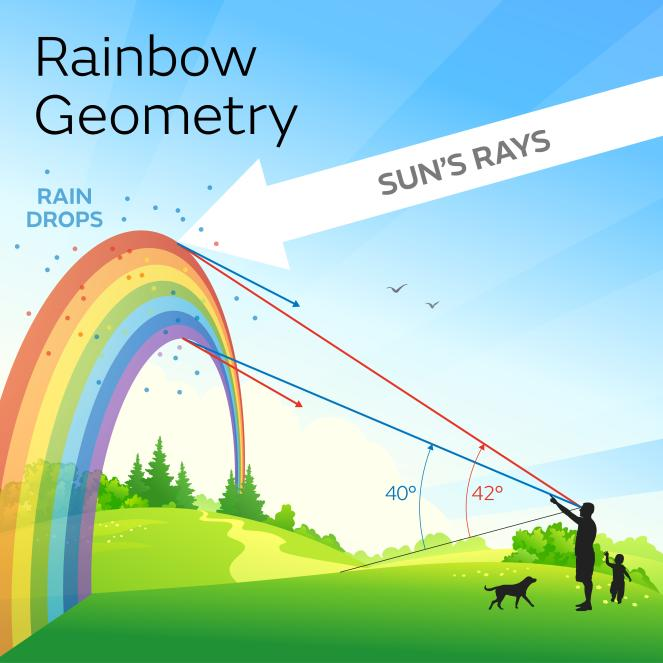
Each ray must undergo “Total Internal Reflection” within the virtual droplet. The tech must account for the 42-degree angle—the specific geometry required for a primary rainbow to become visible to an observer. Without the massive parallel processing power of modern GPUs, calculating these millions of individual light paths would be impossible in real-time.
Hardware Acceleration and the NVIDIA/AMD Revolution
The “cause” of these digital rainbows is increasingly hardware-bound. Dedicated RT (Ray Tracing) cores in modern GPUs are specifically designed to handle the heavy mathematical lifting of bounding volume hierarchies (BVH).
These hardware components allow engines like Unreal Engine 5 or NVIDIA’s Omniverse to calculate the “dispersion” of light through a medium without crashing the frame rate. We are now at a point where the “cause” of a rainbow is no longer a static image, but a real-time calculation of light interference patterns, a feat that was considered the “Holy Grail” of graphics tech only a decade ago.
3. Spectral Rendering and the Pursuit of Absolute Realism
Beyond the standard gaming setups, there is a tier of technology known as Spectral Rendering. Most digital displays and engines operate in the “Trichromatic” (RGB) space, which is a shortcut based on how the human eye perceives color. However, true rainbows are continuous spectra of light, not just three colors mixed together.
RGB vs. Spectral Workflows
In an RGB workflow, you can never truly simulate a rainbow because you are missing the wavelengths between the primary colors. To solve this, high-end rendering software used in architectural visualization and scientific simulation utilizes spectral workflows.
These engines treat light as a continuous wave. This allows for the simulation of “thin-film interference”—the rainbow effect you see on a bubble or an oil slick. By calculating the phase shift of light waves as they reflect off the top and bottom layers of a surface, the tech creates a “cause” for the rainbow that is physically indistinguishable from reality.
Atmospheric Modeling in Open-World Environments
In massive digital environments (like those found in Microsoft Flight Simulator), rainbows are caused by complex atmospheric scattering models. These models, such as Mie Scattering and Rayleigh Scattering, simulate how light interacts with particles in the air.
Engineers use “volumetric rendering” to create a 3D cloud of moisture. When the light source (the sun) hits these volumes at the correct angle relative to the player, the math triggers the spectral split. This is tech at its most poetic: using billions of calculations to recreate a moment of natural wonder.
4. Applications Beyond Gaming: The Tech of Precision
The technology used to understand and create rainbows has significant applications outside of entertainment. From satellite imagery to medical diagnostics, the ability to split light and analyze its “rainbow” (spectrum) is a cornerstone of modern digital security and sensing.
Precision in Digital Photography and Post-Processing
In the world of professional photography, the “rainbow” is often a problem known as purple fringing. Modern software tools, powered by machine learning, analyze the raw data from a sensor to identify where dispersion has occurred.
Advanced AI tools like Adobe’s Sensei or Topaz Labs’ algorithms use “Neural Filters” to reconstruct pixels that have been distorted by light splitting. By understanding the “cause” of the rainbow at the lens level, these tools can digitally “re-focus” the light after the photo has been taken.
Virtual Reality and Physiological Realism
In Virtual Reality (VR) and Augmented Reality (AR), the “cause” of a rainbow is a critical factor in user immersion. If a user moves their head and a rainbow on a surface doesn’t shift its position relative to their eyes, it breaks the “presence” of the simulation.
To solve this, AR glass manufacturers (like those working on the Apple Vision Pro or Meta Quest) use “Waveguide” technology. This tech uses nanoscopic gratings to “steer” light into the eye. If not calibrated perfectly, these waveguides cause a “rainbow effect” (chromatic nonuniformity). The engineering challenge is to use these optical properties to create perfect images while eliminating the unwanted “rainbows” inherent in the hardware itself.
5. The Future of Light: AI and Quantum Rendering
As we look toward the future, the cause of a rainbow in tech will likely shift from brute-force calculation to AI-driven “prediction.”
AI-Denoising and Light Prediction
Full spectral path tracing is still incredibly “noisy.” It produces images that look grainy because not enough rays have been calculated. The next leap in tech is AI-denoising, where a neural network looks at a partially rendered rainbow and “predicts” what the finished, smooth arc should look like. This allows for cinematic-quality light effects on relatively low-power hardware, like mobile devices.
The Pot of Gold: Neural Radiance Fields (NeRFs)
One of the most exciting trends in tech today is the use of NeRFs. Instead of building a 3D model and shining a light on it, a NeRF uses a neural network to represent a 3D scene based on a few 2D images.
If you take photos of a rainbow and feed them into a NeRF, the AI learns the “view-dependent” nature of the light. It understands that the rainbow isn’t a physical object, but a result of the camera’s position. This represents a shift in how we “cause” digital phenomena: we are moving from simulating physics to training machines to understand the perception of physics.

Conclusion
What is the cause of a rainbow? In the tech sector, it is the convergence of optical physics, GPU architecture, and advanced mathematics. It is the result of a “Spectral Workflow” that refuses to settle for the RGB shortcut, a “Ray Tracing” engine that tracks photons across a digital void, and “AI Denoising” that cleans up the mathematical noise.
As our hardware grows more powerful and our algorithms more refined, the line between the “natural” rainbow and the “digital” rainbow continues to blur. For the technologist, the rainbow is more than just a beautiful sight—it is a benchmark of computational excellence and a testament to our ability to decode and replicate the very fabric of reality through code and silicon.
aViewFromTheCave is a participant in the Amazon Services LLC Associates Program, an affiliate advertising program designed to provide a means for sites to earn advertising fees by advertising and linking to Amazon.com. Amazon, the Amazon logo, AmazonSupply, and the AmazonSupply logo are trademarks of Amazon.com, Inc. or its affiliates. As an Amazon Associate we earn affiliate commissions from qualifying purchases.