
In the world of fine jewelry and precious commodities, few terms are as frequently used yet as widely misunderstood as the “carat.” When consumers enter a luxury boutique or evaluate an engagement ring, the carat weight is often the first metric discussed. However, understanding this unit of measurement is not merely about knowing a number on an appraisal document; it is about understanding how value is quantified, how rarity is assessed, and how your capital is allocated when purchasing gemstones.
In the context of wealth management and asset allocation, understanding the carat is essential for those who view high-quality diamonds and precious stones as alternative investment vehicles. Just as one must understand the basis points of an interest rate or the price-to-earnings ratio of a stock, one must understand the carat to navigate the high-stakes market of tangible assets.
The Definition and History of the Carat
The term “carat” is a unit of mass used exclusively for measuring gemstones and pearls. One metric carat is defined as exactly 200 milligrams, or 0.2 grams. This standardization, adopted internationally at the beginning of the 20th century, replaced a chaotic system of local units that varied from city to city, often leading to price discrepancies and fraud.
The Origin: The Carob Seed
Historically, the term originates from the Greek “keration,” referring to the carob seed. Ancient traders believed that carob seeds had a remarkably consistent weight, making them ideal counterweights for balancing scales when weighing small, high-value items like diamonds. While modern science has debunked the uniformity of carob seeds, the name survived, evolving into the standardized metric we use today.
From Scales to Precision Digital Tools
Today, the appraisal process for a diamond’s carat weight is conducted with extreme precision. Using electronic analytical balances calibrated to the thousandth of a gram, gemologists can determine weight with infinitesimal margins of error. For the investor or the luxury buyer, this shift from ancient seeds to digital precision represents the transition of the diamond market from a bazaar-based trade to a global, data-driven financial industry.
Carat Weight vs. Physical Size: Understanding the Distinction
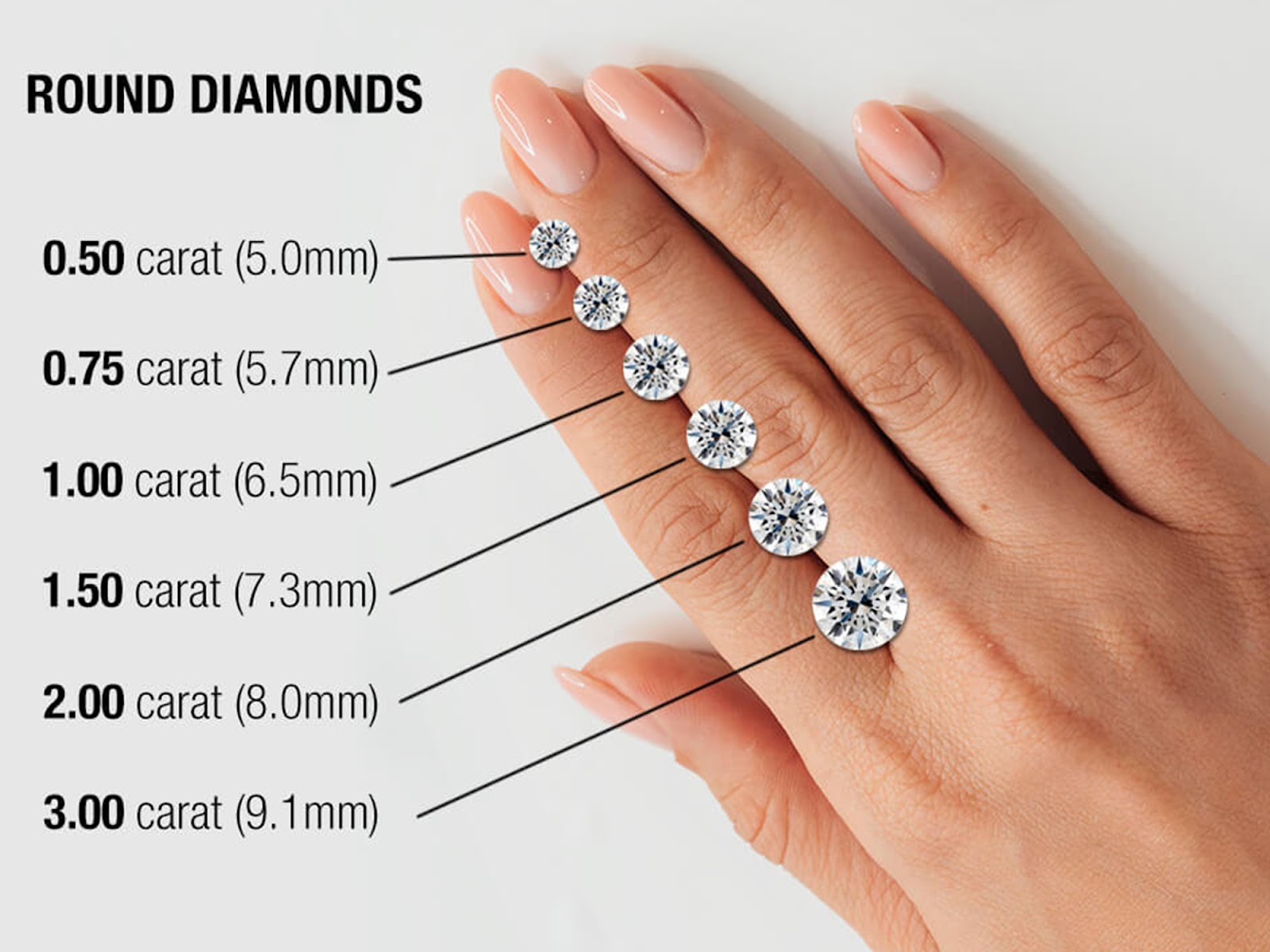
A common misconception among consumers is that carat weight is a direct measurement of a stone’s physical size or diameter. While there is a strong correlation, the two are not synonymous. This distinction is critical when evaluating the “value for money” in a potential purchase.
Density and Cutting Styles
The carat measures weight, not volume. Two diamonds of identical weight can appear to be vastly different sizes depending on how they are cut. A diamond cut with a deep pavilion—the lower portion of the stone—will carry more of its weight in the bottom, making the face of the stone appear smaller. Conversely, a shallow cut might make a diamond appear larger than it actually is, but at the risk of sacrificing brilliance and light return.
The Cost of “Spread”
In the wholesale diamond market, stones that possess a larger “spread” (the surface area visible from above) while maintaining a lower carat weight often command a premium. This is why understanding the cut grade alongside the carat weight is vital for asset preservation. If your objective is purely aesthetic, you may prioritize a larger-looking stone. If your objective is investment, you are paying for the actual mass of the carbon—the weight—which remains the most stable metric of value.

The Economics of “Magic Sizes”
When discussing the financial aspect of the carat, we must address the phenomenon of “magic sizes.” In the psychological landscape of luxury retail, certain weight thresholds—most notably the 0.50, 1.00, and 2.00-carat marks—act as significant price barriers.
Price Discontinuities
A diamond weighing 0.98 carats is often significantly cheaper than a diamond weighing 1.01 carats, despite the physical difference being virtually imperceptible to the naked eye. This occurs because the market creates high demand at the “full” or “round” carat numbers. For the astute buyer, this presents a tactical opportunity. Purchasing a stone just under the 1.00-carat threshold allows the buyer to acquire a diamond of superior color and clarity grades for the same price as a lower-quality stone that happens to hit the 1.00-carat mark.
Liquidity and Marketability
While the “magic sizes” are excellent for retail appeal, they also affect liquidity. Diamonds that hit these standard milestones are easier to sell on the secondary market because they align with established consumer desires. When holding gemstones as a store of value, choosing a weight that is highly liquid is as important as choosing a weight that offers a good price-per-carat ratio.
Evaluating Carat as an Investment Asset
If you are incorporating gemstones into a broader financial strategy, the carat weight must be viewed through the lens of scarcity. The value of a diamond does not increase linearly with its carat weight; it increases exponentially.
The Scarcity Factor
A 2-carat diamond is significantly more expensive than two 1-carat diamonds of equal quality. This is because larger, high-quality diamonds are statistically much rarer than smaller ones. As you move up the scale, the geological probability of finding a high-clarity, high-color stone increases in difficulty. Investors recognize this, which is why larger, investment-grade stones (typically 3 carats and above) tend to hold their value more robustly against market volatility than smaller, “commercial” grade stones.
Risks and Considerations
It is important to note that diamonds are not as liquid as equities or bonds. They are “hard” assets that require appraisal, certification (from reputable bodies like the GIA), and secure storage. When you invest in a diamond, you are paying a retail markup that can be difficult to recoup in the short term. Therefore, the carat weight is only one component of the equation; the “Four Cs”—Carat, Cut, Color, and Clarity—must be balanced to ensure the asset is actually an investment-grade piece rather than a depreciating consumer good.
Strategic Acquisition
For the sophisticated buyer, the strategy often involves looking for “investment-grade” properties. This involves targeting specific carat weights that are large enough to be rare, while ensuring the cut grade is “Excellent” or “Ideal.” A heavy diamond with a poor cut is essentially dead weight; a perfectly cut diamond within a desirable carat range is a concentrated store of wealth.

Conclusion: The Holistic View of Value
The carat is the fundamental unit of measurement in the gemstone industry, serving as the bridge between raw natural beauty and economic valuation. Whether you are a connoisseur seeking a statement piece or an investor looking to diversify into tangible assets, viewing the carat as more than just a number is essential.
By understanding the historical standardization of weight, the physics of diamond cutting, the psychological impact of magic sizes, and the exponential nature of rarity, you can navigate the market with confidence. The carat is the anchor of your purchase, but the knowledge of how to leverage that weight is what truly determines the quality and longevity of your investment. Always remember that while weight is the primary factor in pricing, it is the interplay between the carat and the other structural characteristics of the stone that dictates the ultimate financial return.
aViewFromTheCave is a participant in the Amazon Services LLC Associates Program, an affiliate advertising program designed to provide a means for sites to earn advertising fees by advertising and linking to Amazon.com. Amazon, the Amazon logo, AmazonSupply, and the AmazonSupply logo are trademarks of Amazon.com, Inc. or its affiliates. As an Amazon Associate we earn affiliate commissions from qualifying purchases.