
In the vast universe of chemistry, every element, from the humble hydrogen to the exotic transuranic elements, possesses a fundamental characteristic: its atomic mass. But when we talk about the “average atomic mass,” we’re not just referring to a single, fixed number. Instead, we’re delving into a concept that has significant implications, not only for scientific understanding but also for how we perceive and even brand the very building blocks of our world.
While seemingly a purely scientific query, understanding average atomic mass can be approached through the lenses of technology, brand strategy, and even financial implications, especially when considering the value and application of elements in various industries. This exploration will reveal how this seemingly esoteric concept connects to our modern technological landscape, shapes our perception of materials, and indirectly influences economic value.

The Fundamental Nature of Atomic Mass: More Than Just a Number
At its core, the atomic mass of an element is determined by the number of protons and neutrons within its nucleus. Protons, with their positive charge, define the element itself – its atomic number. Neutrons, while lacking a charge, contribute significantly to the mass. Together, these subatomic particles form the nucleus, and their combined mass is what we generally refer to when discussing atomic mass.
However, the term “average atomic mass” introduces a crucial layer of complexity. Elements rarely exist as a single, uniform entity. Instead, they often occur in nature as a mixture of isotopes. Isotopes are atoms of the same element (meaning they have the same number of protons) but differ in the number of neutrons. This difference in neutron count leads to variations in their atomic masses.
For instance, carbon, a cornerstone of organic chemistry, exists primarily as two stable isotopes: carbon-12 and carbon-13. Carbon-12 has 6 protons and 6 neutrons, giving it a mass number of 12. Carbon-13 has 6 protons and 7 neutrons, resulting in a mass number of 13. While both are carbon, their slight mass difference is significant in certain applications.
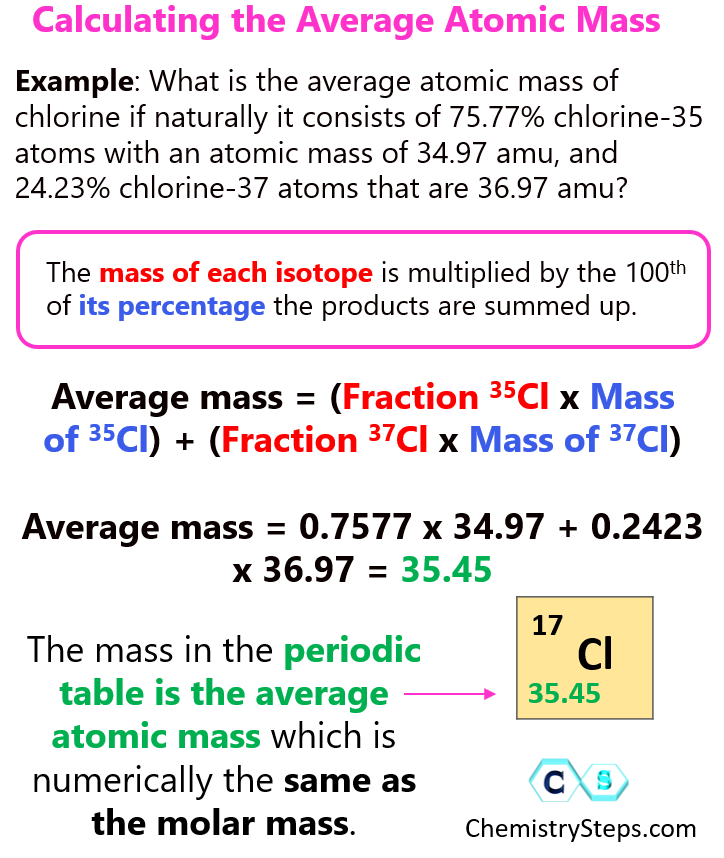
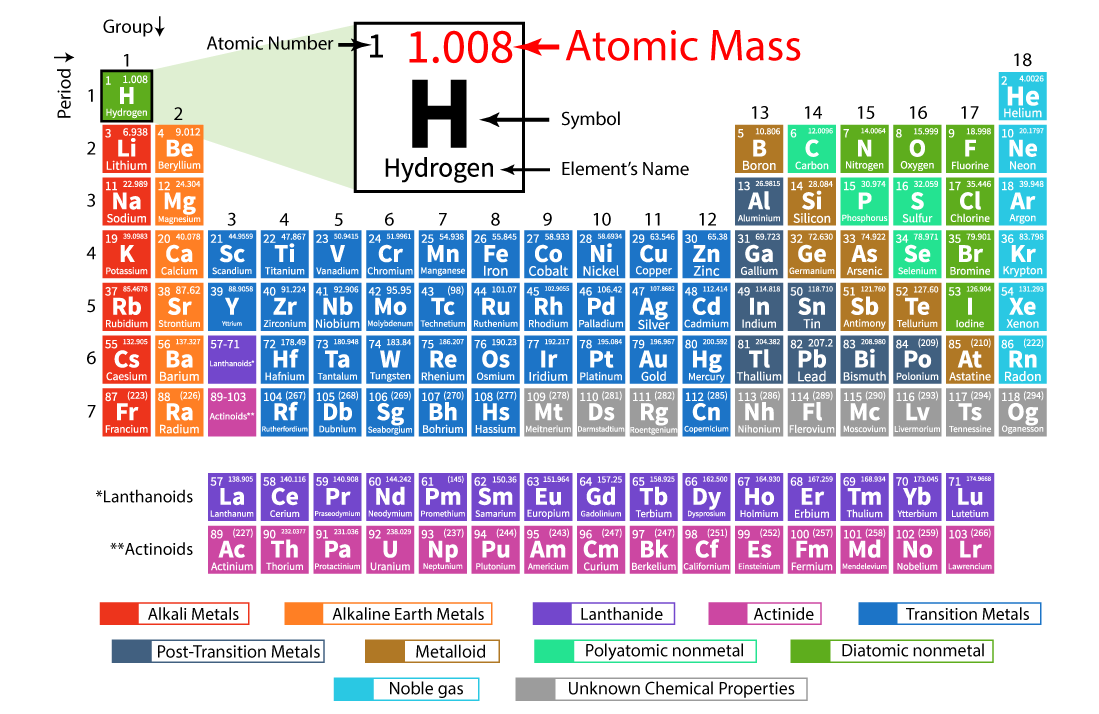
The average atomic mass listed on the periodic table is not the mass of any single atom of that element but rather a weighted average of the masses of its naturally occurring isotopes. This weighting is determined by the natural abundance of each isotope. If an isotope is more prevalent in nature, its mass will contribute more significantly to the average.
### Isotopes: The Unseen Variations Shaping Average Mass
The concept of isotopes is fundamental to understanding average atomic mass. Imagine an element as a product line, and its isotopes as slightly different versions of that product. Each version has the same core functionality (defined by protons) but minor variations in its build (defined by neutrons), leading to subtle differences in weight or performance.
- Natural Abundance: The percentage of each isotope found in a typical sample of the element is crucial. For example, if an element has two isotopes, one making up 99% of the natural sample and the other 1%, the average atomic mass will be much closer to the mass of the more abundant isotope.
- Atomic Mass Units (amu): Atomic masses are typically expressed in atomic mass units (amu). One amu is approximately equal to the mass of a single proton or neutron. This unit allows for precise comparison of the masses of different atoms.
- Calculating the Average: The weighted average is calculated by multiplying the mass of each isotope by its natural abundance (expressed as a decimal) and then summing these values.
This inherent variability within elements is not just a scientific curiosity; it has profound implications for how we develop and utilize materials in technology.
Tech’s Reliance on Atomic Precision: From Semiconductors to Superalloys
The world of technology is built upon the precise manipulation of matter at the atomic level. From the intricate circuits of our smartphones to the robust materials used in aerospace, understanding and controlling the properties of elements is paramount. The average atomic mass, as a representation of the elemental composition, plays a silent yet critical role in numerous technological advancements.
Precision in Manufacturing: The Role of Isotopic Purity
In high-tech industries, particularly in the manufacturing of semiconductors and advanced materials, isotopic purity can be a critical factor. While the average atomic mass is useful for general chemical calculations, certain applications demand a higher degree of control over isotopic composition.
- Semiconductor Fabrication: The performance of microprocessors and other semiconductor devices is highly sensitive to the composition of the materials used. While not directly about average atomic mass, understanding isotopic variations can be crucial for predicting and controlling material properties like thermal conductivity and neutron scattering, which are relevant in advanced manufacturing processes. For instance, using isotopically pure silicon can lead to more efficient heat dissipation in chips, improving their longevity and performance.
- Nuclear Applications: In nuclear reactors and medical imaging, the isotopic composition of elements is not just important; it’s critical for safety and efficacy. The average atomic mass is a starting point, but specific isotopes have unique nuclear properties. For example, the enrichment of uranium for nuclear fuel focuses on specific isotopes like Uranium-235, which are fissile.
- Advanced Materials: The development of high-strength alloys for aerospace or specialized materials for scientific research often involves careful selection and processing of elements. The average atomic mass of the constituent elements influences the overall density, strength, and reactivity of these materials. Even subtle isotopic differences can impact the performance of superalloys or catalysts.
The ability to measure, isolate, and even synthesize specific isotopes is a testament to technological progress. Techniques like mass spectrometry allow scientists to determine the isotopic composition of samples with incredible accuracy. Furthermore, isotope separation technologies, such as gas centrifugation, enable the enrichment or depletion of specific isotopes, opening doors to applications where isotopic purity is paramount. This technological mastery over atomic composition directly impacts the reliability and efficiency of the gadgets and systems we rely on daily.
Branding Elements: From Elemental Purity to Material Identity
The concept of “average atomic mass” also intersects with the world of branding and marketing, albeit indirectly. While consumers rarely ponder the isotopic distribution of the aluminum in their soda cans, the perceived purity, origin, and consistent properties of materials are crucial for brand perception and product reliability.
Communicating Material Value: Beyond the Periodic Table
Brand managers and product designers leverage the inherent qualities of elements to build trust and communicate value. The “average atomic mass” is a scientific descriptor, but what it represents – the fundamental building blocks of a material – carries significant branding weight.
- Perceived Purity and Quality: When a product is advertised as being made with “high-purity copper” or “aerospace-grade titanium,” it’s communicating a desired characteristic. While “high-purity” might not directly refer to isotopic purity in a consumer context, it evokes a sense of quality, consistency, and lack of undesirable contaminants. This perception is built on the understanding that the element behaves predictably due to its consistent composition, which is underpinned by its average atomic mass.
- Origin Stories and Sourcing: Just as brands highlight the origin of their coffee beans or the craftsmanship of their leather, the sourcing of raw materials can become part of a brand’s narrative. While the average atomic mass is universal for an element, the geological location where it’s mined can be a selling point, implying unique qualities or ethical sourcing practices. This connects to the broader idea of material identity.
- The “Element of Surprise” in Innovation: New technologies often emerge from the novel application of elements or their isotopes. When a new material with exceptional properties is discovered or engineered, its branding will focus on those unique attributes. For example, the rare-earth elements, despite their relatively common average atomic masses, are branded as “critical” for modern electronics due to their unique magnetic and optical properties. This branding hinges on the specific behaviors of these elements, which are ultimately determined by their atomic structure and isotopic composition.
The way we talk about and present materials in our products shapes consumer perception. While the average atomic mass is a scientific constant, the marketing of elements as reliable, pure, and innovative components contributes to the overall brand identity of a product and, by extension, the elements themselves.
Money Matters: The Economic Implications of Elemental Properties
The economic value of elements is intrinsically linked to their abundance, their useful properties, and the technological sophistication required to extract and utilize them. Average atomic mass, as a descriptor of an element’s fundamental composition, plays a role in these economic considerations.
Resource Valuation and Investment: From Precious Metals to Rare Earths
The financial markets recognize the inherent value of elements. This valuation is influenced by a complex interplay of supply, demand, and the utility of these elements in various industries.
- Precious Metals: Gold, silver, and platinum are valued not only for their rarity but also for their chemical inertness and aesthetic appeal. Their consistent atomic structure, reflected in their average atomic masses, contributes to their predictable behavior and thus their enduring value as stores of wealth and components in high-end jewelry and electronics.
- Industrial Commodities: Elements like iron, copper, and aluminum are the backbone of global industry. Their widespread use in construction, transportation, and manufacturing makes their price fluctuations a significant indicator of global economic health. The average atomic mass of these elements informs their density and reactivity, which are critical for their industrial applications.
- Rare Earth Elements (REEs) and Strategic Minerals: The demand for REEs, essential for magnets in electric vehicles and wind turbines, has skyrocketed. The economic and geopolitical significance of these elements is immense. While their average atomic masses are not what makes them “rare” or “strategic” in the economic sense (their geological scarcity and difficulty of extraction are key), their specific electronic configurations, dictated by their atomic structure, are what make them indispensable for modern technology. The economic scramble for access to these elements highlights how fundamental atomic properties, which average atomic mass is a part of, translate directly into significant financial and strategic value.
The cost of research and development into new extraction techniques, isotope separation, and material science applications also directly impacts the economic landscape. Technologies that enable more efficient use of rare elements or the discovery of new materials with desirable properties can create significant economic opportunities and reshape industries.
Conclusion: The Interconnectedness of Science, Technology, and Value
The question “what is the average atomic mass of an element” might initially seem confined to the academic realm of chemistry. However, as we’ve explored, this fundamental scientific concept is interwoven with the fabric of our modern world.
From the intricate technologies that power our digital lives, which rely on the precise manipulation of matter at the atomic level, to the branding strategies that communicate quality and innovation through material perception, and finally to the global economic considerations that dictate the value of resources, the average atomic mass serves as a foundational piece of information.
It is a reminder that even the most abstract scientific principles have tangible, far-reaching implications, shaping our understanding, our tools, and our world. The continuous advancement in our ability to understand, measure, and even engineer materials at the atomic scale ensures that the study of concepts like average atomic mass will remain not just relevant, but vital, for future innovation and progress.
aViewFromTheCave is a participant in the Amazon Services LLC Associates Program, an affiliate advertising program designed to provide a means for sites to earn advertising fees by advertising and linking to Amazon.com. Amazon, the Amazon logo, AmazonSupply, and the AmazonSupply logo are trademarks of Amazon.com, Inc. or its affiliates. As an Amazon Associate we earn affiliate commissions from qualifying purchases.