
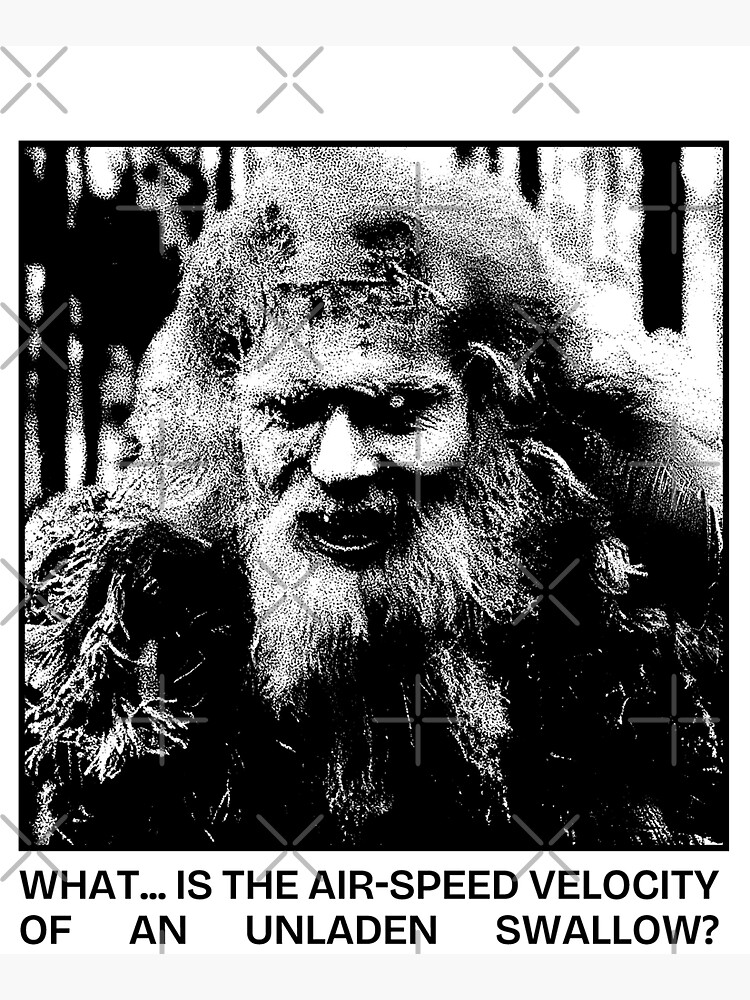
In the pantheon of internet culture and cinematic history, few questions are as iconic or as deceptively complex as “What is the air velocity of an unladen swallow?” Originating from the 1975 film Monty Python and the Holy Grail, this query has evolved from a comedic trope into a legitimate benchmark for testing the limits of search engine algorithms, the reasoning capabilities of Large Language Models (LLMs), and the precision of computational fluid dynamics (CFD).
While the original joke hinges on the absurdity of demanding scientific data for a nonsensical guard’s inquiry, the technological community has adopted the swallow as a mascot for a much deeper challenge: how do we teach machines to handle underspecified problems? To answer the question today requires more than a witty retort; it requires an exploration of modern aerodynamics, data modeling, and the evolution of artificial intelligence.
The Physics of Flight: Computational Modeling and Aerodynamics
To determine the air velocity of a swallow, one must move beyond the script and into the realm of biomechanics and physics-based simulation. In technical terms, the flight of a bird is a complex interplay of lift, drag, thrust, and weight, often modeled using the Strouhal number—a dimensionless value used in physics to describe oscillating flow mechanisms.
Kinematics and Wing Beat Frequency
The velocity of a bird in flight is not a static number but a variable dependent on wing beat frequency and amplitude. For a swallow—specifically the Hirundo rustica (European Barn Swallow)—ornithologists and physicists have utilized high-speed imaging and sensor data to feed into computational models.
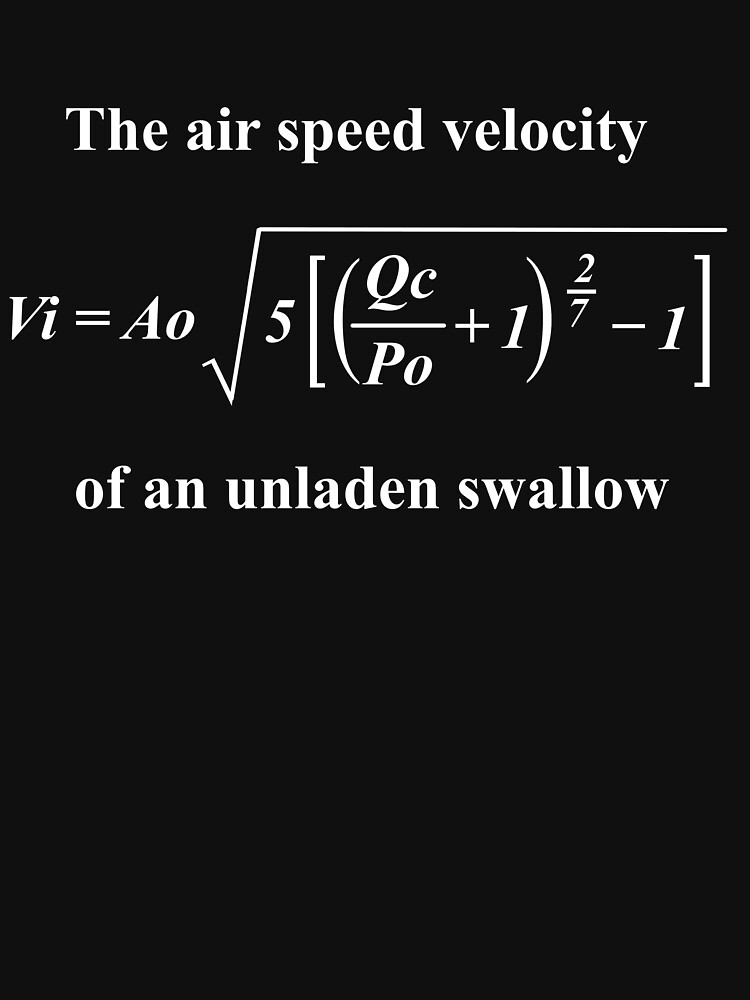
Technologically, this involves calculating the “u” (velocity) based on the formula where velocity is roughly proportional to the frequency of the wing beat multiplied by the amplitude. Research suggests that a Barn Swallow has a wing beat frequency of roughly 18 beats per second with an amplitude of 18 centimeters. When these variables are processed through modern physics engines, the resulting cruising speed sits at approximately 11 meters per second, or roughly 24 miles per hour.
Computational Fluid Dynamics (CFD) in Avian Study
To get a more precise answer, aerospace engineers utilize Computational Fluid Dynamics (CFD). This software simulates how air flows around the swallow’s unique wing geometry. By creating a 3D mesh of a swallow and subjecting it to virtual wind tunnel tests, researchers can analyze the lift-to-drag ratio at various speeds. These simulations are resource-intensive, requiring significant GPU compute power to solve the Navier-Stokes equations that govern fluid motion. This tech-driven approach reveals that the “unladen” aspect is critical; any additional mass (like a coconut) radically shifts the power-to-weight ratio, requiring a non-linear increase in energy expenditure that the swallow’s metabolism cannot sustain.
The “African or European” Problem: AI, Context, and Parameterization
The most famous rebuttal to the swallow question is the counter-query: “What do you mean? An African or a European swallow?” In the world of software engineering and Artificial Intelligence, this represents the classic problem of parameterization and contextual awareness.
Dealing with Underspecified Queries
When a user asks a modern AI an underspecified question, the system must decide whether to provide a general answer, ask for clarification, or make an educated guess based on probability distributions. Early search engines would simply look for the string of text and return movie quotes. However, contemporary AI models utilize Natural Language Processing (NLP) to recognize the intent behind the question.
If you ask a sophisticated LLM today, it recognizes the cultural context (the movie) while simultaneously accessing its training data to provide the biological facts. This dual-track processing is a hallmark of “Reasoning” models. The AI must disambiguate the “European Swallow” (which is migratory and well-studied) from the “African Swallow” (a broader category involving several species).
Logic Gates and Prompt Engineering
For developers, the swallow question serves as a perfect case study for “edge cases.” In a controlled logic environment, a system cannot proceed without defined variables.
- Input: Swallow Species? (Option A: European, Option B: African)
- Input: Payload? (Boolean: True/False)
- Calculation: If Unladen and European, then Velocity = 11m/s.
Modern prompt engineering uses this specific joke to test if an AI can maintain “persona” while delivering factual accuracy. It tests the model’s ability to handle “hallucinations”—ensuring the AI doesn’t invent a velocity for a non-existent “Cylindrical Swallow” just to satisfy the user’s prompt.
From Keyword Matching to Semantic Understanding
The evolution of how technology answers the “swallow question” mirrors the transition of the internet from a repository of documents to a web of interconnected meanings (The Semantic Web).
The Role of Knowledge Graphs
Search giants like Google and Bing use “Knowledge Graphs” to answer this. When you type the query, the engine doesn’t just look for pages containing those words; it identifies “Swallow” as an entity (an organism) and “Air Velocity” as an attribute (a physical constant).
The technology links these entities through a massive web of verified data points. This allows the engine to bypass the joke entirely if the user is looking for scientific data, or to highlight the movie trivia if the intent is identified as entertainment. This “intent recognition” is powered by deep learning transformers that analyze the relationship between words in a high-dimensional vector space.
The Impact of Large Language Models (LLMs)
LLMs have changed the stakes by providing “zero-shot” reasoning. Unlike a standard database, an LLM doesn’t just “find” the answer; it “synthesizes” it. If a new research paper were published tomorrow claiming the swallow is actually 15% faster due to climate-driven migratory changes, a RAG-enabled (Retrieval-Augmented Generation) AI could integrate that new tech data into its answer in real-time. This represents a shift from static data retrieval to dynamic knowledge synthesis.
Digital Security and the “Swallow” as a Turing Test
In the realm of digital security and bot detection, the swallow question has occasionally been used as a low-level “human-check” or a cultural Turing test.
Creative Verification
Because the answer requires a mix of cultural literacy and logical reasoning, it was once a popular “easter egg” in software validation. Bots that were programmed to only scrape literal data would fail to provide the “African or European” retort, marking them as non-human or poorly programmed.
While modern AI can easily bypass this now, the principle remains: using “cultural nuances” as a layer of authentication. In digital security, this falls under the category of behavioral analysis—looking for the “quirks” in how a user interacts with a system to verify identity.
Information Provenance
The swallow question also highlights the tech challenge of “Information Provenance.” Because the “24 mph” figure is widely cited across the internet (often based on a specific 2003 article by Jonathan Corum), it has become a “truth” in the digital ecosystem. For tech professionals, this raises the question of algorithmic bias and circular reporting. If every AI is trained on the same internet meme, does the “true” velocity of the bird get lost in favor of the “popular” velocity? Maintaining data integrity in an era of AI-generated content is the next great hurdle for tech architects.
Conclusion: Why the Swallow Matters in the Age of Artificial Intelligence
What began as a surrealist comedy bit has become a fascinating intersection of avian biology, computational physics, and the cutting edge of AI development. The “air velocity of an unladen swallow” is no longer just a joke; it is a testament to our technological progress.
We have moved from a world where such a question was a dead-end to one where we can simulate the bird’s flight in a virtual wind tunnel, parse the linguistic intent of the asker through neural networks, and synthesize an answer that respects both the comedy of the source and the rigor of the science.
In the end, the velocity of the swallow is less important than the tools we built to find it. Whether it is a European swallow cruising at 11 meters per second or an African species navigating the tropics, the ability of our technology to categorize, simulate, and understand the nuance of the question is what truly takes flight. As AI continues to evolve, our “swallow-like” queries will only become more complex, pushing the boundaries of what machines can perceive and what we, as humans, continue to wonder.
aViewFromTheCave is a participant in the Amazon Services LLC Associates Program, an affiliate advertising program designed to provide a means for sites to earn advertising fees by advertising and linking to Amazon.com. Amazon, the Amazon logo, AmazonSupply, and the AmazonSupply logo are trademarks of Amazon.com, Inc. or its affiliates. As an Amazon Associate we earn affiliate commissions from qualifying purchases.