
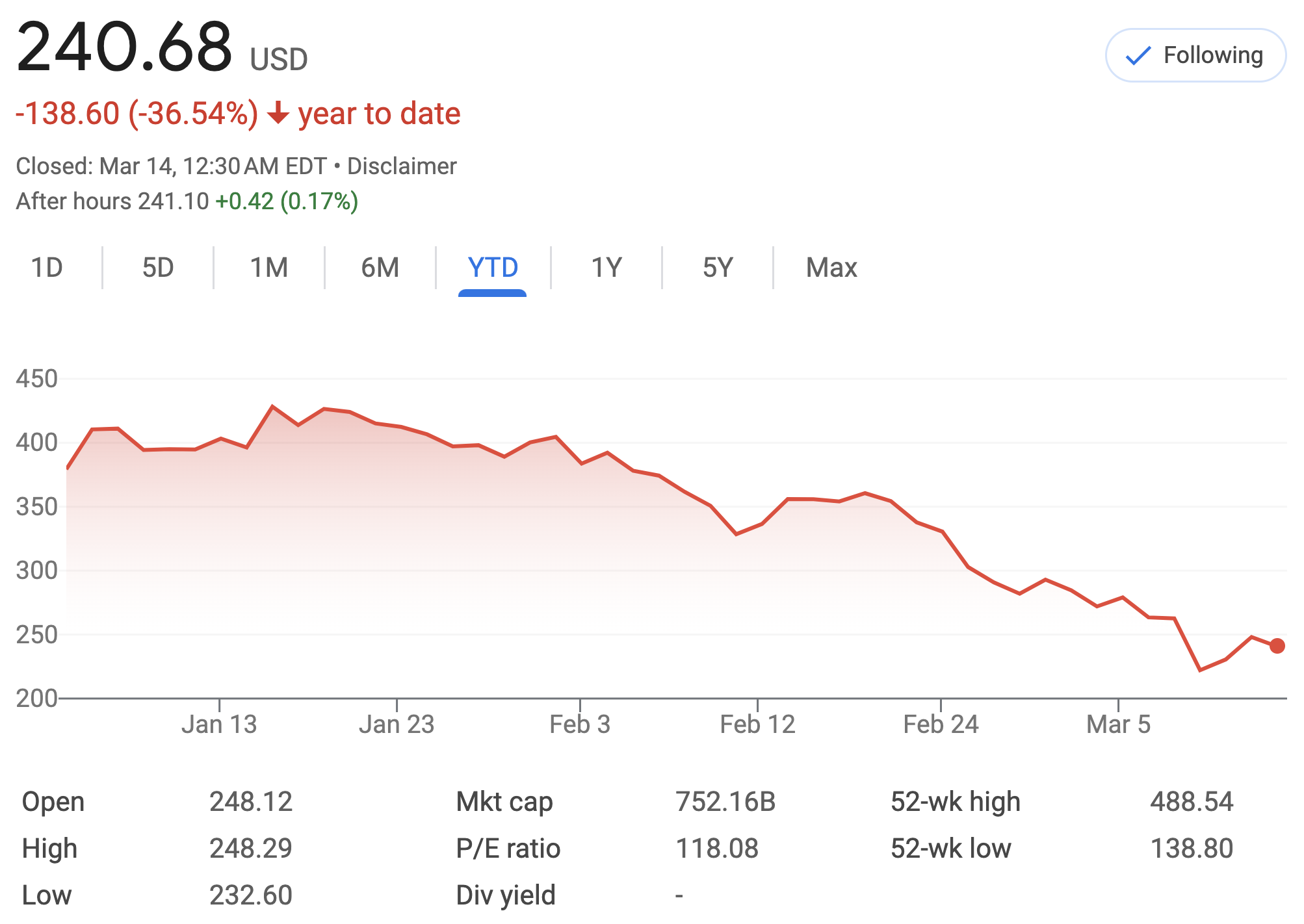
The question “What is Tesla’s stock price today?” is often the starting point for millions of retail and institutional investors worldwide. However, for the serious investor, the numeric value flashing on a brokerage app is merely the tip of the iceberg. Tesla (TSLA) has established itself not just as an automaker, but as a financial barometer for the broader growth stock market, electric vehicle (EV) sentiment, and the future of industrial scaling. To understand Tesla’s stock price today, one must look beyond the ticker and analyze the underlying financial drivers, valuation metrics, and macroeconomic forces that dictate its movement.

Understanding the Factors Driving Tesla’s Market Valuation
Tesla’s stock price is notoriously volatile, often experiencing swings that seem disconnected from the traditional automotive industry. This is because the market treats Tesla as a high-growth technology firm rather than a legacy manufacturer. The valuation is driven by several core financial pillars.
Earnings Reports and Profit Margins
The most significant driver of Tesla’s price on any given day is its quarterly earnings performance. Unlike many of its competitors, Tesla’s bottom line is scrutinized for its “Automotive Gross Margin.” Investors look specifically at margins excluding regulatory credits to see if the company is making a healthy profit on the vehicles themselves. When Tesla cuts prices to stimulate demand, as seen in recent fiscal years, the stock often reacts to the resulting compression in margins. A narrowing margin suggests increased competition and price sensitivity, while expanding margins signal operational efficiency and brand pricing power.
Production Volume and Delivery Targets
In the world of capital-intensive manufacturing, volume is king. Tesla’s stock price is highly sensitive to “Deliveries vs. Estimates.” Every quarter, Wall Street sets a benchmark for how many vehicles Tesla should deliver. Missing these targets, even by a small percentage, can lead to a sharp decline in stock price as it raises concerns about demand saturation or supply chain bottlenecks. Conversely, beating delivery estimates often triggers “short squeezes” and bullish rallies, as it proves Tesla’s ability to scale its Gigafactories in Texas, Berlin, and Shanghai effectively.
Analyzing Tesla Through Key Financial Metrics
To determine if Tesla’s current stock price represents a fair value, a premium, or a discount, investors must move away from nominal price and toward valuation multiples. Tesla has historically traded at a significant premium compared to the rest of the S&P 500.
The Price-to-Earnings (P/E) Ratio Debate
Tesla’s P/E ratio is a constant point of contention among financial analysts. Traditional value investors often point to a high P/E ratio as evidence that the stock is overvalued compared to legacy giants like Toyota or Volkswagen. However, growth-oriented investors argue that the forward P/E is more relevant. This perspective suggests that because Tesla’s earnings are expected to grow at an exponential rate due to software services (Full Self-Driving) and energy storage, a higher multiple today is justified. When the stock price falls, the P/E ratio “contracts,” which can sometimes signal an attractive entry point for long-term buyers.
Free Cash Flow and Capital Expenditure
A company’s ability to generate cash after accounting for capital expenditures (CapEx) is a sign of financial maturity. Tesla’s transition from burning through cash to generating billions in Free Cash Flow (FCF) was the primary catalyst for its inclusion in the S&P 500. For investors tracking the stock price today, the FCF yield is a vital metric. High CapEx is necessary for Tesla to build new factories and develop the “Robotaxi” infrastructure. If Tesla can maintain a positive FCF while spending billions on R&D and expansion, the stock price generally maintains a “growth premium.”
The Macroeconomic Environment and Its Impact on TSLA
Tesla does not exist in a vacuum. Its stock price is heavily influenced by the global economic climate, particularly interest rates and geopolitical shifts.
Interest Rates and Growth Stock Volatility
Tesla is categorized as a “long-duration” asset. This means that a significant portion of its perceived value is based on cash flows expected far into the future. When the Federal Reserve or other central banks raise interest rates, the “discount rate” applied to those future cash flows increases, making them less valuable in today’s dollars. This is why Tesla’s stock price often moves in inverse correlation with Treasury yields. For the modern investor, monitoring the macro-interest rate environment is just as important as monitoring Tesla’s own balance sheet.
Global Competitive Landscape in the EV Sector
The financial health of Tesla is also tied to its market share. In recent years, the entry of low-cost Chinese manufacturers like BYD and the electrification efforts of luxury brands like Porsche and BMW have created a “margin war.” Investors track Tesla’s market share in key regions like China and Europe to gauge future revenue growth. If Tesla is forced to sacrifice price to maintain share, the stock may suffer. However, if Tesla’s vertical integration allows it to maintain lower production costs than its rivals, it maintains a “moat” that protects the stock price from permanent impairment.
Long-Term Investment Strategies for Tesla Shareholders
Given the inherent volatility of TSLA, retail investors often struggle with the timing of their entries and exits. Professional financial planning suggests a more disciplined approach to such a high-beta stock.
Dollar-Cost Averaging into Volatility
Because it is nearly impossible to predict the “bottom” of a Tesla price correction, many financial advisors recommend Dollar-Cost Averaging (DCA). By investing a fixed amount of capital at regular intervals, investors buy more shares when the price is low and fewer when the price is high. This strategy mitigates the risk of a “lump sum” investment made at a local peak and allows the investor to benefit from the stock’s long-term upward trajectory without being paralyzed by daily fluctuations.
Assessing Risk and Portfolio Allocation
Tesla is a “high-risk, high-reward” component of a portfolio. From a business finance perspective, it is rarely advisable for an individual to have 100% of their net worth in a single equity, especially one as volatile as Tesla. Proper portfolio construction involves balancing a position in TSLA with more stable value stocks or index funds. This ensures that a 10% or 20% swing in Tesla’s price—which is common—does not jeopardize the investor’s overall financial security.
Looking Ahead: The Financial Roadmap for Tesla
The future trajectory of Tesla’s stock price will likely depend on its evolution from a hardware company to a software and energy company. This shift has profound implications for its financial statements.
Energy Storage and the “Second Growth Engine”
While vehicles comprise the bulk of Tesla’s revenue today, the “Tesla Energy” division (Megapacks and Powerwalls) is growing at a rapid pace. From an investing standpoint, this provides revenue diversification. High-margin energy storage contracts can offset the cyclical nature of the automotive market. Analysts are increasingly including the valuation of the energy business as a separate line item in their “Sum of the Parts” (SOTP) models, which can provide a higher floor for the stock price.

The Financial Potential of Autonomy and AI
The “X-factor” in Tesla’s stock price is its development of Autonomous Driving and the Optimus robot. If Tesla successfully transitions to a licensing model for its AI software or launches a functional Robotaxi network, its revenue model shifts from one-time hardware sales to recurring, high-margin software revenue. This is the “bull case” that many institutional investors bet on. However, because this revenue is speculative, it adds a layer of “valuation risk.” If timelines for these technologies are pushed back, the stock price often undergoes significant “de-risking” events.
In conclusion, knowing Tesla’s stock price today is only the beginning of the journey. For the savvy investor, the real work lies in analyzing gross margins, monitoring interest rate pivots, and understanding the company’s capital allocation strategy. Whether viewed as an overvalued car company or an undervalued AI powerhouse, Tesla remains one of the most significant financial assets of the modern era, requiring a sophisticated and disciplined approach to investment.
aViewFromTheCave is a participant in the Amazon Services LLC Associates Program, an affiliate advertising program designed to provide a means for sites to earn advertising fees by advertising and linking to Amazon.com. Amazon, the Amazon logo, AmazonSupply, and the AmazonSupply logo are trademarks of Amazon.com, Inc. or its affiliates. As an Amazon Associate we earn affiliate commissions from qualifying purchases.