
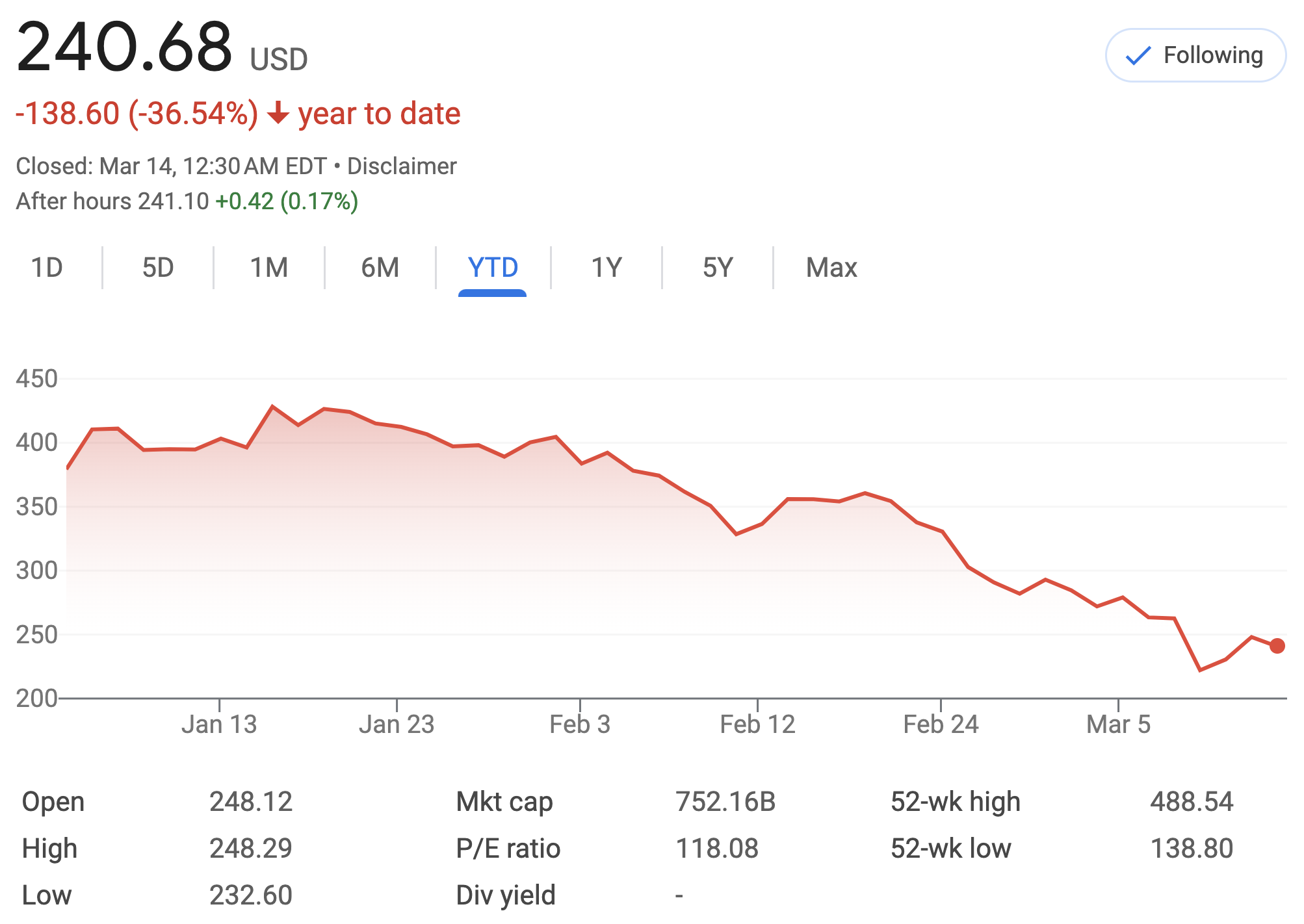
Determining “what Tesla stock is at” requires much more than a glance at a real-time ticker symbol. For the modern investor, Tesla (TSLA) represents one of the most polarizing and complex assets in the financial markets. It is a stock that defies traditional automotive valuation metrics, frequently trading at multiples that suggest it is a software powerhouse rather than a manufacturer of physical goods. To understand the current standing of Tesla stock, one must navigate the intersection of macroeconomic pressures, internal production efficiencies, and the speculative fervor surrounding autonomous intelligence.

The Foundations of Tesla’s Market Valuation
When investors ask where Tesla stock stands, they are often grappling with its unconventional valuation. Unlike legacy automakers such as Ford or General Motors, which are valued based on steady dividends and modest price-to-earnings (P/E) ratios, Tesla has historically commanded a premium that reflects high-growth expectations.
Analyzing the P/E Ratio: Premium Pricing in a Competitive Market
Tesla’s price-to-earnings ratio is frequently the subject of intense debate on Wall Street. While a traditional car manufacturer might trade at a P/E of 5 to 10, Tesla often finds itself in the 40 to 80 range, or even higher during bullish cycles. This premium signifies that investors are not just paying for the cars sold today, but for the projected dominance of the energy and transport sectors tomorrow. When the stock price dips, it is often because the market is recalibrating these growth expectations against the reality of current interest rates. High-interest environments tend to discount future earnings, making Tesla’s “growth” narrative harder to sustain for short-term traders.
Market Cap vs. Traditional Automakers: Why the Disconnect?
At various points in its history, Tesla’s market capitalization has exceeded that of the next ten largest global automakers combined. From a purely financial perspective, this disconnect is driven by Tesla’s vertical integration and its software-first approach. Investors view Tesla’s data-gathering capabilities and its proprietary Supercharger network as “moats” that provide a recurring revenue stream, similar to a SaaS (Software as a Service) business. Therefore, the stock’s “level” is often a reflection of how much the market trusts Tesla’s ability to maintain a monopoly-like grip on the infrastructure of the electric vehicle (EV) ecosystem.
Key Financial Drivers of Tesla’s Price Action
The actual price of Tesla stock on any given day is heavily influenced by specific financial KPIs (Key Performance Indicators) that the company releases quarterly. For those looking to understand the stock’s movement, these metrics are the primary catalysts for volatility.
Quarterly Deliveries and Production Margins
The most immediate driver of Tesla’s stock price is the delivery report. Because Tesla sells directly to consumers rather than through a dealer network, its delivery numbers are a transparent look at real-world demand. However, the stock’s health is equally dependent on “gross margins.” In recent years, Tesla has engaged in strategic price cuts to maintain market share against rising competition from Chinese manufacturers and European incumbents. For the investor, the “bottom line” is whether Tesla can lower prices to stimulate volume without eroding the industry-leading margins that justified its high stock price in the first place.
The Impact of Interest Rates and Macroeconomic Sentiment
As a “high-beta” stock, Tesla is more sensitive to market swings than the average S&P 500 company. Because electric vehicles are significant capital purchases, high interest rates directly impact Tesla’s affordability for the average consumer. When the Federal Reserve signals a “higher for longer” stance on rates, Tesla stock often faces downward pressure. Investors must monitor the cost of capital, as Tesla’s capital-intensive projects—such as the construction of new Gigafactories in Texas, Berlin, and potentially Mexico—require massive liquidity and favorable lending conditions to remain accretive to the stock price.
Risk Factors and Volatility in the Tech-Centric Portfolio
Investing in Tesla is not for the faint of heart. The stock is characterized by “drawdowns” that can exceed 50% in a single year, only to recover and hit new highs. Understanding where the stock is “at” requires an acknowledgment of the unique risks associated with the brand and its leadership.
The “Elon Premium”: CEO Influence on Stock Performance
Tesla’s stock is inextricably linked to the persona and public actions of its CEO, Elon Musk. This creates what analysts call the “key person risk.” Musk’s involvement in other ventures—such as X (formerly Twitter), SpaceX, and xAI—often leads to concerns about “CEO dilution” or the potential for Musk to sell Tesla shares to fund his other interests. Any news regarding Musk’s focus or his legal battles can cause immediate, double-digit fluctuations in the stock price, independent of the company’s actual financial performance. For the disciplined investor, the “Elon Premium” is a double-edged sword that provides both the visionary momentum for the stock and its most significant source of erratic movement.
Regulatory Hurdles and Global Competition from China
Tesla no longer operates in a vacuum. The rise of BYD and other Chinese EV giants has created a price war that threatens Tesla’s dominance in the world’s largest auto market. Furthermore, regulatory scrutiny regarding “Full Self-Driving” (FSD) and Autopilot features remains a persistent shadow over the stock. If the National Highway Traffic Safety Administration (NHTSA) or international regulators impose strict limitations on Tesla’s software, a significant portion of the stock’s speculative value could vanish. Investors must balance the potential for a “Robotaxi” future against the grim reality of recalls and safety investigations.
Long-Term Investment Outlook: Beyond the Passenger Vehicle
To determine if Tesla stock is a “buy,” “hold,” or “sell” at its current price, one must look at the company’s revenue diversification. If Tesla is viewed solely as a car company, it may appear overvalued. If it is viewed as an energy and AI conglomerate, it may be undervalued.
Revenue Diversification: Energy Storage and Solar
A growing segment of Tesla’s balance sheet is dedicated to Tesla Energy. The deployment of Megapacks (large-scale battery storage) and Powerwalls is becoming a more significant contributor to the company’s total revenue. As the global power grid shifts toward renewables, the demand for stationary storage is projected to grow exponentially. Institutional investors often look at the growth rate of the Energy division as a “buffer” for the stock; even if car sales fluctuate due to consumer sentiment, the utility-scale energy business provides a more stable, long-term growth trajectory that could eventually rival the automotive sector in terms of valuation.

Autonomous Driving and AI as Financial Multipliers
The ultimate “bull case” for Tesla stock lies in its artificial intelligence and robotics programs. This includes the development of the Optimus humanoid robot and the aforementioned FSD software. From a financial standpoint, the successful deployment of a Robotaxi network would shift Tesla’s business model from a hardware manufacturer to a high-margin service provider. This is why the stock often rallies on “AI Days” or software updates. For the long-term investor, the “value” of Tesla stock is largely a bet on whether the company can solve the physics of autonomous navigation. If Tesla succeeds in licensing its FSD software to other automakers, the stock could undergo a fundamental re-rating, moving from a cyclical consumer discretionary asset to a high-margin technology utility.
In summary, knowing “what Tesla stock is at” involves a deep dive into the company’s financial fundamentals, its role in the broader macroeconomic environment, and its progress toward becoming an AI-driven powerhouse. While the ticker price provides a snapshot of current market sentiment, the true value of the stock lies in its ability to navigate the transition from a niche EV maker to a global leader in sustainable energy and autonomous technology. Investors must remain vigilant, recognizing that with Tesla’s high potential for returns comes a commensurate level of risk and market volatility.
aViewFromTheCave is a participant in the Amazon Services LLC Associates Program, an affiliate advertising program designed to provide a means for sites to earn advertising fees by advertising and linking to Amazon.com. Amazon, the Amazon logo, AmazonSupply, and the AmazonSupply logo are trademarks of Amazon.com, Inc. or its affiliates. As an Amazon Associate we earn affiliate commissions from qualifying purchases.