
Terrazzo, an ancient yet perpetually modern composite material, has graced some of the world’s most iconic buildings and public spaces for centuries. Its distinctive speckled appearance, incredible durability, and endless design possibilities have cemented its status as a favored material among architects, designers, and developers worldwide. However, beyond its captivating aesthetics, lies a sophisticated blend of raw materials that gives terrazzo its unique characteristics. To truly appreciate its enduring legacy in design, one must first understand its fundamental composition.
The essence of terrazzo lies in its simple yet ingenious formula: aggregates, typically chips of marble, quartz, granite, glass, or other suitable materials, are mixed with a binder, which is usually cementitious or polymeric. This mixture is then poured, ground, and polished to reveal a smooth, continuous surface that is both beautiful and exceptionally robust. This article will delve into the core components that make up this design classic, exploring how each element contributes to its aesthetic versatility, functional performance, and ultimate impact on spatial identity.
The Enduring Legacy of Terrazzo in Design
Terrazzo’s journey from humble beginnings to a design stalwart is a testament to its intrinsic qualities. Its history is intertwined with human ingenuity and a continuous quest for both beauty and utility in construction. Understanding this legacy provides crucial context for why its composition matters so much to contemporary design.
A Brief History: From Ancient Scraps to Modern Marvel
The origins of terrazzo can be traced back over 1,500 years to ancient Egypt, where similar techniques were used. However, the most direct lineage points to 15th-century Venice, Italy. Venetian construction workers, accustomed to laying marble floors, began to use discarded marble chips from their projects to create inexpensive, durable, and attractive surfaces for their own homes. These early iterations involved laying marble chips in clay and then grinding them flat with rudimentary tools, often involving a long-handled stone. The name “terrazzo” itself comes from the Italian word for “terraces,” referring to the outdoor patios where it was first used.
Over centuries, techniques evolved, incorporating Portland cement as a binder and later, mechanical grinding machines. The 20th century saw a major resurgence, particularly in Art Deco and Mid-Century Modern architecture, thanks to advancements in binders and the recognition of its hygienic and durable properties. Today, modern technology and materials have further refined terrazzo, expanding its applications and aesthetic range while retaining its core principles. This rich history demonstrates how a material, initially born out of resourcefulness, transcended its utilitarian roots to become a symbol of sophisticated design.
Why Terrazzo Persists: Aesthetics Meets Durability
Terrazzo’s persistence in design discourse is largely due to its unparalleled combination of aesthetic flexibility and practical durability. From a design perspective, it offers an almost infinite palette. Designers can specify virtually any color for the binder and select from a vast array of aggregate types, sizes, and colors, allowing for bespoke patterns, logos, and intricate designs. This customizability means terrazzo can perfectly align with a brand’s visual identity or a space’s desired mood, from vibrant and playful to subtle and sophisticated.
Functionally, terrazzo is incredibly resilient. It is known for its longevity, often outlasting the buildings it’s installed in. Its seamless surface is non-porous when properly sealed, making it highly resistant to stains, moisture, and microbial growth, which is critical for healthcare, education, and retail environments where hygiene is paramount. Furthermore, it’s easy to clean and maintain, contributing to lower lifecycle costs—a significant consideration in both commercial and public design projects. This blend of beauty and brawn makes terrazzo a compelling choice for spaces that demand both visual impact and long-term performance, directly reflecting on the “brand” of a space as one of quality and foresight.
The Core Components: Demystifying Terrazzo’s Composition
At its heart, terrazzo is a composite material, and understanding what it’s made of reveals the secrets to its strength, beauty, and adaptability. The interplay of its primary components—aggregate, binder, and sometimes dividers—is crucial to its final performance and aesthetic.
Aggregate: The Heart of Terrazzo’s Visual Appeal
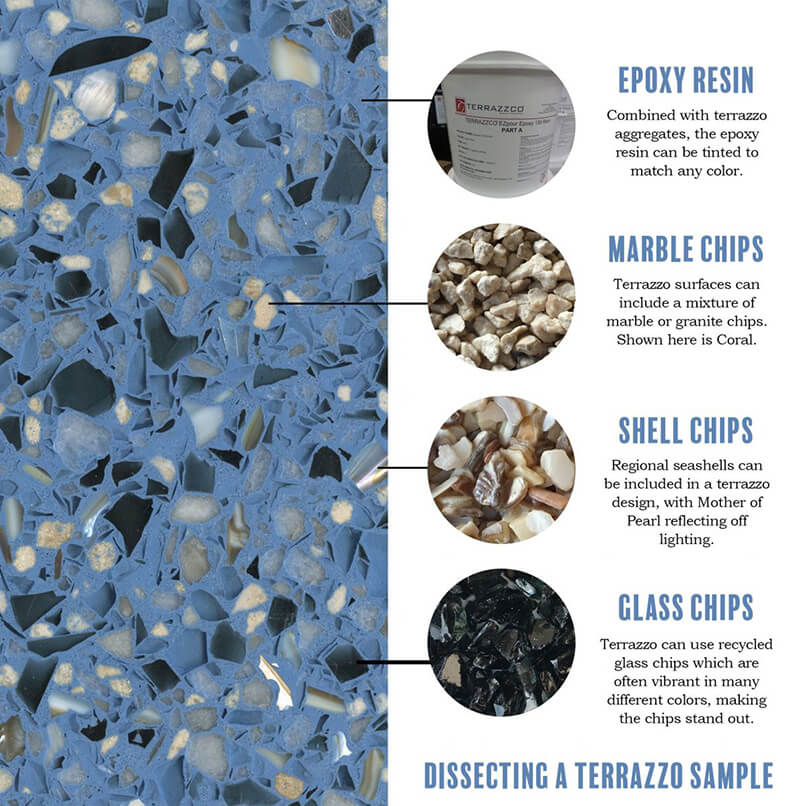
The aggregate is arguably the most visually dominant component of terrazzo, giving it its characteristic speckled or mottled appearance. Traditionally, marble chips were the aggregate of choice, owing to their beauty and availability in Italy. Today, the range of aggregates has expanded dramatically, offering designers an unprecedented array of textures, colors, and reflective qualities.
- Marble Chips: Still a classic, marble provides a timeless, elegant look. Available in various colors and sizes, it allows for both subtle and dramatic effects.
- Granite Chips: Known for its hardness and crystalline structure, granite offers excellent durability and a sophisticated, often sparkling finish.
- Quartz Chips: Similar to granite in hardness, quartz chips come in a wide spectrum of colors and can add a brilliant, jewel-like quality to the surface.
- Glass Chips: Recycled glass is a popular choice, offering vibrant colors and a contemporary feel. It can be clear, colored, or mirrored, creating unique light play.
- Mother-of-Pearl, Abalone Shells, Metal Filings: For specialty designs, these aggregates can add unique iridescence, shimmer, or industrial edge, allowing for truly distinctive spatial branding.
The size of the aggregate also plays a critical role. Finer aggregates create a more uniform, subtle texture, while larger chips produce a bolder, more fragmented pattern. The ratio of aggregate to binder also affects the final look and feel, with higher aggregate content often yielding a richer, more luxurious appearance.
Binder: The Matrix of Strength and Cohesion
The binder is the material that holds the aggregates together, forming the continuous matrix that defines terrazzo’s monolithic surface. The choice of binder profoundly impacts the material’s properties, including its strength, flexibility, color stability, and suitability for various applications.

- Cementitious Binders: These are the traditional binders, typically based on Portland cement. Cementitious terrazzo is known for its exceptional hardness, breathability, and suitability for exterior applications due to its UV stability. It can be pigmented to match or contrast with the aggregates. While highly durable, it is less flexible than resin-based systems and may be prone to cracking if not properly installed with control joints.
- Epoxy Binders: Modern epoxy binders have revolutionized terrazzo, offering significant advantages. Epoxy terrazzo is non-porous, highly resistant to chemicals and stains, and incredibly strong, allowing for thinner installations. Its superior bond strength reduces the need for extensive control joints, creating more seamless designs. Epoxy also offers an almost unlimited color palette, as the resin can be tinted precisely, providing designers with ultimate color matching capabilities—a huge asset when trying to align a space’s floor with a corporate color scheme or brand identity. However, epoxy systems are generally not recommended for exterior use due to potential UV degradation and yellowing.
- Polyacrylate Binders: These are a hybrid, offering some of the flexibility and chemical resistance of epoxy with greater breathability, making them suitable for some exterior applications or projects requiring moisture vapor transmission.
The binder acts as the backdrop for the aggregates, and its color choice is just as critical as the aggregate selection in achieving the desired design aesthetic.
Dividers: Crafting Patterns and Preventing Cracks
Metal divider strips are an integral part of terrazzo installation, serving both functional and aesthetic purposes. Functionally, they accommodate structural movement in the slab beneath, preventing random cracking by creating planned control joints. They also allow for the separation of different colors of terrazzo, enabling the creation of intricate patterns, geometric designs, and embedded logos.
Common materials for dividers include:
- Zinc: A popular choice for its durability and relatively low cost.
- Brass: Offers a warm, elegant look and can develop a beautiful patina over time, often chosen for more luxurious designs.
- Aluminum: Lightweight and corrosion-resistant.
- Plastic: Used in some applications, particularly where metal is undesirable or specific flexibility is needed.
The width and material of the dividers are design decisions that contribute to the overall visual language of the terrazzo floor, seamlessly integrating into the grand scheme of the space’s identity.
Terrazzo’s Design Versatility and Sustainable Appeal
The intricate composition of terrazzo underpins its immense versatility, making it a powerful tool for designers seeking to create unique and impactful spaces. Beyond its beauty and brawn, terrazzo also offers compelling sustainability credentials, aligning with contemporary demands for environmentally responsible building materials.
Aesthetic Freedom: Color, Texture, and Pattern
The beauty of terrazzo from a design perspective is its unparalleled customizability. By manipulating the type, size, and color of aggregates, combined with the binder color and divider layout, designers can achieve virtually any aesthetic.
- Monochromatic Schemes: Subtle shifts in aggregate and binder tones create sophisticated, minimalist surfaces.
- Bold Contrasts: High-contrast aggregates against a complementary or contrasting binder can make a dramatic statement.
- Complex Patterns and Murals: Dividers allow for the creation of intricate geometric patterns, custom logos, wayfinding elements, and even expansive artistic murals, turning a floor into a canvas that reinforces brand identity or tells a story.
- Texture Play: The degree of polish can influence the final texture, from a high-gloss sheen that reflects light and expands a space to a matte finish that provides a softer, more subdued look.
This level of control means terrazzo is not just a material; it is a design medium. It enables architects and interior designers to meticulously craft environments that resonate with a specific brand ethos, evoke a desired emotion, or serve a particular functional narrative.
Sustainability in Practice: Reclaimed Materials and Longevity
In an era where environmental stewardship is paramount, terrazzo stands out as a highly sustainable material, primarily due to its composition and lifecycle.
- Recycled Content: Many modern terrazzo formulations incorporate recycled materials, such as post-consumer glass, recycled concrete, and even salvaged ceramics or metals as aggregates. This diverts waste from landfills and reduces the demand for virgin resources.
- Longevity: Terrazzo’s extraordinary durability means it lasts for decades, often for the life of the building. This drastically reduces the need for replacement and the associated energy and material consumption, making it a truly long-term investment.
- Low VOCs: Epoxy terrazzo systems can be formulated with low or zero volatile organic compounds (VOCs), contributing to better indoor air quality—a crucial factor for occupant health and LEED certification.
- Thermal Mass: Its dense composition can contribute to a building’s thermal mass, potentially helping to regulate indoor temperatures and reduce energy consumption.
By choosing terrazzo, designers are not only selecting a visually striking and durable material but also making a responsible environmental choice, which can significantly enhance a building’s green credentials and align with a company’s commitment to sustainability – an increasingly vital aspect of brand perception.
The Impact of Materiality on Brand and Space Identity
The choices made in material specification are rarely superficial; they are integral to shaping the identity and perceived value of a space. For designers and brand strategists, understanding “what is terrazzo made of” translates into understanding how to leverage its inherent qualities to sculpt a powerful and lasting impression.
Defining Corporate and Public Spaces
In commercial and public buildings, materials speak volumes about the organization or institution they house. Terrazzo, with its robustness and refined appearance, communicates stability, quality, and a forward-thinking design sensibility. A custom-designed terrazzo floor in a corporate lobby, featuring a company logo or specific brand colors, instantly reinforces corporate identity, creating a memorable first impression. In public spaces like airports, museums, or hospitals, its durability and ease of maintenance project an image of efficiency and care for the public, while its aesthetic allows for a grand, welcoming, or educational environment. The material becomes an architectural extension of the brand’s values, contributing to brand recognition and user experience.

Elevating Personal Branding in Residential Design
While traditionally associated with large-scale projects, terrazzo is increasingly finding its way into high-end residential design. Here, it elevates personal branding by allowing homeowners to express individual taste and sophistication. A terrazzo kitchen countertop, a custom bathroom floor, or a statement wall transforms a private space into a curated reflection of the owner’s aesthetic vision. Its bespoke nature means that each residential installation can be truly unique, avoiding mass-produced uniformity and instead embodying a personalized luxury that speaks volumes about the resident’s design acumen and appreciation for craftsmanship.
In conclusion, “what is terrazzo made of” is not merely a technical question; it’s an inquiry into the very building blocks of design and identity. The careful selection and combination of aggregates, binders, and dividers allow terrazzo to be endlessly customized, transforming it from a simple construction material into a potent design tool. Its capacity for bespoke aesthetics, combined with unparalleled durability and significant sustainability advantages, positions terrazzo as a critical element in crafting spaces that not only function flawlessly but also powerfully articulate the brand, vision, and values they embody.
aViewFromTheCave is a participant in the Amazon Services LLC Associates Program, an affiliate advertising program designed to provide a means for sites to earn advertising fees by advertising and linking to Amazon.com. Amazon, the Amazon logo, AmazonSupply, and the AmazonSupply logo are trademarks of Amazon.com, Inc. or its affiliates. As an Amazon Associate we earn affiliate commissions from qualifying purchases.