
In the intricate world of finance and decision-making, understanding the psychological biases that influence our choices is paramount. Among the most pervasive and financially detrimental is the sunk cost fallacy. This cognitive trap describes our tendency to continue investing in an endeavor or project, even when it’s clearly failing or no longer aligns with our objectives, simply because we’ve already committed significant resources – be it money, time, or effort – that cannot be recovered. It’s the human inclination to avoid admitting past mistakes by compounding them in the present, leading to further financial losses and missed opportunities.
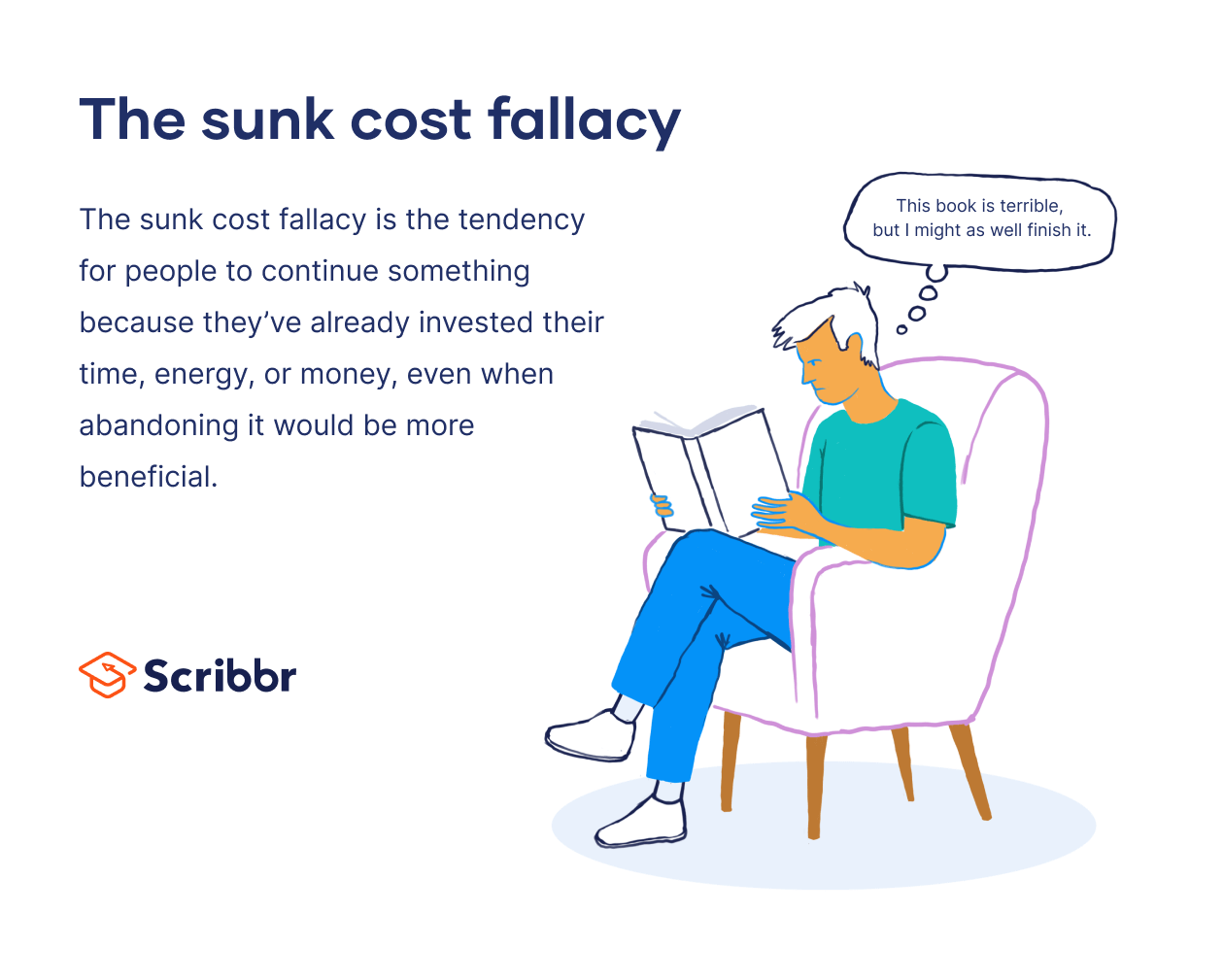
The concept of sunk costs is fundamental to rational economic decision-making. A sunk cost is an expense that has already been incurred and cannot be recovered. From a purely economic standpoint, such costs should be irrelevant to future decisions. What matters are the prospective costs and benefits. Yet, human psychology frequently overrides this logic. We feel the weight of our past investments, transforming them into a psychological burden that dictates our path forward, often at our own financial peril. This article will delve deep into the nature of the sunk cost fallacy, explore its manifestations in personal finance, business, and investing, and provide actionable strategies to mitigate its adverse effects, fostering more resilient and profitable financial choices.
Understanding the Core Concept
To effectively combat the sunk cost fallacy, one must first grasp its fundamental components: what constitutes a sunk cost, the psychological underpinnings that make this fallacy so potent, and the critical distinction between rational economic thought and emotional bias.
Defining Sunk Costs
A sunk cost, by definition, is money, time, or resources that have already been spent and cannot be recovered. For example, if you buy a non-refundable concert ticket for $100 and then on the day of the concert you feel unwell, the $100 is a sunk cost. It’s gone whether you go to the concert or not. The decision of whether to attend should ideally be based on your current well-being versus the enjoyment you expect from the concert, not on the $100 you’ve already spent. In a business context, this could be research and development expenses for a product that now appears unviable, or the cost of machinery purchased for a project that has since been canceled. These costs are “sunk” because they are immutable; no future action can bring them back. Rational economic theory dictates that future decisions should only consider future costs and future benefits, completely disregarding sunk costs.
The Psychology Behind the Fallacy
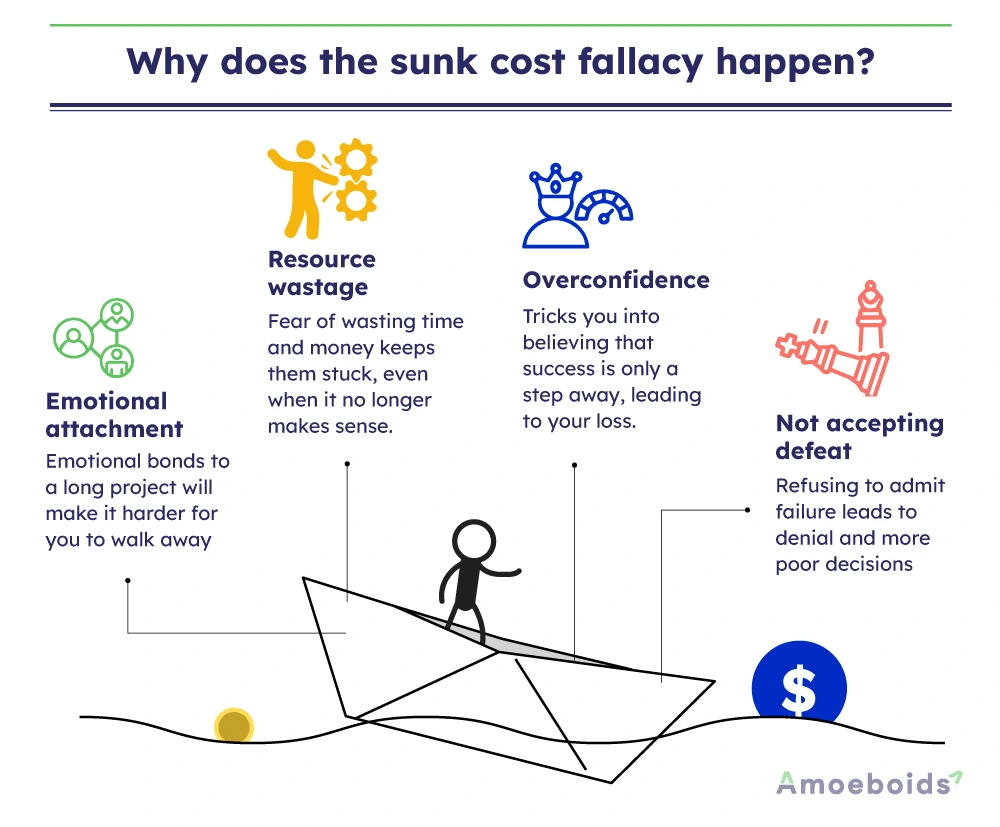
Why do we fall victim to this seemingly illogical behavior? The sunk cost fallacy is rooted in several powerful psychological phenomena. Firstly, there’s the loss aversion principle, where the pain of losing is psychologically more powerful than the pleasure of gaining an equivalent amount. Admitting that a past investment was a mistake feels like a loss, and we try to avoid that feeling by continuing to invest, hoping to “turn things around” and thereby validate our initial decision. Secondly, cognitive dissonance plays a significant role. This is the mental discomfort experienced by a person who holds contradictory beliefs, ideas, or values. If we’ve invested heavily in something, admitting it was a bad idea creates dissonance, so we rationalize continuing to invest to maintain consistency with our past choices. Thirdly, a desire to avoid regret fuels the fallacy. We fear regretting the decision to cut our losses, especially if, by some chance, the project eventually succeeds after we’ve abandoned it. Finally, a sense of personal responsibility or accountability, particularly in professional settings, can make individuals or teams reluctant to pull the plug on a failing project if they were the ones who initiated or championed it. The fear of being perceived as having made a mistake can override objective financial assessment.
Rational vs. Emotional Decision-Making
The conflict between rational economic principles and psychological biases is at the heart of the sunk cost fallacy. Rational decision-making in finance dictates a forward-looking perspective: every decision should be based on its future costs and benefits, marginal gains, and opportunity costs. Emotions, however, often pull us backward, tethering us to past investments. Our inherent biases – loss aversion, regret aversion, and the need for consistency – make it incredibly difficult to objectively evaluate a situation when personal investment is involved. Understanding this distinction is the first step towards liberating our financial choices from the shackles of past commitments, allowing us to make decisions that truly serve our future financial well-being.
Sunk Cost Fallacy in Personal Finance
The impact of the sunk cost fallacy isn’t confined to large corporations or complex investment portfolios; it permeates our daily personal financial decisions, often subtly draining our resources and limiting our financial growth.
Holding onto Losing Investments
One of the most common manifestations of the sunk cost fallacy in personal finance is the reluctance to sell losing investments. An investor might hold onto a stock or mutual fund that has significantly underperformed, often for years, telling themselves, “I can’t sell now; I’ve already lost so much money. It has to come back.” The initial purchase price becomes an anchor, and selling at a loss feels like solidifying that loss, even if holding onto it prevents them from investing in more promising opportunities. This behavior directly contradicts the principle of cutting your losses short and letting your winners run, a cornerstone of successful investing. The money already spent on the losing investment is a sunk cost and should not influence the decision to sell or hold based on future prospects.
Unnecessary Upgrades and Subscriptions
Another subtle yet widespread area where sunk costs influence personal finance is in recurring expenditures. Consider a homeowner who has spent a significant amount of money on renovations for an old car or a particular appliance. When the item inevitably breaks down again, instead of considering a new, more reliable replacement, they might opt for yet another expensive repair, reasoning, “I’ve already put so much money into it; I might as well fix it one more time.” Similarly, consumers might continue paying for a gym membership they rarely use, a streaming service they no longer watch, or software subscriptions they don’t utilize, because they’ve “already paid for the whole year” or “it was part of a bundle.” The money is already spent, yet the feeling of not getting “full value” out of the sunk cost compels continued, often wasteful, expenditure.
Persisting with Unprofitable Ventures
From personal side hustles that never gain traction to online courses left unfinished, the sunk cost fallacy can keep individuals trapped in unprofitable personal ventures. Someone might have invested hundreds or even thousands of dollars in a new business idea that, after months, shows no signs of profitability. Instead of acknowledging the market’s lack of interest or their own limitations and pivoting, they continue to pour more money, time, and emotional energy into it, fearing that abandoning it would render all previous efforts meaningless. This can be particularly damaging, as it ties up capital and personal bandwidth that could be better utilized in more promising endeavors or simply saved. The emotional attachment to the initial investment often blinds individuals to the clear signs of failure, preventing them from making a rational decision to cut ties and move forward.
Sunk Cost Fallacy in Business and Investing
The repercussions of the sunk cost fallacy are magnified in the realm of business and investing, where decisions can involve millions or even billions of dollars, affecting shareholder value, employee livelihoods, and the strategic direction of entire organizations.
Project Management Pitfalls

Businesses are particularly susceptible to the sunk cost fallacy in project management. Imagine a large-scale IT project that is significantly over budget and behind schedule. Despite clear indicators that the project will not deliver the expected ROI or may even become obsolete by the time it’s completed, management might decide to “double down” on the investment. The argument often heard is, “We’ve already spent $X million; we can’t abandon it now.” This leads to throwing good money after bad, diverting critical resources from potentially more profitable ventures. The Concorde supersonic airliner project is a classic example: a collaboration between the British and French governments, it was plagued by cost overruns and technical challenges. Despite clear signs of its commercial non-viability, political and prestige factors, combined with the immense sunk costs, kept the project alive for decades, leading to massive financial losses for both nations.
Strategic Investment Errors
At a strategic level, companies can make monumental errors due to the sunk cost fallacy when evaluating acquisitions, mergers, or market entry strategies. A company might acquire another business at a premium, only to find later that the synergy was overestimated or market conditions changed. Instead of divesting the underperforming acquisition, the executive team might resist, citing the huge sum already spent, the integration costs, and the reputational damage of admitting a bad deal. This can cripple the acquiring company’s balance sheet and strategic flexibility for years. Similarly, businesses might cling to outdated product lines or manufacturing processes because of the capital equipment or intellectual property already invested, rather than innovating or reallocating resources to emergent, more profitable areas.
The Entrepreneurial Trap
Entrepreneurs, often driven by passion and personal investment, are especially vulnerable to the sunk cost fallacy. Starting a business requires immense personal capital – financial, emotional, and temporal. When a startup encounters significant challenges or pivots fail to yield results, the entrepreneur’s deep personal investment can make it excruciatingly difficult to admit defeat. They might continue to fund a failing venture with personal savings, borrow more money, or sacrifice personal well-being, all because of the “blood, sweat, and tears” already poured into the business. While persistence is a valuable entrepreneurial trait, the inability to distinguish between healthy perseverance and a commitment driven by sunk costs can lead to catastrophic personal financial ruin. Understanding when to pivot, when to iterate, and crucially, when to fold, is a critical skill for sustainable entrepreneurship.
Overcoming the Sunk Cost Fallacy
While deeply ingrained, the sunk cost fallacy is not insurmountable. By consciously adopting certain mindsets and implementing practical strategies, individuals and businesses can make more objective, forward-looking financial decisions.
Adopting a Forward-Looking Mindset
The most powerful antidote to the sunk cost fallacy is to consciously adopt a forward-looking mindset. This means deliberately shifting focus from “what I have already spent” to “what I will gain or lose from this point forward.” Every financial decision should be framed as if no previous investment had been made. Ask yourself: “Knowing what I know now, would I make this investment today?” Or, “If I were starting from scratch, would I put new money into this?” If the answer is no, then the rational course of action is to cut your losses, regardless of past expenditures. This approach prioritizes future potential and minimizes future regrets.
The Power of Independent Evaluation
In organizational settings, bringing in objective third parties or establishing independent review processes can be crucial. Project managers or teams emotionally invested in a project may find it difficult to objectively assess its viability. An external consultant, an independent committee, or even a different internal team with no prior involvement can provide a fresh perspective, free from the bias of sunk costs. For personal finance, this could mean consulting a financial advisor who can offer unbiased advice on your investment portfolio, or discussing a major financial decision with a trusted friend or mentor who can help you see past your emotional attachments.
Setting Clear Exit Strategies
Proactive planning is a potent weapon against the sunk cost fallacy. Before embarking on a significant investment, project, or business venture, establish clear, objective criteria for success and equally clear “kill points” or exit strategies. What are the key performance indicators (KPIs) that, if not met by a certain date, will trigger a re-evaluation or even an automatic cessation of investment? By defining these thresholds in advance, when emotions are not yet running high due to sunk costs, you create a rational framework that can guide future decisions. This pre-commitment strategy removes the subjective bias from future evaluations, making it easier to pull the plug when necessary.
Practical Strategies for Financial Resilience
Beyond mindset shifts, concrete tools and practices can further fortify financial decision-making against the influence of sunk costs.
Cost-Benefit Analysis and Opportunity Cost
Regularly performing a thorough cost-benefit analysis for any ongoing project or investment is critical. This means weighing the future costs against the future benefits. Crucially, this analysis must also incorporate the concept of opportunity cost. What alternative investments or uses of resources are you foregoing by continuing down the current path? The true cost of continuing a failing venture is not just the additional money spent, but also the potential returns or benefits lost from a more promising alternative. By explicitly quantifying these opportunity costs, the financial implications of continuing to commit to a poor decision become much clearer and more compelling.
Seeking External Advice
Whether you are an individual managing personal finances or a CEO steering a multi-million-dollar enterprise, seeking external, impartial advice can provide invaluable perspective. Financial advisors, business consultants, mentors, or even trusted peers can offer a dispassionate view of your situation. They are not emotionally invested in your past decisions and can help you identify when you are falling prey to the sunk cost fallacy, prompting you to consider alternatives based on current facts and future potential. This “outside-in” perspective is often exactly what’s needed to break free from the self-imposed prison of past expenditures.
Embracing Failure as a Learning Opportunity
Finally, a fundamental shift in perspective towards failure is crucial. In many cultures and organizational environments, failure is stigmatized, making individuals and teams even more reluctant to admit mistakes and cut losses. However, viewing failure not as an end but as a valuable learning opportunity can transform how we react to challenges. Every abandoned project or divested losing investment provides critical insights into market dynamics, project management, or personal limitations. By embracing this philosophy, the psychological pain of admitting a “sunk” cost is mitigated by the recognition of the future value of the lessons learned, fostering an environment where rational decision-making is prioritized over the avoidance of perceived failure.
In conclusion, the sunk cost fallacy is a powerful, yet often hidden, impediment to sound financial decision-making. By understanding its psychological roots, recognizing its manifestations in both personal and business finance, and actively employing forward-looking strategies, individuals and organizations can cultivate a financial resilience that prioritizes future growth and profitability over the lingering shadow of past expenditures. Making decisions based on what lies ahead, rather than what has already been spent, is the cornerstone of effective financial management and a pathway to greater financial success.
aViewFromTheCave is a participant in the Amazon Services LLC Associates Program, an affiliate advertising program designed to provide a means for sites to earn advertising fees by advertising and linking to Amazon.com. Amazon, the Amazon logo, AmazonSupply, and the AmazonSupply logo are trademarks of Amazon.com, Inc. or its affiliates. As an Amazon Associate we earn affiliate commissions from qualifying purchases.