
In the world of finance, few terms are uttered with as much reverence and frequency as the “S&P 500.” Whether you are watching a nightly news broadcast, reading a quarterly earnings report, or discussing retirement plans with a financial advisor, the S&P 500 invariably takes center stage. But for many, it remains a nebulous concept—a fluctuating number on a screen that somehow dictates the health of the global economy.
To the disciplined investor, the S&P 500 is far more than a statistic. It is a barometer of American corporate health, a vehicle for passive wealth accumulation, and the yardstick against which almost all other investment performances are measured. This guide provides a deep dive into the mechanics, history, and strategic importance of the S&P 500, framing it within the context of a robust personal finance strategy.

1. What is the S&P 500? Deciphering the Benchmark of American Capitalism
The Standard & Poor’s 500, commonly known as the S&P 500, is a stock market index that tracks the performance of 500 of the largest companies listed on stock exchanges in the United States. While there are thousands of publicly traded companies, the S&P 500 represents approximately 80% of the total market capitalization of the U.S. equity market. Because of this massive breadth, it is widely considered the single best gauge of “the market.”
The Origins and Evolution of the Index
The index was launched in its current form in 1957 by Standard & Poor’s, a financial services company. However, its roots trace back to 1923, when the company first began tracking a smaller group of stocks. The transition to a 500-company list in the late 1950s coincided with the post-war economic boom, capturing the expansion of American industry. Over the decades, the index has evolved from being dominated by industrial and railroad giants to being led by technology and healthcare innovators, mirroring the structural shifts in the global economy.
Selection Criteria and the Index Committee
Unlike some indices that are purely algorithmic, the S&P 500 is maintained by a committee at S&P Dow Jones Indices. To be included, a company must meet strict eligibility requirements. As of recent updates, these include a minimum market capitalization (often exceeding $14 billion), high liquidity, a public float of at least 10% of its shares, and—crucially—positive earnings over the most recent quarter and the sum of the previous four quarters. This “profitability rule” acts as a quality filter, distinguishing the S&P 500 from indices like the Russell 2000, which may include companies that are not yet profitable.
2. The Mechanics of Market Capitalization Weighting
One of the most important aspects to understand about the S&P 500 is that it is a market-capitalization-weighted index. This means that companies with the largest total market value have a disproportionately larger impact on the index’s performance.
Float-Adjusted Market Cap Explained
The index specifically uses a “float-adjusted” market capitalization. Market capitalization is calculated by multiplying the share price by the total number of outstanding shares. However, “float-adjusted” means the index only considers the shares available to the public for trading, excluding shares held by insiders, founders, or government agencies.
This weighting system ensures that the index reflects the actual investment opportunities available to the public. If a trillion-dollar company’s stock price rises by 2%, it will move the entire S&P 500 index much more significantly than if a $20 billion company’s stock price rises by 20%.
Why Weighting Matters for Your Portfolio
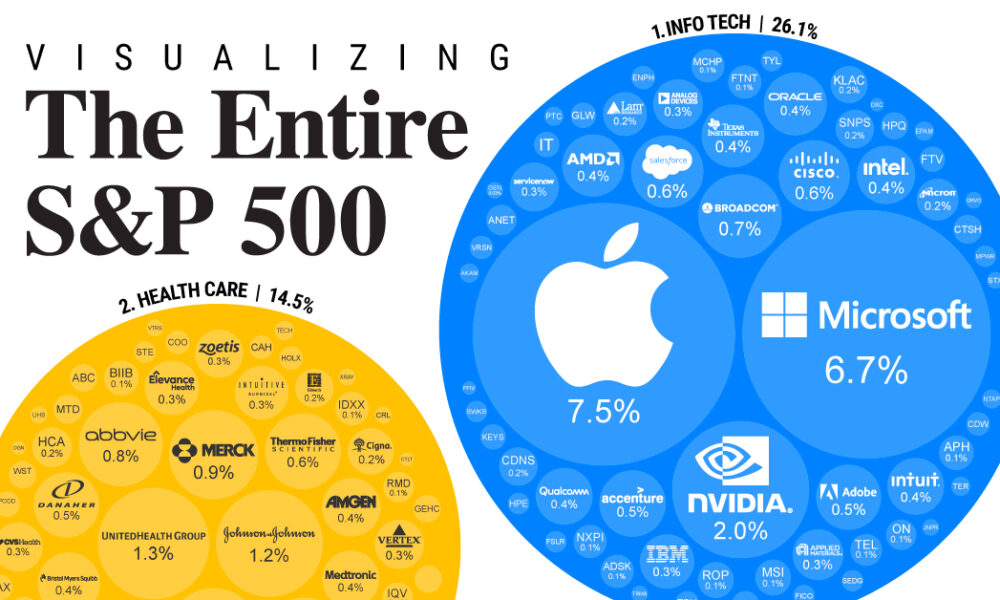
For the individual investor, this weighting means that when you invest in an S&P 500 fund, you are inherently betting more heavily on “mega-cap” stocks. In the modern era, this has led to a heavy concentration in the technology sector, with companies like Apple, Microsoft, Amazon, and Nvidia carrying significant weight. While this allows investors to benefit from the explosive growth of industry leaders, it also means the index can be sensitive to the volatility of a few specific names. Understanding this concentration is vital for maintaining a balanced perspective on risk.
3. Why the S&P 500 is the Gold Standard for Investors
The S&P 500 has earned its reputation as the “gold standard” because of its historical consistency and its ability to capture the long-term upward trajectory of the U.S. economy. For most retail investors, it serves as the foundation of a “buy and hold” strategy.

Historical Returns and Long-Term Wealth Building
Historically, the S&P 500 has delivered an average annual return of approximately 10% (before inflation) over long periods. While there are years of significant decline (such as the 2008 financial crisis or the 2022 bear market), the index has a 100% recovery rate over its history. This compounding effect is the engine of modern retirement planning. An investor who consistently contributes to an S&P 500 index fund over 30 years benefits from the “survivorship bias” of the index; as companies fail or shrink, they are removed and replaced by newer, growing companies, ensuring the index always reflects the leaders of the day.
Diversification Across 11 Economic Sectors
The S&P 500 is divided into 11 Global Industry Classification Standard (GICS) sectors:
- Information Technology
- Health Care
- Financials
- Consumer Discretionary
- Communication Services
- Industrials
- Consumer Staples
- Energy
- Utilities
- Real Estate
- Materials
This internal diversity provides a cushion. During an economic cycle where Tech might be underperforming due to high interest rates, the Energy or Consumer Staples sectors might provide stability. By owning the S&P 500, an investor is essentially owning a diversified “basket” of the American economy, reducing the risk associated with betting on a single company or industry.
4. How to Invest in the S&P 500: Vehicles and Strategies
You cannot “buy” the S&P 500 index directly because it is a mathematical calculation. Instead, you invest in financial products that are designed to track or replicate the index’s performance.
Index Funds vs. ETFs
The two primary vehicles for S&P 500 exposure are Mutual Funds and Exchange-Traded Funds (ETFs).
- S&P 500 ETFs: Options like the SPDR S&P 500 ETF Trust (SPY) or the Vanguard S&P 500 ETF (VOO) are highly popular. They trade like stocks on an exchange throughout the day and are generally very tax-efficient.
- Index Mutual Funds: Companies like Fidelity and Schwab offer S&P 500 mutual funds. These are often used in 401(k) plans and trade only once a day after the market closes.
The primary advantage of both is the “expense ratio.” Because these are passively managed (a computer simply mimics the index), the fees are incredibly low—often less than 0.05% per year. This is significantly cheaper than actively managed funds, where a human manager tries to “beat the market” but often fails to do so after accounting for their higher fees.
The Role of Passive Investing in a Wealth Strategy
The rise of the S&P 500 has been synonymous with the rise of passive investing. Legendary investor Warren Buffett has famously advocated for the average person to simply buy a low-cost S&P 500 index fund and hold it for decades. The logic is simple: it is extremely difficult for even professional hedge fund managers to consistently outperform the S&P 500 over long periods. By adopting a “passive” approach, you eliminate the stress of stock picking and benefit from the collective growth of the most successful corporations in the world.
5. Risks and Limitations to Consider
While the S&P 500 is a powerful tool, it is not without risks. A sophisticated financial plan requires an understanding of where this index might fall short.
Concentration Risk and the “Magnificent Seven”
In recent years, a small group of tech giants—often dubbed the “Magnificent Seven”—has come to represent a huge percentage of the index’s total value. This creates “concentration risk.” If a regulatory change or a shift in AI sentiment hits the tech sector particularly hard, the S&P 500 could suffer even if the “average” American company is doing fine. Investors who want more balance sometimes look into “Equal Weighted” S&P 500 funds, where every company has a 0.2% stake regardless of size, though these tend to have different performance profiles.
The Impact of Global Economic Volatility
The S&P 500 is a U.S. index, but the companies within it are global. Roughly 40% of the revenue for S&P 500 companies comes from outside the United States. While this provides international exposure, it also means the index is sensitive to foreign exchange rates, geopolitical tensions, and global supply chain disruptions. Furthermore, the S&P 500 does not include small-cap companies or emerging market stocks. Therefore, while it is an excellent core holding, most financial experts suggest supplementing it with other assets—like international stocks, bonds, or real estate—to create a truly comprehensive portfolio.
Conclusion
The S&P 500 is more than just a list of stocks; it is a testament to the enduring nature of corporate innovation and economic expansion. For the person focused on building long-term wealth, understanding the S&P 500 is fundamental. It offers a transparent, low-cost, and historically proven way to participate in the growth of the world’s largest economy. By recognizing its strengths—such as its rigorous selection process and diversification—and its weaknesses—such as concentration risk—you can better position your personal finances for a future of stability and growth. Whether the market is at an all-time high or in the depths of a recession, the S&P 500 remains the ultimate benchmark for the modern investor’s journey.
aViewFromTheCave is a participant in the Amazon Services LLC Associates Program, an affiliate advertising program designed to provide a means for sites to earn advertising fees by advertising and linking to Amazon.com. Amazon, the Amazon logo, AmazonSupply, and the AmazonSupply logo are trademarks of Amazon.com, Inc. or its affiliates. As an Amazon Associate we earn affiliate commissions from qualifying purchases.