
In the landscape of modern software, few companies have successfully navigated the transition from a niche consumer utility to a foundational pillar of artificial intelligence as effectively as SoundHound. To the casual smartphone user, SoundHound is often remembered as the app that can identify a song simply by hearing a few hummed notes. However, in the broader context of technology trends, SoundHound has evolved into a powerhouse of conversational AI and voice-to-meaning processing, challenging the dominance of tech giants like Google, Amazon, and Apple.
Understanding what SoundHound is today requires a deep dive into its dual nature: it is both a consumer-facing audio recognition tool and a sophisticated B2B developer platform known as Houndify. By prioritizing speed, accuracy, and brand independence, SoundHound has carved out a unique position in the Internet of Things (IoT) and automotive sectors, providing the “brains” behind some of the most advanced voice interfaces in the world.

The Origins: From Music Identification to Sonic Intelligence
SoundHound began its journey in the mid-2000s, emerging as a primary competitor to Shazam. While both apps focused on identifying music through digital fingerprints, SoundHound differentiated itself early on through its proprietary “Sound2Sound” technology. This was a significant technological leap that allowed the software to process audio patterns in a way that mimicked human hearing.
The SoundHound App Experience
For the average consumer, the SoundHound app remains a staple for digital discovery. Unlike traditional recognition software that requires a direct recording of a studio track, SoundHound’s algorithms were designed to recognize humming and singing. This capability stems from the engine’s ability to strip away the “noise” of a performance—such as pitch fluctuations or tempo changes—and match the core melodic structure against a massive database of musical signatures.
Over time, the app expanded from a simple identification tool into a comprehensive music discovery platform. It integrated lyrics through LiveLyrics technology, provided deep links to streaming services, and curated personalized music maps. However, while the music app remains popular, it served as the proving ground for a much more ambitious technological project: natural language understanding (NLU).
How Sound2Sound Technology Works
At the heart of SoundHound’s technical superiority is the Sound2Sound engine. Traditional voice recognition systems typically follow a two-step process: Automatic Speech Recognition (ASR) converts the audio into text, and then Natural Language Understanding (NLU) interprets that text to find meaning. This “pipelined” approach often leads to latency and errors, as the meaning is lost if the text conversion is slightly off.
SoundHound’s technology bypasses this traditional bottleneck by processing the speech and the meaning simultaneously. This “Speech-to-Meaning” approach allows the AI to understand intent in real-time, even before the speaker has finished their sentence. This results in faster response times and a higher degree of accuracy in complex environments, such as a noisy car cabin or a busy kitchen.
Houndify: The Engine Behind Modern Conversational AI
As the demand for voice-enabled devices exploded with the rise of smart speakers, SoundHound pivoted to offer its core technology as a service. This platform, named Houndify, represents the company’s most significant contribution to the current AI landscape. Houndify is an independent AI platform that allows developers to integrate voice assistants into their own products without handing over their data or brand identity to a massive ecosystem like Amazon Alexa or Google Assistant.
Speed and Accuracy in Natural Language Understanding (NLU)
The technical differentiator for Houndify is its ability to handle “complex” queries. While most voice assistants struggle with multi-part questions or filters—such as “Find me Italian restaurants in San Francisco that are open after 9 PM and have outdoor seating, but exclude pizzerias”—Houndify is built to parse these variables instantly.
This is achieved through a massive library of “domains.” Domains are specialized sets of data and logic that cover specific topics like weather, flight information, sports scores, or local business data. By using a modular architecture, Houndify can tap into these domains simultaneously, allowing for a conversational flow that feels much more natural and human-like than the rigid, command-based interfaces of the past.
Independent AI vs. Big Tech Ecosystems
In the tech industry, the concept of “Independent AI” is becoming increasingly vital. When a company integrates Google Assistant or Alexa into a product, they often lose control over the user data and the “wake word.” The user says “Hey Google” to a third-party device, reinforcing Google’s brand rather than the manufacturer’s.

SoundHound’s B2B model offers an alternative. It allows a car manufacturer or a smart appliance maker to create their own custom wake word (e.g., “Hey Mercedes” or “Hey Toaster”). This gives companies total control over the user experience and ensures that the proprietary data generated by the device remains within their own ecosystem. This strategic move has made SoundHound the preferred partner for brands that want to maintain a direct relationship with their customers.
SoundHound in the Real World: Automotive and IoT Integrations
The most impactful application of SoundHound’s technology is currently found in the automotive industry and the growing world of IoT. As software becomes the defining feature of modern vehicles, the need for a reliable, fast, and private voice interface has never been higher.
Revolutionizing the In-Car Experience
Drivers require hands-free control for safety, but they also demand a level of functionality that goes beyond simple radio tuning. SoundHound has partnered with major automotive players including Hyundai, Kia, Mercedes-Benz, and Stellantis to provide deep vehicle integration.
Through SoundHound’s AI, a driver can control the air conditioning, check tire pressure, navigate to a destination, and even order food, all through voice commands. Because the system uses “Edge+Cloud” connectivity, it can function even in areas with poor cellular reception. The “Edge” component allows the car to process basic commands locally on its internal hardware, while the “Cloud” component handles more complex requests that require internet access, ensuring the system is always responsive.
Smart Home and Hospitality Applications
Beyond the car, SoundHound is infiltrating the hospitality and restaurant sectors. In the restaurant industry, the company has deployed “SoundHound for Restaurants,” an AI-driven voice ordering system. This technology can answer phone calls, take complex orders, and handle modifications—like “no onions” or “extra spicy”—without human intervention. This addresses labor shortages and improves order accuracy, showcasing how voice AI is moving from a novelty gadget to a critical business tool.
In the smart home sector, SoundHound’s Houndify platform powers everything from smart coffee machines to advanced security systems. The goal is to create an environment where the “Ambient Internet” is always available, responding to voice commands without the need for a centralized hub or a screen.
The Future of SoundHound: Generative AI and Voice Commerce
The recent surge in Generative AI and Large Language Models (LLMs) has provided SoundHound with a new frontier for innovation. While LLMs like ChatGPT are excellent at generating text, they often lack real-time data and a voice interface that feels integrated into physical hardware. SoundHound is bridging this gap.
Combining LLMs with Voice Assistants
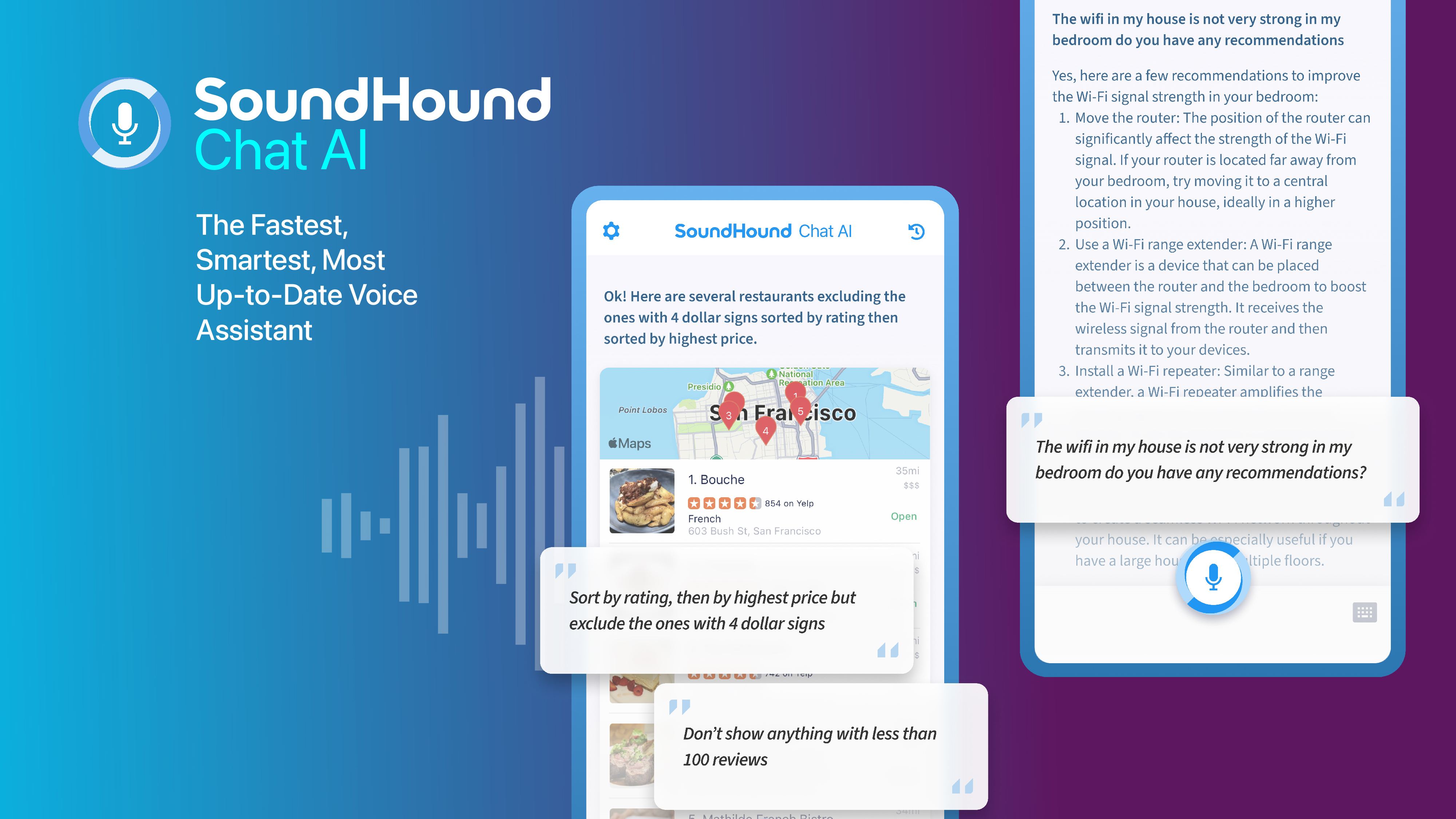
SoundHound recently introduced “SoundHound Chat AI,” a platform that combines the power of its own NLU with the creative and generative capabilities of LLMs. This integration allows for a “best of both worlds” scenario. For instance, if a user asks for a recipe, SoundHound can provide real-time pricing for the ingredients at a local store while the LLM provides the step-by-step cooking instructions.
This hybrid approach solves one of the biggest problems with current AI: “hallucinations.” By grounding the generative AI in SoundHound’s structured data domains, the system can provide answers that are both conversational and factually accurate. This makes the assistant far more useful for professional and utility-driven tasks.
The Rise of “Voice-to-Order” Systems
The ultimate trajectory for SoundHound is the perfection of “Voice Commerce.” As digital assistants become more reliable, the friction of making a purchase will move from clicking buttons on a screen to simply stating a desire. SoundHound is positioning itself as the transaction layer for this future.
By integrating payment processors and merchant APIs directly into its voice platform, SoundHound enables users to buy movie tickets, pay for parking, or order groceries through a single voice interface. This shift toward a voice-first economy represents a significant change in how we interact with the digital world, moving away from the “app-based” economy toward a more seamless, conversational experience.
In conclusion, SoundHound is far more than a music recognition app. It is a sophisticated technology stack that is redefining the boundaries of human-computer interaction. Through its pioneering Speech-to-Meaning technology, its commitment to independent AI for brands, and its rapid integration of generative models, SoundHound is building a future where voice is the primary interface for the digital world. Whether you are driving a car, ordering a meal, or discovering a new song, SoundHound’s invisible influence is likely powering the experience.
aViewFromTheCave is a participant in the Amazon Services LLC Associates Program, an affiliate advertising program designed to provide a means for sites to earn advertising fees by advertising and linking to Amazon.com. Amazon, the Amazon logo, AmazonSupply, and the AmazonSupply logo are trademarks of Amazon.com, Inc. or its affiliates. As an Amazon Associate we earn affiliate commissions from qualifying purchases.