
In the modern financial landscape, the “share market” is often portrayed as a complex labyrinth of flashing red and green numbers, frantic trading floors, and sophisticated algorithms. However, at its core, the concept of a share is remarkably simple and serves as the bedrock of global capitalism. Understanding what a share represents is the first step for any individual looking to transition from a casual observer to a strategic investor.
To understand the share market, one must first understand the fundamental unit of trade: the share itself. A share is a unit of ownership in a company. When you purchase a share, you are essentially buying a small piece of that business. Whether it is a global tech giant or a local manufacturing firm, owning a share means you are a partial owner, entitled to a portion of the company’s success, assets, and earnings.

Understanding the Fundamentals: What is a Share?
At its most basic level, a share—often referred to as “stock” or “equity”—represents a claim on a part of the corporation’s assets and earnings. When a company decides to grow, it requires capital. Instead of borrowing money from a bank and incurring debt with interest, the company may choose to “go public.” This involves dividing the total value of the company into millions of small parts and selling them to the public. Each part is a share.
The Concept of Fractional Ownership
When you own a share, you are legally a shareholder. This status grants you fractional ownership. For example, if a company has 1,000,000 shares outstanding and you own 10,000 of them, you own 1% of that company. While this might seem insignificant in a massive corporation, it entitles you to specific rights. These include the right to vote on corporate policies, the right to elect the board of directors, and the right to receive a portion of the profits if the company decides to distribute them.
Fractional ownership bridges the gap between the average individual and massive industrial enterprises. It democratizes wealth creation, allowing a schoolteacher or an engineer to own a piece of the same company as a billionaire venture capitalist. The value of your “piece” of the company fluctuates based on the company’s performance and the market’s perception of its future potential.
Equity vs. Debt: Why Companies Issue Shares
From a corporate finance perspective, issuing shares is a strategic move to raise “equity capital.” Unlike a loan, which is “debt capital,” equity does not need to be paid back. There are no monthly interest payments that could strain a company’s cash flow. Instead, the company trades away a portion of its ownership in exchange for liquid cash.
For the investor, the trade-off is different. If you lend money to a company (buy a bond), you are a creditor. You are guaranteed interest but do not benefit if the company becomes the next global sensation. If you buy a share, you are an owner. You take on more risk—because if the company fails, you are the last to be paid—but your potential for profit is theoretically infinite.
How the Share Market Functions
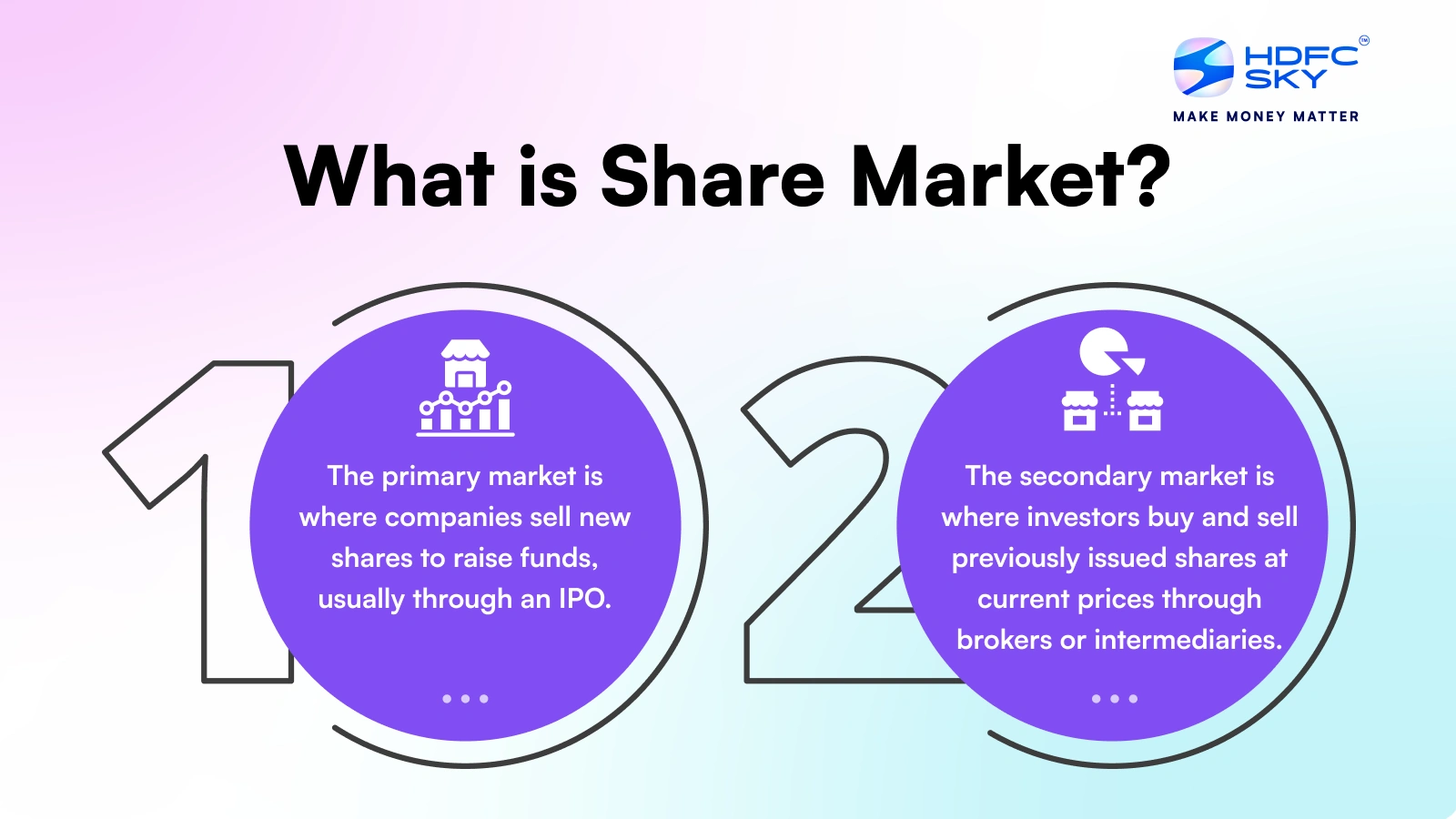
The share market is the ecosystem where these units of ownership are bought and sold. It acts as a bridge between companies looking for capital and investors looking for a return on their savings. To navigate this market, one must distinguish between the two primary stages of share distribution: the primary market and the secondary market.
The Primary Market: Initial Public Offerings (IPOs)
The primary market is where shares are “born.” When a private company decides to offer its shares to the public for the first time, it undergoes an Initial Public Offering (IPO). During an IPO, the company works with investment banks to determine a price for its shares and sells them directly to a group of investors.
The money raised in the primary market goes directly into the company’s bank account to fund research, expand into new territories, or pay off existing debts. For investors, participating in an IPO is an opportunity to get in on the “ground floor” of a company’s public life, though it often comes with higher volatility as the market attempts to find a fair price for the new entrant.
The Secondary Market: Stock Exchanges
Once the IPO is complete, the shares begin trading on the secondary market. This is what most people refer to when they talk about the “share market.” On the secondary market, investors trade shares among themselves. If you buy 50 shares of a company on a platform like the New York Stock Exchange (NYSE) or the Nasdaq, you are not buying them from the company itself; you are buying them from another investor who wants to sell.
The price in the secondary market is governed by the laws of supply and demand. If more people want to buy a share (perhaps due to a positive earnings report), the price goes up. If more people want to sell (perhaps due to a management scandal), the price goes down. The stock exchange acts as a regulated, transparent marketplace that ensures these trades happen fairly and instantaneously.
Different Types of Shares You Can Own

Not all shares are created equal. Depending on the company’s charter and its financial strategy, it may issue different classes of shares that offer varying levels of risk, reward, and control.
Equity Shares (Common Stock)
Equity shares, also known as common stock, are the most prevalent type of share. When people talk about “buying stocks,” they are almost always referring to equity shares. These shares offer the highest potential for long-term capital appreciation.
Holders of common stock usually have voting rights—typically one vote per share. This allows them to participate in major corporate decisions. However, in the event of a company’s liquidation or bankruptcy, common stockholders are at the bottom of the priority list. They only receive what is left after creditors, bondholders, and preferred shareholders have been fully paid.
Preference Shares
Preference shares occupy a middle ground between common stocks and bonds. As the name suggests, these shareholders have a “preference” over common shareholders in two main areas: dividends and liquidation.
Preference shareholders receive a fixed dividend, which must be paid out before any dividends are given to common shareholders. If the company goes bankrupt, preference shareholders are paid before common shareholders. The downside is that preference shares typically do not carry voting rights, and their price doesn’t usually appreciate as significantly as common stock when the company grows. They are often favored by investors seeking steady income rather than aggressive growth.
Growth vs. Value Stocks
In the world of investing, shares are often categorized by their behavior.
-
Growth Stocks: These belong to companies that are expected to grow at a rate significantly above the average for the market. These companies usually reinvest all their profits into research and development rather than paying dividends. Investors buy these shares hoping for a massive increase in share price.
-
Value Stocks: These are shares of companies that appear to be trading for less than their intrinsic worth. They are often established, “boring” companies with steady cash flows. They frequently pay dividends and are seen as a safer, more conservative investment during market downturns.
Why Invest in Shares? The Path to Wealth Creation
Investing in the share market is one of the most effective ways to build wealth over time. While it involves risk, the historical performance of the equity market has consistently outpaced inflation and traditional savings accounts.
Capital Appreciation
The primary reason most people invest in shares is capital appreciation. This occurs when you sell a share for more than you paid for it. For example, if you bought a share for $100 five years ago and it is now worth $250, you have achieved $150 in capital gains. This growth is driven by the company’s increasing profitability, innovation, and expansion. Over decades, the power of compounding—where your gains earn their own gains—can turn modest savings into a substantial nest egg.
Dividend Income
Some companies distribute a portion of their profits back to shareholders in the form of dividends. This provides investors with a regular stream of passive income. Many long-term investors employ a “Dividend Reinvestment Plan” (DRIP), where they use their dividend payments to buy even more shares of the company. Over time, this increases their total ownership and the size of future dividend checks, creating a powerful snowball effect for wealth accumulation.
Voting Rights and Corporate Governance
While retail investors rarely own enough shares to single-handedly change a company’s direction, the collective power of shareholders is immense. Through voting, shareholders can influence executive compensation, approve or reject mergers and acquisitions, and push for changes in environmental or social policies. Owning a share gives you a seat at the table of global commerce.
Navigating the Risks and Market Dynamics
While the rewards of the share market are significant, they are not guaranteed. The market is influenced by a myriad of factors, ranging from global geopolitics to psychological shifts in investor sentiment.
Market Volatility and Economic Factors
Share prices do not move in a straight line. They are subject to volatility—rapid, often unpredictable changes in price. This volatility can be caused by macroeconomic factors such as interest rate changes, inflation, or unemployment data. It can also be caused by company-specific news, such as a missed earnings target or a product recall. Successful investors learn to distinguish between “noise” (temporary price swings) and “signals” (fundamental changes in a company’s value).
Diversification as a Shield
One of the most critical strategies in the share market is diversification. This is the practice of spreading your investments across different companies, industries, and geographic regions. The logic is simple: if you put all your money into one company and it fails, you lose everything. However, if you own shares in thirty different companies across ten different sectors, a failure in one is likely to be offset by gains in others. Diversification reduces the risk of a single catastrophic event wiping out your portfolio.
Long-term Perspective vs. Short-term Speculation
The share market often rewards patience and punishes impulsivity. Short-term trading, or speculation, involves trying to predict daily price movements. This is extremely difficult and often leads to losses due to transaction fees and emotional decision-making.
Conversely, long-term investing focuses on the underlying health of businesses. By holding high-quality shares for years or even decades, investors can ride out market cycles and benefit from the long-term upward trajectory of the global economy. Understanding that a share is a piece of a business—not just a ticker symbol on a screen—is the key to maintaining the discipline required for successful wealth management.
aViewFromTheCave is a participant in the Amazon Services LLC Associates Program, an affiliate advertising program designed to provide a means for sites to earn advertising fees by advertising and linking to Amazon.com. Amazon, the Amazon logo, AmazonSupply, and the AmazonSupply logo are trademarks of Amazon.com, Inc. or its affiliates. As an Amazon Associate we earn affiliate commissions from qualifying purchases.