
The study of water is foundational to every scientific discipline, but understanding its molecular geometry is essential to comprehending the physical world. While often simplified in elementary education, the true shape of a water molecule is a complex dance of quantum mechanics and electrostatic forces. At its core, water is defined by a bent molecular geometry, a structural quirk that dictates everything from the formation of snowflakes to the very existence of life on Earth.
The Quantum Mechanics of Molecular Geometry
To understand why water takes its specific shape, one must look at the arrangement of electrons within the oxygen atom. Oxygen, which has six valence electrons, seeks to achieve a stable octet by sharing electrons with two hydrogen atoms. This sharing process, known as covalent bonding, creates the H2O molecule. However, the story does not end with the bonds themselves; it is the “lone pairs” of electrons that truly dictate the final architecture of the molecule.
Understanding Electron Domain Theory
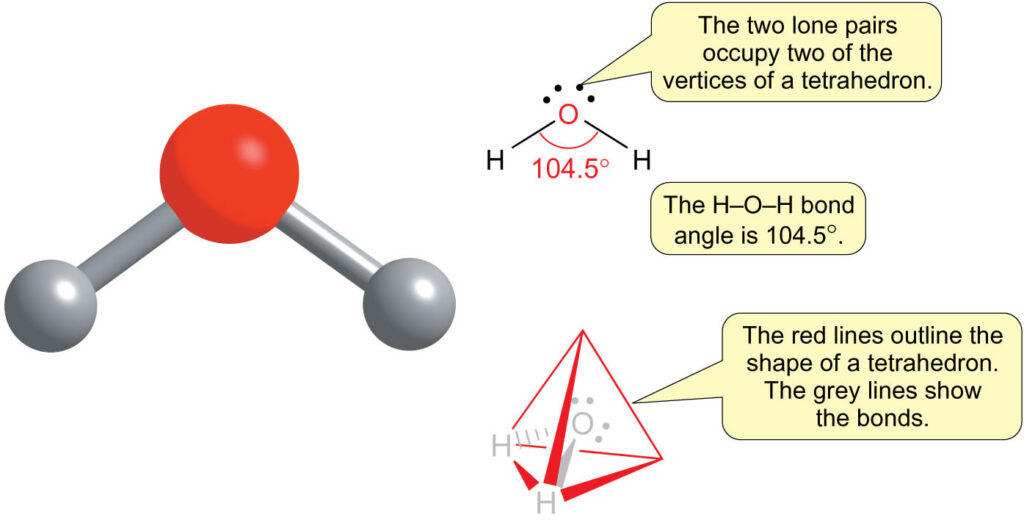
According to the Valence Shell Electron Pair Repulsion (VSEPR) theory, electron pairs—whether they are bonding pairs or non-bonding lone pairs—naturally repel one another. In an oxygen atom, there are four electron domains: two occupied by the hydrogen atoms and two occupied by lone pairs of electrons that remain attached to the oxygen.
These four domains arrange themselves in a tetrahedral formation to maximize the distance between each other, minimizing repulsion. If all four domains were occupied by atoms, the shape would be a perfect tetrahedron. Because two of these domains are lone pairs, they exert greater repulsive pressure on the bonding pairs, effectively “squeezing” the hydrogen atoms closer together.
The Significance of the Bent Angle
The result of this electrostatic squeeze is a bond angle of approximately 104.5 degrees. This is distinctly different from the 109.5-degree angle found in a perfect tetrahedron (such as in methane). This 104.5-degree angle is the hallmark of the “bent” molecular geometry. It is this specific deviation that grants water its life-sustaining properties, allowing it to act as a universal solvent and creating the potential for intricate hydrogen bonding networks.
Polarity: The Consequence of the Bent Shape
The bent shape of the water molecule is the primary driver of its polarity. Because oxygen is significantly more electronegative than hydrogen, it exerts a much stronger pull on the shared electrons in the covalent bonds. This creates a partial negative charge near the oxygen atom and a partial positive charge near the two hydrogen atoms.
Dipole Moment and Molecular Asymmetry
If the water molecule were linear—with the oxygen atom positioned directly between the two hydrogens—the partial charges would cancel each other out, resulting in a non-polar molecule. Instead, the bent geometry ensures that the molecule is asymmetrical. The positive charges are clustered at one end, and the negative charge is concentrated at the other. This creates a permanent dipole moment, turning every water molecule into a tiny, microscopic magnet.
How Polarity Drives Biological Processes
This dipolar nature allows water to interact with a vast array of substances. In a biological context, this polarity is why water is so effective at dissolving salts and polar organic molecules. The partially negative oxygen atom attracts the positive ions of a solute, while the partially positive hydrogen atoms attract negative ions. Without the specific bent geometry that allows for this permanent dipole, the complex chemical reactions required for cellular metabolism simply could not occur.

Hydrogen Bonding and Macroscopic Behavior
The bent shape and resulting polarity of the water molecule lead to the formation of hydrogen bonds. A hydrogen bond is a strong intermolecular force that occurs when the positive hydrogen atom of one water molecule is attracted to the negative oxygen atom of a neighboring molecule. This creates a dynamic, ever-changing network of attractions that fundamentally alters the physical state of water.
The Complexity of Liquid Water
In the liquid phase, these hydrogen bonds are constantly breaking and reforming. This “flickering cluster” model of water explains why it possesses such high surface tension and a high specific heat capacity. The energy required to break these hydrogen bonds is significant, which is why water remains a liquid at room temperature despite its relatively low molecular weight. If water were not bent, these forces would be vastly weaker, and water would likely exist only as a gas in Earth’s atmospheric conditions.
Implications for Phase Transitions
The bent structure is also responsible for the unique behavior of ice. As water cools toward its freezing point, the hydrogen bonds force the molecules into a rigid, hexagonal lattice structure. Because this structure is less dense than the chaotic, jumbled arrangement of liquid water, ice floats. If the geometry of the molecule were different, this density anomaly would not exist. The entire biosphere—from the survival of aquatic organisms in frozen lakes to the global climate patterns regulated by ocean currents—depends on the specific, low-density lattice formed by bent water molecules.
The Role of Water Geometry in Material Science
Beyond biology and chemistry, the shape of the water molecule has become a focal point in modern material science and nanotechnology. Engineers and researchers are now leveraging the dipolar nature and the bent geometry of water to create “smart” surfaces and advanced filtration systems.
Hydrophobicity and Hydrophilicity
By manipulating the surfaces of materials at the nanoscale, scientists can control how water droplets interact with them. For instance, superhydrophobic surfaces are designed to mirror the geometry of lotus leaves, forcing water to bead up into spheres. This is achieved by creating textures that minimize the surface contact area, preventing the water molecule’s dipole from forming strong hydrogen bonds with the surface. These technologies are crucial for developing self-cleaning glass, anti-icing coatings for aircraft, and high-efficiency heat exchangers.
Advancements in Membrane Technology
In the field of water purification, the bent shape is exploited to facilitate molecular sieving. Reverse osmosis membranes are engineered with pores so precise that they favor the passage of water molecules while blocking larger contaminants. Understanding the hydration shell—the layer of water molecules that surrounds an ion or a protein—allows scientists to design membranes that can filter out heavy metals or bacteria with unprecedented selectivity. The ability to “steer” water molecules through nanofluidic channels is currently at the frontier of solving the global water crisis.

Conclusion: The Structural Foundation of Existence
The shape of the water molecule is far more than a footnote in a chemistry textbook; it is the structural blueprint for life. The 104.5-degree bent geometry creates a delicate balance of forces that manifest as polarity, hydrogen bonding, and unique thermal properties. From the formation of a single droplet of dew to the vast, circulation-driven systems of our global oceans, the physical behavior of water is dictated by the spatial arrangement of its atoms.
As we continue to advance in our technological capabilities, the ability to manipulate these molecular interactions will only grow more sophisticated. We are moving from observing the properties of water to actively designing systems that utilize its geometric peculiarities. Whether in the synthesis of new polymers, the creation of efficient energy storage solutions, or the desalination of water for an expanding population, the bent shape of the water molecule remains the ultimate engineer of our natural world. By mastering our understanding of this fundamental geometry, we continue to unlock the secrets of how the physical universe sustains itself.
aViewFromTheCave is a participant in the Amazon Services LLC Associates Program, an affiliate advertising program designed to provide a means for sites to earn advertising fees by advertising and linking to Amazon.com. Amazon, the Amazon logo, AmazonSupply, and the AmazonSupply logo are trademarks of Amazon.com, Inc. or its affiliates. As an Amazon Associate we earn affiliate commissions from qualifying purchases.