
In the rapidly evolving landscape of digital security and software development, cryptographic hash functions serve as the invisible bedrock of data integrity. Among the most historically significant of these functions is the Secure Hash Algorithm 1, or SHA-1. Designed to transform any piece of data into a unique, fixed-length string of characters, SHA-1 was once the gold standard for verifying everything from software downloads to secure web connections. However, the story of SHA-1 is not just one of technical utility, but also a cautionary tale regarding the relentless march of computational power and the eventual obsolescence of once-secure standards.
Decoding the Mechanics of the SHA-1 Algorithm
To understand SHA-1, one must first understand the fundamental concept of a cryptographic hash function. Unlike encryption, which is a two-way process (encrypting and then decrypting data), hashing is a one-way mathematical operation. The goal is to take an input—whether it is a simple password, a text file, or a massive operating system image—and produce a fixed-size output known as a “message digest.”
What is a Cryptographic Hash Function?
A cryptographic hash function must possess several key properties to be effective in a technological environment. First, it must be deterministic: the same input must always produce the exact same output. Second, it must be fast to compute. Third, it must be “pre-image resistant,” meaning it should be computationally impossible to reverse the process and determine the original input based solely on the hash. Finally, it must be “collision-resistant,” meaning that no two different inputs should produce the same output hash.
SHA-1 produces a 160-bit hash value, typically represented as a 40-digit hexadecimal number. This small, fixed-size digest acts as a digital fingerprint. If even a single bit of the original input is changed, the resulting SHA-1 hash changes so dramatically—a phenomenon known as the “avalanche effect”—that it becomes immediately obvious that the data has been tampered with.
How SHA-1 Generates a Digital Fingerprint
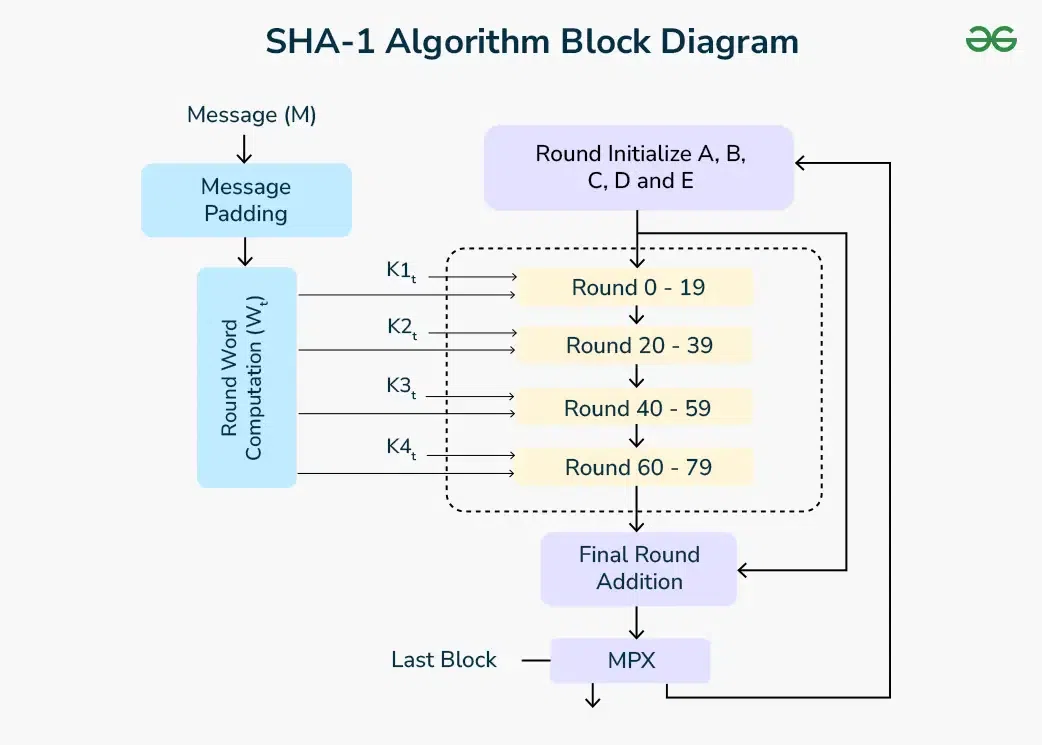
The internal architecture of SHA-1 is based on the Merkle-Damgård construction. When an input is fed into the algorithm, it is first padded so that its length is a multiple of 512 bits. This data is then processed in blocks.
The algorithm utilizes five 32-bit working variables (initially set to specific constants) and performs 80 rounds of operations. These rounds involve complex bitwise logical operations, such as “AND,” “OR,” and “XOR,” along with modular addition and bitwise rotations. By the time the algorithm finishes processing all blocks, the final state of those working variables is concatenated to form the 160-bit message digest. This complexity was designed to ensure that the relationship between the input data and the output hash remained mathematically obscured.
The Historical Context and Rise of SHA-1
The SHA-1 algorithm was developed by the National Security Agency (NSA) and published as a Federal Information Processing Standard (FIPS) by the National Institute of Standards and Technology (NIST) in 1995. It was a successor to the original SHA (now called SHA-0), which was quickly withdrawn due to an undisclosed flaw.
Origins and Standardization
Upon its release, SHA-1 was hailed as a significant improvement over previous algorithms like MD5. In the mid-to-late 1990s and throughout the 2000s, SHA-1 became the backbone of digital security. It was integrated into a vast array of protocols that we still use today, including Transport Layer Security (TLS), Secure Sockets Layer (SSL), Pretty Good Privacy (PGP), and Secure Shell (SSH).
For over a decade, when you saw a green padlock in your browser, there was a high probability that SHA-1 was the algorithm verifying the authenticity of the website’s security certificate. Its widespread adoption was driven by its perceived balance between security and performance, making it ideal for the hardware of that era.
Wide Adoption in Digital Certificates and Git
Beyond web security, SHA-1 found a home in the world of version control. When Linus Torvalds created Git in 2005, he chose SHA-1 as the mechanism for identifying and verifying every commit and file in a repository. In Git, the SHA-1 hash is not necessarily used as a security measure against malicious actors, but rather as a robust way to ensure that no data is lost or corrupted during the development process. Because Git relies on the uniqueness of these hashes to manage its internal database, SHA-1 became deeply ingrained in the workflow of millions of software developers worldwide.
The Fall of SHA-1: Vulnerabilities and Collision Attacks

In the world of cryptography, an algorithm is considered “broken” long before a standard home computer can crack it. For SHA-1, the cracks began to appear as early as 2005, when researchers identified theoretical weaknesses that suggested a “collision” could be found much faster than through a brute-force attack.
The Concept of a Collision
A collision occurs when two different inputs produce the exact same hash output. If an attacker can generate two different documents—for example, a legitimate contract and a fraudulent one—that share the same SHA-1 hash, they can swap the files without the system detecting the change. This undermines the entire concept of data integrity.
For a 160-bit hash like SHA-1, a brute-force attack would theoretically require $2^{80}$ operations to find a collision (based on the “Birthday Paradox”). However, cryptanalysts found ways to reduce this number significantly, making the attack feasible for those with high-end computational resources.
The SHAttered Research and Computational Feasibility
The final nail in the coffin for SHA-1 came in 2017. A team of researchers from CWI Amsterdam and Google announced the first practical collision for SHA-1, an attack they dubbed “SHAttered.” They produced two different PDF files with the same SHA-1 hash.
While the attack required immense processing power—equivalent to 6,500 years of single-CPU computations—it proved that SHA-1 was no longer safe for security-critical applications. With the rise of GPU acceleration and cloud computing, the cost of performing such an attack has continued to plummet, moving SHA-1 from the realm of “theoretically weak” to “practically dangerous.”
Life After SHA-1: Transitioning to More Secure Alternatives
As the vulnerabilities of SHA-1 became undeniable, the tech industry began a massive migration toward more robust hashing algorithms. The transition was not instantaneous, as millions of legacy systems relied on SHA-1, but the shift is now nearly complete in modern software environments.
Introduction to SHA-2 and SHA-3
The primary successor to SHA-1 is the SHA-2 family. SHA-2 is not a single algorithm but a set of six hash functions with different digest sizes, the most common being SHA-256 and SHA-512. SHA-256 is currently the industry standard, used in everything from Bitcoin mining to securing the modern web (via TLS 1.2 and 1.3). It offers a significantly larger “keyspace,” making collision attacks practically impossible with current technology.
In addition to SHA-2, NIST also standardized SHA-3 (based on the Keccak algorithm) in 2015. SHA-3 is internally very different from SHA-1 and SHA-2, providing an extra layer of security; if a fundamental mathematical flaw is ever discovered in the SHA-2 structure, SHA-3 serves as a secure backup that would likely remain unaffected.
Best Practices for Modern Cryptographic Security
For developers and IT professionals, the deprecation of SHA-1 means that it should no longer be used for digital signatures, SSL certificates, or any application where security is a priority. Modern browsers like Chrome, Firefox, and Edge now flag any website using an SHA-1 certificate as “Not Secure.”
In software development, if you are building an application that requires hashing—such as storing password hashes (where you should use Argon2 or bcrypt) or verifying file integrity—you should default to SHA-256 or higher. Even Git, which relied on SHA-1 for years, has introduced support for SHA-256 to ensure the long-term integrity of the world’s source code.
Summary: The Importance of Cryptographic Agility
The history of the SHA-1 algorithm serves as a vital lesson in the concept of “cryptographic agility.” Technology is never static; what is considered unbreakable today may be trivial to crack tomorrow. SHA-1 was a masterpiece of 1990s engineering that served the tech world faithfully for two decades, but its retirement was an inevitable consequence of the growth of computing power.
By understanding what SHA-1 is and why it fell out of favor, tech professionals can better appreciate the need for constant vigilance. Security is not a product you buy, but a process of continuous upgrading and adaptation. As we move further into the era of quantum computing and hyper-fast processing, the transition from SHA-1 to SHA-2 and SHA-3 reminds us that staying ahead of vulnerabilities is the only way to maintain trust in the digital age.
aViewFromTheCave is a participant in the Amazon Services LLC Associates Program, an affiliate advertising program designed to provide a means for sites to earn advertising fees by advertising and linking to Amazon.com. Amazon, the Amazon logo, AmazonSupply, and the AmazonSupply logo are trademarks of Amazon.com, Inc. or its affiliates. As an Amazon Associate we earn affiliate commissions from qualifying purchases.