
In the rapidly evolving landscape of data science and artificial intelligence, certain tools emerge as foundational pillars, empowering researchers, developers, and data enthusiasts alike. Among these, Scikit-learn stands out as a preeminent open-source machine learning library for the Python programming language. Far from being just another piece of software, Scikit-learn is a gateway to understanding and applying complex machine learning algorithms, making it an indispensable asset in the toolkit of anyone venturing into predictive analytics, data modeling, or AI development.
At its core, Scikit-learn is a robust, well-documented, and highly accessible library designed to provide simple and efficient tools for predictive data analysis. Built upon the scientific Python ecosystem (NumPy, SciPy, and Matplotlib), it offers a consistent interface for a vast array of supervised and unsupervised learning algorithms. Whether you’re a seasoned data scientist looking to fine-tune a complex model or a budding enthusiast eager to perform your first classification task, Scikit-learn provides the structure, functionality, and clarity needed to transform raw data into actionable insights. Its power lies not just in its breadth of algorithms, but in its commitment to usability, performance, and adherence to best practices in scientific computing.
The Foundational Pillars: Philosophy and Ecosystem Integration
Scikit-learn’s enduring popularity and widespread adoption can be attributed to a deliberate design philosophy centered on simplicity, consistency, and efficiency, coupled with its seamless integration into the broader Python data science ecosystem. This combination makes it both powerful for advanced users and approachable for newcomers.
Simplicity and Accessibility Through a Unified API
One of Scikit-learn’s most celebrated features is its consistent Application Programming Interface (API) across all its estimators (models). This uniformity means that once you learn how to use one algorithm in Scikit-learn, applying another becomes remarkably intuitive. For instance, the fit() method is consistently used to train a model, predict() to make predictions, and transform() for data preprocessing or dimensionality reduction. This predictable structure drastically reduces the learning curve and allows users to quickly experiment with different algorithms without needing to learn a new set of commands for each.
This commitment to a user-friendly API extends to its clear and comprehensive documentation. Every algorithm, function, and parameter is meticulously explained, often accompanied by practical examples. This makes Scikit-learn an excellent educational tool, allowing users to not only apply algorithms but also to understand the theoretical underpinnings and practical implications of their choices. For many, Scikit-learn is the first touchpoint with machine learning, demystifying concepts that might otherwise seem daunting.
Seamless Integration with the Python Data Science Stack
Scikit-learn doesn’t operate in isolation; it thrives within the rich ecosystem of Python’s scientific computing libraries. Its dependencies on NumPy and SciPy are not merely technical requirements but strategic choices that leverage their strengths. NumPy provides the powerful N-dimensional array object, which Scikit-learn uses to handle numerical data efficiently, making computations fast and memory-efficient. SciPy, a library for scientific and technical computing, offers advanced mathematical routines that Scikit-learn can utilize for specialized tasks.
Furthermore, its compatibility with Pandas DataFrames facilitates easy data loading and manipulation. Data often arrives in complex, messy formats, and Pandas excels at cleaning, transforming, and preparing this data. Once data is cleaned and structured into DataFrames, it can be seamlessly converted into NumPy arrays for Scikit-learn processing. Visualization libraries like Matplotlib and Seaborn also integrate effortlessly, allowing users to plot data distributions, model outputs, and performance metrics, turning abstract numbers into interpretable graphs. This symbiotic relationship with other libraries makes Scikit-learn a central component of a complete, end-to-end data science workflow, from data ingestion and cleaning to model building, evaluation, and visualization.
A Comprehensive Toolkit: Algorithms and Functionalities
The true power of Scikit-learn lies in the sheer breadth and depth of its algorithms, covering almost every major category of machine learning. From tasks involving labeled data to exploring hidden patterns in unlabeled datasets, Scikit-learn provides efficient and robust implementations.
Supervised Learning: Prediction with Labeled Data
Supervised learning is perhaps the most widely used branch of machine learning, where models learn from data that includes both input features and corresponding output labels. Scikit-learn offers a rich collection of algorithms for two primary supervised tasks: classification and regression.
Classification Algorithms
Classification involves predicting a categorical label, such as spam or not spam, or identifying the type of an object in an image. Scikit-learn provides implementations for a wide array of classification algorithms, each suited for different types of data and problem complexities:
-
Support Vector Machines (SVMs): Powerful for both linear and non-linear classification, especially effective in high-dimensional spaces.
-
Decision Trees and Random Forests: Intuitive, interpretable models that can handle both numerical and categorical data. Random Forests, an ensemble method, mitigate overfitting common in single decision trees and generally offer higher accuracy.
-
Logistic Regression: A fundamental algorithm for binary classification, despite its name, it’s a classification algorithm that models the probability of a binary outcome.
-
K-Nearest Neighbors (KNN): A simple, non-parametric algorithm that classifies a data point based on the majority class of its nearest neighbors.
-
Naive Bayes: A family of probabilistic classifiers based on Bayes’ theorem, particularly useful for text classification and problems with high-dimensional input.
-
Gradient Boosting (e.g., GradientBoostingClassifier, AdaBoostClassifier): These ensemble methods build models sequentially, where each new model corrects errors made by previous ones, often achieving state-of-the-art performance.
Regression Algorithms
Regression tasks involve predicting a continuous numerical value, such as house prices, stock values, or temperature. Scikit-learn’s regression capabilities are equally extensive:
-
Linear Regression: The most basic form, modeling a linear relationship between input features and the target variable.
-
Ridge, Lasso, and Elastic-Net Regression: Regularized linear models that help prevent overfitting, especially when dealing with multicollinearity or a large number of features.
-
Support Vector Regression (SVR): An extension of SVMs for regression, aiming to find a function that deviates from the true targets by no more than a certain epsilon.
-
Decision Tree Regressors and Random Forest Regressors: The regression counterparts to their classification algorithms, used for predicting continuous values.
Unsupervised Learning: Discovering Patterns in Unlabeled Data
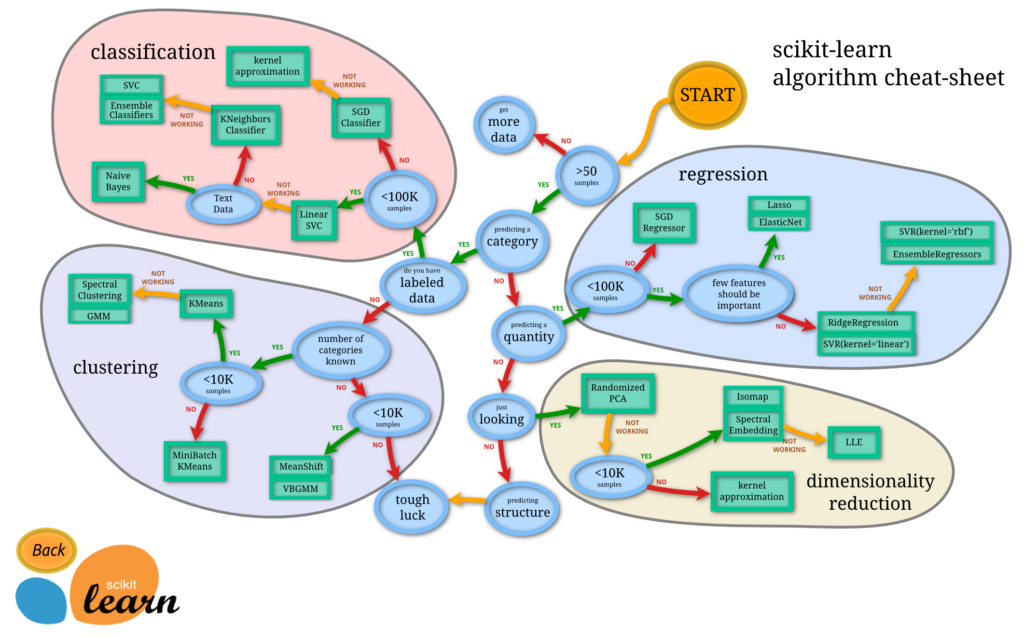
Unsupervised learning deals with unlabeled data, aiming to find hidden structures, patterns, or representations within the dataset without any prior knowledge of output labels. Scikit-learn provides robust tools for key unsupervised tasks: clustering and dimensionality reduction.
Clustering Algorithms
Clustering groups similar data points together. This is useful for market segmentation, anomaly detection, or organizing large datasets. Scikit-learn offers several popular algorithms:
-
K-Means: A widely used algorithm that partitions data into k distinct clusters, where each data point belongs to the cluster with the nearest mean.
-
DBSCAN (Density-Based Spatial Clustering of Applications with Noise): An algorithm capable of discovering clusters of arbitrary shape and identifying noise points.
-
Agglomerative Clustering: A hierarchical method that builds a hierarchy of clusters, starting with individual data points and merging them.
-
Gaussian Mixture Models (GMMs): A probabilistic model that assumes data points are generated from a mixture of several Gaussian distributions.
Dimensionality Reduction Techniques
Dimensionality reduction aims to reduce the number of input features in a dataset while preserving as much variance or information as possible. This is crucial for visualizing high-dimensional data, speeding up training times, and mitigating the “curse of dimensionality.”
-
Principal Component Analysis (PCA): A classic linear technique that transforms the data into a new coordinate system such that the greatest variance by any projection lies on the first coordinate (called the first principal component), the second greatest variance on the second coordinate, and so on.
-
t-Distributed Stochastic Neighbor Embedding (t-SNE): A non-linear technique particularly well-suited for visualizing high-dimensional datasets by mapping them to a low-dimensional space (typically 2D or 3D) while preserving local structure.
-
Singular Value Decomposition (SVD) and Non-negative Matrix Factorization (NMF): Useful for matrix decomposition, often employed in recommender systems and topic modeling.
Enhancing Model Performance: Preprocessing, Selection, and Evaluation
Beyond merely providing algorithms, Scikit-learn also offers an extensive suite of tools essential for the complete machine learning pipeline: from preparing raw data to selecting the best model and rigorously evaluating its performance. These functionalities are critical for building effective and reliable AI systems.
Data Preprocessing and Feature Engineering
Raw data is rarely in a state suitable for direct input into machine learning models. Scikit-learn provides robust transformers and utilities to clean, transform, and scale data, preparing it for optimal model performance:
-
Handling Missing Values:
SimpleImputercan fill in missing data points using strategies like mean, median, or most frequent value. -
Feature Scaling: Algorithms often perform better when numerical features are scaled to a standard range.
StandardScalerstandardizes features by removing the mean and scaling to unit variance, whileMinMaxScalerscales features to a given minimum and maximum value, typically between zero and one. -
Encoding Categorical Features:
OneHotEncoderconverts categorical variables into a one-hot numerical array, andOrdinalEncoderconverts them into integer ordinals. -
Polynomial Features:
PolynomialFeaturescan generate new features by creating polynomial combinations of existing features, allowing models to capture non-linear relationships. -
Pipelines: The
Pipelineutility allows users to chain multiple preprocessing steps with an estimator, ensuring consistent data transformation and preventing data leakage during cross-validation. This also makes the workflow cleaner and more organized.
Model Selection and Hyperparameter Tuning
Choosing the right model and optimizing its hyperparameters are crucial steps to achieve high predictive accuracy and generalization. Scikit-learn offers powerful tools for this iterative process:
-
Cross-Validation:
KFold,StratifiedKFold, andLeaveOneOutare examples of utilities for splitting data into training and test sets multiple times, providing a more robust estimate of model performance than a single train-test split. This helps detect overfitting and assesses how well the model generalizes to unseen data. -
Hyperparameter Tuning:
-
GridSearchCV: Exhaustively searches over a specified parameter grid for the best combination of hyperparameters that yields the best cross-validation score. -
RandomizedSearchCV: Samples a fixed number of parameter settings from specified distributions, often finding good solutions much faster thanGridSearchCVfor large search spaces. -
These tools automate the process of finding optimal parameters, saving immense manual effort and often leading to significantly better model performance.
-
Model Evaluation Metrics
Once a model is trained, its performance needs to be rigorously evaluated using appropriate metrics. Scikit-learn provides a wide range of evaluation metrics for both classification and regression tasks:
-
For Classification:
-
Accuracy Score: The proportion of correctly classified instances.
-
Precision, Recall, F1-Score: Crucial for imbalanced datasets, offering insights into false positives and false negatives.
-
Confusion Matrix: A table describing the performance of a classification model on a set of test data for which the true values are known.
-
ROC AUC Score: Area Under the Receiver Operating Characteristic Curve, useful for evaluating the performance of a binary classifier.
-
-
For Regression:
-
Mean Absolute Error (MAE): The average of the absolute differences between predictions and actual values.
-
Mean Squared Error (MSE) and Root Mean Squared Error (RMSE): Measure the average squared difference between predictions and actual values, penalizing larger errors more heavily.
-
R-squared (R²): Represents the proportion of the variance in the dependent variable that is predictable from the independent variables.
-
Scikit-learn in Practice: Impact and Future
Scikit-learn’s impact extends far beyond academic research; it’s a staple in industrial applications, educational settings, and open-source contributions, shaping how machine learning is developed and deployed today.
The Go-To for Rapid Prototyping and Production Readiness
For data scientists and machine learning engineers, Scikit-learn is often the first choice for rapid prototyping. Its ease of use and consistent API allow for quick experimentation with various models and feature sets. This agility is crucial in the iterative process of model development, where insights need to be gained quickly and hypotheses tested efficiently. While some highly specialized deep learning tasks might leverage frameworks like TensorFlow or PyTorch, Scikit-learn remains highly competitive for traditional machine learning problems and often serves as a baseline for comparison.
Furthermore, Scikit-learn models are often robust enough for production environments. While scaling to massive datasets might require distributed computing frameworks, individual Scikit-learn models can be easily serialized (e.g., using joblib or pickle) and deployed as part of web services or backend applications, making predictions in real-time. Its stability and well-tested algorithms contribute to its reliability in operational settings.
Educational Value and Community Support
Scikit-learn is an unparalleled resource for learning machine learning. Its clear API, comprehensive documentation, and numerous examples make complex concepts accessible to beginners. Universities and online courses frequently use Scikit-learn as the primary tool for teaching fundamental machine learning principles, allowing students to bridge the gap between theory and practical application quickly.
The library also benefits from a vibrant and active open-source community. Developers constantly contribute new features, improve existing algorithms, fix bugs, and enhance documentation. This collaborative spirit ensures that Scikit-learn remains up-to-date with the latest advancements in the field and responsive to the needs of its users. Forums, Stack Overflow, and GitHub repositories are replete with discussions and solutions related to Scikit-learn, providing an extensive support network for users encountering challenges.
Looking Ahead: The Evolving Landscape
As the field of machine learning continues to evolve, Scikit-learn is poised to maintain its relevance. While deep learning has captured significant attention for tasks like image recognition and natural language processing, traditional machine learning algorithms remain highly effective and often more interpretable for a vast array of tabular data problems. Scikit-learn continues to integrate new algorithms and improve existing ones, adapting to new challenges and computational paradigms. Its foundational role in the Python data science stack guarantees its continued importance as a robust, versatile, and user-friendly tool for anyone working with data and predictive modeling.
In conclusion, Scikit-learn is more than just a library; it’s an ecosystem, a pedagogical tool, and a cornerstone of practical machine learning. Its commitment to accessibility, efficiency, and comprehensive functionality has democratized the field, allowing countless individuals and organizations to harness the power of artificial intelligence to solve real-world problems. For anyone embarking on a journey in data science or seeking to deepen their understanding of machine learning, mastering Scikit-learn is not merely an option but a fundamental necessity.
aViewFromTheCave is a participant in the Amazon Services LLC Associates Program, an affiliate advertising program designed to provide a means for sites to earn advertising fees by advertising and linking to Amazon.com. Amazon, the Amazon logo, AmazonSupply, and the AmazonSupply logo are trademarks of Amazon.com, Inc. or its affiliates. As an Amazon Associate we earn affiliate commissions from qualifying purchases.