
Saturn, the ringed jewel of our solar system, has captivated humanity for millennia. Its ethereal beauty, a celestial ballet of icy rings and a majestic gas giant, prompts us to ponder its place in the cosmic neighborhood. Among the most fundamental questions we ask about any celestial body is its distance from our Sun. Understanding this distance isn’t just a matter of astronomical curiosity; it underpins our comprehension of planetary dynamics, the formation of the solar system, and even the potential for life beyond Earth. While seemingly a straightforward astronomical fact, delving into Saturn’s distance from the Sun opens a portal to fascinating scientific concepts and technological endeavors.
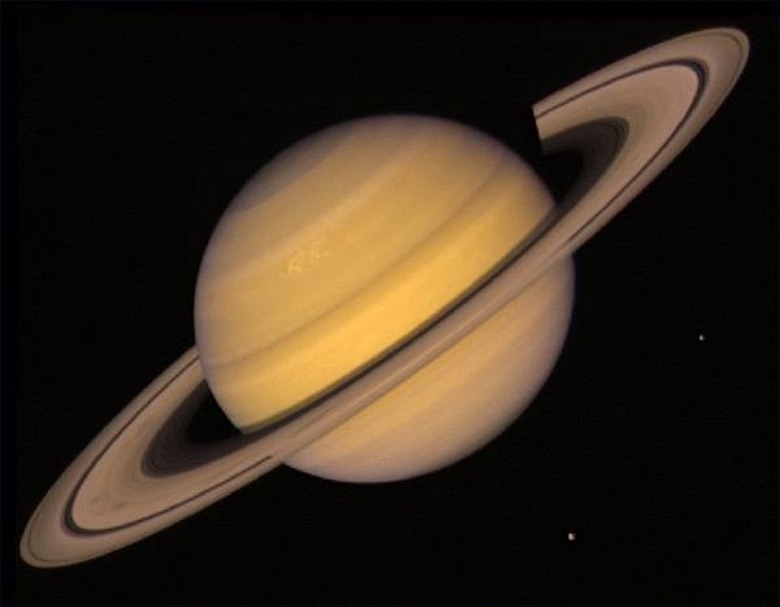
The Astronomical Foundation: Measuring Saturn’s Orbit
Saturn’s distance from the Sun is not a static figure. Like all planets in our solar system, Saturn follows an elliptical orbit around the Sun. This means its distance varies throughout its orbital period, which takes approximately 29.5 Earth years to complete. Therefore, when we speak of Saturn’s distance, we typically refer to its average distance.
Average Distance: The Astronomical Unit (AU) as a Yardstick
Astronomers use a standard unit of measurement called the Astronomical Unit (AU) to describe distances within our solar system. One AU is defined as the average distance between the Earth and the Sun, which is approximately 93 million miles (150 million kilometers). This unit provides a relatable scale for understanding the vastness of space.
Saturn’s average distance from the Sun is a staggering 9.54 AU. To put this into perspective, this means Saturn is, on average, over nine times farther from the Sun than Earth is. Translating this into miles, Saturn’s average distance is about 886 million miles (1.42 billion kilometers). This immense gulf of space has profound implications for the conditions on Saturn and its moons.
The Elliptical Dance: Perihelion and Aphelion
While the average distance provides a useful benchmark, it’s important to acknowledge the nuances of Saturn’s orbit.
- Perihelion: This is the point in Saturn’s orbit where it is closest to the Sun. At its perihelion, Saturn is approximately 8.96 AU (about 834 million miles or 1.34 billion kilometers) from the Sun.
- Aphelion: Conversely, this is the point in Saturn’s orbit where it is farthest from the Sun. At its aphelion, Saturn is approximately 10.12 AU (about 940 million miles or 1.51 billion kilometers) from the Sun.
The difference between Saturn’s closest and farthest points from the Sun, while significant, is less pronounced than for some other planets, like Mars. This relatively stable distance contributes to Saturn’s consistent orbital characteristics.
Why Does Distance Matter? Implications for Saturn
Saturn’s considerable distance from the Sun has several critical consequences for the planet itself:
- Temperature: Being so far from the Sun, Saturn receives significantly less solar radiation than Earth. This results in extremely low temperatures. The cloud tops of Saturn are estimated to be around -288 degrees Fahrenheit (-178 degrees Celsius). This frigid environment is a far cry from the conditions that support liquid water and life as we know it.
- Light Intensity: The intensity of sunlight diminishes with the square of the distance. At Saturn’s distance, sunlight is about 100 times fainter than it is on Earth. This means the planet is perpetually shrouded in a dim, diffused light.
- Energy for Atmospheric Dynamics: While solar energy is less intense, Saturn’s atmosphere is still a dynamic place. Internal heat generated by the planet’s core plays a significant role in driving its complex weather systems, including its powerful winds and the iconic hexagonal storm at its north pole.
- Moons and Their Environments: The distance from the Sun also influences the conditions on Saturn’s many moons. Moons like Titan, with its thick atmosphere, and Enceladus, with its subsurface ocean, have unique environments shaped by a combination of internal geological activity and the faint but present solar radiation.
Technological Innovations in Measuring Interplanetary Distances
Measuring the distance to celestial bodies like Saturn is a monumental achievement of scientific and technological prowess. This endeavor has evolved dramatically over centuries, moving from rudimentary observations to sophisticated remote sensing and deep-space probes.
Early Astronomical Observations and Kepler’s Laws

Before the advent of space exploration, astronomers relied on sophisticated observational techniques and mathematical models. Johannes Kepler’s laws of planetary motion, formulated in the early 17th century, were revolutionary. His third law, in particular, established a relationship between a planet’s orbital period and its average distance from the Sun. By observing Saturn’s orbital period and comparing it to Earth’s, astronomers could infer its relative distance using Kepler’s framework, albeit with less precision than modern methods.
The Dawn of Space Exploration: Radar Astronomy and Parallax
As technology advanced, new methods emerged. Radar astronomy, while more effective for closer objects, has been used to refine distances within the solar system. However, the most precise measurements of planetary distances have been achieved through sophisticated techniques involving:
- Parallax: This method involves observing an object from two different vantage points. For celestial distances, this can involve using different points in Earth’s orbit around the Sun to create a baseline for measurement. However, for distant planets like Saturn, this effect is very small and requires incredibly precise measurements.
- Light Travel Time: Perhaps the most impactful method for deep-space distances has been the measurement of light travel time. By sending radio signals to spacecraft orbiting or flying by Saturn and measuring the time it takes for those signals to return, scientists can calculate the precise distance to the spacecraft, and by extension, to Saturn. This technique requires highly accurate atomic clocks and advanced signal processing.
The Voyager and Cassini Missions: Revolutionizing Our Understanding
The Voyager probes in the late 1970s and early 1980s provided humanity with its first close-up views of Saturn and its moons. These missions not only delivered stunning imagery but also conducted precise measurements of Saturn’s orbital path and gravitational field.
Later, the Cassini-Huygens mission, which orbited Saturn from 2004 to 2017, was a game-changer. This ambitious project provided an unprecedented wealth of data about Saturn, its rings, and its moons. Cassini’s instruments continuously tracked its own position relative to Saturn and Earth, allowing for incredibly accurate calculations of distances and orbital parameters. The mission’s success relied heavily on advanced communication systems and precise trajectory calculations, showcasing the pinnacle of current space technology.
The Economic and Branding Significance of Space Exploration
While the scientific pursuit of understanding Saturn’s distance is paramount, the underlying technologies and the very act of space exploration have significant economic and branding implications that resonate far beyond pure science.
The Multi-Billion Dollar Space Economy and Technological Spin-offs
The endeavor to explore distant planets like Saturn is not a solitary scientific pursuit; it is a massive economic undertaking. Billions of dollars are invested annually in space programs by governments and increasingly by private companies. This investment fuels innovation in a wide range of sectors:
- Advanced Materials: The extreme conditions of space necessitate the development of incredibly robust and lightweight materials. These innovations often find applications in industries like aerospace, automotive, and even consumer goods.
- Miniaturization and Efficiency: Spacecraft require highly efficient and compact components. The drive for miniaturization has led to advancements in microelectronics, battery technology, and power management systems that benefit countless everyday technologies.
- Communication and Data Processing: The vast distances involved in interplanetary communication demand sophisticated and resilient communication systems. The development of error correction codes, advanced antenna designs, and efficient data compression algorithms for deep-space missions have had profound impacts on global communication networks.
- Robotics and AI: The autonomous operation of probes and rovers in environments where direct human control is impossible has been a major driver for advancements in robotics and artificial intelligence. These technologies are now transforming manufacturing, healthcare, and numerous other industries.
The return on investment in space exploration often comes in the form of these “spin-off” technologies that improve our lives on Earth, drive economic growth, and create new markets.

Branding Through Cosmic Ambition: Inspiring Innovation and National Pride
The exploration of Saturn and other celestial bodies serves as a powerful branding tool for nations and organizations.
- National Prestige and Soft Power: Successful space missions project an image of technological prowess, scientific leadership, and ambitious vision. This enhances national prestige and contributes to a nation’s “soft power” on the global stage. The “space race” of the 20th century was a prime example of how space exploration was intertwined with geopolitical branding and competition.
- Inspiring Future Generations: The awe-inspiring images and discoveries from Saturn capture the public imagination, particularly among young people. This can inspire interest in STEM (Science, Technology, Engineering, and Mathematics) fields, fostering a future generation of innovators and scientists who will continue to push the boundaries of exploration and technological development.
- Corporate Branding and Innovation: Private aerospace companies are increasingly leveraging the allure of space to build their brands. Companies like SpaceX have masterfully used their ambitious goals and visible technological achievements to create a powerful brand identity, attracting talent, investment, and public support. This demonstrates that even in highly technical fields, effective branding is crucial for success.
- Global Collaboration and Shared Identity: Large-scale space projects, like the International Space Station, foster international collaboration. While these are not directly related to Saturn’s distance, they highlight how grand scientific endeavors can build bridges and promote a sense of shared human ambition, a powerful form of global branding for peace and progress.
In conclusion, understanding Saturn’s distance from the Sun is more than just a number; it’s a gateway to appreciating the vastness of our solar system, the ingenuity of human scientific endeavor, and the far-reaching economic and branding implications of our insatiable curiosity about the cosmos. From the fundamental laws of physics to the cutting-edge technology of space probes and the strategic branding of ambitious missions, the journey to comprehend our place among the stars is a testament to humanity’s enduring drive to explore, innovate, and understand.
aViewFromTheCave is a participant in the Amazon Services LLC Associates Program, an affiliate advertising program designed to provide a means for sites to earn advertising fees by advertising and linking to Amazon.com. Amazon, the Amazon logo, AmazonSupply, and the AmazonSupply logo are trademarks of Amazon.com, Inc. or its affiliates. As an Amazon Associate we earn affiliate commissions from qualifying purchases.