
The S&P 500, or the Standard & Poor’s 500 Index, is arguably the most recognizable name in the world of finance. For seasoned Wall Street traders and novice retail investors alike, it serves as the ultimate yardstick for measuring the health of the U.S. stock market and, by extension, the broader global economy. But beyond the daily fluctuations reported on financial news networks, the S&P 500 is a sophisticated financial instrument with a rigorous set of rules and a profound impact on how trillions of dollars are allocated worldwide.

To understand the S&P 500 is to understand the engine of American corporate growth. It is not merely a list of 500 companies; it is a curated index representing the leading industries of the United States. From the technology giants of Silicon Valley to the healthcare innovators of the East Coast, the index captures the performance of the 500 largest publicly traded companies in the U.S., offering a diversified snapshot of economic productivity.
Understanding the Mechanics: How the Index is Constructed
The S&P 500 is managed by S&P Dow Jones Indices, a joint venture that oversees several of the world’s most prominent market indicators. Unlike some other indices that are price-weighted—meaning stocks with higher share prices have more influence—the S&P 500 is a float-adjusted market-capitalization-weighted index. This means that the impact of a single company on the index’s performance is proportional to its total market value (share price multiplied by the number of shares available for public trading).
The Selection Criteria and the Index Committee
A common misconception is that the S&P 500 is simply the 500 largest companies in America. In reality, a company must meet strict eligibility requirements to be included, and final decisions are made by an “Index Committee.” This committee ensures that the index remains a representative sample of the U.S. economy.
To qualify, a company must be a U.S. corporation, have a market capitalization of at least $15.8 billion (a threshold that is periodically adjusted), and maintain high liquidity. Crucially, the company must also demonstrate financial viability, defined as having positive as-reported earnings over the most recent quarter and the sum of the most recent four consecutive quarters. This “profitability rule” distinguishes the S&P 500 from other indices like the Russell 1000, which are purely mechanical and do not filter for earnings quality.
Market Capitalization Weighting Explained
Because the index is market-cap weighted, the largest companies—often referred to as “mega-caps”—carry significantly more weight than the smaller companies in the index. For example, if a tech giant like Microsoft or Apple experiences a 2% move in its stock price, it will have a much larger impact on the S&P 500’s overall value than a 2% move from a mid-sized utility company.
This weighting methodology reflects the reality of the market; larger companies have a greater impact on the economy, and therefore, they should have a greater impact on the benchmark. However, it also means that the index can become “top-heavy,” where a handful of technology companies represent a substantial percentage of the total index value.
Why the S&P 500 Matters to Every Investor
For the average individual looking to grow their wealth, the S&P 500 is more than just a data point; it is the cornerstone of modern passive investing. Before the rise of index funds, investors had to hand-pick individual stocks, a process that is both time-consuming and fraught with the risk of picking “losers.” The S&P 500 changed the paradigm by allowing anyone to own a small piece of the entire American corporate landscape.
A Barometer for Economic Health
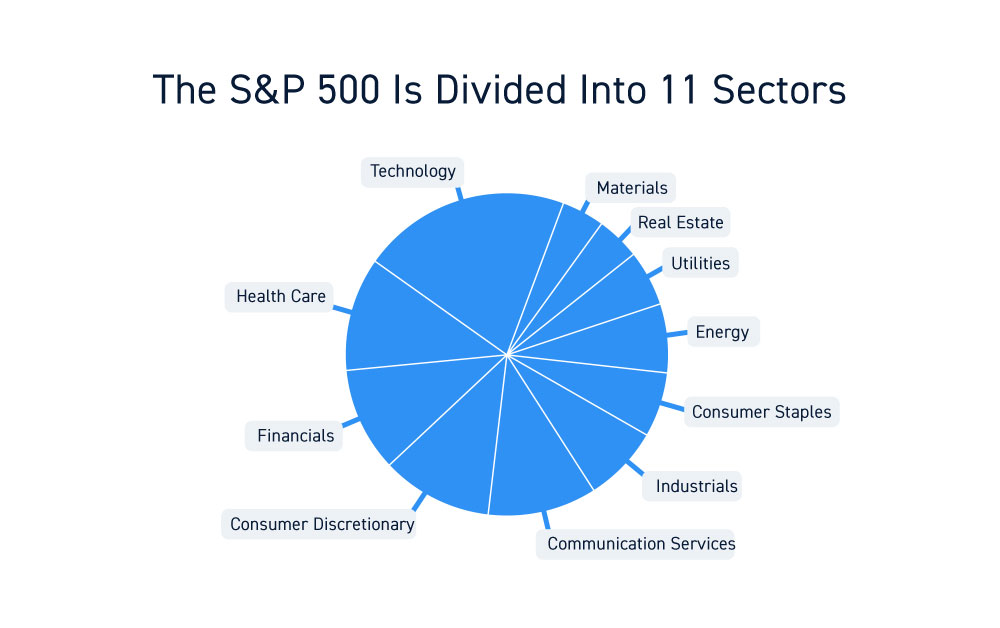
The S&P 500 covers approximately 80% of the available market capitalization of the U.S. equity market. Because it spans 11 different sectors—including Information Technology, Healthcare, Financials, Consumer Discretionary, and Industrials—it provides a diversified view of how different parts of the economy are performing. When the S&P 500 is rising, it generally signals investor confidence in corporate earnings and future economic growth. Conversely, a sustained decline, known as a bear market, often precedes or coincides with economic recessions.
Historical Performance and the Power of Compounding
Historically, the S&P 500 has delivered an average annual return of approximately 10% before inflation. While the market does not return 10% every single year—some years see gains of 30%, while others see losses of 20%—the long-term trajectory has been consistently upward.

For an investor, the S&P 500 represents one of the most effective tools for long-term wealth building. Through the power of compounding, a modest monthly investment into an S&P 500 index fund can grow into a substantial nest egg over several decades. It removes the “human error” of trying to time the market or find the next “hot” stock, instead betting on the long-term ingenuity and growth of the American business sector.
How to Invest: Index Funds and ETFs
You cannot “buy” the S&P 500 directly, as it is an index (a list of numbers). However, you can invest in financial products that are designed to track the index with near-perfect accuracy. These are primarily Index Mutual Funds and Exchange-Traded Funds (ETFs).
The Rise of the ETF
The introduction of S&P 500 ETFs revolutionized the investment world. An ETF allows you to trade a basket of all 500 stocks as if it were a single stock on an exchange. The most famous example is the SPDR S&P 500 ETF Trust (ticker: SPY), which was the first ETF listed in the United States. Other popular options include the Vanguard S&P 500 ETF (VOO) and the iShares Core S&P 500 ETF (IVV).
Lowering the Cost of Investing
One of the primary advantages of S&P 500 funds is their extremely low “expense ratio.” Because these funds are managed by computers that simply mirror the index, they do not require expensive teams of active stock-pickers. Many S&P 500 ETFs charge as little as 0.03% per year. This means for every $10,000 invested, you only pay $3 in management fees annually. Keeping costs low is one of the most critical factors in long-term investment success, as high fees can eat away at a significant portion of your returns over time.
The Risks and Limitations of Index Investing
While the S&P 500 is a gold standard for many, it is not without its drawbacks. Investors should be aware of the inherent risks involved in any equity-based investment.
Concentration Risk and Sector Dominance
In recent years, the S&P 500 has become increasingly concentrated in the technology sector. The “Magnificent Seven”—a group of high-performing tech giants—now accounts for a large portion of the index’s total weight. This concentration means that if the tech sector faces regulatory headwinds or a valuation correction, the entire index can suffer, even if other sectors like energy or healthcare are performing well. For an investor seeking true “total market” exposure, the S&P 500 might feel slightly lopsided toward growth and technology.
Market Volatility and Drawdowns
It is essential to remember that the S&P 500 is a 100% equity index. It offers no protection against market crashes. During the 2008 financial crisis, the index lost over 50% of its value from peak to trough. During the COVID-19 crash in early 2020, it dropped over 30% in a matter of weeks. Investors must have the stomach to endure these periods of volatility without panic-selling, as the historical “10% return” is only realized by those who stay the course through the downturns.
Building a Portfolio Around the Benchmark
For many people, an S&P 500 fund is the “core” of their portfolio. However, a well-rounded financial plan often requires looking beyond these 500 companies.
Diversification Beyond Large-Cap Stocks
While the S&P 500 represents large-cap U.S. stocks, it does not include small-cap companies (the “engines of tomorrow”), nor does it include international stocks from Europe, Asia, or emerging markets. Many financial advisors recommend pairing an S&P 500 fund with an international index fund and perhaps a bond fund to reduce overall portfolio volatility.
Consistency Through Dollar-Cost Averaging
The most successful S&P 500 investors often employ a strategy called dollar-cost averaging (DCA). Instead of trying to guess when the market is at its “low,” they invest a fixed amount of money at regular intervals (e.g., every payday). This strategy ensures that they buy more shares when prices are low and fewer shares when prices are high, effectively smoothing out the purchase price over time.
In conclusion, the S&P 500 is more than just a number on a screen; it is the definitive map of the American corporate landscape. It offers a transparent, low-cost, and historically proven way for individuals to participate in the growth of the world’s largest economy. Whether you are saving for retirement, a child’s education, or long-term wealth, understanding the S&P 500 is the first step toward mastering your financial future. By focusing on the fundamentals of this index—its composition, its low-cost accessibility, and its historical resilience—investors can move forward with the confidence that they are aligned with the most powerful economic engine in history.
aViewFromTheCave is a participant in the Amazon Services LLC Associates Program, an affiliate advertising program designed to provide a means for sites to earn advertising fees by advertising and linking to Amazon.com. Amazon, the Amazon logo, AmazonSupply, and the AmazonSupply logo are trademarks of Amazon.com, Inc. or its affiliates. As an Amazon Associate we earn affiliate commissions from qualifying purchases.