
In the sophisticated world of derivatives trading, the ability to adapt to changing market conditions is what separates consistent traders from those who rely on luck. One of the most critical techniques in an options trader’s arsenal is the “roll.” When you hear a trader discuss a “roll position,” they are referring to a specific management technique where an existing options contract is closed and a new, similar position is opened immediately. This maneuver allows a trader to extend their timeline, adjust their price targets, or defend a position that has moved against them.

Understanding how to roll a position is not merely about clicking buttons on a brokerage platform; it is about managing risk, capital efficiency, and the “Greeks”—the mathematical variables that dictate options pricing. Whether you are trading covered calls to generate income or managing complex credit spreads, mastering the roll is essential for long-term portfolio sustainability.
Understanding the Fundamentals of Rolling Options Positions
At its core, a roll is a combined transaction. It consists of two distinct legs executed simultaneously: the closing of an existing position and the opening of a new one with the same underlying asset but different parameters. This is typically done to maintain exposure to a stock or index while altering the expiration date, the strike price, or both.
The Mechanics: Closing to Reopen
To understand a roll, you must first understand the opening and closing of options. If you are “long” a call option (you bought it), closing that position requires you to sell it. If you are “short” a put option (you sold it to collect premium), closing it requires you to buy it back.
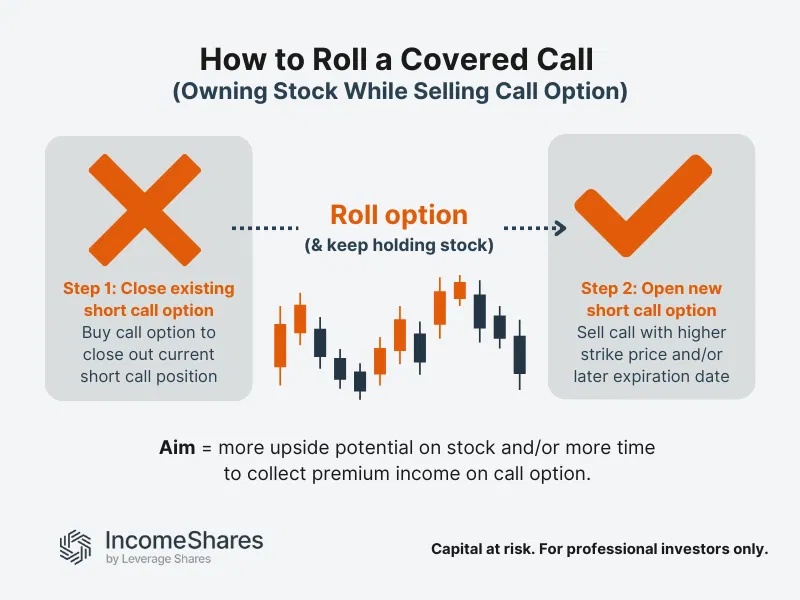
When you roll, your broker executes these trades as a single package. For example, if you sold a Covered Call that is nearing expiration and you want to keep the position active for another month, you would “Buy to Close” the current call and “Sell to Open” a new call with a later expiration date. By executing these as a single “spread” order, you ensure that you aren’t left with an unintended gap in your strategy and often save on slippage between the bid and ask prices.
Common Terminology: Up, Down, and Out
The terminology used in rolling describes exactly how the parameters are changing:
- Rolling Out: This refers to extending the time to expiration. You close a near-term option and open one further into the future.
- Rolling Up: This involves moving to a higher strike price. A trader might do this if the underlying stock has risen and they want to capture more upside or defend a short position.
- Rolling Down: This involves moving to a lower strike price. This is common when a stock price falls and a trader wants to adjust their protection or income levels.
Why Traders Choose to Roll Their Positions
Rolling is rarely a random act; it is a tactical response to market movement or the passage of time. Traders generally roll for three primary reasons: to manage time decay, to defend a losing trade, or to lock in profits while staying in the game.
Managing Time Decay (Theta) and Expiration
Options are wasting assets. Every day that passes reduces the extrinsic value of an option, a phenomenon known as “Theta decay.” For sellers of options, like those utilizing the “Wheel Strategy” or selling Iron Condors, time decay is a friend. However, as an option nears expiration, the “Gamma” risk increases—meaning the option’s price becomes extremely sensitive to small moves in the underlying stock.
By rolling “out” to a further expiration date, a trader can reset their Theta and Gamma exposure. This allows them to continue collecting “rent” on their shares (in the case of covered calls) without the immediate risk of having their shares called away or having the option fluctuate wildly in value during the final hours of the expiration Friday.
Defending a Losing Position
One of the most powerful uses of rolling is to manage a trade that has gone “In the Money” (ITM) when the trader wanted it to stay “Out of the Money” (OTM). If you sell a put option on a stock at a $100 strike price and the stock drops to $95, you are facing a loss.
By rolling the position out in time and potentially down in strike price, you can often collect a “net credit.” This means you receive more money for the new option than it costs to close the old one. This credit lowers your “break-even” point and gives the stock more time to recover. It turns a potential immediate loss into a managed, ongoing trade.
Locking in Gains while Maintaining Exposure
Conversely, rolling can be used to protect profits. If you bought a call option for $2.00 and it is now worth $10.00 because the stock skyrocketed, you have a massive gain. However, you might still believe the stock will go higher.
To “take some chips off the table,” you could roll your position “up.” You sell your current $10.00 option and buy a cheaper, higher-strike call for $4.00. You have effectively locked in $6.00 of profit per share while still maintaining a “long” position that will benefit if the stock continues its bullish run.
Strategic Variations: Roll Up, Roll Down, and Roll Out
The direction of the roll depends entirely on the trader’s outlook and the specific strategy being employed. Each variation serves a distinct purpose in the lifecycle of a trade.
Rolling Out: Buying More Time
Rolling out is the most common adjustment. It is frequently used in income-generating strategies. If you are selling monthly options, you roll out when the current month is ending to capture the premium for the next month. The goal here is “duration.” By staying in the trade longer, you allow the probabilities of the math-based trade to work in your favor.
Rolling Up/Down: Adjusting for Directional Shifts
These adjustments are about “delta” or price sensitivity.
- Rolling Up and Out: Often used by covered call sellers when the stock price rises. By moving the strike price up and the expiration date out, the trader can potentially realize more capital appreciation on the underlying stock while still collecting a premium.
- Rolling Down and Out: Often used by put sellers when the stock price falls. This moves the “strike” further away from the current price, reducing the likelihood of being “assigned” (forced to buy the stock), while the extra time provides more premium to offset the move.
Rolling for a Credit vs. a Debit
The financial result of a roll is paramount.
- Rolling for a Credit: This means you receive money to make the adjustment. This is the gold standard for defensive rolling, as it reduces your total risk in the trade.
- Rolling for a Debit: This means you are paying extra money to make the adjustment. This is typically done when a trader wants to significantly improve their strike price or “buy” more protection. Generally, professional traders are cautious about rolling for a debit, as it increases the “total capital at risk” in a single trade.
Risks and Considerations in the Rolling Process
While rolling feels like a “magic wand” that can fix bad trades, it is not without significant risks. It is a tool that requires discipline and a clear understanding of the costs involved.
Transaction Costs and Slippage
Every time you roll, you are executing two trades. Even in an era of commission-free trading for many retail investors, there are still “per-contract” fees and, more importantly, the “bid-ask spread.” If a stock is illiquid, the difference between what you can buy an option for and what you can sell it for can be wide. Rolling frequently in illiquid stocks can “bleed” a portfolio dry through transaction friction alone.
The “Sunk Cost” Fallacy in Options Trading
Perhaps the greatest psychological risk is the “perpetual roll.” This occurs when a trader refuses to admit a trade is a loser and continues to roll a losing position month after month, year after year.
Just because you can roll for a small credit doesn’t mean you should. Sometimes, the fundamental reason you entered the trade has changed. If a company’s business model is failing, rolling a short put “down and out” might just be throwing good money after bad. Traders must ask themselves: “If I weren’t already in this trade, would I open this new position today?” If the answer is no, a roll is likely a mistake.
Tax Implications of Realized Gains and Losses
In many jurisdictions, rolling is not viewed as a single event by tax authorities. Closing the first leg of the roll triggers a “realized” gain or loss for that tax year. This can create “wash sale” complications or unexpected tax liabilities. Traders should be aware that while a roll feels like a continuation of a single strategy, the IRS (or relevant tax body) sees it as the termination of one contract and the commencement of another.
Best Practices for Implementing a Rolling Strategy
To use the roll position technique effectively, traders should follow a structured approach rather than making emotional decisions in the heat of market volatility.
Setting Exit and Adjustment Triggers
The best time to decide when to roll is before you ever place the initial trade. Many professional traders use the “21 Days to Expiration” (DTE) rule. They decide that once a trade reaches 21 days before expiration, they will either close it or roll it to the next month to avoid the “Gamma risk” associated with the final weeks of an option’s life. Others use price triggers, such as “rolling when the strike price is touched” by the underlying stock price.

Analyzing Implied Volatility (IV) Before the Roll
Rolling is essentially selling volatility. If you are rolling during a period of very low Implied Volatility into a period of high IV, you may be getting a great deal. Conversely, rolling when IV is collapsing might mean you receive very little premium for the extra risk you are taking on. Always check the “IV Rank” or “IV Percentile” of the underlying asset before committing to a roll.
By integrating these tactical adjustments, traders can transform their options activity from a series of disconnected bets into a cohesive, managed business. Rolling a position is the ultimate expression of flexibility in the financial markets, allowing you to stay in the game, adjust to new information, and manage your capital with precision.
aViewFromTheCave is a participant in the Amazon Services LLC Associates Program, an affiliate advertising program designed to provide a means for sites to earn advertising fees by advertising and linking to Amazon.com. Amazon, the Amazon logo, AmazonSupply, and the AmazonSupply logo are trademarks of Amazon.com, Inc. or its affiliates. As an Amazon Associate we earn affiliate commissions from qualifying purchases.