
Ripple has emerged as a formidable player in the financial technology sector, often sparking conversations that transcend mere technological curiosity to delve deep into its monetary implications. When the question “what is Ripple at?” is posed, it typically seeks to understand its current market position, its financial health, its utility in the global financial system, and its investment prospects. Far more than just another cryptocurrency, Ripple, through its parent company Ripple Labs and its native digital asset XRP, aims to fundamentally transform cross-border payments and remittances, addressing long-standing inefficiencies that plague traditional financial infrastructures.
This exploration will dissect Ripple’s multifaceted presence in the financial world, from its core mission to its market performance, regulatory battles, and future potential. We will examine how Ripple is positioned within the broader financial ecosystem, its impact on businesses and investors, and the critical factors that will shape its trajectory in the coming years.
Understanding Ripple: Beyond Just a Cryptocurrency
To fully grasp Ripple’s financial standing, it’s crucial to first differentiate its various components and understand its overarching mission. Ripple is not a singular entity but rather a complex ecosystem designed to facilitate faster, cheaper, and more reliable global financial transactions.
The Dual Identity: Ripple Labs and XRP
At the heart of the Ripple phenomenon are two distinct yet intertwined entities: Ripple Labs Inc. and XRP. Ripple Labs is a private technology company that develops and promotes the RippleNet payment protocol. Its objective is to build a global network for financial institutions that enables real-time gross settlement, lower exchange rates, and reduced operating costs for cross-border payments. The company licenses its technology solutions, such as On-Demand Liquidity (ODL), to banks, payment providers, and other financial institutions.
XRP, on the other hand, is the native digital asset of the XRP Ledger (XRPL), an open-source, decentralized blockchain technology that operates independently of Ripple Labs. While Ripple Labs holds a significant portion of XRP and utilizes it within its ODL product, it’s important to recognize that XRP itself is a distinct digital asset traded on various exchanges worldwide. Its primary function within Ripple’s vision is to serve as a bridge currency, facilitating rapid and low-cost conversion between different fiat currencies or other digital assets without the need for traditional nostro/vostro accounts. This dual identity often creates confusion but is essential for understanding its comprehensive financial strategy.
Mission and Vision: Revolutionizing Global Payments
Ripple’s fundamental mission is to modernize and democratize global payments. Traditional international transfers are notorious for being slow, expensive, and opaque, often taking days to settle and incurring significant fees for both senders and recipients. This inefficiency particularly impacts remittances to developing nations and complicates international trade for businesses of all sizes.
Ripple envisions a world where money moves as effortlessly as information does today. By leveraging blockchain technology and digital assets like XRP, the company aims to enable instant, near-free, and highly transparent transactions across borders. This vision is not just about speed and cost but also about financial inclusion, providing easier access to financial services for the unbanked and underbanked populations globally. For financial institutions, Ripple offers a solution to reduce liquidity costs, expand market reach, and enhance operational efficiency, directly impacting their bottom lines.
Core Technology: RippleNet and the XRP Ledger
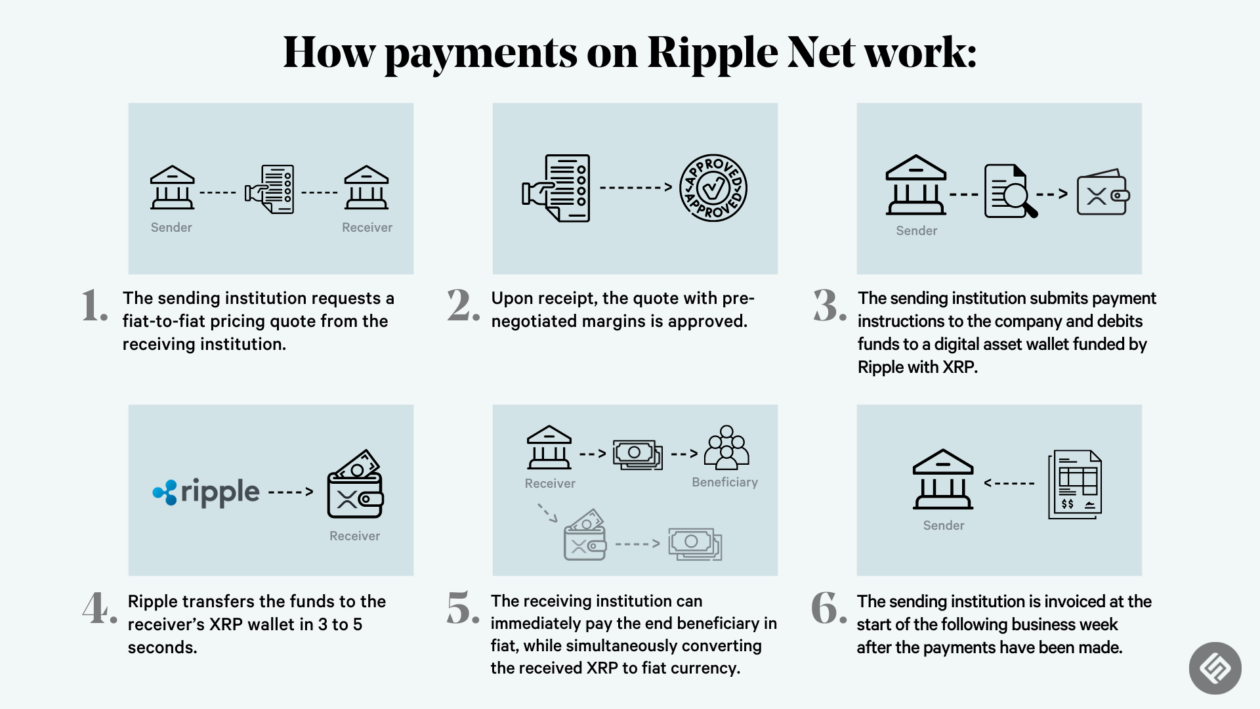
The technological backbone supporting Ripple’s financial ambitions comprises RippleNet and the XRP Ledger. RippleNet is a network of institutional payment providers that use Ripple’s software to send and receive payments globally. It offers various solutions, including xCurrent for real-time messaging and settlement, and xVia for standardized payment interfaces. The most financially significant offering, however, is On-Demand Liquidity (ODL).
ODL specifically leverages XRP to eliminate the need for pre-funded nostro accounts when conducting international payments. Instead of holding capital in various currencies across different countries, financial institutions can instantly convert their local currency into XRP, send it across the XRP Ledger, and then instantly convert it into the destination currency. This significantly reduces capital requirements, lowers foreign exchange costs, and speeds up settlement times from days to seconds. The XRP Ledger itself is a public, open-source distributed ledger technology that processes transactions quickly and cost-effectively, acting as the underlying infrastructure for XRP and a platform for various other financial applications. Its consensus mechanism, different from Bitcoin’s proof-of-work, allows for high transaction throughput and energy efficiency, making it suitable for high-volume financial operations.
Navigating the Financial Landscape: Market Position and Investment
Ripple’s journey in the financial markets has been dynamic, characterized by periods of rapid growth, significant market capitalization, and considerable regulatory scrutiny. Understanding its investment profile and market position requires an examination of XRP’s performance and the broader financial and legal environment in which Ripple operates.
XRP’s Market Performance and Volatility
As a leading cryptocurrency, XRP’s market performance is a crucial indicator of Ripple’s overall financial standing in the digital asset space. XRP consistently ranks among the top cryptocurrencies by market capitalization, indicating significant investor interest and market liquidity. However, like all cryptocurrencies, XRP is subject to substantial price volatility, influenced by broader market trends, technological developments, regulatory news, and global economic factors.
Investors often track XRP’s price movements as an indicator of the market’s perception of Ripple’s progress in achieving its mission. Periods of positive news, such as new partnerships or advancements in ODL adoption, can drive price increases, while negative news, particularly regarding regulatory challenges, can lead to significant declines. This volatility presents both opportunities and risks for investors, making a detailed understanding of the underlying factors essential. Its price discovery is also heavily influenced by its utility as a bridge currency and speculative trading.
Investment Thesis: The Case for XRP
The investment thesis for XRP is multifaceted, appealing to various types of investors. For those focused on utility, XRP’s role in facilitating frictionless cross-border payments through ODL is a primary draw. If Ripple’s solutions achieve widespread adoption among financial institutions, the demand for XRP as a liquidity tool could theoretically increase, driving its value. This perspective positions XRP less as a speculative digital gold and more as a functional asset integral to a future global payment network.
Furthermore, investors are often attracted to XRP’s technological advantages, such as its speed, low transaction costs, and scalability compared to other blockchain networks. The fixed supply of XRP (100 billion tokens created at inception) with a significant portion held in escrow by Ripple Labs, which releases it programmatically, provides a degree of supply predictability, though concerns exist about the potential for large market dumps. The potential for XRP to become a global standard for value transfer, similar to how TCP/IP became a standard for information transfer, forms a compelling narrative for long-term holders.
Regulatory Challenges and Their Financial Implications
One of the most significant financial impediments and areas of uncertainty for Ripple and XRP has been the ongoing regulatory scrutiny, particularly in the United States. The lawsuit filed by the U.S. Securities and Exchange Commission (SEC) in December 2020, alleging that XRP is an unregistered security, has had profound financial implications.
The lawsuit led to many cryptocurrency exchanges delisting or suspending trading of XRP for U.S. customers, significantly impacting its liquidity and price within the U.S. market. It created a cloud of regulatory uncertainty that deterred potential institutional partners in regulated markets and made it challenging for Ripple to expand its operations in certain jurisdictions. Financially, the lawsuit has incurred substantial legal costs for Ripple Labs, diverted resources, and created a perception of risk that has weighed on XRP’s valuation.
A favorable resolution for Ripple would likely lead to a resurgence in market confidence, potential relisting on U.S. exchanges, and an increased willingness of financial institutions to integrate Ripple’s ODL solutions. Conversely, an unfavorable outcome could significantly impair XRP’s utility in the U.S. and potentially set precedents for other digital assets, with far-reaching financial consequences for the entire crypto market. The legal battle highlights the critical interplay between emerging financial technologies and established regulatory frameworks, and its resolution is keenly watched by investors and industry players alike.
Ripple’s Role in Global Finance and Enterprise Adoption
Ripple’s ambition extends beyond just market capitalization; it seeks to embed itself within the very fabric of global finance. Its strategy hinges on enterprise adoption, forging partnerships with established financial institutions to integrate its technology into existing payment flows.
Cross-Border Payments: Addressing Inefficiencies
The inefficiencies in cross-border payments are staggering, amounting to billions in fees and lost opportunity costs annually. Ripple directly targets these inefficiencies, offering a compelling value proposition to banks and payment providers. By utilizing RippleNet and ODL with XRP, these institutions can process international payments in seconds, as opposed to days, with transaction costs often reduced by over 50%. This not only saves money but also frees up capital that would otherwise be held in pre-funded accounts, improving liquidity management and operational efficiency.
For businesses, this means faster access to funds from international sales, reduced foreign exchange risk, and more predictable cash flows. For individuals, especially migrant workers sending remittances, it means more of their hard-earned money reaches their families quicker and cheaper, fostering greater financial inclusion. Ripple’s focus on this specific, high-value problem area positions it as a practical, rather than purely speculative, financial solution.
Strategic Partnerships and Ecosystem Growth
Ripple’s success is heavily reliant on its ability to forge and maintain strategic partnerships with financial institutions worldwide. The company has a growing network of partners, including banks, payment processors, and remittance companies across various continents. These partnerships are critical for expanding RippleNet’s reach and increasing the volume of transactions settled using its technology, particularly ODL.
Each new partnership represents a potential increase in demand for XRP, as more institutions utilize it for liquidity. Beyond direct payment providers, Ripple also engages with financial technology innovators and developers to build out the XRP Ledger ecosystem, creating a broader range of financial applications and services that could indirectly boost XRP’s utility and value. The growth of this ecosystem is a key metric for understanding Ripple’s financial health and its potential for long-term success.
Central Bank Digital Currencies (CBDCs) and Ripple’s Involvement
An emerging area of financial innovation that Ripple is actively exploring is Central Bank Digital Currencies (CBDCs). As central banks globally investigate or pilot their own digital currencies, Ripple sees an opportunity to position itself as a technology provider for these initiatives. The XRP Ledger’s robust, scalable, and secure architecture makes it a suitable platform for issuing and managing CBDCs, as well as for facilitating interoperability between different CBDCs and existing financial systems.
Ripple’s involvement in CBDC discussions and pilot programs underscores its ambition to remain at the forefront of digital finance. By offering its expertise and technology, Ripple could play a significant role in shaping the future of national and international digital money, further cementing its position as a critical infrastructure provider in the evolving financial landscape. This potential for engagement with sovereign financial systems represents a substantial long-term financial opportunity for Ripple.
The Future Outlook: Opportunities and Challenges
Ripple’s future financial trajectory is subject to a confluence of opportunities and challenges. Its ability to navigate these will determine its ultimate success in reshaping global finance and its impact on investors.
Potential for Broader Adoption and Market Expansion
The primary opportunity for Ripple lies in the continued expansion of its payment network and the broader adoption of ODL. As more financial institutions and enterprises recognize the undeniable cost and speed advantages of Ripple’s solutions over traditional methods, the demand for its services and, by extension, XRP, could grow significantly. Emerging markets, in particular, stand to benefit immensely from more efficient remittance and cross-border payment solutions, representing a massive untapped market for Ripple.
Furthermore, the general trend towards digitalization in finance, accelerated by global events, provides a tailwind for Ripple. As societies become increasingly digital-first, the need for agile, instant, and borderless financial infrastructure will only intensify, creating fertile ground for Ripple’s technologies to thrive. The company’s proactive engagement with developers and its commitment to building out the XRP Ledger’s capabilities for decentralized finance (DeFi) and NFTs also open new avenues for market expansion and utility.
Competitive Landscape and Emerging Technologies
Ripple operates in a highly competitive and rapidly evolving financial technology landscape. It faces competition not only from traditional players in the remittance and banking sectors who are also modernizing but also from other blockchain-based solutions and new fintech startups. Companies like Stellar (XLM), SWIFT’s GPI initiative, and even stablecoins offer alternative approaches to improving cross-border payments.
The pace of technological innovation in areas like distributed ledger technology, artificial intelligence, and quantum computing could introduce new paradigms that either complement or disrupt Ripple’s current offerings. Remaining agile, continually innovating, and adapting its strategy to incorporate new technologies and market demands will be crucial for Ripple to maintain its competitive edge and secure its financial future.
Regulatory Clarity: A Key to Unlocking Value
Perhaps the most significant challenge and opportunity for Ripple is achieving comprehensive regulatory clarity. The outcome of the SEC lawsuit, and future regulatory frameworks for digital assets globally, will heavily influence Ripple’s ability to operate, grow, and be adopted by mainstream financial institutions, particularly in key markets like the U.S.
A definitive regulatory status, especially one that clearly differentiates XRP from a security, could unlock significant value for investors, provide certainty for financial institutions considering Ripple’s solutions, and pave the way for broader market participation. Conversely, adverse regulatory decisions could severely limit its financial potential and market reach. Ripple’s advocacy for clear, innovation-friendly regulation globally underscores its understanding that legal certainty is not just a compliance issue but a fundamental driver of financial success and market acceptance.
In conclusion, “what is Ripple at?” is a question that reveals a company and an asset at a critical juncture. It stands as a pioneer in leveraging blockchain for real-world financial problems, with a powerful vision for global payments. Its financial standing is intrinsically linked to the adoption of its technology, the utility of XRP, and its ability to successfully navigate the complex interplay of technological innovation, market dynamics, and regulatory landscapes. For investors and financial institutions alike, Ripple represents a significant case study in the ongoing transformation of global finance.
aViewFromTheCave is a participant in the Amazon Services LLC Associates Program, an affiliate advertising program designed to provide a means for sites to earn advertising fees by advertising and linking to Amazon.com. Amazon, the Amazon logo, AmazonSupply, and the AmazonSupply logo are trademarks of Amazon.com, Inc. or its affiliates. As an Amazon Associate we earn affiliate commissions from qualifying purchases.