
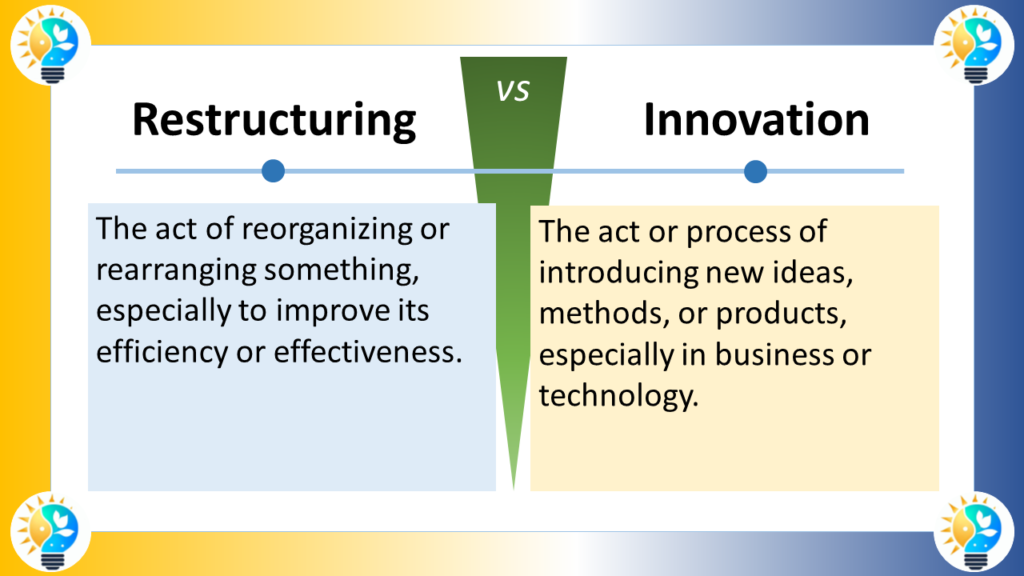
In the volatile landscape of modern business and finance, the term “restructuring” often surfaces as a headline-grabbing buzzword. Whether it is a multinational corporation navigating a global recession or a small business owner attempting to pivot their revenue model, restructuring represents a significant turning point. At its core, restructuring is the corporate process of significantly changing a company’s financial, operational, or legal structure to improve its efficiency, profitability, and overall viability.
While the term may sound intimidating—often associated with layoffs or bankruptcy—restructuring is a fundamental tool in the “Money” niche. It is a strategic mechanism used by investors, creditors, and business owners to salvage value from distress or to position a healthy company for exponential growth. Understanding the nuances of restructuring is essential for anyone involved in business finance, investing, or entrepreneurship.
The Core Principles of Financial Restructuring
Financial restructuring is the most common form of this process, primarily focusing on the right side of the balance sheet: liabilities and equity. When a company’s debt burden becomes unsustainable, or its capital structure no longer aligns with its long-term goals, financial restructuring becomes necessary. The objective is to rearrange the company’s financial obligations to ensure it has the liquidity to continue operations.
Debt-for-Equity Swaps
One of the most effective tools in financial restructuring is the debt-for-equity swap. In this scenario, creditors agree to cancel a portion or all of the company’s outstanding debt in exchange for an equity stake in the business. This is a win-win in many distressed situations. For the company, it eliminates the pressure of interest payments and the looming threat of default. For the creditors, while they lose the guaranteed income of debt, they gain the potential for high returns if the company recovers and its stock price appreciates. This process often results in original shareholders seeing their value diluted, but it is frequently the only alternative to total liquidation.
Debt Rescheduling and Refinancing
When a company is fundamentally sound but faces a temporary liquidity crunch, it may opt for debt rescheduling. This involves renegotiating the terms of existing loans with lenders to extend the maturity dates or lower the interest rates. Refinancing, a similar but distinct approach, involves taking out a new loan—often at more favorable terms—to pay off older, more expensive debt. In the world of business finance, successful refinancing can free up significant cash flow, allowing the company to reinvest in its core operations rather than merely servicing its debt.
Capital Infusion and Private Equity Involvement
Restructuring often attracts the attention of private equity firms and “venture-turnaround” investors. These entities specialize in providing capital to companies in the midst of a restructure. This capital infusion acts as a bridge, allowing the company to stabilize its operations while it implements structural changes. In return, these investors typically demand significant control over the company’s direction, using their financial expertise to steer the business back toward profitability.
Operational Restructuring: Streamlining for Profitability
While financial restructuring deals with the money the company owes, operational restructuring focuses on how the company makes money. It involves a deep dive into the Profit and Loss (P&L) statement to identify inefficiencies, eliminate waste, and optimize resource allocation. A company can have a perfect balance sheet, but if its operations are bloated or outdated, it will eventually face financial ruin.
Asset Divestiture and Spin-offs
A key component of operational restructuring is the “slimming down” process. Companies often find themselves holding onto assets or business units that are no longer aligned with their core mission or are consistently underperforming. Divestiture—the sale of these assets—provides an immediate influx of cash that can be used to pay down debt or invest in more profitable sectors. Spin-offs are a variation of this, where a company turns a subsidiary into an independent entity, distributing shares of the new company to existing shareholders. This allows both the parent and the new company to focus on their respective strengths, often unlocking hidden value for investors.
Cost Reduction and Resource Optimization
Operational restructuring frequently necessitates a hard look at overhead costs. This can include everything from renegotiating supplier contracts and consolidating office space to the more difficult task of workforce reductions. However, modern restructuring is moving toward “resource optimization” rather than just blind cutting. This means utilizing financial tools and data analytics to determine which departments generate the highest return on investment (ROI) and shifting human and financial capital toward those areas. By automating repetitive tasks and streamlining supply chains, companies can achieve a leaner, more agile operational model.
Pivoting the Business Model

In the modern digital economy, operational restructuring often involves a total pivot of the business model. This is especially relevant in the “online income” and “side hustle” sectors, where market trends shift rapidly. A company that previously relied on physical retail might restructure to become a direct-to-consumer (DTC) e-commerce entity. This requires a complete overhaul of logistics, marketing budgets, and sales funnels. While risky, a successful pivot during a restructuring phase can transition a dying brand into a market leader in the digital finance space.
The Strategic Lifecycle of a Corporate Turnaround
Restructuring is rarely a single event; it is a lifecycle that requires meticulous planning and execution. Professionals in the finance world view restructuring through a chronological lens, moving from the immediate crisis to long-term sustainability.
The Crisis Phase and Stabilization
The first stage of any restructuring is stabilization. This is the “triage” phase of business finance. The primary goal is to stop the bleeding—meaning, to halt the immediate outflow of cash. Management will often implement a “cash command center,” where every single expenditure must be justified and approved. During this phase, communication with stakeholders—creditors, employees, and investors—is paramount. Transparency helps maintain trust, which is the most valuable currency during a period of financial instability.
Developing the Turnaround Plan
Once the company is stabilized, a formal turnaround plan is developed. This plan serves as the blueprint for the restructuring process. It outlines the specific financial and operational changes that will be made, sets clear KPIs (Key Performance Indicators), and establishes a timeline for recovery. Investors look for “low-hanging fruit”—quick wins that can demonstrate the plan is working—to build momentum. This might include closing a single underperforming branch or launching a high-margin digital product.
Long-term Growth and Market Re-entry
The final stage of restructuring is the transition from survival to growth. A restructured company is often unrecognizable from its former self. It is leaner, more focused, and possesses a healthier balance sheet. At this stage, the focus shifts to reclaiming market share and exploring new revenue streams. For investors, this is the “exit” phase, where they may look to sell their stake or take the company public through an Initial Public Offering (IPO), capitalizing on the value created during the restructuring process.
Restructuring for Small Businesses and Solo Entrepreneurs
Restructuring is not exclusively for Fortune 500 companies. In the world of personal finance and side hustles, restructuring is a vital skill for maintaining financial health. Whether you are managing a freelance business or a growing online startup, the principles of restructuring apply directly to your “Money” strategy.
Personal Financial Restructuring
For the individual, restructuring often takes the form of debt consolidation or a total overhaul of the personal budget. If an entrepreneur’s side hustle is failing to gain traction, they must perform a “mini-restructure.” This involves analyzing the time and money invested versus the income generated. It might mean cutting expensive software subscriptions (SaaS tools) that aren’t providing an ROI, or restructuring their schedule to focus on high-ticket clients rather than low-volume work.
Managing Cash Flow in Times of Volatility
Small businesses are particularly vulnerable to cash flow gaps. Restructuring a small business’s finance might involve changing the billing cycle—moving from “net-30” to “upfront payments”—to ensure there is always liquidity available. It could also involve “restructuring” the service offering. For example, a consultant might move from a one-time project fee to a recurring monthly retainer model, providing the financial stability necessary to weather economic downturns.

The Role of Financial Tools in Modern Restructuring
Technology has revolutionized how restructuring is handled in the finance niche. There are now myriad financial tools designed to help businesses track every penny, forecast future cash flows, and model “what-if” scenarios. Utilizing these tools allows business owners to see the need for restructuring long before a crisis hits. Proactive restructuring is always more successful than reactive restructuring. By monitoring debt-to-equity ratios and burn rates in real-time, entrepreneurs can make incremental changes that prevent the need for a massive, painful overhaul later.
In conclusion, restructuring is the ultimate expression of financial adaptability. It is a complex, often difficult process, but it is the primary way that value is preserved and created in a changing economy. By understanding the interplay between financial obligations and operational efficiency, and by viewing restructuring as a strategic tool rather than a sign of failure, business owners and investors can navigate even the most turbulent financial waters with confidence and insight.
aViewFromTheCave is a participant in the Amazon Services LLC Associates Program, an affiliate advertising program designed to provide a means for sites to earn advertising fees by advertising and linking to Amazon.com. Amazon, the Amazon logo, AmazonSupply, and the AmazonSupply logo are trademarks of Amazon.com, Inc. or its affiliates. As an Amazon Associate we earn affiliate commissions from qualifying purchases.