
Resistance welding stands as a cornerstone in modern manufacturing, a sophisticated thermal joining process that leverages the fundamental principle of electrical resistance to generate heat and forge durable bonds between metal components. Far from the visible arc or open flame often associated with welding, resistance welding is a clean, efficient, and highly controllable method, critical for mass production across a multitude of industries. At its core, it’s a process where two or more metal parts are clamped together under pressure, and a carefully controlled electrical current is passed through them. The inherent electrical resistance of the metals at the interface causes localized heating, melting the material at the contact points and, under sustained pressure, forming a strong metallurgical bond upon cooling.

The Fundamental Principles of Resistance Welding
Understanding resistance welding begins with grasping the physics that underpins its operation. The process relies heavily on a combination of electrical, thermal, and mechanical principles, meticulously orchestrated to achieve a precise weld.
The Joule Heating Effect
The primary mechanism for heat generation in resistance welding is the Joule heating effect, also known as ohmic heating. This principle states that the heat generated (Q) by an electrical current (I) flowing through a conductor with resistance (R) over a period of time (t) is given by the formula Q = I²Rt. In resistance welding, a high current at low voltage is passed through the workpieces. The highest electrical resistance typically occurs at the interface between the two metals, as well as in the bulk material itself and between the electrodes and the workpiece. This localized high resistance causes the temperature at the interface to rise rapidly and intensely, reaching the molten state necessary for welding.
Applied Force and Material Characteristics
Beyond electrical current, mechanical force is indispensable. Electrodes, typically made from highly conductive copper alloys, not only deliver the current but also apply precise clamping force to the workpieces. This force serves several critical functions: it holds the parts in intimate contact, ensuring a consistent electrical path; it forges the molten metal together; and it facilitates rapid cooling by conducting heat away from the weld zone once the current is switched off. The material characteristics of the workpieces—their electrical resistivity, thermal conductivity, melting point, and mechanical properties—are paramount. Different metals require specific current, time, and force parameters to achieve an optimal weld, highlighting the nuanced control required in the process.
Essential Equipment Components
A typical resistance welding setup comprises several key components working in concert:
- Power Source: This transforms high-voltage AC utility power into the low-voltage, high-current electricity required for welding. Modern systems often use inverter-based power supplies for greater control and energy efficiency.
- Electrodes: These are crucial for delivering current and applying force. They are designed in various shapes and sizes to concentrate current density at the weld point and often include internal cooling channels to dissipate heat and prevent premature wear.
- Welding Machine (Controller, Actuator): The welding machine houses the mechanical actuator that applies and releases the welding force, often pneumatically or hydraulically driven. The sophisticated electronic controller manages the welding schedule, precisely coordinating current magnitude, weld time, hold time, and force application.
Diverse Applications Across Industries
The inherent advantages of resistance welding—speed, automation potential, and the ability to join specific geometries—have made it indispensable in a broad spectrum of manufacturing sectors.
Automotive Manufacturing
The automotive industry is perhaps the largest consumer of resistance welding technology. Spot welding, in particular, is the backbone of car body construction, joining sheet metal panels to create robust and rigid vehicle frames. From doors and hoods to chassis components, thousands of spot welds are used in every car, contributing significantly to structural integrity and passenger safety. Projection welding is also vital for attaching fasteners, brackets, and reinforcing elements, while seam welding is used for fuel tanks and exhaust components.
Aerospace and Aviation
In aerospace, where precision and reliability are paramount, resistance welding finds applications in joining thin-gauge materials and fabricating intricate assemblies. While high-performance alloys demand specialized techniques, resistance welding contributes to non-critical structural components, electrical enclosures, and various sheet metal sub-assemblies. Its ability to create strong, consistent welds with minimal heat distortion is highly valued.
Electronics and Consumer Goods
The production of electronic components and consumer goods relies heavily on resistance welding for miniature and precision joining tasks. Battery tabs, electrical contacts, and small wire assemblies are often resistance welded. Micro-resistance welding techniques enable the creation of minute, highly reliable connections essential for printed circuit boards, sensors, and various electronic devices.
Medical Devices
The medical device industry benefits from the precision and cleanliness of resistance welding. Joining small, delicate components for instruments, implants, and diagnostic equipment often requires processes that produce minimal heat affected zones and no contaminants. Resistance welding, especially in its micro-welding forms, provides controlled, repeatable bonds critical for high-stakes applications.
Construction and Fabrication
While larger structural elements often employ arc welding, resistance welding contributes to various construction and fabrication needs. Mesh products, wire cages, grates, and certain types of ductwork utilize resistance welding for efficient, high-volume production. Its application here focuses on rapid assembly of standardized components.
Key Types of Resistance Welding
Resistance welding is not a monolithic process; rather, it encompasses several distinct techniques, each optimized for specific joint configurations and material requirements.
Spot Welding
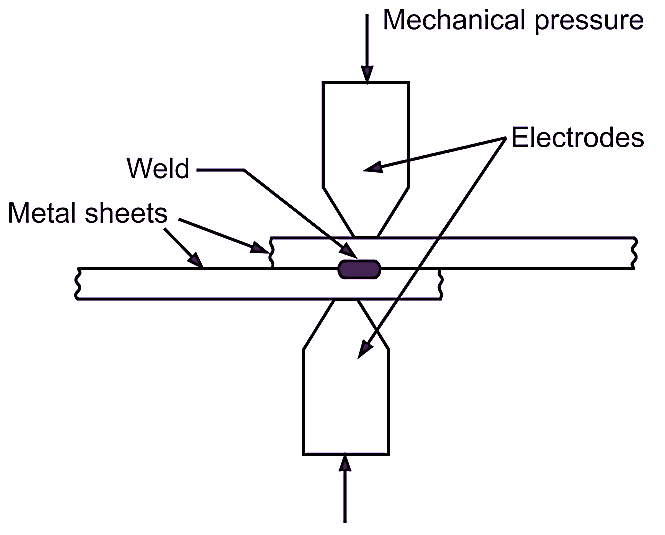
Spot welding is the most prevalent form of resistance welding. It involves clamping two overlapping metal sheets between two electrodes and passing current through them to form a single, localized weld “spot.” The electrodes are typically pointed or domed to concentrate the current and force. This process is incredibly fast, highly automatable, and widely used for joining sheet metal panels, especially in the automotive industry. It’s ideal for producing discrete, strong, and consistent joints on accessible surfaces.
Seam Welding
Seam welding is an extension of spot welding, where instead of pointed electrodes, two rotating wheel electrodes are used to continuously roll over the workpieces while current is intermittently or continuously applied. This creates a series of overlapping spot welds, resulting in a continuous, leak-tight seam. Applications include fuel tanks, heat exchangers, mufflers, and other containers requiring hermetic seals. Both conventional seam welding (with overlapping spots) and mash seam welding (where the overlap is minimal, forming a flush joint) are utilized.
Projection Welding
Projection welding introduces strategically designed projections or embossments on one or both workpieces. When pressure and current are applied, these projections act as localized points of high current density and resistance, concentrating heat generation at specific points. As the metal heats and softens, the projections collapse, forming strong, consistent welds. This method is highly effective for welding dissimilar thicknesses, attaching fasteners (like nuts and studs to sheet metal), and joining complex assemblies where multiple welds can be made simultaneously with a single machine stroke.
Flash Welding and Upset Welding
These related processes are often used for joining larger sections or creating butt joints.
- Flash Welding: Two workpieces are brought together slowly, then rapidly separated, creating an arc or “flash” at the interface. This arc generates intense heat, melting and expelling impurities from the joint. As the parts are brought back together under high force, the molten material is extruded, and a solid-state forge weld is formed. It’s excellent for joining pipes, rods, and heavy-duty sections.
- Upset Welding: Similar to flash welding, but the parts are clamped and brought together under pressure before current is applied. The current passes through the interface, heating the material to its plastic state. Then, additional force is applied, causing an “upset” or bulging at the joint as the material forges together. It’s often used for smaller sections and wires.
Butt Welding (Resistance Butt Welding)
Resistance butt welding is a simpler form of joining workpieces end-to-end. The ends of the two parts are clamped and brought into direct contact under pressure. Current is then passed through the joint, heating the interface to a forging temperature. An upsetting force is applied, forging the two pieces together. It’s commonly used for joining wires, rods, and small sections where a flush, solid-state weld is desired, without the flashing action.
Advantages and Limitations of Resistance Welding Technology
Like any industrial process, resistance welding offers distinct benefits while presenting specific constraints that influence its suitability for various applications.
Advantages:
- High Production Speed: Resistance welding processes, particularly spot and seam welding, are inherently fast, enabling rapid cycle times crucial for high-volume manufacturing.
- Automation Potential: The precise control over current, time, and force makes resistance welding highly amenable to automation, integration with robotics, and in-line production systems, reducing labor costs and increasing consistency.
- No Filler Material Required: Unlike arc welding, resistance welding typically creates a direct metallurgical bond between the parent metals, eliminating the need for costly filler metals, flux, or shielding gases, simplifying the process and reducing material consumption.
- Cost-Effectiveness: While initial equipment investment can be significant, the absence of consumables, high speed, and automation capabilities often lead to lower per-unit production costs.
- Minimal Heat Affected Zone (HAZ): The localized and rapid heating, combined with rapid cooling facilitated by the electrodes, results in a very small HAZ, preserving the mechanical properties of the surrounding material better than many other welding methods.
- Environmental Benefits: The process produces no fumes, spatter, or hazardous by-products associated with arc welding, making it a cleaner and safer operation.
- Ability to Join Dissimilar Metals: Under controlled conditions and with careful parameter selection, resistance welding can be used to join certain combinations of dissimilar metals, expanding its utility.
Limitations:
- Restricted to Overlapping Joints: Spot and seam welding typically require overlapping joint configurations, which may not always be feasible or desirable for certain designs. Butt welding mitigates this but has its own constraints.
- Surface Preparation Critical: The quality of resistance welds is highly sensitive to surface conditions. Oxide layers, dirt, oil, or coatings can significantly increase resistance, leading to inconsistent welds or electrode degradation, thus requiring meticulous cleaning.
- High Initial Equipment Cost: Sophisticated resistance welding machines, especially those with advanced control systems and robotic integration, can represent a substantial capital investment.
- Limited Material Thickness: There are practical limits to the thickness of materials that can be effectively joined by resistance welding, typically favoring sheet metal and thinner sections. Welding very thick plates becomes challenging due to the high current requirements and heat dissipation issues.
- Electrode Wear: Electrodes, particularly those made of copper alloys, wear down over time due to high current, force, and heat cycling. This necessitates regular maintenance, dressing, or replacement, which impacts uptime and costs.
Advancements and Future Outlook in Resistance Welding
The field of resistance welding is continually evolving, driven by demands for greater precision, efficiency, and adaptability. Technological advancements are addressing existing limitations and expanding its capabilities.
Process Monitoring and Control Systems
Modern resistance welding machines are equipped with sophisticated process monitoring systems that track parameters like current, voltage, electrode force, and displacement in real-time. These systems provide invaluable data for quality assurance, allowing operators to detect deviations and potential issues instantaneously. Predictive analytics can even forecast electrode wear or upcoming maintenance needs.
Adaptive Welding Technology
A significant leap has been the development of adaptive welding controllers. These intelligent systems can dynamically adjust welding parameters (current, time, force) during the welding cycle in response to real-time feedback from the weld process. This capability allows for consistent weld quality even in the presence of minor variations in material thickness, surface conditions, or electrode wear, drastically improving reliability and reducing scrap.
New Electrode Materials and Geometries
Research into advanced electrode materials and novel geometries is ongoing. Electrodes made from dispersion-strengthened copper (e.g., CuCrZr, CuAl2O3) offer improved wear resistance and extended lifespan, particularly when welding high-strength steels. Innovative electrode designs, such as those with integrated cooling channels or multi-faceted tips, are enhancing current density control and reducing heat buildup, further extending electrode life and improving weld quality.
Integration with Robotics and AI
The inherent automation-friendliness of resistance welding makes it a prime candidate for integration with robotics. Robotic arms precisely position welding guns, executing complex weld sequences with unmatched repeatability and speed. Looking ahead, Artificial Intelligence (AI) and machine learning algorithms are being explored to optimize welding parameters autonomously, predict failure modes, and even adapt to unforeseen process variables, pushing the boundaries of autonomous manufacturing.

Energy Efficiency Innovations
With a global focus on sustainability, innovations in power sources are leading to more energy-efficient resistance welding. Inverter-based power supplies offer greater energy efficiency compared to traditional AC transformers, consuming less power and reducing operational costs. Research into optimized welding schedules and pulse current techniques also aims to achieve strong welds with reduced overall energy input, contributing to a greener manufacturing footprint.
Resistance welding, with its foundational principles rooted in basic physics and its future intertwined with advanced digital technologies, continues to be a vital and evolving process in the modern industrial landscape. Its blend of speed, precision, and efficiency ensures its continued relevance in building the products that define our technological world.
aViewFromTheCave is a participant in the Amazon Services LLC Associates Program, an affiliate advertising program designed to provide a means for sites to earn advertising fees by advertising and linking to Amazon.com. Amazon, the Amazon logo, AmazonSupply, and the AmazonSupply logo are trademarks of Amazon.com, Inc. or its affiliates. As an Amazon Associate we earn affiliate commissions from qualifying purchases.