
In the landscape of business finance and operational management, replenishment is the strategic process of ensuring that inventory levels are maintained at an optimal point to satisfy customer demand while minimizing the capital tied up in stock. Far from being a simple logistical task, replenishment is a cornerstone of financial health. It represents the delicate balance between liquidity—having cash available for investment and debt service—and serviceability—having the product available to generate revenue.
For any business that deals with physical goods, from retail giants to specialized manufacturers, the replenishment cycle dictates the rhythm of cash outflows and inflows. When managed effectively, it ensures a high inventory turnover ratio, which is a primary indicator of how efficiently a company is using its assets to generate profit. When managed poorly, it leads to the twin financial traps of overstocking and stockouts, both of which can erode margins and threaten the long-term viability of a corporate balance sheet.

The Financial Pillars of Inventory Replenishment
At its core, replenishment is about managing working capital. Working capital is the difference between a company’s current assets and its current liabilities. Because inventory is a significant component of current assets, the speed and accuracy of replenishment directly impact a firm’s liquidity.
Maximizing Working Capital Efficiency
Every dollar spent on inventory that sits on a shelf is a dollar that cannot be used for marketing, research and development, or paying down high-interest debt. This is known as the opportunity cost of capital. An efficient replenishment strategy seeks to reduce the “Cash-to-Cash Cycle”—the time it takes from the moment a company pays its suppliers for raw materials or finished goods to the moment it receives cash from the customer for those products. By synchronizing replenishment with actual sales velocity, businesses can keep their capital “lean,” ensuring that money is constantly moving rather than stagnating in a warehouse.
The Impact on EBITDA and Net Income
Replenishment strategies directly influence the cost of goods sold (COGS) and operating expenses, which in turn impact EBITDA (Earnings Before Interest, Taxes, Depreciation, and Amortization). Efficient replenishment reduces holding costs, which include warehousing fees, insurance, and the risk of obsolescence. Furthermore, by preventing stockouts, a business avoids “lost sale” scenarios and the expensive “firefighting” costs of expedited shipping or emergency procurement, both of which drastically reduce the net profit margin on a per-unit basis.
Strategic Models of Replenishment
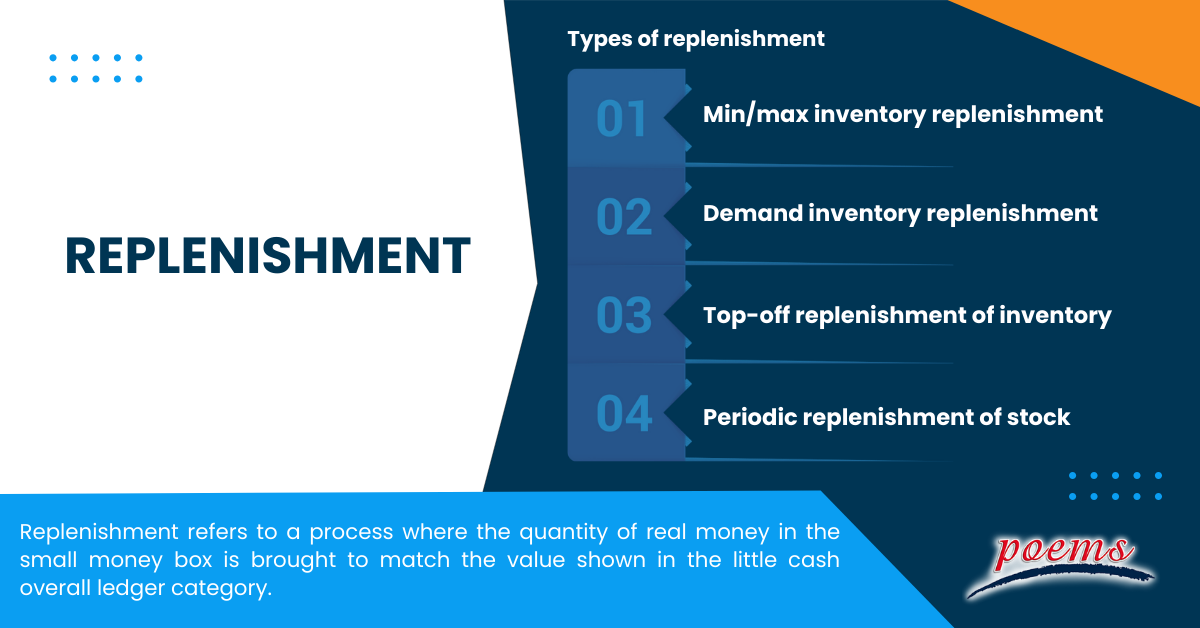
To achieve financial optimization, businesses employ several replenishment models. The choice of model depends on the nature of the business, the predictability of demand, and the cost of the capital involved.
Reorder Point (ROP) Strategy
The Reorder Point strategy is a classic financial control mechanism. It involves setting a specific inventory level that, when reached, triggers a new purchase order. The formula for ROP typically considers the lead time (how long it takes for a supplier to deliver) and the average daily sales. From a business finance perspective, this model provides a predictable rhythm for cash outflows, allowing the finance department to forecast accounts payable with a high degree of accuracy.
Just-in-Time (JIT) Replenishment
Popularized by the automotive industry, JIT is a high-stakes financial strategy where replenishment occurs exactly when the inventory is needed for production or sale. The goal is to keep inventory levels as close to zero as possible. Financially, this is the most “efficient” model because it virtually eliminates holding costs. However, it requires a robust and reliable supply chain; any disruption can lead to immediate revenue loss, making it a high-reward but high-risk strategy for capital management.
Economic Order Quantity (EOQ)
The Economic Order Quantity is a fundamental financial formula used to determine the ideal order size that minimizes the total costs of inventory management. It balances two competing costs: ordering costs (administrative and shipping fees) and carrying costs (the interest and storage costs of holding inventory). By utilizing the EOQ model, a business can mathematically identify the “sweet spot” where they are not over-spending on frequent small deliveries nor tying up too much capital in massive bulk orders.
The Hidden Costs of Replenishment Failure
In business finance, the risks of a failed replenishment strategy are often more expensive than they appear on a surface-level ledger. These costs manifest in two primary ways: the “Dead Capital” of overstock and the “Lost Opportunity” of understock.
The Financial Drain of Overstocking
Overstocking occurs when replenishment cycles are too frequent or based on overly optimistic demand forecasts. This leads to several financial burdens:
- Storage and Carrying Costs: These typically range from 20% to 30% of the inventory’s value annually. This includes rent, utilities, labor for handling, and insurance.
- Obsolescence and Markdowns: In industries like electronics or fashion, products lose value rapidly. Overstocked items eventually require aggressive discounting to clear space, which can result in selling items at or below cost, leading to a negative gross margin.
- Depreciation of Assets: Inventory is a depreciating asset. The longer it sits, the more its book value may need to be written down, which directly impacts the company’s net worth and equity.
The Cost of Stockouts and Understocking
Understocking is equally damaging to the bottom line, though its impact is often harder to quantify immediately.
- Direct Revenue Loss: If a customer wants to buy and the product isn’t there, the sale is lost to a competitor.
- Customer Acquisition Cost (CAC) Erosion: Companies spend significant money on marketing to acquire customers. If a customer arrives at the store or website and finds an out-of-stock message, the money spent to acquire that lead is effectively wasted.
- Supply Chain Premiums: To correct a stockout, businesses often pay premium prices for “rush” orders or air freight, which can cost five to ten times more than standard ocean or ground freight, wiping out any potential profit on the restocked items.
Leveraging Data and Financial Tools for Intelligent Replenishment
In the modern era, replenishment has moved from the warehouse manager’s intuition to the chief financial officer’s (CFO) dashboard. The integration of financial tools and predictive analytics has transformed replenishment into a precision instrument for wealth preservation.
Predictive Analytics and Demand Forecasting
Modern business finance tools utilize historical sales data, seasonal trends, and even external factors like economic shifts to predict future demand. By refining these forecasts, companies can tighten their replenishment cycles. High-precision forecasting allows a business to operate with a smaller “safety stock,” freeing up cash for other strategic investments while maintaining a 99% or higher service level.
Automated Financial Integration
Leading Enterprise Resource Planning (ERP) systems now link replenishment triggers directly to financial workflows. When a reorder point is hit, the system can automatically generate a purchase order, update the accounts payable forecast, and check the available credit lines with suppliers. This integration ensures that the business maintains a healthy balance between its physical assets and its cash reserves, preventing the common pitfall of “growing broke”—where a company has plenty of sales but runs out of cash because it is all tied up in inventory.
Supplier Relationship Management (SRM) and Financing
Sophisticated replenishment also involves financial negotiation with suppliers. Strategies such as Vendor Managed Inventory (VMI)—where the supplier monitors the buyer’s stock levels and replenishes automatically—can shift the financial burden of holding stock. Furthermore, many businesses use “Supply Chain Finance” programs, where a third-party financier pays the supplier early at a discount, allowing the buyer to keep their cash longer while the replenishment cycle continues uninterrupted.

Conclusion: Replenishment as a Competitive Advantage
Understanding replenishment through a financial lens shifts the conversation from “how much product do we have?” to “how effectively is our capital working for us?” In a global economy characterized by volatility and thin margins, the ability to master the replenishment cycle is a significant competitive advantage. It allows a business to remain agile, respond to market demands without over-leveraging its balance sheet, and maintain the liquidity necessary to pivot or expand when opportunities arise.
Ultimately, replenishment is the heartbeat of a product-based business. When it is steady and data-driven, it fuels growth and sustains profitability. When it is erratic, it drains resources and stifles potential. For the savvy business owner or financial professional, mastering the art and science of replenishment is not just about keeping shelves full—it is about ensuring the business remains fiscally robust and prepared for the future.
aViewFromTheCave is a participant in the Amazon Services LLC Associates Program, an affiliate advertising program designed to provide a means for sites to earn advertising fees by advertising and linking to Amazon.com. Amazon, the Amazon logo, AmazonSupply, and the AmazonSupply logo are trademarks of Amazon.com, Inc. or its affiliates. As an Amazon Associate we earn affiliate commissions from qualifying purchases.