
In the rapidly evolving landscape of aesthetic technology and minimally invasive medical procedures, Renuvion has emerged as a disruptive tool that bridges the gap between traditional surgical interventions and non-surgical skin tightening. As the demand for procedures with shorter recovery times and high-precision results grows, practitioners are increasingly turning to advanced energy-based devices. Renuvion represents a convergence of helium plasma technology and radiofrequency (RF) energy, offering a unique approach to tissue contraction that was previously difficult to achieve without significant surgical excision.
Understanding Renuvion requires looking past the marketing veneer and examining the physics of the technology. By leveraging a stream of ionized helium gas—plasma—in combination with precisely controlled radiofrequency energy, the device creates a highly focused thermal effect. This allows surgeons to target subcutaneous tissue with a level of accuracy that minimizes thermal damage to surrounding healthy tissue. As patients continue to prioritize “lunchtime procedures” and limited downtime, the integration of such high-tech tools into surgical suites marks a significant shift in the medical aesthetic industry.
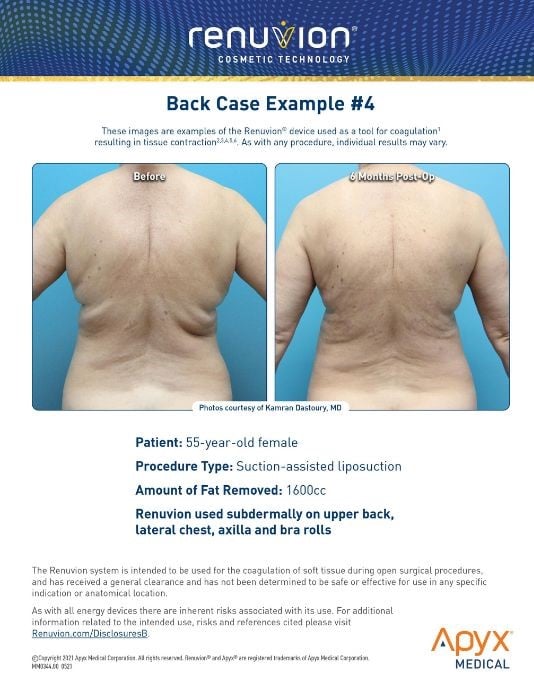
The Engineering Behind Plasma Technology
At its core, Renuvion is an energy-based surgical device that utilizes cold atmospheric plasma. While the term “cold” might seem contradictory when discussing tissue contraction, it refers to the ability of the plasma stream to deliver energy efficiently without the excessive, uncontrolled heat associated with traditional cauterization or older laser-based devices.
The Synergy of Helium and Radiofrequency
The Renuvion system operates by passing a stream of inert helium gas through a handpiece, where it is subjected to an electrical current. This process ionizes the helium, converting it into a cold plasma stream. Once ionized, the helium acts as a conduit for radiofrequency energy. This unique delivery mechanism is what sets Renuvion apart from standard monopolar RF devices. Because helium is an inert gas, it is exceptionally stable, allowing the surgeon to maintain a consistent flow of energy while the ionized gas helps to cool the target area simultaneously.
The primary goal of this synergy is “subdermal coagulation.” By targeting the fibrous septae—the connective tissue bands that anchor the skin to the underlying muscle—Renuvion induces a controlled inflammatory response and subsequent collagen contraction. This structural tightening occurs beneath the surface, providing a foundation for skin retraction that is both immediate and progressive over the months following the procedure.
Precision Control and Safety Profiles
Safety in high-energy aesthetic technology is defined by the margin of error between effective contraction and thermal injury. Renuvion’s design prioritizes a low thermal footprint. The helium gas serves as a cooling agent, preventing the buildup of heat that might otherwise cause fat necrosis or deep dermal burns. Furthermore, the device is engineered for portability and integration within existing surgical workflows, meaning that the parameters of energy delivery can be adjusted based on the specific anatomical area being treated. Whether working on the submental region (neck) or the abdomen, the surgeon maintains granular control over the energy output, ensuring that the treatment remains within the safe, therapeutically active range.
Applications in Contemporary Aesthetic Surgery
Renuvion is rarely used in isolation; rather, it has become a cornerstone of modern body contouring and facial rejuvenation protocols. Its versatility stems from its ability to address skin laxity in areas that were once considered challenging for traditional surgical lifting.
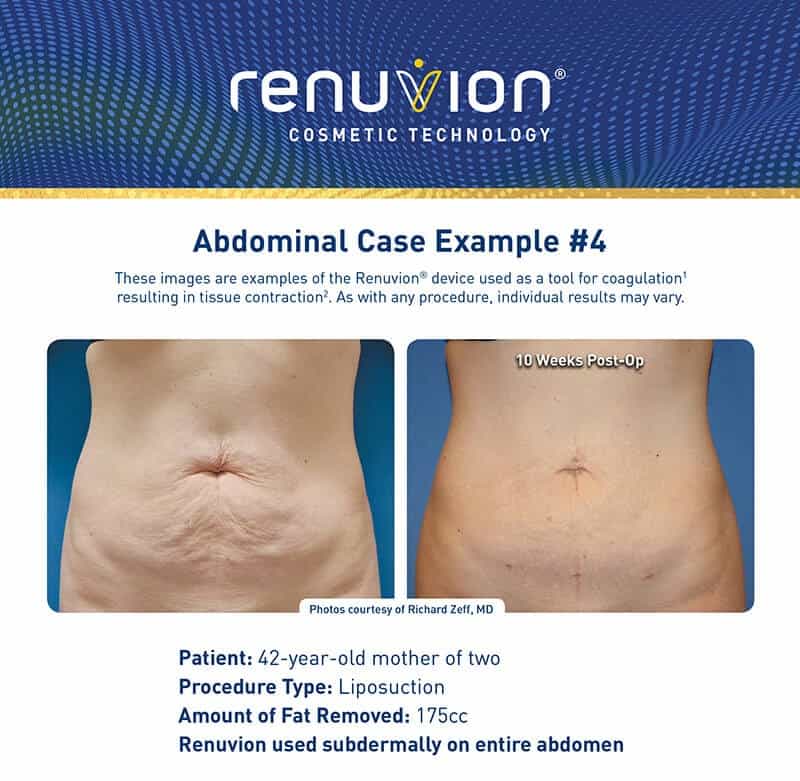
Body Contouring and Post-Liposuction Refinement
One of the most common applications for Renuvion is as an adjunct to liposuction. Traditional liposuction removes volume, but it does not inherently tighten the skin. In patients with mild to moderate skin laxity, the removal of fat can sometimes leave behind sagging skin that detracts from the sculpted result. By inserting the Renuvion cannula through the same small incisions used for liposuction, surgeons can perform subdermal coagulation. This “shrink-wrap” effect helps the skin retract against the newly contoured underlying structures, significantly improving the aesthetic outcome of the procedure.
Facial and Neck Rejuvenation
The submental area—the neck and jawline—is often the first place to show signs of aging. Historically, addressing this required a cervicoplasty or a full facelift, which involves significant downtime and scarring. Renuvion offers a middle ground. When used to treat the neck, it can firm the skin and improve the definition of the jawline without the long recovery associated with traditional surgery. Because the technology can be delivered through very small entry points, the risk of visible scarring is drastically reduced, making it an attractive option for patients who are not yet ready for invasive surgical facelifts but are dissatisfied with the results of purely non-invasive topical treatments.
Integrating Renuvion into Surgical Practice
For medical providers, the adoption of Renuvion represents a strategic investment in the efficiency and efficacy of their practice. The integration of this technology requires a specialized understanding of both the device’s capabilities and its limitations, as well as an appreciation for the shift in patient expectations.
Workflow Efficiency and Outcomes
In a clinical setting, throughput and outcome consistency are the metrics of success. Renuvion’s design allows for relatively quick application, which does not excessively lengthen the surgical time of procedures like liposuction or abdominoplasty. From a patient satisfaction standpoint, the ability to promise—and deliver—a firmer contour with minimal additional recovery time is a powerful marketing tool. Practices that utilize Renuvion often report higher patient retention rates, as the technology addresses the “skin laxity gap” that often leads to disappointment in traditional body contouring procedures.
The Role of Training and Skill Acquisition
Despite the technological sophistication of Renuvion, it is not a “set-and-forget” device. The results are highly dependent on the technique of the surgeon. Understanding the proper vectors of the cannula, the depth of treatment, and the density of the energy delivery is crucial for achieving uniform contraction. Proper training is therefore a non-negotiable aspect of adopting this technology. Practitioners must be well-versed in the anatomical layers of the skin to avoid over-treatment in areas where the dermis is thin, or under-treatment where the fibrous septae are particularly dense. As the tech landscape continues to favor results that look natural rather than “pulled,” the surgeon’s artistic touch remains the most important component of the procedure.
Future Trends in Energy-Based Aesthetic Devices
The success of Renuvion points to a broader trend in the medical device industry: the movement toward “minimally invasive maximalism.” Patients are increasingly demanding interventions that provide surgical-grade results without the surgical-grade trauma.
The Evolution of Hybrid Technologies
Renuvion is a prime example of hybrid technology, combining distinct energy modalities to create a result greater than the sum of its parts. Future iterations of aesthetic devices will likely follow this path, incorporating real-time feedback loops, such as temperature sensors or impedance monitors, to further reduce the reliance on surgeon intuition. As AI and machine learning are integrated into surgical hardware, we may see devices that automatically adjust energy output based on real-time tissue response, ensuring that every patient receives a perfectly customized treatment.
Setting Market Standards
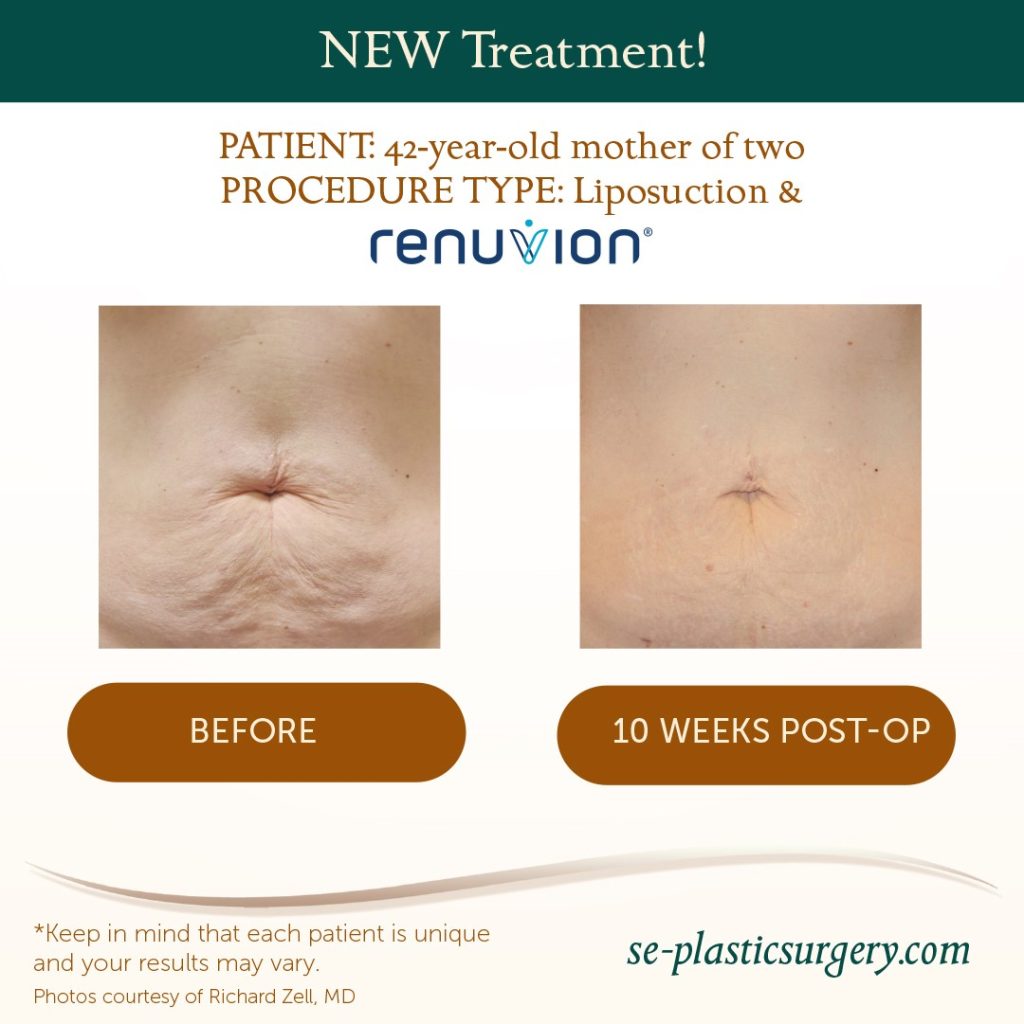
As the category of energy-based skin tightening matures, the standard of care will likely shift toward devices that offer the specific combination of safety, precision, and efficiency that Renuvion pioneered. Whether the focus is on the face, the abdomen, or the extremities, the industry is clearly moving toward solutions that prioritize cellular stimulation—triggering the body’s own healing and contraction mechanisms—rather than simply removing tissue.
In conclusion, Renuvion serves as a benchmark for modern aesthetic medical technology. By harnessing the physical properties of ionized helium and pairing them with the precision of radiofrequency energy, it provides a sophisticated solution to the universal challenge of skin laxity. For both practitioners and patients, it represents a shift toward more intelligent, targeted interventions, signaling a future where the line between “surgical” and “non-surgical” continues to blur in favor of superior, safer, and more refined outcomes. As we look forward, the legacy of Renuvion will likely be its role in standardizing high-energy precision, forever changing how we approach the art and science of skin and body rejuvenation.
aViewFromTheCave is a participant in the Amazon Services LLC Associates Program, an affiliate advertising program designed to provide a means for sites to earn advertising fees by advertising and linking to Amazon.com. Amazon, the Amazon logo, AmazonSupply, and the AmazonSupply logo are trademarks of Amazon.com, Inc. or its affiliates. As an Amazon Associate we earn affiliate commissions from qualifying purchases.