
In the vast and ever-evolving landscape of computing, the pursuit of greater processing power has always been a driving force. For decades, engineers and scientists have sought ways to break free from the limitations of single processors, leading to the development of parallel and distributed computing. Among the foundational technologies that paved the way for modern supercomputing and cloud architectures, the Parallel Virtual Machine (PVM) stands as a significant milestone. But what exactly is PVM, and why was it so instrumental in shaping the way we approach complex computational problems?
PVM, an acronym for Parallel Virtual Machine, is a software package that permits a heterogeneous collection of Unix and/or Windows computers hooked together by a network to be used as a single large parallel computer. Developed at Oak Ridge National Laboratory, the University of Tennessee, and Emory University in the early 1990s, PVM provided a high-level message-passing library and a daemon-based runtime system that allowed users to write parallel applications using a familiar programming model on a distributed set of machines. It democratized parallel computing, making it accessible to a wider range of researchers and institutions without requiring specialized supercomputer hardware.
The Dawn of Distributed Computing: PVM’s Genesis and Purpose
The early 1990s marked a pivotal era in computing. While specialized supercomputers offered immense power, their exorbitant costs and proprietary architectures limited their accessibility. The burgeoning availability of powerful, off-the-shelf workstations and the rise of local area networks presented an intriguing opportunity: could these disparate machines be harnessed collectively to solve problems traditionally reserved for supercomputers?
The Need for Parallelism
Many scientific, engineering, and data analysis problems are inherently complex and computationally intensive. Simulating molecular dynamics, weather patterns, fluid dynamics, or large-scale financial models often requires computations that could take years on a single processor. The solution lay in parallelism – breaking down a large problem into smaller, independent sub-problems that could be processed simultaneously. Before robust distributed systems, achieving this usually meant investing in costly, purpose-built parallel machines.
How PVM Emerged
PVM emerged as an elegant and practical response to this challenge. Its creators envisioned a system that could turn a collection of networked computers into a “virtual machine” dedicated to parallel tasks. Instead of buying a new supercomputer, organizations could leverage their existing infrastructure – a cluster of workstations or personal computers – to achieve significant computational speedups. This concept was revolutionary because it decoupled the parallel programming model from the underlying hardware, providing a layer of abstraction that made distributed computing more manageable.
Core Philosophy: Message Passing Interface (MPI) Predecessor
At its heart, PVM adopted a message-passing paradigm. In this model, individual tasks (processes) communicate with each other by explicitly sending and receiving messages. This approach aligns naturally with distributed memory architectures, where each processor has its own local memory, and data must be explicitly moved between them. While the Message Passing Interface (MPI) later became the de-facto standard for message passing, PVM predated it and played a crucial role in validating the efficacy and design principles that would later influence MPI’s development. PVM demonstrated the power and flexibility of the message-passing model for a diverse range of parallel applications.
Deconstructing PVM: Architecture and Core Components
To understand how PVM transformed a network of individual computers into a cohesive parallel processing unit, it’s essential to delve into its architectural components and operational mechanisms. PVM achieved this integration through a client-server model, where a daemon process orchestrates tasks across the virtual machine.
The PVM Daemon (pvmd)
The cornerstone of the PVM system is the pvmd (PVM daemon) process. This daemon runs in the background on each machine that is part of the PVM virtual machine. When a PVM application is started, a pvmd is launched on the initial host, and then it can dynamically enroll other machines by connecting to their respective pvmd processes. The pvmd is responsible for:
- Resource Management: Keeping track of all participating hosts and their current load.
- Task Management: Spawning, monitoring, and terminating application tasks on local and remote machines.
- Message Routing: Facilitating the transfer of messages between tasks across different hosts.
- Configuration: Maintaining the configuration of the virtual machine.
Task Spawning and Management
PVM applications consist of multiple tasks (processes) that run concurrently. A master task typically initiates the application, and then it can dynamically spawn child tasks on any of the enrolled machines in the PVM virtual machine. PVM provides functions for:
pvm_spawn: To create new tasks.pvm_parent,pvm_children: To manage task hierarchies.pvm_mytid: To get the task ID (TID) of the current task.
These capabilities allow developers to design flexible parallel programs that can adapt to available resources or dynamically scale based on computational needs.
Inter-Process Communication: Sending and Receiving Messages
The communication primitives are the heart of PVM’s functionality. Tasks communicate by sending and receiving messages, which can contain arbitrary data. PVM handles the marshaling (packing) and unmarshaling (unpacking) of data types, ensuring data consistency across heterogeneous architectures (e.g., between a little-endian and a big-endian machine). Key communication functions include:
pvm_initsend,pvm_pkint,pvm_pkfloat, etc.: For packing data into a send buffer.pvm_send: To send the packed buffer to a specific task or a group of tasks.pvm_recv: To receive a message from a specific task or any task.pvm_unpkint,pvm_unpkfloat, etc.: For unpacking data from a receive buffer.
This explicit control over message passing gives programmers fine-grained control over data movement and synchronization, crucial for optimizing parallel application performance.
Fault Tolerance and Heterogeneity
A significant advantage of PVM was its inherent support for heterogeneous environments. It could integrate machines with different architectures (e.g., Sun Sparc, HP-UX, Intel x86) and operating systems (Unix variants, Windows) into a single virtual machine. PVM handled the byte-ordering and data representation differences transparently. While PVM offered some basic fault tolerance (e.g., graceful removal of a host that goes offline), robust error handling often required application-level implementation, but the framework allowed for such considerations.
Key Features and Benefits of PVM
PVM’s design offered several compelling features that made it a powerful and attractive solution for parallel computing during its heyday. These benefits facilitated its widespread adoption in academic and research communities.
Portability Across Diverse Architectures
One of PVM’s most significant strengths was its portability. Being written primarily in C, with Fortran interfaces, PVM could be compiled and run on virtually any Unix-like system. This meant that an application developed on one type of workstation could be easily moved to another, or run across a mixed cluster of machines, without significant code changes. This level of hardware independence was a tremendous boon, liberating developers from vendor lock-in and allowing them to focus on the parallel algorithms rather than platform-specific nuances.
Dynamic Task Creation and Resource Allocation

PVM allowed for dynamic management of the virtual machine and its tasks. New hosts could be added to or removed from the PVM configuration at runtime, adapting to changes in network availability or computational demand. Similarly, tasks could be spawned on specific hosts, or PVM could automatically select the least loaded machine. This flexibility made it possible to create adaptive parallel applications that could adjust their resource usage on the fly, a precursor to modern cloud elasticity concepts.
Simplicity in Distributed Application Development
While parallel programming is inherently complex, PVM aimed to simplify the development process. Its API (Application Programming Interface) was relatively straightforward and intuitive, providing clear functions for communication, task management, and error handling. For programmers familiar with standard C or Fortran, PVM offered a gentle entry point into the world of distributed computing, enabling them to quickly prototype and deploy parallel solutions without needing extensive expertise in network programming or low-level operating system interactions.
Support for Heterogeneous Computing Environments
As previously mentioned, PVM excelled at integrating different types of machines. This wasn’t just about operating systems; it extended to processor architectures, memory models, and even network speeds. PVM’s intelligent message packing and routing mechanisms ensured that data exchanged between, say, a Sun SPARC machine and an Intel Pentium machine would be correctly interpreted by both. This heterogeneity was critical in environments where organizations had a mix of hardware from different generations or vendors, allowing them to pool all available resources.
Applications and Legacy of PVM
PVM’s impact was felt across numerous domains, particularly in scientific research and education. Its accessibility and flexibility made it a go-to tool for many who couldn’t afford dedicated parallel hardware.
Scientific and Engineering Simulations
From weather forecasting and climate modeling to structural analysis and quantum chemistry, PVM was widely used for running computationally intensive scientific and engineering simulations. Researchers could distribute complex grid-based calculations, finite element analyses, and Monte Carlo simulations across their lab’s workstations, drastically reducing computation times compared to single-machine execution. This accelerated discovery and allowed for more detailed and numerous simulations.
Financial Modeling and Data Analysis
In the financial sector, PVM found applications in complex tasks like option pricing, risk analysis, and econometric modeling. These activities often involve running large numbers of independent simulations (e.g., Monte Carlo simulations for valuing derivatives) or processing vast datasets, making them ideal candidates for parallelization on a PVM cluster. Similarly, in other data-intensive fields, PVM was used for parallel data processing and analytics.
Academic Research and Education
Perhaps PVM’s most profound impact was in academia. It served as an invaluable tool for teaching parallel programming concepts without requiring access to expensive supercomputers. Universities could set up small PVM clusters using their existing computer lab infrastructure, allowing students to gain hands-on experience with distributed application development. This educational role was crucial in training a generation of computer scientists and engineers in the principles of parallel computing. Many research projects also leveraged PVM to achieve results that would otherwise be out of reach.
PVM’s Influence on Modern Parallel Computing
While PVM’s direct usage has declined in favor of more modern frameworks, its legacy is undeniable. It demonstrated the viability and benefits of network-based parallel computing. Many of the concepts pioneered or popularized by PVM, such as daemon-based runtime systems, dynamic resource management, and heterogeneous message passing, found their way into subsequent, more advanced systems. PVM helped lay the groundwork for the widespread adoption of cluster computing, grid computing, and eventually, cloud computing.
PVM in the Modern Computing Landscape and Its Future
The world of computing has advanced dramatically since PVM’s inception. Newer technologies have emerged, offering greater performance, scalability, and ease of use. How does PVM fit into this contemporary landscape, and what lessons can we draw from its history?
PVM vs. MPI: A Historical Perspective
The most significant successor to PVM was the Message Passing Interface (MPI). While PVM was developed by a specific team, MPI was born out of a community effort to create a standardized, portable, and high-performance message-passing library. MPI generally offered better performance, greater scalability, and a more comprehensive set of communication primitives, eventually becoming the industry standard for parallel programming on distributed memory systems. This standardization, coupled with active development and commercial support, led to MPI largely superseding PVM for high-performance computing tasks.
Evolution Towards Cloud and Containerization
Today, the concepts of distributed computing are often manifested in cloud platforms (AWS, Azure, GCP) and containerization technologies (Docker, Kubernetes). These platforms offer unparalleled elasticity, resource management, and fault tolerance that were once the exclusive domain of supercomputers or laboriously built PVM clusters. Cloud services abstract away the underlying infrastructure, allowing developers to focus purely on their application logic, while containers provide a lightweight and portable way to package and deploy applications across diverse environments. These modern tools provide the “virtual machine” concept that PVM pioneered, but at a much grander and more automated scale.
Enduring Principles in Contemporary Systems
Despite the shift to newer technologies, the core principles that PVM embodied remain highly relevant. The idea of abstracting a collection of machines into a single computational resource, the importance of efficient inter-process communication, the challenges of heterogeneity, and the benefits of dynamic resource allocation are all fundamental aspects of modern distributed systems. Whether it’s a Kubernetes cluster orchestrating microservices or a Spark cluster processing big data, the underlying conceptual lineage can often be traced back to pioneers like PVM.
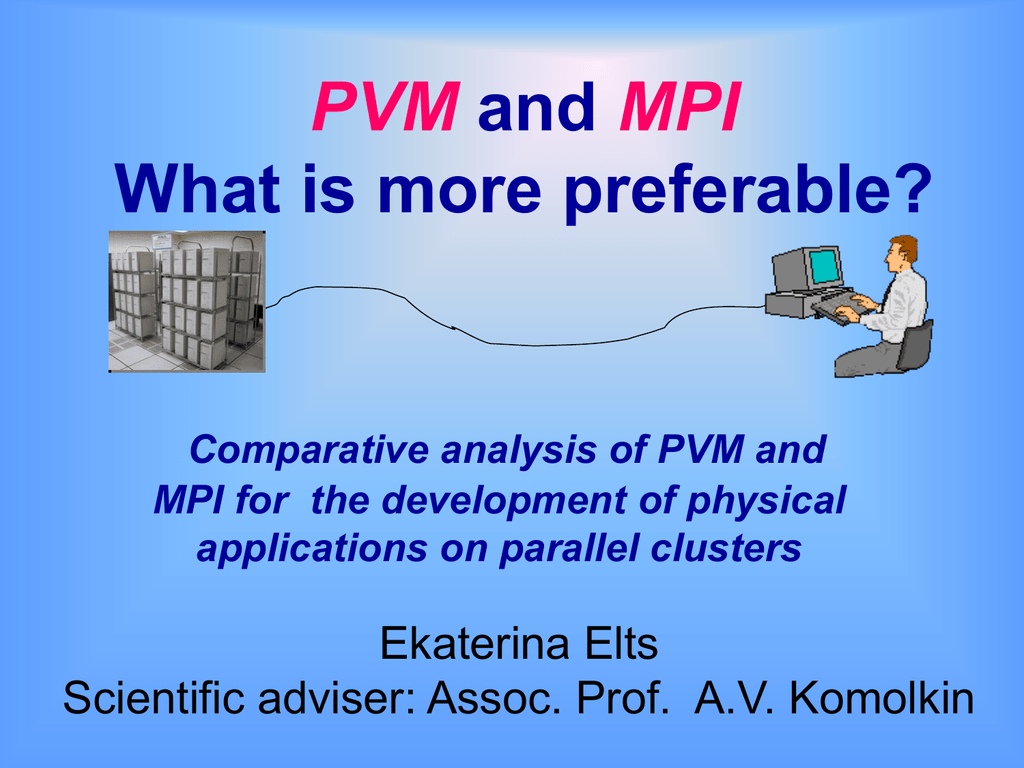
Is PVM Still Relevant Today?
While PVM is no longer actively developed and its direct use in mainstream high-performance computing is minimal, it retains historical and educational significance. For legacy applications, PVM might still be in use, but new parallel computing projects almost universally opt for MPI, OpenMP, CUDA, or cloud-native solutions. However, studying PVM offers invaluable insights into the evolution of parallel computing and the foundational challenges and solutions that continue to shape the field. It serves as a testament to ingenuity in harnessing networked resources and an important chapter in the story of how we learned to build powerful virtual supercomputers from humble components.
In conclusion, PVM was a pioneering force that democratized parallel computing, making it accessible and practical for a wide array of users. It effectively transformed disparate networked machines into a powerful, cohesive computational entity, laying crucial groundwork for the distributed computing paradigms that dominate our digital world today.
aViewFromTheCave is a participant in the Amazon Services LLC Associates Program, an affiliate advertising program designed to provide a means for sites to earn advertising fees by advertising and linking to Amazon.com. Amazon, the Amazon logo, AmazonSupply, and the AmazonSupply logo are trademarks of Amazon.com, Inc. or its affiliates. As an Amazon Associate we earn affiliate commissions from qualifying purchases.