
The prime rate serves as one of the most critical benchmarks in the American financial system. It is the foundational interest rate that commercial banks charge their most creditworthy corporate customers, but its influence extends far beyond the boardrooms of Wall Street. For the average consumer, the prime rate dictates the cost of carrying a balance on a credit card, the monthly payment on a home equity line of credit (HELOC), and the interest owed on various small business loans.
As of late 2024, the prime rate sits at 7.75%. This figure is a direct reflection of the Federal Reserve’s recent shifts in monetary policy. After a prolonged period of aggressive interest rate hikes designed to curb post-pandemic inflation, the central bank has entered a new phase of gradual easing. When the Federal Open Market Committee (FOMC) adjusts the federal funds target rate, the prime rate follows suit almost instantly—typically maintaining a spread of exactly 3 percentage points above the federal funds rate. To understand why the prime rate is at its current level and what that means for your wallet, one must look at the mechanics of the Federal Reserve and the broader economic landscape.
Decoding the Prime Rate: The Anchor of the Financial World
To understand where the prime rate is now, one must first understand what anchors it. While each bank technically has the autonomy to set its own prime rate, the industry almost universally follows the lead of the “Wall Street Journal Prime Rate,” which is derived from a survey of the 30 largest banks in the United States.
How the Federal Reserve Dictates the Prime Rate
The federal funds rate is the interest rate at which commercial banks borrow and lend their excess reserves to each other overnight. This is the primary tool the Federal Reserve uses to influence the economy. When the Fed wants to slow down inflation, it raises this rate, making borrowing more expensive and cooling off consumer spending. Conversely, when the Fed wants to stimulate economic growth, it lowers the rate.
The relationship between the federal funds rate and the prime rate is essentially a fixed mathematical bond. Since 1994, the prime rate has been set at exactly 3.00% above the federal funds target rate. Therefore, when the Fed reduced the federal funds rate to a range of 4.50% to 4.75% in late 2024, the prime rate adjusted downward to 7.75%. This synchronicity ensures that the cost of borrowing for businesses and consumers remains aligned with the central bank’s broader economic objectives.
The Significance of the 3% Spread
The 3% spread represents the profit margin and risk premium that banks require to operate. It covers the administrative costs of lending and accounts for the minor risk associated even with “prime” borrowers. Because this spread is standardized, the prime rate acts as a transparent barometer for the cost of credit. If you have a variable-rate loan, your interest rate is likely expressed as “Prime + X%.” As the prime rate moves, your specific interest rate moves in tandem, often effective on the very next billing cycle.
Where the Prime Rate Stands Today: Navigating the Current Economic Climate
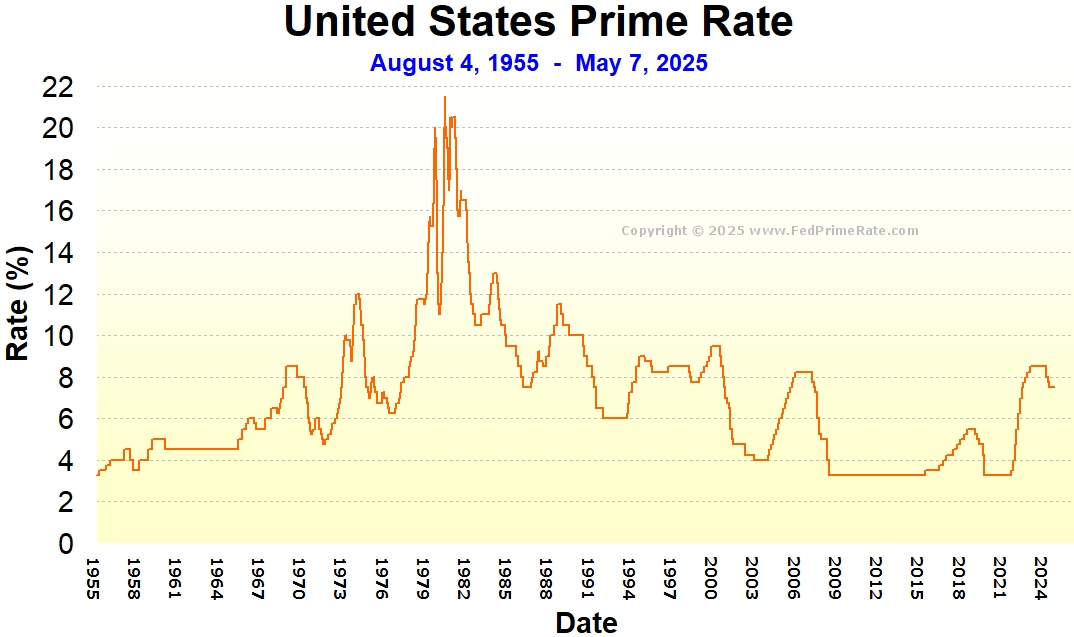
The current prime rate of 7.75% represents a notable departure from the ultra-low rate environment of 2020 and 2021, when the prime rate sat at a rock-bottom 3.25%. However, it also marks a descent from the 8.50% peak seen during the height of the Federal Reserve’s recent tightening cycle.
Inflation, Employment, and the Fed’s Balancing Act
The Federal Reserve operates under a “dual mandate”: to promote maximum employment and maintain stable prices (targeting 2% inflation). For much of 2023 and early 2024, the Fed prioritized fighting inflation, which had surged to 40-year highs. This required keeping the prime rate high to discourage excessive borrowing and spending.
Now, with inflation cooling and approaching the 2% target, the Fed has shifted its focus. Concerns about the labor market potentially softening have prompted a series of rate cuts. This transition from a “higher for longer” stance to a policy of normalization is the reason the prime rate is currently trending downward. For borrowers, this suggests that the era of peak interest rates may be behind us, though rates remain high by the standards of the last decade.
Historical Context: Comparing Today to the Recent Past
To put 7.75% in perspective, it is helpful to look at the historical trajectory of the prime rate. During the 1980s, in an effort to combat hyperinflation, the prime rate peaked at a staggering 21.5%. In contrast, following the 2008 financial crisis, the rate stayed at 3.25% for seven consecutive years. The current rate sits in a middle ground—higher than the post-2008 era but significantly lower than the historical extremes. This “new normal” reflects a stabilized economy that no longer requires emergency stimulus but is still navigating the complexities of global supply chains and shifting labor dynamics.
How the Prime Rate Influences Your Personal Wallet
The prime rate is not just an abstract economic indicator; it is a number that directly affects your monthly expenses. If you carry debt, the current prime rate dictates exactly how much of your payment goes toward principal versus interest.
Credit Cards and Variable APRs
Most credit cards feature a variable Annual Percentage Rate (APR). These rates are typically calculated by taking the prime rate and adding a “margin” based on the borrower’s creditworthiness. For example, if your credit card agreement specifies a margin of 15.99%, and the prime rate is 7.75%, your total APR is 23.74%.

Because credit card interest compounds daily, even small shifts in the prime rate can lead to significant changes in the total interest paid over time. When the prime rate drops, consumers with high-interest debt see a slight reduction in their financing costs, providing a marginal but welcome relief to household budgets.
Mortgages and Home Equity Lines of Credit (HELOCs)
While 30-year fixed-rate mortgages are more closely tied to the yields on 10-year Treasury notes, Home Equity Lines of Credit (HELOCs) are almost always tied directly to the prime rate. A HELOC functions similarly to a credit card, allowing homeowners to borrow against their equity at a variable rate.
At the current prime rate of 7.75%, a homeowner with a HELOC might be paying an effective rate of 8% to 9%. When the Fed cuts rates and the prime rate falls, these homeowners see an immediate reduction in their monthly interest-only payments. This makes the current environment a pivotal time for homeowners to evaluate their borrowing strategies, especially those who used HELOCs for home renovations or debt consolidation.
Personal Loans and Auto Financing
While many auto loans are fixed-rate at the time of purchase, the prime rate influences the “floor” for new loan offers. When the prime rate is high, lenders must charge more to maintain their margins. For consumers looking to purchase a vehicle or take out a personal loan today, the 7.75% prime rate means that even those with excellent credit should expect higher borrowing costs than they would have seen three years ago. However, the downward trend provides an opportunity for those with existing high-interest variable loans to consider refinancing options as the market cools.
The Ripple Effect on Business and Investment
The prime rate is the heartbeat of business finance. From small “mom-and-pop” shops to mid-sized manufacturing firms, the cost of doing business is inextricably linked to this benchmark.
Cost of Capital for Small Businesses
Many small business loans, particularly those backed by the Small Business Administration (SBA), are pegged to the prime rate. For instance, the popular SBA 7(a) loans often have a maximum interest rate of “Prime + 2.25%” or “Prime + 2.75%.” With the prime rate at 7.75%, small businesses are currently facing borrowing costs upwards of 10%.
This high cost of capital affects everything from inventory management to expansion plans. When the prime rate is high, businesses may delay purchasing new equipment or hiring additional staff. As the rate begins to tick downward, as we are seeing now, it signals a potential reopening of the spigot for business investment, which can lead to broader economic growth.
Impact on the Stock and Bond Markets
The prime rate also influences investor behavior. When interest rates are high, “safe” investments like Treasury bonds and high-yield savings accounts become more attractive. This can sometimes lead to a “flight to safety,” where investors pull money out of the stock market to lock in guaranteed returns elsewhere.
Furthermore, higher interest rates reduce the present value of future corporate earnings, which can weigh down stock valuations, particularly for growth-oriented tech companies that rely on heavy borrowing. The current stabilization and slight decline of the prime rate suggest a more favorable environment for equities, as lower borrowing costs generally support higher corporate profit margins.
Strategic Moves: How to Manage Your Money When Rates Are High
Even as the prime rate begins to decline from its recent peaks, it remains at a level that requires disciplined financial management. Navigating a 7.75% prime rate environment involves a combination of aggressive debt management and strategic saving.
Debt Consolidation and Refinancing
For those carrying variable-rate debt, the current environment is a signal to act. If you have significant credit card balances, transitioning that debt to a 0% APR balance transfer card or a fixed-rate personal loan can shield you from the volatility of the prime rate. While personal loan rates are influenced by the prime rate, a fixed-rate loan provides the security of a consistent payment, regardless of what the Federal Reserve decides in its next meeting.
Maximizing High-Yield Savings Returns
The “silver lining” of a higher prime rate is the corresponding increase in yields for savers. High-yield savings accounts (HYSAs) and Certificates of Deposit (CDs) often move in the same direction as the prime rate. While banks are often quick to raise loan rates and slow to raise deposit rates, the competitive landscape of online banking has forced many institutions to offer rates in the 4% to 5% range.
As the prime rate begins to fall, these high savings rates will eventually follow. Financial experts often recommend “locking in” current rates by moving funds into long-term CDs before the prime rate drops further. This allows savers to benefit from the high-rate environment even as the rest of the economy transitions toward lower borrowing costs.

Looking Ahead: The Future of the Prime Rate
The trajectory of the prime rate for the remainder of the year and into 2025 will depend entirely on economic data. If inflation remains stable and the labor market shows signs of cooling, the Federal Reserve is likely to continue its cycle of 25-basis-point cuts. Each of these cuts will trigger a corresponding 0.25% drop in the prime rate.
Monitoring the prime rate is essential for anyone looking to optimize their financial health. Whether you are a homeowner with a HELOC, an entrepreneur seeking a business loan, or an investor balancing a portfolio, the prime rate is the primary lens through which the cost of money is viewed. Staying informed about its current status—presently at 7.75%—allows you to make proactive decisions rather than reactive ones in an ever-shifting economic landscape.
aViewFromTheCave is a participant in the Amazon Services LLC Associates Program, an affiliate advertising program designed to provide a means for sites to earn advertising fees by advertising and linking to Amazon.com. Amazon, the Amazon logo, AmazonSupply, and the AmazonSupply logo are trademarks of Amazon.com, Inc. or its affiliates. As an Amazon Associate we earn affiliate commissions from qualifying purchases.