
The prime interest rate, a cornerstone of the financial system, is a critical benchmark that influences borrowing costs across the United States. While often discussed in economic reports, its direct impact on personal and business finances is profound and far-reaching. Understanding what the prime rate is, how it’s determined, and its implications is essential for navigating the complexities of modern finance.
The Bedrock of Lending: Defining the Prime Rate
The prime interest rate, commonly referred to simply as the prime rate, represents the interest rate that commercial banks charge their most creditworthy corporate customers. Although this definition suggests an exclusive rate for elite borrowers, in practice, the prime rate serves as a fundamental index upon which interest rates for a vast array of consumer and business loans are calculated. It acts as a base, or a floor, with many lending products featuring interest rates expressed as “Prime + a margin” (e.g., Prime + 1.5%).
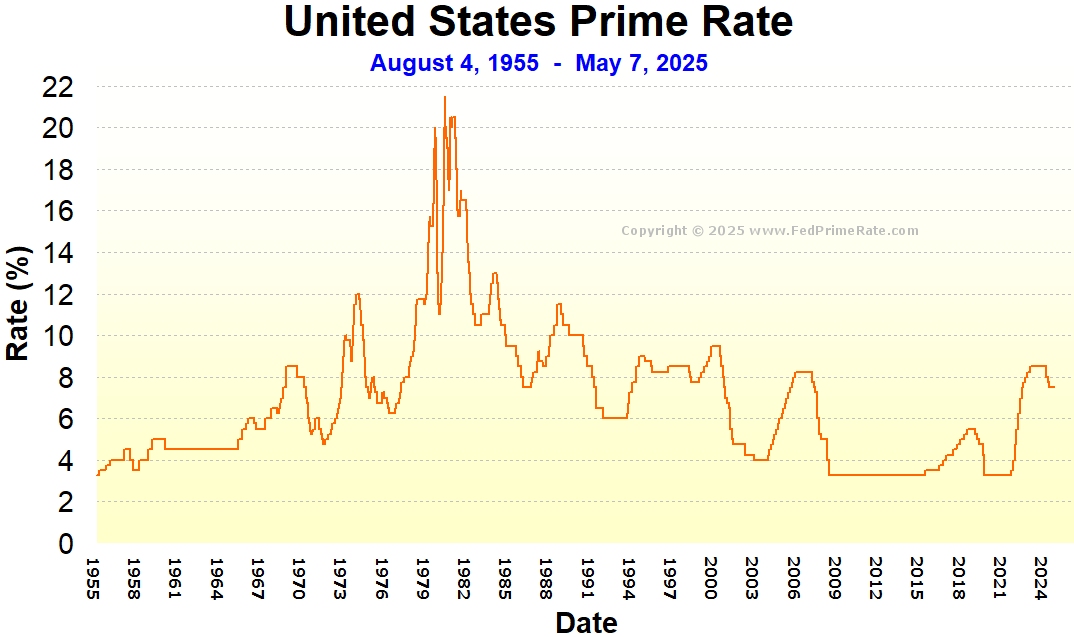
This pivotal rate is not set independently by individual banks based solely on their internal metrics. Instead, its movement is predominantly dictated by the monetary policy decisions of the U.S. Federal Reserve, specifically relating to the federal funds rate. The federal funds rate is the target rate at which banks lend their excess reserves to each other overnight. Historically, the prime rate maintains a consistent spread, typically 300 basis points (3 percentage points), above the upper bound of the federal funds target rate. Consequently, when the Federal Open Market Committee (FOMC) of the Federal Reserve decides to adjust the federal funds rate, commercial banks invariably follow suit, modifying their prime rate almost immediately.
For anyone with variable-rate debt, from credit cards and home equity lines of credit (HELOCs) to certain business loans, knowing the current prime rate is paramount. Its shifts directly translate into changes in monthly interest payments, making it a powerful factor in budgeting and debt management.
The Dynamics Behind Fluctuations: How the Prime Rate is Set
The prime rate is a dynamic metric, constantly adapting to the broader economic environment and the Federal Reserve’s strategic objectives. Its fluctuations are a direct consequence of the Fed’s dual mandate: to foster maximum employment and maintain price stability, primarily by controlling inflation.
The Federal Reserve’s Role: Monetary Policy and the Federal Funds Rate
The Federal Open Market Committee (FOMC) is the primary policy-making body within the Federal Reserve. Through regularly scheduled meetings, the FOMC scrutinizes a broad spectrum of economic indicators, including inflation rates (such as the Consumer Price Index and Producer Price Index), employment figures (non-farm payrolls, unemployment rate), Gross Domestic Product (GDP) growth, and global economic conditions. Based on their assessment and outlook, they determine whether to raise, lower, or maintain the target range for the federal funds rate.
- Rate Hikes: When the Fed aims to curb inflation or cool down an overheated economy, it typically raises the federal funds rate. This action makes it more expensive for banks to borrow from one another, a cost that is subsequently passed on to consumers and businesses through a higher prime rate. The strategic intent is to slow down borrowing and spending, thereby reducing aggregate demand and alleviating inflationary pressures.
- Rate Cuts: Conversely, during periods of economic slowdown, recession, or when inflation is consistently below target, the Fed may lower the federal funds rate to stimulate economic activity. A lower federal funds rate translates directly to a lower prime rate, making borrowing more affordable. This encourages investment, boosts consumption, and supports job creation, aiming to re-energize a languishing economy.
Economic Indicators and Market Expectations
While the Fed is the primary determinant, its decisions are informed by an extensive array of economic data. Beyond inflation and employment, data points like retail sales, manufacturing output, and housing market statistics all contribute to the FOMC’s perspective. Furthermore, financial markets are perpetually analyzing and anticipating the Fed’s next moves. These market expectations, often reflected in bond yields, can influence long-term interest rates even before the Fed makes an official announcement. A robust economy coupled with rising inflation usually signals potential rate hikes, whereas a weakening economy tends to suggest forthcoming rate cuts.
Direct Impact on Borrowers: Managing Debt in a Shifting Landscape
For individuals and businesses with outstanding loans, the prime rate is not an abstract economic concept; it’s a tangible factor that directly influences their monthly payments and overall financial burden.
Variable-Rate Loans and Credit Products
The most immediate and significant impact of prime rate changes is experienced by those holding variable-rate loans. These financial products are explicitly tied to the prime rate, often with a stated margin that is added to it.
- Home Equity Lines of Credit (HELOCs): HELOCs are a quintessential example. The interest rate on a HELOC is almost invariably expressed as Prime + X%. When the prime rate increases, the interest charged on the outstanding balance of a HELOC rises, leading directly to higher minimum monthly payments. Conversely, a decline in the prime rate can offer welcome payment relief.
- Credit Cards: The vast majority of credit cards feature variable Annual Percentage Rates (APRs) that are indexed to the prime rate. If you routinely carry a balance on your credit cards, a rising prime rate means higher interest charges, making it more expensive and challenging to pay down debt. This linkage underscores the critical importance of minimizing high-interest credit card debt, particularly in an environment of increasing rates.
- Adjustable-Rate Mortgages (ARMs): While many mortgages carry fixed rates, ARMs have interest rates that adjust periodically after an initial fixed-rate period. Some ARMs are indexed to the prime rate, though others might be tied to Treasury yields or the Secured Overnight Financing Rate (SOFR), which replaced LIBOR. Borrowers with ARMs face the risk of significantly higher monthly payments during periods of rising prime rates once their fixed-rate period expires and the rate resets.
- Business Loans and Lines of Credit: Small and medium-sized businesses frequently rely on lines of credit and term loans with interest rates directly linked to the prime rate. An increase in the prime rate directly elevates the cost of capital for these businesses, potentially impacting their profitability, investment strategies, and capacity to manage cash flow or pursue expansion.
- Personal Loans: Certain personal loans, especially unsecured ones or those from alternative lenders, may also feature variable rates tied to the prime rate.

Indirect Effects on Fixed-Rate Products and Loan Availability
Even fixed-rate mortgages and other fixed-rate loans, while not directly indexed to the prime rate, are indirectly influenced by its movements. The prime rate’s direction signals the broader trend in interest rates and the Fed’s overall stance on monetary policy. When the Fed raises rates, it generally pushes up borrowing costs across the entire spectrum of financial products, including longer-term fixed-rate offerings. This occurs as lenders anticipate higher funding costs and adjust their pricing to maintain profit margins. Furthermore, a higher interest rate environment can lead to a tightening of lending standards, potentially making it more difficult for some borrowers to qualify for loans.
Broader Financial Implications: Savers, Investors, and Economic Outlook
The prime rate’s influence extends well beyond direct borrowing costs, subtly shaping the landscape for savers and significantly impacting the broader investment climate.
Implications for Savers
In stark contrast to borrowers who face increased costs, savers typically benefit from rising interest rates. When the Federal Reserve increases the federal funds rate, banks, in turn, tend to raise the interest rates they offer on savings accounts, money market accounts, and certificates of deposit (CDs). While these rates rarely track the prime rate directly, they generally move in the same direction, albeit often with a lag and with a smaller magnitude. Higher savings rates provide a compelling incentive for individuals to save more, earning a better return on their deposits, which can be particularly attractive during periods of high inflation where preserving purchasing power is a key concern.
Impact on Investment Markets
The prime rate, acting as a crucial indicator for the cost of money, carries significant implications for various investment markets:
- Bonds: Bond prices and yields exhibit an inverse relationship. When interest rates, including the prime rate, rise, newly issued bonds offer higher yields, making existing lower-yielding bonds less attractive. This typically causes the prices of existing bonds to fall as investors demand higher returns.
- Stocks: The impact on the stock market is more nuanced. Higher interest rates increase the cost of borrowing for corporations, which can depress corporate earnings and make future cash flows less valuable when discounted at a higher rate. This can lead to downward pressure on stock valuations, particularly for growth stocks that heavily rely on future earnings projections. Conversely, rising rates can sometimes be interpreted as a sign of a strong, healthy economy, which may be positive for cyclical stocks. Generally, however, market sentiment often becomes more cautious during prolonged periods of rate hikes.
- Real Estate: Higher interest rates directly translate to higher mortgage costs for prospective homebuyers. This can dampen demand for housing, potentially leading to a slowdown in home price appreciation or even declines in certain markets. Commercial real estate is similarly affected, as increased borrowing costs impact development projects and property acquisitions.
Economic Outlook and Consumer Behavior
The direction of the prime rate serves as a key indicator of the Federal Reserve’s assessment of the economy’s health. A rising prime rate signals the Fed’s concern about persistent inflation and its active efforts to moderate economic activity. This can lead to reduced consumer spending and business investment as borrowing becomes more expensive, potentially cooling off an overheated economy but also carrying the inherent risk of a broader economic slowdown or even a recession. Conversely, a falling prime rate is typically aimed at stimulating economic growth by making money cheaper, thereby encouraging increased spending and investment.
Navigating Today’s Prime Rate Environment: Strategies for Financial Prudence
Given the inherently dynamic nature of the prime rate and its expansive consequences, individuals and businesses must adopt proactive strategies to manage their finances effectively and prudently.
For Borrowers
- Prioritize High-Interest Debt: If you carry variable-rate credit card balances or HELOCs, focus on aggressive repayment, especially when the prime rate is high or on an upward trajectory. Consider debt consolidation into a lower, fixed-rate personal loan if feasible, or strategically transferring balances to a 0% APR introductory offer credit card, meticulously noting the end date of the promotional period.
- Review Variable-Rate Loans: Thoroughly understand the terms and adjustment mechanisms of your variable-rate loans. For HELOCs or ARMs, model how much your monthly payments would increase with further hypothetical rate hikes. Explore options to convert variable-rate debt to fixed-rate, such as refinancing an ARM into a fixed-rate mortgage, or securing a fixed-rate personal loan to pay off a variable-rate balance.
- Manage Business Credit: Businesses should regularly review their lines of credit and consider locking in fixed rates for new capital expenditures if the long-term outlook suggests continued rate increases. Optimizing inventory management and accounts receivable can help reduce reliance on short-term, prime-rate-indexed borrowing.

For Savers and Investors
- Maximize Savings Returns: Capitalize on higher rates offered on savings accounts, money market accounts, and certificates of deposit (CDs). Actively shop around for the best yields, as rates can vary significantly between different financial institutions. Consider employing a CD laddering strategy to balance liquidity with enhanced returns.
- Re-evaluate Investment Portfolios: Understand how a high or rising prime rate environment might impact your existing investment portfolio. Diversification remains paramount. Consider investments that historically perform well in rising rate environments, such as value stocks or shorter-duration bonds, always ensuring alignment with your individual risk tolerance and long-term financial goals.
- Stay Informed: Remain vigilant regarding Federal Reserve announcements and economic forecasts. Comprehending the central bank’s likely trajectory for the federal funds rate provides invaluable insight into the probable direction of the prime rate and, by extension, the broader financial markets.
In essence, “what is prime interest today” is far more than a simple numerical value; it is a critical economic indicator with profound and pervasive implications for the cost of borrowing, the return on savings, and the overall health and direction of the economy. By diligently understanding its origins, its drivers, and its ripple effects, individuals and businesses are empowered to make more informed financial decisions, effectively mitigate risks, and proactively capitalize on opportunities within an ever-evolving financial landscape.
aViewFromTheCave is a participant in the Amazon Services LLC Associates Program, an affiliate advertising program designed to provide a means for sites to earn advertising fees by advertising and linking to Amazon.com. Amazon, the Amazon logo, AmazonSupply, and the AmazonSupply logo are trademarks of Amazon.com, Inc. or its affiliates. As an Amazon Associate we earn affiliate commissions from qualifying purchases.