
The prime interest rate is often described as the heartbeat of the consumer credit market. Whether you are a homeowner with a line of credit, a small business owner seeking an expansion loan, or a consumer managing credit card debt, the prime rate dictates the cost of your borrowing. In the current economic climate, characterized by the Federal Reserve’s aggressive battle against inflation and subsequent shifts in monetary policy, understanding what the prime rate is and where it stands today is more critical than ever.
This guide explores the mechanics of the prime rate, its current status in the financial landscape, and how it ripples through every corner of your personal and professional finances.
The Mechanics of the Prime Interest Rate
To understand where the prime rate is today, one must first understand what it represents and how it is calculated. The prime rate is the interest rate that commercial banks charge their most creditworthy customers—usually large corporations. However, its influence extends far beyond the boardroom.
Defining the Prime Rate
In the United States, the prime rate is not set by a government agency. Instead, it is a benchmark determined by individual banks. To maintain consistency across the industry, most financial institutions follow the “Wall Street Journal Prime Rate,” which is defined as the base rate on corporate loans posted by at least 70% of the nation’s ten largest banks. While it is technically a private sector rate, it is inextricably linked to public policy.
The Relationship with the Federal Funds Rate
The prime rate moves in lockstep with the Federal Funds Rate, which is the target interest rate set by the Federal Open Market Committee (FOMC). The Federal Funds Rate is the interest rate at which commercial banks borrow and lend their excess reserves to each other overnight.
Historically, there is a fixed relationship between these two figures: the prime rate is almost always 3.00% (300 basis points) higher than the upper bound of the Federal Funds Target Range. For example, if the Federal Reserve sets the target range at 5.25% to 5.50%, the prime rate will typically sit at 8.50%. This spread allows banks to cover their operating costs and manage the risks associated with lending while maintaining a profit margin.
Who Determines the Prime Rate?
While the Federal Reserve triggers the change, the banks are the ones who officially “set” the rate. When the Fed announces a hike or a cut, the major commercial banks usually update their prime rates within hours. This immediate reaction is why consumers see almost instantaneous changes in their variable-rate financial products, such as credit cards and Home Equity Lines of Credit (HELOCs).
Why the Prime Rate is Moving: The Current Economic Landscape
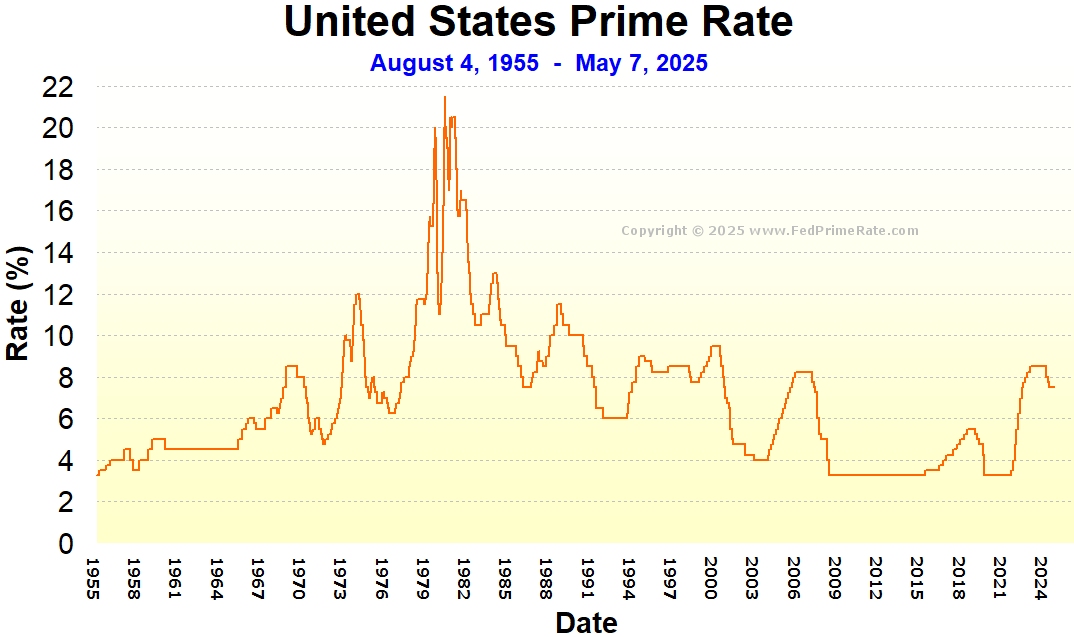
As of mid-2024, the prime interest rate has reached levels not seen in over two decades. This peak is the direct result of a transformative period in global economics, shifting from an era of “easy money” to one of “quantitative tightening.”
Inflation and the Federal Reserve’s Mandate
The primary driver behind the current elevated prime rate is the Federal Reserve’s dual mandate: to promote maximum employment and maintain stable prices. Following the pandemic-era stimulus and subsequent supply chain disruptions, inflation surged to 40-year highs. To cool the economy and bring inflation back toward its 2% target, the Fed initiated a series of rapid interest rate hikes beginning in early 2022.
When the Fed raises the cost of borrowing for banks, banks raise the prime rate. This makes it more expensive for businesses to expand and for consumers to spend, effectively slowing down the economy to curb rising prices.
Historical Context vs. Today’s Reality
For much of the decade following the 2008 financial crisis, the prime rate sat at a historic low of 3.25%. Consumers grew accustomed to cheap debt. However, the current environment has pushed the prime rate toward the 8.5% range. While this feels astronomical to younger borrowers, it is important to note that in the early 1980s, the prime rate peaked at an incredible 21.5%.
Today’s “high” rates are, in a broader historical sense, a return to normalcy, though the speed at which the rate rose—climbing several percentage points in less than two years—has created significant “sticker shock” for modern participants in the economy.
How Current Prime Rates Affect Your Personal Finances
The prime rate serves as the index for the majority of variable-rate consumer debt. When the prime rate moves, your monthly obligations move with it, often without much warning.

The Impact on Credit Cards and Revolving Debt
Most credit cards carry a variable Annual Percentage Rate (APR) that is calculated as “Prime + Margin.” For instance, if your credit card agreement specifies a margin of 12.99% and the prime rate is 8.50%, your effective APR is 21.49%.
Because credit card rates are sensitive to the prime rate, the current high-interest environment has made carrying a balance significantly more expensive. For the average household, a 5% increase in the prime rate can result in hundreds of dollars in additional interest charges annually, making it more difficult to pay down the principal balance.
Mortgages and Home Equity Lines of Credit (HELOCs)
While most traditional 30-year fixed-rate mortgages are influenced more by the 10-year Treasury yield than the prime rate, HELOCs and Adjustable-Rate Mortgages (ARMs) are tied directly to it.
Current HELOC holders have seen their monthly interest-only payments skyrocket over the last 24 months. For those looking to buy a home, high prime rates also influence the broader lending market, driving up the cost of entry and reducing purchasing power. This has led to a “lock-in” effect where homeowners with low fixed rates are reluctant to move, further tightening the housing supply.
Auto Loans and Personal Lending
While many auto loans are fixed-rate, the base interest rate offered to new borrowers is heavily influenced by the prime rate. As the prime rate stays elevated, the “deal” you might have received three years ago (e.g., 2.9% financing) has vanished, replaced by average rates closer to 7% or 8% for even the most qualified buyers. This increase in the cost of capital has a direct impact on the affordability of big-ticket items, forcing many consumers to extend their loan terms to keep monthly payments manageable.
Business Implications of a Fluctuating Prime Rate
For the business world, the prime rate is more than just a consumer benchmark; it is a fundamental cost of doing business. From tech startups to local manufacturing, the cost of capital dictates the pace of innovation and employment.
Financing Corporate Growth and Operations
Many commercial loans, especially those used for working capital or equipment financing, are floating-rate loans tied to the prime rate. When the rate is high, the cost of servicing existing debt increases, which can eat into profit margins. Consequently, companies may delay capital expenditures, pause hiring, or reduce inventory levels to preserve cash flow.
The Ripple Effect on Small Business Loans
The Small Business Administration (SBA) often uses the prime rate as the base for its loan programs. SBA 7(a) loans, for example, frequently have a maximum interest rate of “Prime + 2.25%” or “Prime + 2.75%.” In an 8.5% prime rate environment, a small business could be looking at double-digit interest rates. This makes the barrier to entry higher for entrepreneurs and can stifle the growth of the small businesses that form the backbone of the economy.
Strategic Financial Planning in a High-Rate Environment
While a high prime rate presents challenges, it also offers unique opportunities for those who know how to navigate the financial landscape. Strategic planning is essential to mitigate the “cost of money” while maximizing potential returns.
Debt Management Strategies
In a high-prime-rate environment, the priority should be the aggressive repayment of variable-rate debt. Consumers should look into:
- Balance Transfers: Moving high-interest credit card debt to a 0% introductory APR card to “freeze” the interest.
- Debt Consolidation: Taking out a fixed-rate personal loan to pay off variable-rate debt, providing a predictable payment schedule.
- Refinancing HELOCs: Converting variable-rate home equity debt into a fixed-rate home equity loan to hedge against future rate hikes.
Investment Opportunities: The Silver Lining
There is a beneficiary to high prime rates: the saver. When the prime rate is high, banks must compete more aggressively for deposits to fund their lending activities. This has led to the return of the High-Yield Savings Account (HYSA) and Certificates of Deposit (CDs) offering 4% to 5% returns—levels unseen for nearly two decades.
For conservative investors or those building an emergency fund, the current prime rate environment provides a “risk-free” return that finally keeps pace with or exceeds inflation. This shift allows for a more balanced portfolio where cash and fixed-income assets can once again play a meaningful role in wealth preservation.

Conclusion
The prime interest rate is a powerful economic tool that bridges the gap between the Federal Reserve’s policy decisions and the everyday financial lives of citizens. While the current elevated rates represent a challenge for borrowers, they are a necessary component of a stabilizing economy seeking to move past inflationary pressures.
By staying informed on the current prime rate and understanding how it interacts with your debt and savings, you can make more insightful decisions. Whether that means accelerating debt repayment, locking in a fixed rate, or taking advantage of high-yield savings, navigating the prime rate environment with a professional and strategic mindset is the key to long-term financial resilience.
aViewFromTheCave is a participant in the Amazon Services LLC Associates Program, an affiliate advertising program designed to provide a means for sites to earn advertising fees by advertising and linking to Amazon.com. Amazon, the Amazon logo, AmazonSupply, and the AmazonSupply logo are trademarks of Amazon.com, Inc. or its affiliates. As an Amazon Associate we earn affiliate commissions from qualifying purchases.